From Iconic Railway Landmark in 1916 to Declared Monument and Beyond

The J3 Group - Premium Quality Private Tours | Experiences and Insider Chats since 2010
Me Jamie, your host, I am English and I have lived in Hong Kong since January 2nd 1972 - I know the place.
A meaningful blog post with a difference - tips on Travel, Tourism, Tours, Daily Life and my personal thoughts on Hong Kong.
Please do visit Amazing Hong Kong
Hong Kong | Pearl of the Orient


A Resident since 1972 - Private Tours of Hong Kong with Jamie
The Best Things to do in Hong Kong
click on the image to enlarge
© Copyright Acknowledged | All rights reserved | image created by Jamie
The Clock Tower in Tsim Sha Tsui, Kowloon, Hong Kong - The History
Foreword by Jamie
From Iconic Railway Landmark in 1916 to Declared Monument and Beyond
I have lived in Hong Kong for 50+ years and on 3rd January 1972 I got my introduction to the Clock Tower, the KCR Railway Station and the waterfront promenade. We walked from the Merlin Hotel in TST Kowloon to the Star Ferry and eventually crossed Victoria Harbour. I remember the ferry ride but what stuck with me was the Railway Station and that tower. The Clock Tower next to the Star Ferry is a proper cultural icon, but for me the icon was the KCR Railway Station next to it, demolished long ago. What a magnificent building. I visited it on a regular basis as a kid. It is a tragedy that it was not saved and protected. They could still have built the monstrosity that is the Cultural Centre.
To this day I still do not understand why the people of Hong Kong did not try harder. 15,000 people signed a petition to save the Clock Tower and the Railway Station, myself included, which was presented to Queen Elizabeth. A fat lot of good that did. The Government backed down on the Clock Tower but not the Railway Station. If 50,000 people had signed the petition it might have been saved. I completely understand that cities evolve over time and in Hong Kong knocking down old buildings is an art form. I have no problems with them knocking down shabby apartment blocks 60 years old, but the Railway Station was worth saving. Just a personal opinion of course. They actually demolished the beautiful railway station and replaced it with this horrible building, the Cultural Centre, which to me is simply an eyesore. With a bit of re jigging they could have preserved and repurposed the Railway Station (much like they have done at Tai Kwun on Hong Kong Island). Such a shame.
In recent years probably 40 to 50 million visitors to Hong Kong have walked past the Clock Tower in TST, Kowloon and taken a selfie. More than likely they have no idea of its history and importance and the significant cultural aspects of this icon.
The Clock Tower, TST, Kowloon - A Bit of Background
The Clock Tower, officially named the Former Kowloon Canton Railway Clock Tower, is the sole remaining structure of the original Kowloon Canton Railway Terminus. It stands on the Tsim Sha Tsui waterfront along Salisbury Road. The terminus was a key transportation hub in the early 20th century, linking Hong Kong with Guangzhou and points further north. The British Section of the railway was a major colonial project to connect the colony with the Mainland China network. The decision to build a terminus in Tsim Sha Tsui was taken in 1906. The site was chosen on reclaimed land along Victoria Harbour so it could serve travellers arriving by train or by sea.
The Clock Tower - Historical Context
The Kowloon Canton Railway (British Section) was a significant infrastructure project initiated by the British colonial government to connect Hong Kong with Guangzhou (Canton) and beyond, facilitating trade and travel. The decision to build a railway terminus in Tsim Sha Tsui was made in 1906, with the site chosen on reclaimed land along Victoria Harbour to serve as a gateway for travellers arriving by train or sea.
Timeline of the Clock Tower and KCR Terminus
1906: The colonial British administration decided to construct the Kowloon Canton Railway, with Tsim Sha Tsui selected as the location for the southern terminus.
1910: The British Section of the Kowloon Canton Railway commenced service, initially operating from a temporary station as the permanent terminus was not yet built.
1912: Approval was granted for the construction of the Kowloon Terminus on reclaimed land in Tsim Sha Tsui.
1913 to 1915: Construction of the Kowloon Terminus and its Clock Tower took place. The Clock Tower was erected in 1915, with the entire terminus complex officially opened on 28th March 1916.
1916: The Kowloon Canton Railway Terminus began full operations, serving as a major transport hub connecting Hong Kong to Mainland China. The station featured a red brick and granite design in the Edwardian Classical Revival style.
1920s to 1960s: The terminus was a bustling hub. The station facilitated significant passenger traffic, including during festivals like Ching Ming.
1970: The Urban Council proposed constructing a modern cultural venue in Kowloon, leading to plans for the Hong Kong Cultural Centre on the terminus site.
1975: The Kowloon Canton Railway Terminus was relocated to a new, expanded station in Hung Hom due to the original station’s inability to handle increasing passenger volumes.
1977 to 1978: Demolition of the Kowloon Terminus began in 1977 and was completed in 1978, with the Clock Tower spared due to preservation campaigns. The Hong Kong Space Museum, Hong Kong Museum of Art, and Hong Kong Cultural Centre were later built on the site.
1990: The Clock Tower was declared a monument under the Antiquities and Monuments Ordinance, granting it legal protection by the Antiquities and Monuments Office.
2010: The original bell, which had been stored at railway sites within Hong Kong since its removal in 1976, was donated to the Government and returned to the Clock Tower for display.
2025: The Clock Tower remains a prominent landmark, floodlit at night, and a popular meeting point and tourist attraction along the Tsim Sha Tsui waterfront.
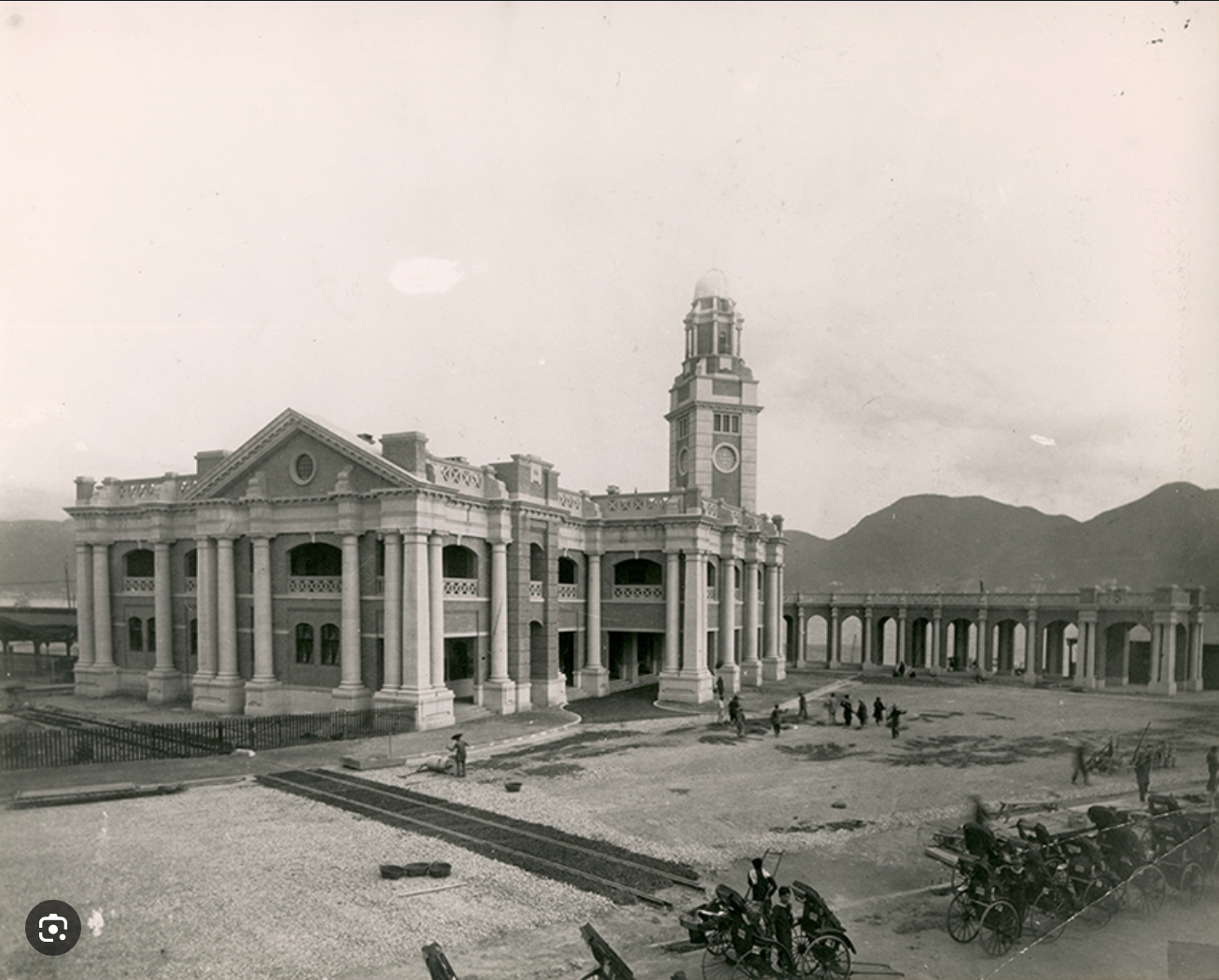
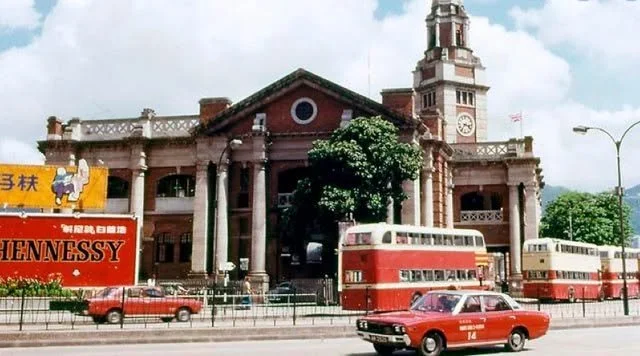
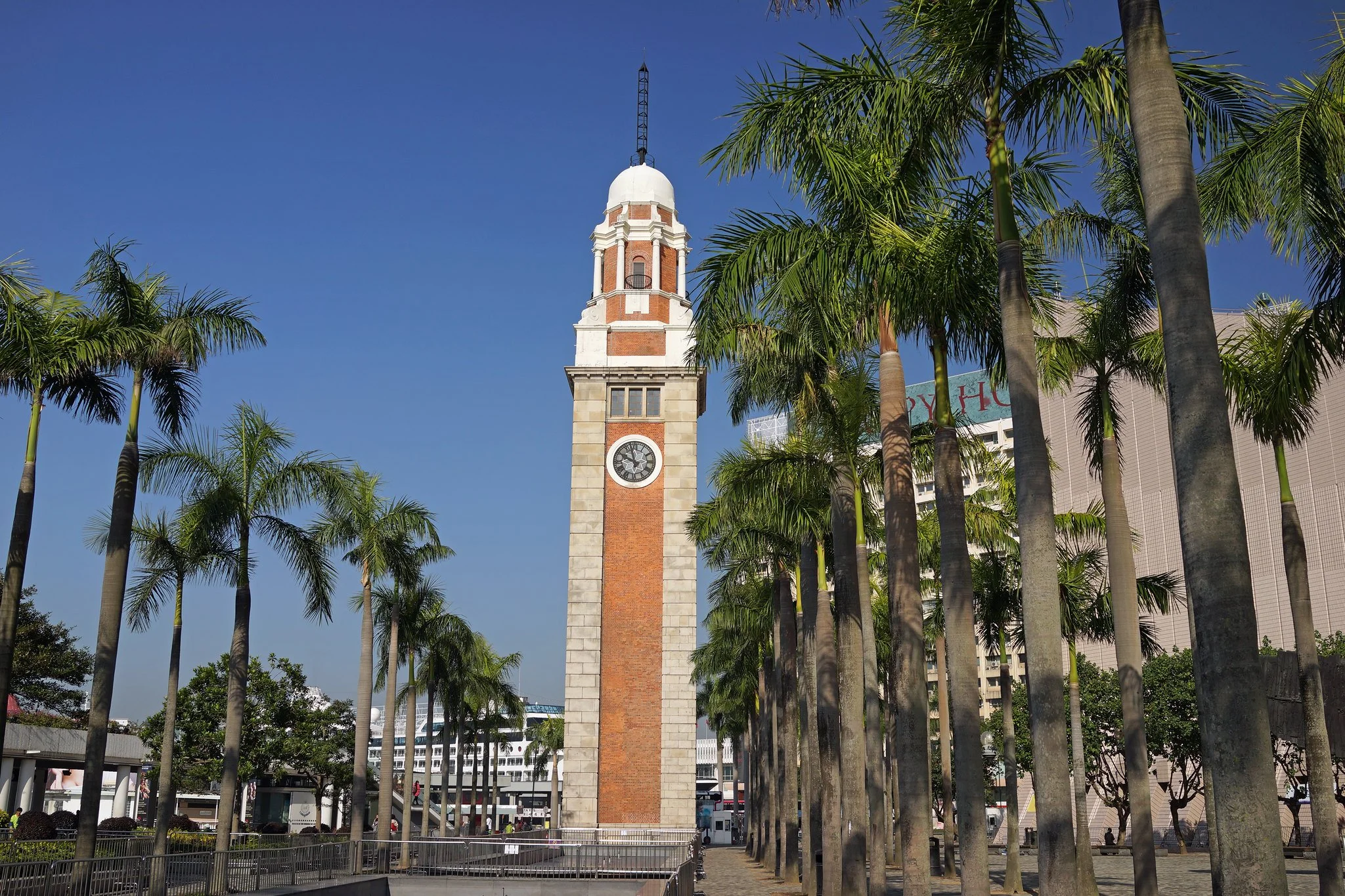
click on any image to enlarge
© Copyright Acknowledged | All rights reserved | images by Jamie and others
The Clock Tower in Tsim Sha Tsui, Kowloon, Hong Kong - 3 time periods
The Clock Tower - How It Was Built
The design went to Arthur Benison Hubback, a British architect working for the Federated Malay States government. He had already designed railway stations in Malaya, including the one in Kuala Lumpur, and that experience is why Hong Kong brought him in. His fee for the work was HK$5,000 (US$640), exclusive of travelling and accommodation expenses. The style is Edwardian Classical Revival. The building used red bricks and local granite. Foundations started in May 1913. The superstructure contract went to a local contractor, Kan On, for HK$173,847 (US$22,288) in February 1914. The Clock Tower itself was finished in 1915. The full terminus complex opened on 28th March 1916.
The tower is 44 metres high (about 144 feet) and is topped by a 7 metre lightning rod, taking the overall height to roughly 51 metres. It is a six storey square structure with a two storey octagonal belfry, a domed roof and scroll shaped buttresses, Tuscan columns and classical detailing. The upper part of the tower is red brick; the lower classical features are painted white. The whole thing was meant to be a landmark for people arriving by train or by ship.
The Clock Tower - The Faces and the Bell
The faces were delayed by the First World War and by funding issues. One face was initially taken from the old Pedder Street tower in Central (that earlier tower dated from 1862 and was demolished in 1913). The other three faces were added later. All four started working on the afternoon of 22nd March 1921. Each dial is 8 feet in diameter. The hands are 5 to 6 feet long and weigh about 10 pounds each. The Roman numeral on the dials is written as IIII rather than IV. That is an old practice for visual balance and for practical reasons when casting the numerals.
The Clock Tower - The Actual Bell in the Clock Tower - the Complete Story
The original bell was cast in 1919 by John Taylor & Co. in Loughborough, England, and installed in 1920. It began chiming on 21st March 1921 at 3:00 pm, initially ringing every 15 minutes to mark the time. The bell was part of a striking mechanism operated by an electric motor and controlled by a master clock system.
By 1950 the bell’s operation ceased due to synchronisation issues caused by the installation of four separate motors for the faces, which disrupted the accuracy of the chime.
In 1976 the bell was removed from the top of the Clock Tower during the demolition of the Kowloon Terminus. It never left Hong Kong. It was displayed at Hung Hom Station’s concourse, then moved to Sha Tin Station in 1984, and later to the Kowloon Canton Railway Corporation (KCRC) House in Fo Tan in 1995. It stayed at these railway locations inside the territory until 2010.
In 2010, to mark the centenary of railway services in Hong Kong, the KCRC and MTR Corporation donated the bell to the Hong Kong Government and it was returned to the Clock Tower. Instead of being reinstalled at the top, it was placed on display at the base of the tower for public viewing and preservation.
In 2021, as part of the “Centenary of the Bell” celebrations, the Clock Tower’s chimes were reinstated, but not through the original physical bell. A digital bell system synchronised with the Hong Kong Observatory’s web clock was introduced, allowing chimes to ring hourly from 8 am to midnight. The original bell at the base is for display only and does not actively ring. The chimes heard today are produced electronically.
Apparently there are several practical reasons why the bell sits at the bottom rather than back at the top. The 1919 bell is a historical artefact and may be too fragile or heavy to reinstall at height. Displaying it at the base protects it from weather and structural stress while letting people see it closely. The digital system introduced in 2021 is easier to maintain, more reliable, and can stay precisely in step with modern timekeeping. The tower’s interior is currently closed for maintenance, so a bell at the top would be inaccessible. The 1915 structure may not safely take the weight and vibration of the original striking mechanism. Reinstalling the mechanical system would also be expensive compared with a digital arrangement. Placing the bell at the base with interpretive material fits the centenary idea of showing visitors the real object after it had been away for decades.
Poppycock and fiddlesticks if you ask me
Over the decades I have read all sorts of really dumb comments like those above about why the bell is at the bottom of ther clock tower, these are ludicrous excuses. For example how can a massive one tonne bronze bell be fragile? And for heavens sake, it was installed over a hundred years ago with no issue at the original height and it worked just fine for almost 60 years and St. Johns Cathedral rings a huge bell from their tower withour an issue and that Church has been around since 1849.
Based on the available information it is unlikely that a physical bell is currently installed at the top of the Clock Tower that actively rings and the big clue, it sounds really tinny The original bell is on display at the base and does not function as a timekeeping chime. The hourly chimes heard since 9th December 2021 come from the digital system, not from a physical bell. No sources confirm a new or replacement bell at the top. The digital system is intended to replicate the sound of the original.
And the bell sounds tinny, it sounds nothing like a real bronze bell (sigh).
I was with a guest in mid November 2026 and as we walked past the tower they remarked on the tinny sound and asked why there was not a proper bell, like the one at St John’s Cathedral. It is a fair question. The original bell is sitting right there at the base for anyone to see, yet the sound coming from the tower is electronic. Guests notice the difference.
The Clock Tower - Clock Maintenance Team
While there is no publicly named permanent team, the Clock Tower is a declared monument and the faces have been kept running since 1921 (apart from the Japanese occupation years of 1941 to 1945). The faces are part of an electric system originally supplied by Gent & Co. Ltd. of Leicester, England. The tower is managed by the Leisure and Cultural Services Department. They coordinate technicians or specialists to keep the mechanism accurate. Historically the installation in 1921 was overseen by railway engineers. Today the work is likely handled by government technicians together with contracted heritage and clock specialists, and the digital chime system needs its own technical support to stay synchronised with the Hong Kong Observatory.
The Clock Tower - Wartime (WW2) and After
During the Japanese occupation the faces stopped. The Japanese painted the whole terminus grey for camouflage and the tower took some shrapnel and gunfire damage. The faces were restarted on 2nd October 1945, reportedly with help from the crew of a Canadian battleship, the Ontario. The original red brick colour was restored after the war.
The Clock Tower - Why the Station Went and the Tower Stayed
By the 1970s the old terminus could no longer handle the passenger numbers. The railway moved to a new station in Hung Hom. The old site was wanted for the Hong Kong Cultural Centre, the Space Museum and the Museum of Art. A preservation campaign was mounted, including by the Hong Kong Heritage Society. Roughly 14,000 to 15,000 people signed a petition that went to Queen Elizabeth. The Queen turned it down. The government agreed to keep the Clock Tower as a compromise and demolished the rest of the station in 1977 to 1978. Six of the original station pillars were saved and later moved to the Urban Council Centenary Garden in Tsim Sha Tsui East.
The tower was declared a monument on 13th July 1990 under the Antiquities and Monuments Ordinance. Technicians still climb the stairs every 15 days or so to maintain the faces. During typhoons the hands are set to half past six and the chiming is stopped to protect the mechanism. In the early 1970s the tower even housed a government dental clinic for a while.
The Clock Tower - Demolition of the Railway Station
The Kowloon Canton Railway Terminus was demolished in 1977 to 1978 for several reasons.
Capacity issues: by the 1970s the station could no longer accommodate the growing number of daily commuters, so the railway moved to a larger facility in Hung Hom. (And I have no problem with that, but why demolish such an amazing building?)
Urban development: the Hong Kong government wanted to modernise the Tsim Sha Tsui waterfront with the Hong Kong Cultural Centre, Hong Kong Space Museum and Hong Kong Museum of Art. The old terminus site was seen as prime real estate for these projects. (And I have no problem with that, but they could have saved the building with a few minor alterations to the plans for these three buildings.)
Economic considerations: maintaining the aging Edwardian style station was deemed costly compared with building modern facilities. The government favoured redevelopment to boost tourism and cultural activities.
The Clock Tower was spared because of conservation campaigns. Advocacy groups pointed out its architectural and historical significance as a symbol of Hong Kong’s colonial and railway heritage. A petition with 15,000 signatures went to Queen Elizabeth. The tower’s relatively small footprint made it feasible to keep it while the rest of the site was redeveloped. (And the Railway Station itself had a relatively small footprint.)
There was significant opposition to the demolition of the terminus, particularly from heritage conservationists. Campaigners argued that the station, with its Edwardian architecture and historical role, was a vital part of Hong Kong’s identity. The public outcry was strong enough to save the Clock Tower but not strong enough to preserve the entire station. The demolition sparked debates about balancing heritage preservation with urban progress, a recurring theme in Hong Kong’s development.
At the time of its demolition the terminus did not have formal protected status under the Antiquities and Monuments Ordinance, which was only enacted in 1976. The lack of legal protection made the decision easier. In 1990 the Clock Tower was officially declared a monument, giving it legal protection from demolition or significant alteration.
The Clock Tower - Speculation on Preserving the Railway Station Alongside the Cultural Centre
The old terminus was relatively small compared with modern stations. Given its compact size it is plausible that the building could have been kept alongside the Cultural Centre with different planning.
It could have been repurposed as a cultural or commercial space, in the same way Tai Kwun (the former Central Police Station) or Lui Seng Chun were later adapted. The Edwardian architecture could have sat next to the modern Cultural Centre and created a mix of old and new.
The site was prime waterfront land and the Government of the day wanted maximum space for the new facilities. Integrating the station into the design (for example as an exhibition hall) might still have been possible. The six railway pillars that were moved to the Urban Council Centenary Garden in Tsim Sha Tsui East show that partial preservation was already being considered.
Preservation would have meant higher maintenance costs and structural upgrades. Public and political will in the 1970s leaned toward modernisation, and heritage protection was not as strong as it is today. The lack of a solid legal framework at the time also limited what could be done.
While it was technically feasible, keeping the whole station would have needed stronger public support and different priorities. The decision to demolish it reflected the era’s focus on progress. The fact that the Clock Tower was successfully kept shows that selective retention was possible.
The Clock Tower - How Other Cities Have Treated Their Old Stations
it is a fair observation that most major cities that still have a substantial railway network have chosen to keep their grand early 20th century stations, or at least the main building, even when they modernise the platforms and tracks behind them. The stations were built as civic monuments as much as transport buildings, and later generations have usually treated them as such.
A few clear examples:
London: St Pancras and King’s Cross were both kept. St Pancras was heavily restored and extended rather than replaced.
Paris: Gare du Nord and Gare de Lyon remain the original buildings, with later additions behind or beside them.
New York: Grand Central Terminal was saved after a long fight and is still the working station.
Amsterdam: Centraal Station is the original late 19th century building on the waterfront.
Antwerp: the Central Station was restored and is regularly listed among the most impressive stations in Europe.
Tokyo: the red brick Marunouchi side of Tokyo Station was carefully restored rather than demolished.
Melbourne: Flinders Street Station was kept and is still the city’s main suburban terminal.
Zurich and Basel: both have retained their historic main stations while expanding the railway infrastructure around them.
There are exceptions. Some cities did clear old stations when they were seen as blocking redevelopment or when the railway itself moved. But for a building of the scale and presence of the old Kowloon Terminus, sitting on a harbour front and already recognised as a landmark in the early 1970s, the decision to demolish it was not the usual path taken elsewhere.
The station was already more than 50 years old when I arrived in 1972. It was red brick and granite, classical in style, and sat right next to the Star Ferry. Even then it stood out as one of the few substantial pre war public buildings left on the Kowloon waterfront. Its loss is still felt by people who remember it, and the Clock Tower is a reminder of what was there rather than a full substitute.
Many other tour guides who are my friends have no concept of there being such a beautiful building next to the Star Ferry. All they see is the ugly Cultural Centre and the Clock Tower. They never saw the original station, so the scale of what was lost is hard for them to picture.
The Clock Tower - The Six Station Pillars
Six of the original station pillars were saved and later moved to what is officially called the Urban Council Centenary Garden in Tsim Sha Tsui East, near Mody Road. I have walked through that garden quite a few times and never noticed the pillars or known the proper name of the Garden. Most people treat it as just another open space with a fountain. The pillars are still there if you look for them
The Clock Tower - The Dental Clinic Yarn
In the early 1970s the tower is said to have housed a government dental clinic. I do not believe it. Government clinics are large places that serve the wider public and they leave records. The tower is a narrow shaft with a staircase and very little usable space. Even a private one chair clinic would have struggled to fit. The claim makes a good yarn but it does not hold up
Apparently this was a Wikipedia reference which is a reason why I do not use Wikipedia ever, it is nonsense
The Clock Tower - Time Signal Notes
There are occasional references to an earlier time ball or time signal function associated with the waterfront area, but the evidence is thin and the dates do not line up cleanly with the Clock Tower itself. It is not something I would rely on in conversation.
The Clock Tower - Today’s Use
The tower is still a popular meeting point on the waterfront. On a busy day thousands of people gather around it, take photographs, and use it as a landmark to find each other. The base where the original bell is displayed is open to the public during normal hours. Visitors can step inside and see the bell sitting on the old railway sleepers. Exact opening times can change, so it is worth checking on the day if you want to go in.
The Clock Tower - Some Quick Figures
Height of the tower: 44 metres
Lightning rod: 7 metres
Dial diameter: 8 feet
Hand length: 5 to 6 feet
Hand weight: about 10 pounds each
Bell weight: 1 tonne
Bell note: E flat at 623 hertz
Superstructure contract (1914): HK$173,847 (US$22,288)
Architect’s fee: HK$5,000 (US$640)
Petition signatures: about 15,000
Declared monument: 13th July 1990
The Clock Tower - What You See Today
The tower stands on the waterfront next to the Star Ferry pier. It is floodlit at night and is a popular meeting point. The original bell is on display inside, sitting on old railway sleepers. The rest of the old terminus is long gone, replaced by the Cultural Centre complex. Most visitors walk past, take a photograph and move on. Very few know that the tower is all that is left of a proper Edwardian railway station, or that a lot of people, including me, tried to keep the whole building, we failed and an iconic relic was lost.
So there you go..






click on any image to enlarge
© Copyright Acknowledged | All rights reserved | images taken by Jamie