Jewish Heritage Tour of Hong Kong 2027
Ohel Leah Synagogue, the Peninsula Hotel and the Jewish families who stayed
The J3 Group - Premium Quality Private Tours | Experiences and Insider Chats since 2010
Me Jamie, your host, I am English and I have lived in Hong Kong since January 2nd 1972 - I know the place.
A meaningful blog post with a difference - tips on Travel, Tourism, Tours, Daily Life and my personal thoughts on Hong Kong.
Please do visit Amazing Hong Kong
Hong Kong | Pearl of the Orient


A Resident since 1972 - Private Tours of Hong Kong with Jamie
The Best Things to do in Hong Kong
click on the image to enlarge
© Copyright Acknowledged | All rights reserved | image created by Jamie
Jewish Heritage Tour of Hong Kong 2027





Foreword by Jamie
Ohel Leah Synagogue, the Peninsula Hotel and the Jewish families who stayed
I have been taking people around Hong Kong since 2011, after setting the company up in mid 2010. I have lived here since 2nd January 1972. That is 50+ years in the same city, watching the same harbour change shape, and listening to the same family names come up in the most unexpected places.
I am not an old historian and I am not a dry academic. I never went to university. I have lived a lifetime in Hong Kong. I do not stand on a street corner giving clever speeches. What I do is research, a lot of research, because I am interested. Being a private tour guide is not a job. It is who I am. I want to know the subject properly before I walk it with you.
Jewish heritage in Hong Kong is not a museum quarter and it is not a ghetto walk. It is a thin, stubborn thread that runs from a handful of Baghdadi merchants in the 1840s through a Grade I synagogue on Robinson Road, a hotel lobby in Tsim Sha Tsui, a road named after the only Jewish Governor this place ever had, and a family that still keeps the lights on for most of the territory. Most visitors never hear any of that. They get a Peak Tram ticket and a photograph and they leave thinking the city began yesterday.
This page is the 2027 refresh of a post that had dated badly. The old version was a short burst of names, a long copied history paragraph, and a shrug about the cemetery. It did not sound like me and it did not help anyone decide whether to write. What follows is the tour I actually give, the limits I will not pretend away, and the reason people who care about this subject keep booking.
Who this page is actually for
It is for Jewish travellers who want the Hong Kong chapter without a lecture. It is for couples and families who have already done the great European Jewish quarters and are curious what a British-Chinese port city did with the same story. It is for cruise passengers with 6 or 8 honest hours ashore. It is for people who are not Jewish at all and simply want to understand why the Peninsula Hotel, the Peak Tram and a large share of the electricity network sit in the same family tree.
It is not a religious service. I am English, I am not a rabbi, and I do not pretend to be inside a community I was not born into. What I am is a resident of 50+ years who has walked this particular thread with guests, hundreds of times, since 2011. I know what the morning actually looks like on Robinson Road, and which stories still sit in the street if you know where to stand.
The Hong Kong Jewish story, without the press pack
Jewish people were among the earliest settlers after the island was ceded to Britain following the Treaty of Nanking in 1842. The first wave was not refugees. It was Baghdadi commercial families who had already moved through India and along the China coast under the British umbrella. The Sassoons were the name that mattered first. They organised services in homes and offices long before there was a synagogue building. They brought other Baghdadi families with them to work in the firms. The Kadoories arrived that way.
So did the other Baghdadi names that never became a brand and still fill the cemetery in Happy Valley: Gubbay, Somech, Sopher, Abraham, Raymond, Ezra, Joseph, Elias. No biography needed. They worked in the same firms, they married into each other, and that is why there are so many grave stones, over 375 at last count.
The numbers were always small.
Around 165 Jewish people in Hong Kong in 1900, against a total population of 221,441 in the 1891 count.
Perhaps 300 to 400 by 1939, in a city of about 1.6 million.
Anywhere between 4,000 to 5,000 today. officially the Hong Kong Government does not track religious affiliation in the Census records.
That is not a district. That is a community you can miss entirely if nobody brings it up. A lot of Hong Kong people still have no idea it is here. The signs are in plain sight once you know the names.
At the turn of the 20th century, Russian and Eastern European Jewish people arrived, fleeing pogroms. In the 1930s they were joined by German and Austrian Jewish people heading, in the main, for visa-free Shanghai. After the war Hong Kong became a transit point again, this time for Jewish people leaving China for Israel, America and Australia. The local Jewish Women's Association and the American Jewish Joint Distribution Committee did the unglamorous work. Horace Kadoorie was the Honorary Representative of the JDC here. Lawrence Kadoorie spent a great many mornings at the Immigration Department on other people's paperwork. That is the part most city tours never reach, because it does not photograph well.


click on any image to enlarge
© Copyright Acknowledged | All rights reserved | images taken by Jamie
Jewish Heritage Tour of Hong Kong 2027
Two families, and the third name most lists forget
The Sassoons built the early commercial spine and they gave the community its house of prayer. Jacob, Edward and Meyer Sassoon put up the Ohel Leah Synagogue in 1901 and 1902 on land they donated, and they named it for their mother, Leah. Ohel Leah means Tent of Leah. The building is still there. The family name is now quieter in daily Hong Kong conversation. You will still find Sassoon Road in Pok Fu Lam if you know to look, other than that all we have left of the Sassoons is a very interesting and colourful history,
The Kadoories stayed, and they stayed in public. Elly Kadoorie arrived in 1880 at 15 to work for the Sassoons. The family later took positions in hotels, in power and in property. Hongkong and Shanghai Hotels owns the Peninsula Hotel Group, the Peak Tram and the Peak Tower. CLP, the old China Light and Power, still supplies electricity to the great majority of the territory. They also hold a serious property book, commercial buildings and a lot of fancy apartment blocks. When I say the family kept the lights on, I am not reaching for a metaphor. I am describing the companies. I tell guests I am in contact with Sir Michael Kadoorie once every 2 months. That is when the CLP electricity bill lands in my letterbox.
The third name I now put on the table is Emanuel Raphael Belilios, a Venetian-Calcutta trader who arrived in 1862, sat on the Legislative Council, funded schools, and is buried in the Jewish Cemetery in Happy Valley. He is not a brand. He is the reminder that this community was never only two surnames.
The living chapter is not only 1902. Allan Zeman, Canadian-German, built most of what people still call Lan Kwai Fong and has advised the Hong Kong Government on tourism for years. Sir Matthew Nathan, the 13th Governor, was the only Jewish Governor Hong Kong ever had. Nathan Road in Kowloon is named for him, from 1909. He was an effective administrator and kept a low profile in Jewish communal life. He did not make the synagogue his stage. That tension is part of the story and I tell it as it is.
What this private tour actually is
It is a private walking and public-transport tour for 1 to 6 people. You get me. Nobody else turns up with a flag and a script. I pick you up at your hotel, at Ocean Terminal, or at the Kai Tak Cruise Terminal, and I drop you back at the same door.
I have never owned or driven a car in Hong Kong. I do not do car tours. We walk, we sit, we use the Star Ferry, the Street Tram, the Mid-Levels escalator, buses and the MTR (Subway), and we take a taxi when the hill or the clock asks for it. That is how the city actually moves. Sitting in the back of a private car for 6 hours will show you facades. It will not show you how the place works.
Jewish heritage is the thread, not a cage. The morning still has to be a Hong Kong morning. The harbour, Victoria Peak, the hotel lobby that still behaves like a civic square, the road named after a Jewish Governor, the Mid-Levels escalator up to Robinson Road. Guests who want only buildings and plaques get bored. Guests who want the story inside the buildings stay with it.
The Ohel Leah Synagogue, told honestly
The synagogue hides behind Robinson Place built by Swire Properties, two tall apartment towers built in the 1990s on part of the old site so the 1902 building could be saved. The Jewish Community Centre sits inside one of those blocks. There is a kindergarten on the grounds. You do not walk in off the pavement. You go through the estate gate.
Ohel Leah is the one building everyone asks about, and it should be. Completed in 1902, Grade I historic building, UNESCO Asia-Pacific Outstanding Project Award for the late 1990s restoration. Architects Leigh and Orange. White, turreted, slightly unexpected against the Mid-Levels towers. It remains an active Modern Orthodox congregation. The Jewish Community Centre sits next to it. That pairing has been the centre of Jewish communal life here for more than a century.
Ohel Leah means Tent of Leah. That is the name on the dedication stone, not a flourish. Jacob, Edward and Meyer Sassoon built the synagogue in 1901 and 1902 for their mother, Leah, and they used the old word ohel rather than temple. In Jewish use, temple is reserved. A tent is a dwelling, a meeting place, a shelter that can be pitched in a new city. The building on Robinson Road is stone and turrets. The name is still a tent. That is the point.
Here is how the visit actually works on my tours. We do not walk up to Ohel Leah. That would be nuts. From Central we take the Mid-Levels escalator. It is quite the adventure, it stops at Robinson Road, and that puts you at the synagogue without a hill march. I take you to the door. I do not go in with you. The synagogue is a working house of prayer, not a museum gallery, and I am not Jewish. My Jewish guests go inside. I wait outside. When they come out we stand on Robinson Road and I answer whatever they want to ask. That arrangement has suited everyone I have taken. Guests love the building. They also understand why their guide stays on the pavement.
I do not ask you to send passport copies in advance and I do not run an appointment paperchase. A great many of my bookings arrive with a week's notice, and quite a few arrive later than that. The official visitor process exists for good security reasons. It is not how my mornings work.
I love doing these tours. I have done hundreds of them since 2011. The joy is not reciting a caption. The joy is standing on Robinson Road with people who recognise, immediately, that a tent built for a mother in 1902 is still doing its job in a city that has rebuilt everything around it.
The war years
he Peninsula Hotel opened on 11th December 1928 as the finest hotel east of Suez, which was the line the Kadoories used and which the building has spent a century trying to live up to. The Jewish connection is not a plaque in a corridor. It is ownership, and it is conduct.
On 25th December 1941, Black Christmas, Governor Sir Mark Young and Major-General Maltby signed the surrender of Hong Kong in Room 336 on the third floor. The Kadoorie family later went back to the old blueprints to pin the room down. It is still a guest room. There is no brass plate on the door. The Japanese took the building as headquarters, renamed it the Toa Hotel, East Asia Hotel, and kept it that way for the 3 years and 8 months of the occupation. Sir Mark was held in the hotel for about 2 months before he was sent to Shanghai. After the war the Kadoories got their hotel back in a poor state and put it to work again. That is the Peninsula story I would rather tell than the afternoon tea queue.
The Ohel Leah Synagogue went dark after Christmas Day 1941. The Japanese took control of Ohel Leah. Services stopped. A good number of the congregation were interned. The building itself came through without serious damage, which is more than can be said for the Jewish Recreation Club next door, which was looted and pulled down. There is a plaque inside the synagogue for members of the community who died defending Hong Kong. About 28 Jewish soldiers were among the dead. The Torah scrolls were got out and hidden. For 3 years and 8 months there were no services on Robinson Road. That is one of only 3 times since 1902 that the building has not been used for prayer. When the occupation ended the congregation came back. The club was rebuilt in 1949 and later demolished in 1994 for the towers you see now.
The Peninsula Hotel, Nathan Road and Victoria Peak
The Peninsula Hotel opened on 11th December 1928 as the finest hotel east of Suez, which was the line the Kadoories used and which the building has spent a century trying to live up to. The Jewish connection is not a plaque in a corridor. It is ownership, and it is conduct. After the war Lawrence Kadoorie put Jewish refugees from Shanghai into the hotel when the city had no rooms. In July 1946 a group of nearly 300 people bound for Australia were stranded when their ship was pulled for troop movements. The ballroom became a dormitory. .
Nathan Road was originally going to be another Robinson Road. It was renamed in 1909 for Sir Matthew Nathan. You can walk it in 20 minutes and learn nothing, or you can stand at the corner with Salisbury Road and watch a Jewish Governor, a Jewish-owned hotel, and a century of Kowloon commerce occupy the same junction.
Victoria Peak is part of this tour because the Peak Tram and the Peak Tower sit in the same Hongkong and Shanghai Hotels group. I do not march every guest to one viewpoint. There are 4 places that come up. Lugard Road Lookout is free and wide and it is a 40 minute round walk with no shelters. Peak Tower Sky Terrace 428 is the paid deck, about US$10 an adult, crowded, a smaller slice. Peak Galleria roof is free, easier and quicker. Lions Pavilion Lookout is free and has essentially the same view as the paid deck. Three of the 4 are free. I will tell you which one fits the weather and your legs. I will not pretend Sky Terrace 428 is compulsory.
Oh, and do not forget to ask me about the story of the current Peak Tower, it is quite fascinating
The Jewish Cemetery, mentioned and then left alone
The Jewish Cemetery in Happy Valley was established in the 1850s on land acquired by David Sassoon. The Sassoon, Kadoorie, Gubbay and Belilios names are there. I have been 5 times on my own. It used to be a place you could walk into. It is not now. The gates are padlocked. You have to book through the synagogue, after trouble with vandalism. Even a booked visit is not a stroll. Staff will send you packing if you try to slip in behind someone leaving, and they will mention the police. Almost every guest already opts not to go. It sits off the usual routes and it eats time you would rather spend on Robinson Road, the hotel and the harbour. A padlock on top of that is, frankly, a reason not to bother. If it is a genuine wish I will ask. If it is not, we will not pretend the tour is incomplete.
The other synagogue, the one next to the Kowloon Shangri-La
Ohel Leah is the historic building. The practical one for many Jewish visitors staying in Tsim Sha Tsui in Kowloon is Hechal Ezra, also known as Kehilat Zion, inside Wing On Plaza on Mody Road, about 60 seconds from the Kowloon Shangri-La Hotel and a short walk from Nathan Road and the Peninsula Hotel. It was set up in the mid 1990s for transient business travellers and the local community. I have had a great many Jewish guests choose that hotel for exactly that reason. A 5 star bed and a one minute walk to services is not a small thing when you are 12 time zones from home.
Cruise ship shore excursions with this thread running through them
Hong Kong has 2 large terminals. Ocean Terminal sits in a central, easy location and generally takes the smaller ships, roughly 500 to 2,000 passengers. Kai Tak Cruise Terminal is the bigger, newer terminal on the old airport runway and it takes the large ships. I pick you up at the terminal and I drop you back at the terminal. I have never missed getting guests back to a ship.
A ship-sponsored coach tour will show you buildings from the opposite pavement and get you back with time to spare. That is the product they sell. A private shore excursion with me is a different product. You see the city. You use the city. You talk about the city. No jewellery workshops. No microphone. No flag. No 40 people wearing stickers and a bored expression.
Most cruise guests do better with 6 hours or 8 hours than with a squeezed 4, particularly if Ohel Leah is on the list, because the Mid-Levels escalator and the morning both have a clock. If 2 or 3 couples meet on board and want to share, that is a very common booking and it brings the cost per person down in a way that is honest. I have done well over 100 shore excursions. The usual group on those days is 2 to 4 people. Bigger groups move slower. Please bear that in mind.
What the hours tend to look like, without a fake sample itinerary
I do not send sample itineraries and have written blog posts about the subject. The weather changes. Ships run late. Knees have opinions. What I can tell you is the shape.
4 hours. The tight version. Peninsula Hotel and Nathan Road, a harbour crossing, the Mid-Levels escalator to Ohel Leah. Jewish guests go inside if the morning allows it. I wait outside and we talk when they come out.
5 or 6 hours. The version most people actually want. Room for Victoria Peak and a proper conversation rather than a dash.
7 or 8 hours. The full thread plus the city around it. Still not a cemetery-by-default morning unless you ask.
I have never run a dedicated 8 hour Jewish-only circuit as a separate product, because the city is small and the heritage sites are few. What guests book is a 4, 5, 6, 7 or 8 hour private tour with the Jewish thread built in. That is the honest description.
Pace, walking and the honest version of comfort
We take the Mid-Levels escalator to Robinson Road. We do not walk up that hill. Happy Valley is a detour. Victoria Peak involves either a tram queue or a walk. I am over 60. A large share of my guests are in the same age group. We will walk and we will sit. We will not jog between plaques. If someone in the group needs a slower morning, say so when you write. I would rather know before we leave the lobby.
What I will not pretend
I will not pretend Hong Kong has a Jewish quarter you can stroll for 3 hours the way you can in Prague or Budapest. The story here is influence out of all proportion to headcount.
I will not pretend I walk into Ohel Leah Synagogue with you. I do not. Jewish guests go in. I do not and we talk afterwards.
I will not pretend every interior visit is guaranteed. It is a working synagogue, not a ticketed deck. If the door is not open that morning, the exterior, the setting and the story still earn their place.
I will not pretend a private car is how I work. It is not.
I will not pretend I am Jewish. I am a long-stay Englishman who has spent 15+ years walking this particular history with people who care about it, and who has lived among the buildings since 1972. I know from years of talking with Jewish guests that they notice when someone who is not Jewish has bothered to learn the culture properly. They do not want a sermon. They want the effort. That is the part I can offer.
I will not pretend this is the cheapest tour in Hong Kong. It never has been. You are not subsidising an OTA commission like Vaitor and you are not finding out who the guide is on the morning.
Prices, cash on the day, no deposit
The only valid price list is the one on the Prices | Book Now page. Please use that page. Do not treat any old grid copied onto a blog post as current.
Prices are the total fee for the group, not per person, published in US$. I will put the Hong Kong dollar beside them here at the rate of about 7.8 so you can see both.
The 4 hour Jewish Heritage line on the current list, for 1 to 4 people, is US$410 / about HK$3,198 for 1 person, US$480 / about HK$3,744 for 2, US$550 / about HK$4,290 for 3, and US$620 / about HK$4,836 for 4. A 5th or 6th adult is an extra US$70 / about HK$546 each. Six is the cap. Children 17 and under travelling with a paying adult are free.
Longer hours cost more, as the same page shows. There is no price difference between a Jewish Heritage tour and any other private tour of the same length. All of them are custom.
I do not take a deposit. You pay cash on the day, US$ or HK$. Public transport that I use with you is included in the sense that I pay my own fares. You pay the Peak Tram, meals, drinks and anything that is a ticket rather than a city bus. Suggested pocket cash for the morning is about HK$400 to HK$500 per adult.
What to write when you contact me
A short note is enough. I do not take phone calls and I do not do video calls. WhatsApp or email keeps a written record, which I prefer.
Please include:
Your name, and the names of everyone walking.
Ages if they matter for pace, and any mobility notes. Be blunt. It helps.
Hotel, or which cruise terminal, and the ship's all-aboard time if you are coming off a ship.
The date, the start time you have in mind, and whether you want 4, 5, 6, 7 or 8 hours.
Whether anyone in the group is Jewish and hopes to go inside Ohel Leah, and whether Saturday or a Jewish holiday is the date you have in mind. Say it in one line. It helps me shape the morning.
Whether the Happy Valley cemetery is a wish or a skip.
I reply within 24 hours unless I am already out with guests. The calendar on the Prices | Book Now page shows the shape of my availability. A blank square is not always a free morning. Ask.
Two insider tips I still give
Insider tip 1. If you book on Viator or Tripadvisor you generally have no control over which guide you get. The guide is the tour. Check the actual company website, read the person's own reviews, and book with the person who will walk with you.
Insider tip 2. Do not confuse Hong Kong with Shanghai. They are not the same Jewish story with different street signs.
Hongkou is a district in Shanghai. During the Second World War it became the place people mean when they say the Shanghai Ghetto, though that was never the official name. From the late 1930s Shanghai was one of the last ports on earth that would take Jewish refugees without a visa. People fleeing Germany, Austria and later the rest of occupied Europe got on ships and ended up there because almost every other door had shut. By the early 1940s there were around 20,000 of them in the city. After Japan tightened control, stateless refugees were ordered in 1943 into a restricted sector in Hongkou. It was crowded, poor and policed. It was not Warsaw. It was not the camps. It was still a confinement. After the war the survivors left for America, Australia, Israel and elsewhere. The old Ohel Moishe synagogue in Hongkou is now a museum, and that museum is what a lot of Jewish travellers have in their heads when they start looking at Jewish heritage in this part of the world.
Hong Kong was never that story. Hong Kong had a small Baghdadi merchant community from the 1840s. Hundreds, not 20,000. The Sassoons and the Kadoories. A synagogue on Robinson Road. A hotel that later put people up in a ballroom while they waited for ships. A transit point after the war, not a wartime ghetto. When Lawrence Kadoorie put nearly 300 people into the Peninsula Hotel in 1946, those people were coming out of Shanghai, heading somewhere else.
If you arrive expecting a ghetto quarter you will be disappointed. If you arrive expecting to understand how a small community bent the shape of a port city, you will have the right morning.
Why book for 2027 rather than hope the city explains itself
The buildings will still be there next year. Victoria Peak will still punish anyone who treats it as a tick box. What will not be there automatically is someone who has walked this thread for 15+ years, who lives here, and who will tell you the truth about a door rather than invent a paperchase you do not need.
I have completed 2,400+ private tours and close to 7,000 guests since 2011. Jewish heritage mornings are a small slice of that number and they are among the ones I really look forward to. Write if the subject matters to you. Bring the questions you would not put in a search box. We will spend the hours on the names that built the tent, the hotel and the lights, and on the city that grew around them.
Book the tour
Go to the Prices | Book Now page for the live price grid, the booking form and the calendar. Use the contact form or email if you want to talk the morning through first. Please put your name on the message.
Tour group size 1 to 6 people only. Hotel or cruise terminal pickup and drop off. You get me. No one else.
So there you go
Customised Private Tours + Experiences in Amazing Hong Kong
Jamie has lived in Hong Kong - Pearl of the Orient for 50+ years
Carefully Crafted Personalised and Customised Itineraries by Jamie | Hong Kong’s Most Experienced Private Tour Guide for : Solo Travellers Friends Families Seniors Couples Business People MICE Delegates.
Private Tours Cultural Tours Walking Tours Sightseeing Tours City Tours Night Tours Layover Tours Transit Tours Private Shore Excursions Bespoke Tours Personalised Tours Jewish Heritage Tours Luxury Private Tours Day Tours Luxury Boat Tours Themed Tours Private Family Tours Private Day Tours Corporate Tours
Just you, your family or friends and Jamie your personal English private tour guide - over 2,400+ tours completed since 2011 - Jamie offers quality Private Tours of Hong Kong
Tour Group Size 1 - 6 people only
J3 Group Hong Kong | J3 Consultants Hong Kong | J3 Private Tours Hong Kong
Creating Memories That Will Last A Lifetime
Go here for the Hong Kong Michelin Restaurant Guide which includes the Bib Gourmand Category
I do not do Food Tours in Hong Kong but I know people that do!
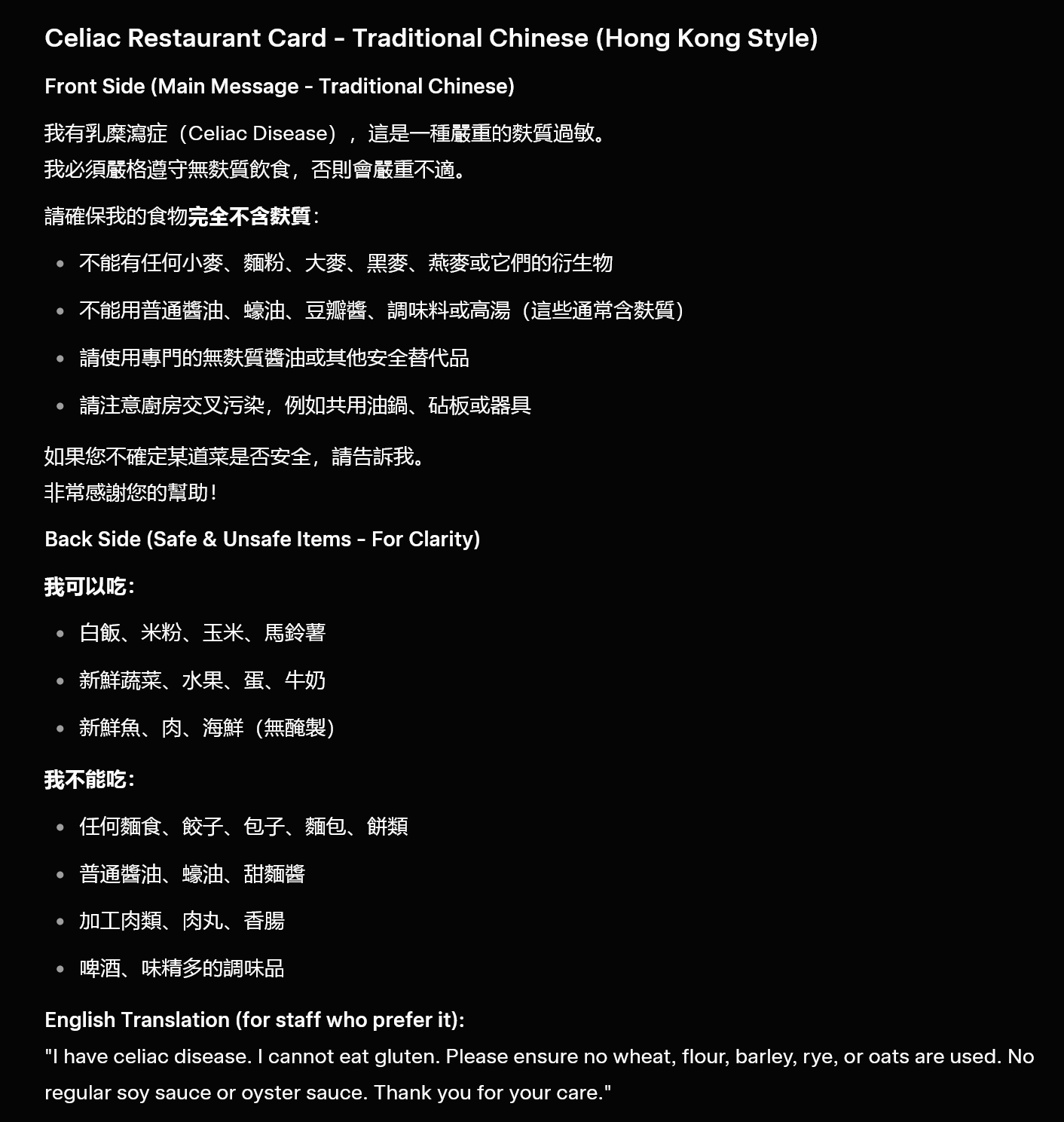
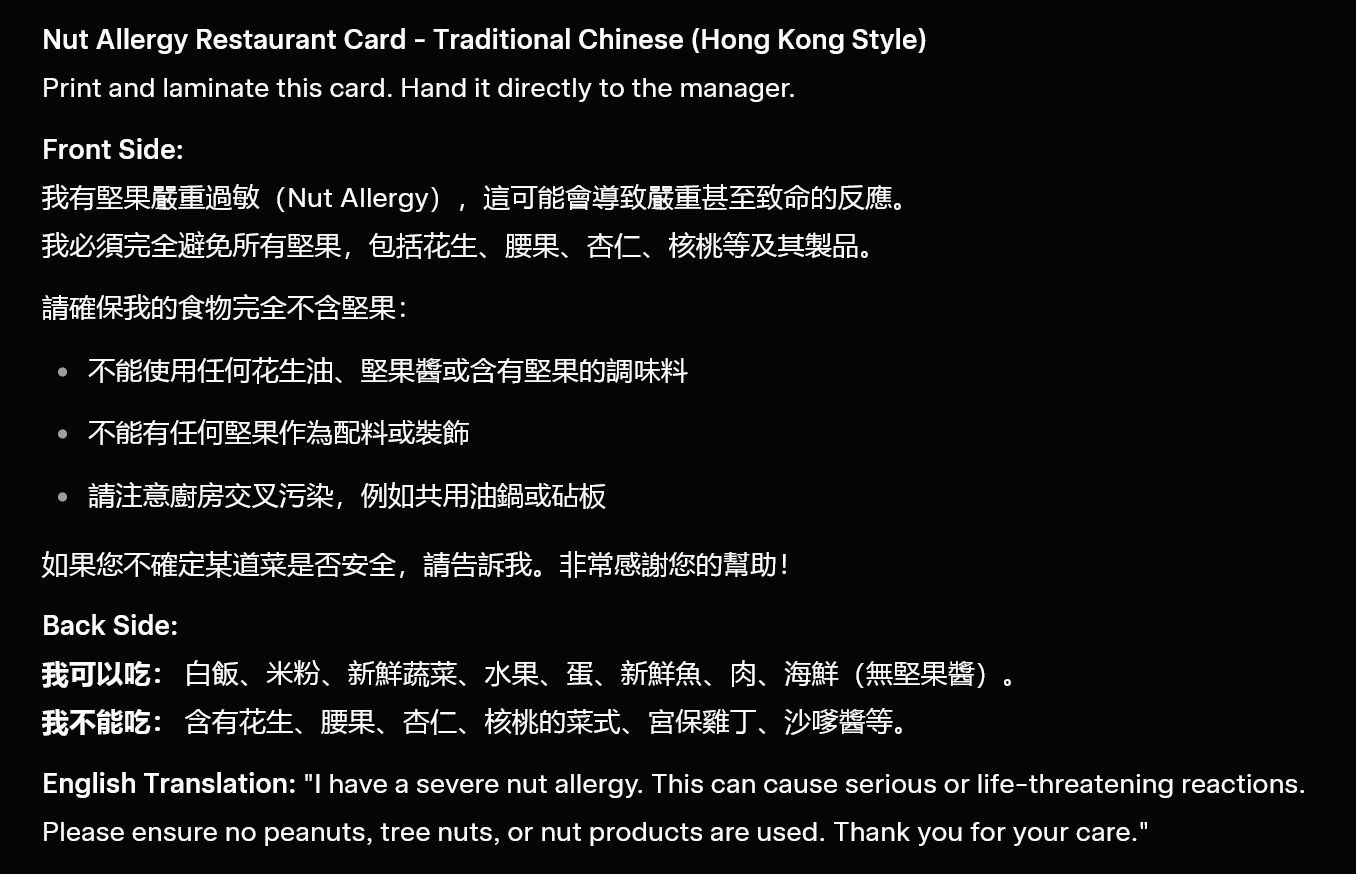
click on any image to enlarge
The information above can be shown to restaurant managers in Hong Kong if you are intolerant to gluten and nuts,
I do not do food tours as mentioned above, I have very specific reasons and part of it is that I do not speak Cantonese or write Chinese, I am from Yorkshire in England and I lack the language gene and it is not through lack of trying and yes a lot of restaurants do not have English menu’s or staff who speak conversational English.
.. and yet I have eaten at close to 1,400 restaurants in Hong Kong since January 2nd 1972, my wife was born in Hong Kong and we have been together over 40 years and her first language is Cantonese and a lot of her family are Chinese or half Chinese so I have never had much of an issue!
This does not translate to doing food tours though, yes, I could do them, no problem there but they would never ever be as good as the food tours done by my friends (see the 3 links above) most of their awesome guides are locally born Hong Kong Chinese and obviously food culture is part of their DNA, it is impossible for me to compete with that!
So please feel free to contact them for food tours
I do not do Hiking Tours in Hong Kong but I know someone that does!
I do not do Hiking Tours, never have and never will even though I used to go Hiking a lot when I was a lot younger, The Hong Kong Government is promoting hiking tours so I urge you to contact my friend Sabrina at Hong Kong Trails and Tours, she is a long time Hong Kong resident and and a very experienced hiker with close to 700 Hikes in 15+ years under her belt, please click on the link below
click on any image to enlarge
© Copyright Acknowledged | All rights reserved | images taken by Jamie