Temple Street Night Market Hong Kong How to get to guide
A Detailed Market History, What’s On Offer + Transport Tips

The J3 Group - Premium Quality Private Tours | Experiences and Insider Chats since 2010
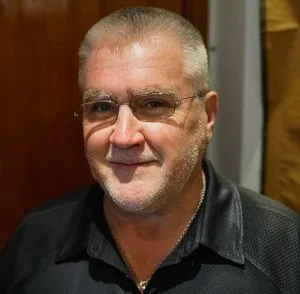
Me Jamie, your host, I am English and I have lived in Hong Kong since January 2nd 1972 - I know the place.
A meaningful blog post with a difference - tips on Travel, Tourism, Tours, Daily Life and my personal thoughts on Hong Kong.
Please do visit Amazing Hong Kong
Hong Kong | Pearl of the Orient
Customised Private Tours + Experiences in Amazing Hong Kong
Jamie has lived in Hong Kong - Pearl of the Orient for 50+ years
Carefully Crafted Personalised and Customised Itineraries by Jamie | Hong Kong’s Most Experienced Private Tour Guide for : Solo Travellers Friends Families Seniors Couples Business People MICE Delegates.
Private Tours Cultural Tours Walking Tours Sightseeing Tours City Tours Night Tours Layover Tours Transit Tours Private Shore Excursions Bespoke Tours Personalised Tours Jewish Heritage Tours Luxury Private Tours Day Tours Luxury Boat Tours Themed Tours Private Family Tours Private Day Tours Corporate Tours
Just you, your family or friends and Jamie your personal English private tour guide - over 2,400+ tours completed since 2011 - Jamie offers quality Private Tours of Hong Kong
Tour Group Size 1 - 6 people only
J3 Group Hong Kong | J3 Consultants Hong Kong | J3 Private Tours Hong Kong
Creating Memories That Will Last A Lifetime
Go here for the Hong Kong Michelin Restaurant Guide which includes the Bib Gourmand Category

Temple Street Night Market Hong Kong - How To Get To Guide
A Detailed Market History, What’s On Offer + Transport Tips
10 compelling reasons to visit the Temple Street Night Market in Hong Kong
Here are 10 solid reasons why tourists should visit the Temple Street Night Market in Yau Ma Tei, Kowloon, Hong Kong)
Temple Street Night Market (Temple Street Yau Ma Tei)
Iconic night market atmosphere with fortune tellers, street opera performers, and buskers.
Famous for "men's market" items like gadgets, watches, lighters, and electronics.
Outdoor Cantonese opera performances and impromptu singing sessions.
Abundance of street food stalls serving claypot rice, seafood skewers, and local desserts.
Unique souvenirs such as antique replicas, jade items, and Mao memorabilia.
Relaxed evening vibe with outdoor dai pai dong dining nearby.
Fortune-telling services ranging from palm reading to face reading.
Affordable massage and foot reflexology stalls for a quick break.
Close proximity to the historic Tin Hau Temple for cultural context.
Lively people-watching scene with a mix of locals and tourists until late night.
I thought I would start things off a little differently and I want to make a few comments about Tripdvisor Reviews for the Temple Street Night Market.
It has over 2,600 reviews and it averages 3.5 out of 5 which is not earth shattering and is distinctly average.
I have read probably 400 reviews and to be honest, I do not disagree with a lot of the comments which basically say that it is a waste of time, I can understand that and was quite valid pre Covid, it was dying a slow and painful death after being around for 50 years.
Most people compare it to the Ladies Market up the road so to speak, that market is the same size as the 3 sections of the Temple Street Night Market and has a lot more on offer but it also has the advantage of opening at lunchtime 12pm
Temple Street has always had a poor image, being just a night market and it does not help that you have 3 distinct sections, I would guess only a tiny fraction of foreign visitors see section 3 which is the biggest section, they simply do not know it exists.
I have been going there for 50 years and I have a different view, to make a proper judgement you really need to do all 3 sections and trust me, it is not just about buying trinkets. as a long term resident and private tour guide I have gotten to know the whole area pretty well and if you had me as a guide you would be amazed at how my information would turn things on a head, the market is far from being a trinket market, it is also a community and I have the advantage of seeing beyond trinkets and as they say what goes on in plain sight.
In addition, all credit to the Hong Kong Government for seeing past the negative reviews and the poor reputation the Market has | had - the solution was so simply it made me laugh
The Ladies Market is trinket heaven, 1 km of stalls but almost nothing in the way of street food or good restaurants, The Temple Street Night market did not have anywhere near the number of stalls but had a lot of space that was unused to the solution, turn into a a street food section, with as many mobile food carts as possible
Initially it was a short term project, it was not meant to keep going long term and the Government is all in and it now looks as it is going to be a permanent feature.
A great friend of mine who offers the best food tours in Hong Kong now has a specific Temple Street Food Tour and as usual I bet it is an amazing food tour! just click the link below for details.
In a nutshell, the street food section is a huge winner and visitors love it
I always used to hate the restaurants around at street level pre Covid, you basically ate there at your own risk,, dodgy hygiene and terrible food at tourists prices for tourists.. somebody did the right research, you get much more of a food buzz by stuffing your face with 30 varieties of bite size street food and Hong Kong Street Food has space for sweet (and amazing) bites.
This street food section is for locals and tourists alike and the market has been revitalised and has a genuine buzz about it and is well worth your time, all sections I might add, 1, 2 and 3!
I would add as a final point that everyone should pay a visit to Yue Hwa Emporium (which probably 80% + of all visitors walk by and completely ignore on the way to the market), where else are you going to see a glass cabinet displaying ginseng roots for US$250,000 to US$400,000 - see below for more details.
click on the image to enlarge
© Copyright Acknowledged | All rights reserved.| Image taken by Jamie
The Temple Street Night Market | How to get to Guide | Hong Kong
The History and Evolution of this iconic afternoon and night market in Hong Kong : For curious visitors who want to explore Hong Kong’s vibrant Street Market scene
Visiting the vibrant market scene in Hong Kong
I always enjpy going to the major markets in Hong Kong, there are 5 of them and for some peruliar reason they are in Kowloon and not on Hong Kong Island.
There are quite a few markets on Hong Kong Island including Stanley Market but for some reason they do not have the popularity of the big markets in Kowloon
As much as I visit these markets quite often people might like to do them on day 2 of their visit or visit the most popular ones (the Ladies Market and the Temple Street Night Market at night time when they close at around 11pm (ish)
These guides provide information and history about the markets with tips about transport options to get there, which is pretty straight forward using the MTR which is our world class subway system
When it comes to the Temple Street Night Market i have always had mixed feelings over the decades, it has always been a staple of my private night tours but to my mind beginning about 10 years ago something got lost along the way, the gritty spark and vibe it had slowly vanished and Covid almost consigned the market ro a slow death
.. and then, someone in our Government had a really solid idea and that what to bring in a street food section at the Jordan Road entrance, there was a stretch of closed road that was always basically empty and had been vacant for as long as I can remember, I never figured out what there where no stalls
Anyway despite many people saying that a new street food section was just a gimmick and it would not last, the exact opposite, it has brought in the crowds both locals and tourists and the gritty spark and vibe is back! and credit to the Government for sticking to the guns and also not strangling it a raft of bureaucratic nonsense, rules and regulations.
A Detailed History of the Temple Street Night Market in Kowloon
Temple Street's story is woven into Hong Kong's gritty, resilient fabric—a tale of fishermen, opium dens, and post-war boom that transformed a quiet bay into the "People's Nightclub." The street itself dates to the late Qing Dynasty (around 1887), when it was built as two parallel roads: "Temple North Street" and "Temple South Street," named after the Tin Hau Temple (dedicated to the sea goddess Tin Hau) constructed on the site in the 19th century. Back then, Yau Ma Tei was a natural harbor with sandy shores, home to fishing communities who gathered here for worship and trade and a lot of the harbour there has been reclaimed with some pretty tall apartment blocks on the site although the typhoon shelter still exists, lots of barges and such
The night market as we know it kicked off in the 1920s, when street hawkers set up informal bazaars in front of the Tin Hau Temple (then called Yung Shue Tau). These early vendors sold handmade goods, fresh produce, and trinkets to locals—fisherfolk, laborers, and theater-goers from nearby venues. By the 1950s–60s, post-WWII refugees flooded Hong Kong, swelling the population and turning Temple Street into a vibrant flea market. It earned the nickname "Men's Street" for its rowdy mix of gambling parlors, street opera performances, and unlicensed bars—earning a seedy reputation as a red-light district with opium dens and brothels tucked into alleys. The 1970s saw a government crackdown on vice, pushing much underground, but the market thrived as a symbol of old Hong Kong
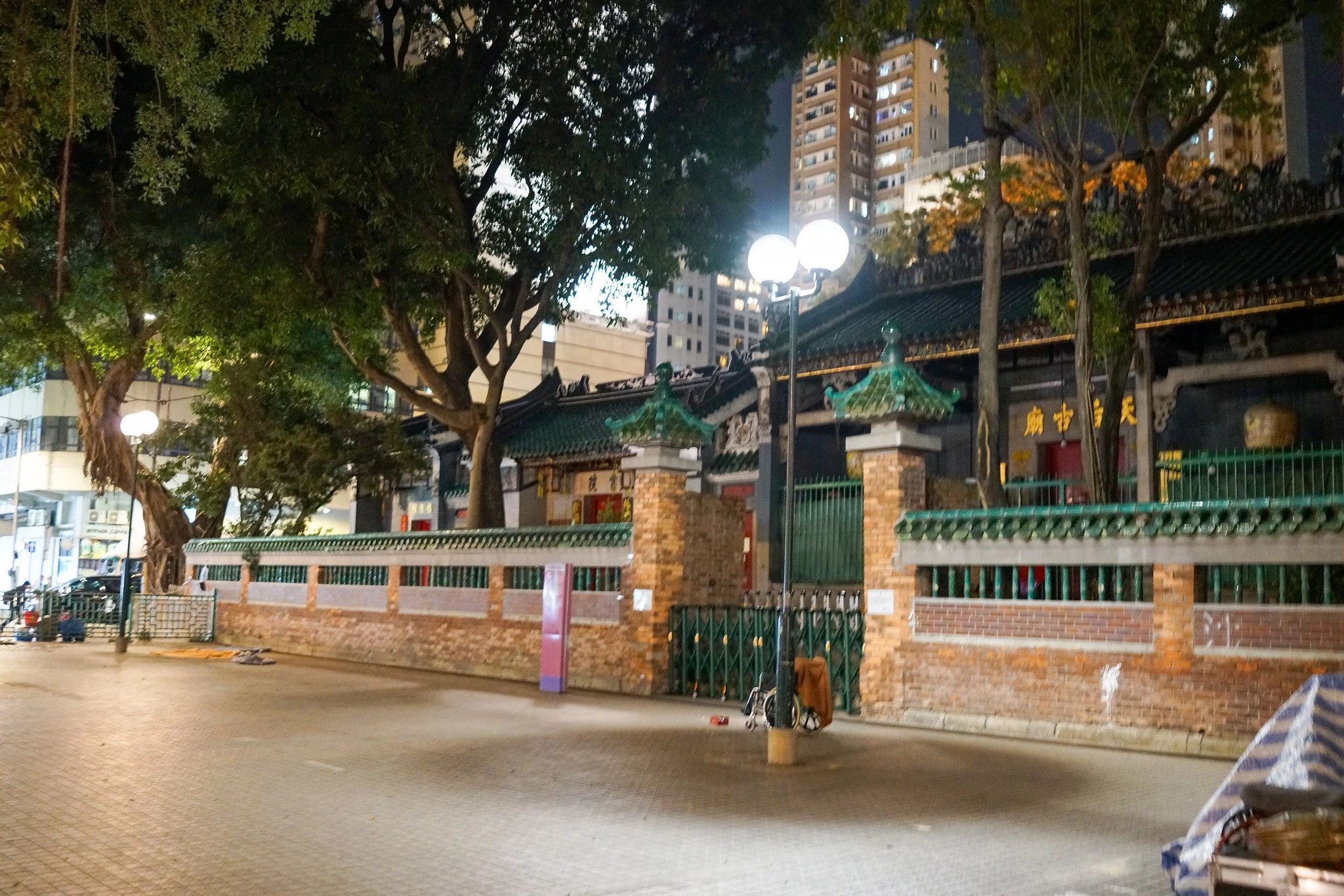
…. and yes, going into 2026 the Tin Hau Temple is very much still there but is generally closed in the evening these days.
… and as mentioned fast-forward to the 21st century: Tourism boomed in the 2000s, drawing crowds for cheap souvenirs and street food. But COVID-19 hit hard, emptying stalls by 2020. In 2023, a government-led revamp under the "Night Vibes Hong Kong" campaign relaunched it with themed zones, boosting visitor numbers to 1.5 million in the first five months of 2024. By 2025, it's stabilized as a cultural staple, blending nostalgia with modern tweaks, though locals lament the loss of its raw edge. Today, it stands as one of Hong Kongs last authentic night markets, outlasting flashier rivals like Ladies' Market.
The Three Distinct Sections of the Temple Street Night Market in 2025 | 2026 (Don't Miss the Third!)
In 2025 and going into 2026, Temple Street has evolved into three clear sections, stretching from Jordan MTR to Yau Ma Tei MTR—a full 20 | 30 minute walk end-to-end. Many tourists (and even locals) bail after Section 2, missing the authentic grit of Section 3
I always lead guests the full length for the complete immersion. Here's the breakdown:
Walking the full length? Start at Jordan for the build-up; end at Yau Ma Tei for easy exit. It's flat, the crowds make it a zig-zag affair.
For the record most visitors do not make it to Section 3 of the Temple Street Night Market which is a shame, it is totally different to sections 1 and 2
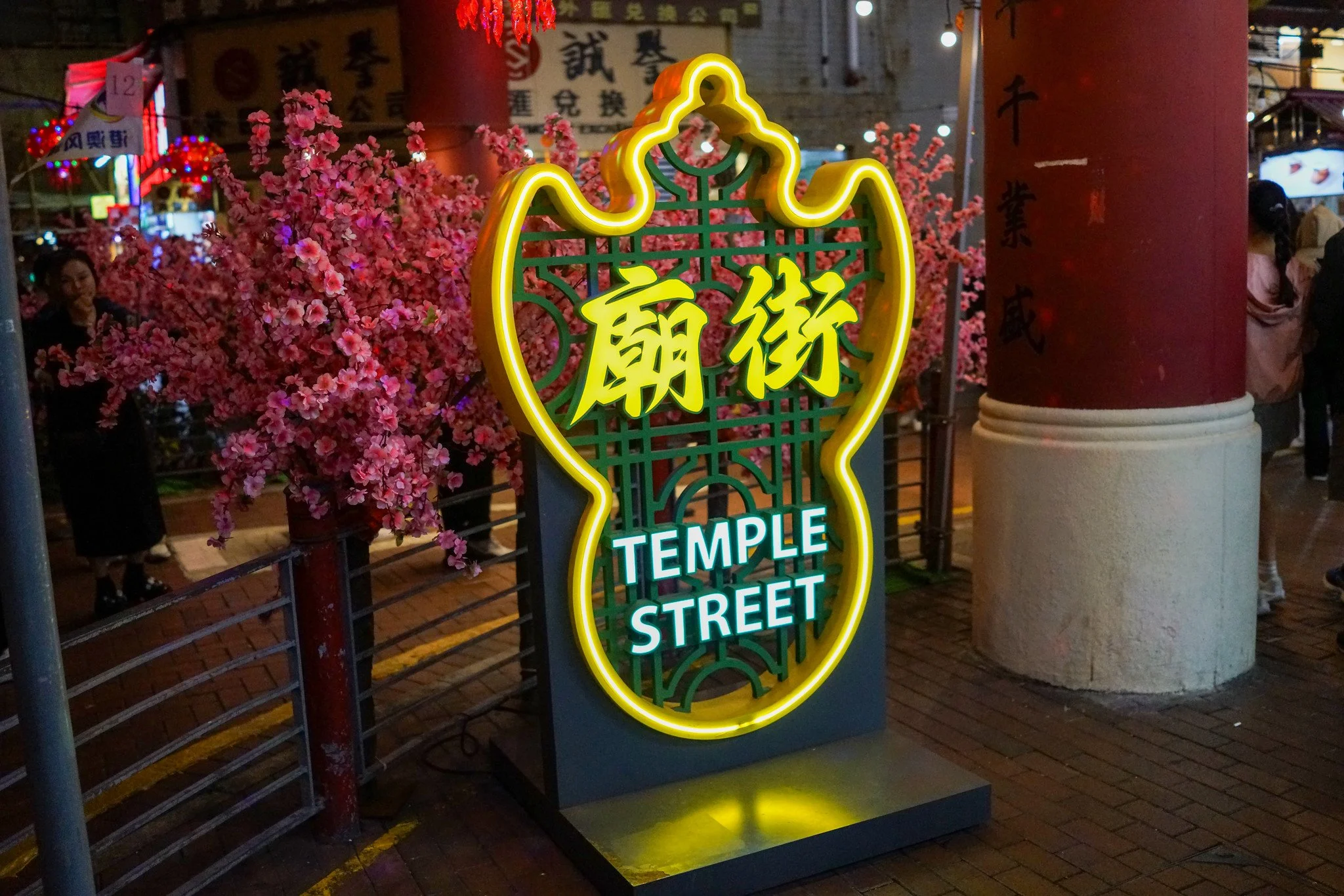
click on any image to enlarge
© Copyright Acknowledged | All rights reserved.| Image taken by Jamie
The Temple Street Night Market | Section 1 Street Food | Hong Kong
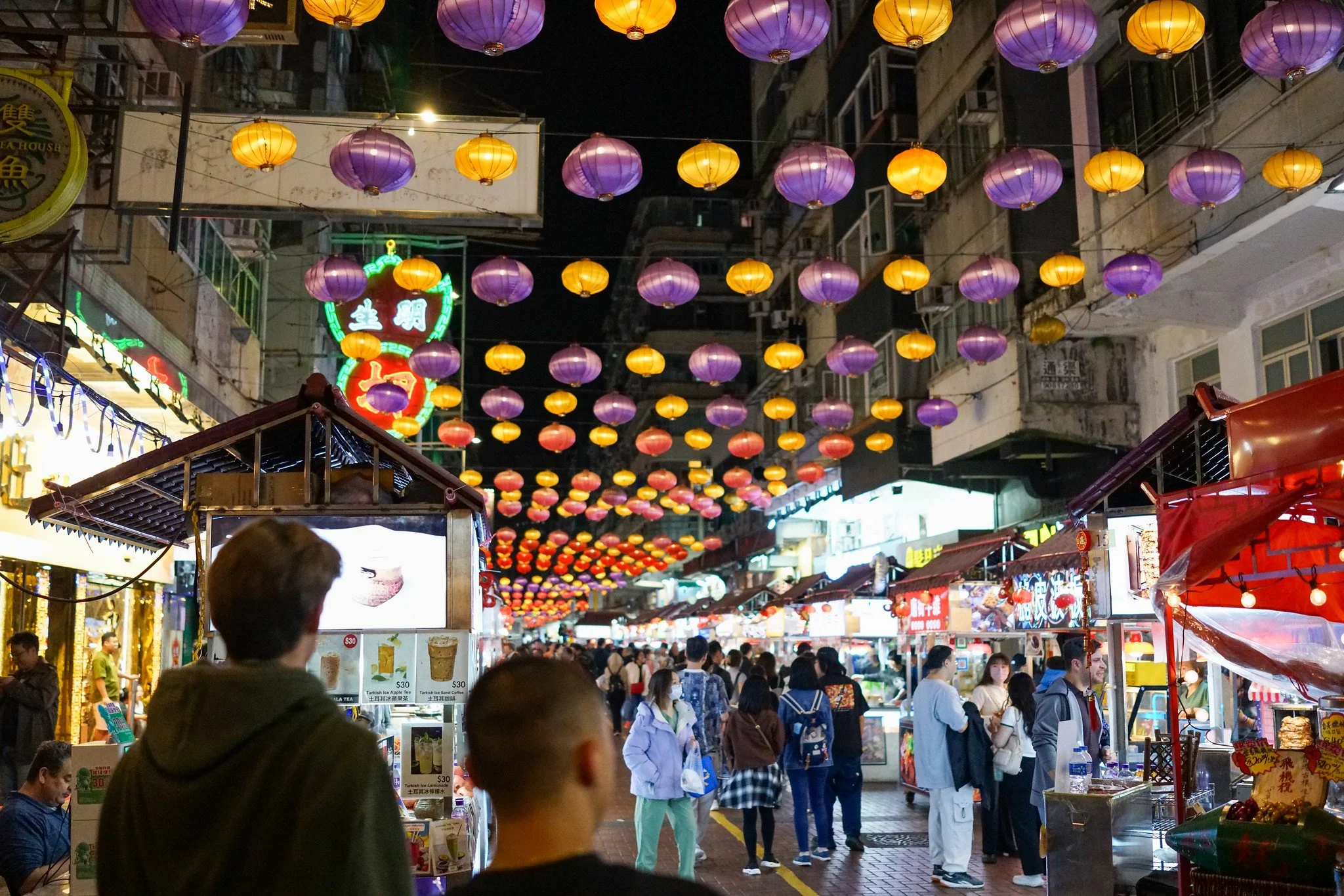
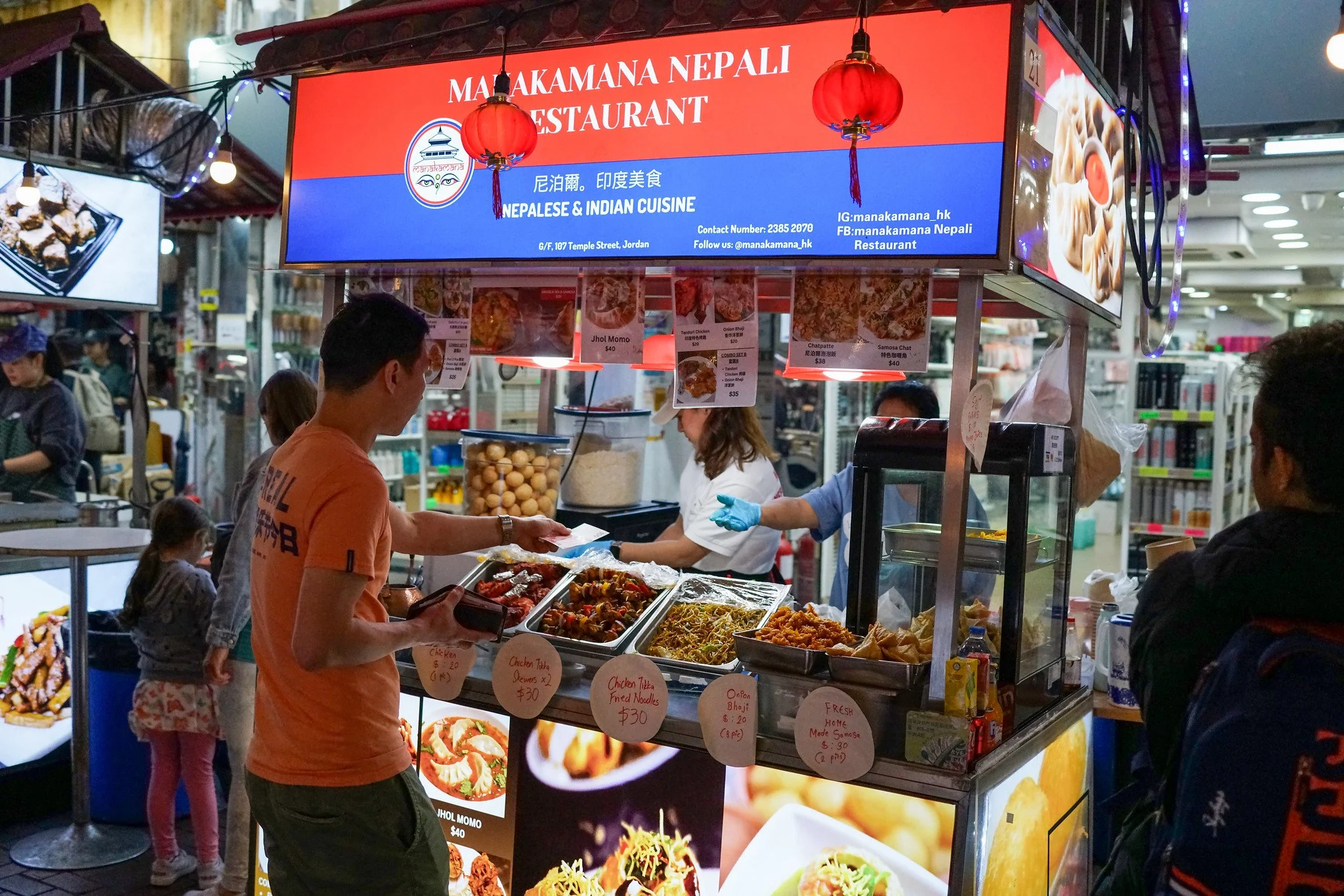
Section 1: Jordan Road - Near Jordan MTR Station (Southern Entry – The Tourist Gateway
Lots of Food carts here and snacks like egg waffles and local curry fish balls, not just mobile carts but actual shops which can be hard to spot
300m) Starting at the red Tin Hau Temple gates, this is the polished intro: A relatively new "Nostalgic Food Zone" (government-added in 2023) runs north along the western side, with hawker stalls | carts slinging claypot rice, stinky tofu, and grilled seafood under colorful lanterns. It's family-friendly, buzzing with mainland Chinese and Western tourists. Expect photo ops at the temple, but it's the least "local" vibe more staged than spontaneous but visitors and locals love the place, they should do this at all the markets
Make sure you look for the egg waffles shop (not a mobile cart) they are awesome
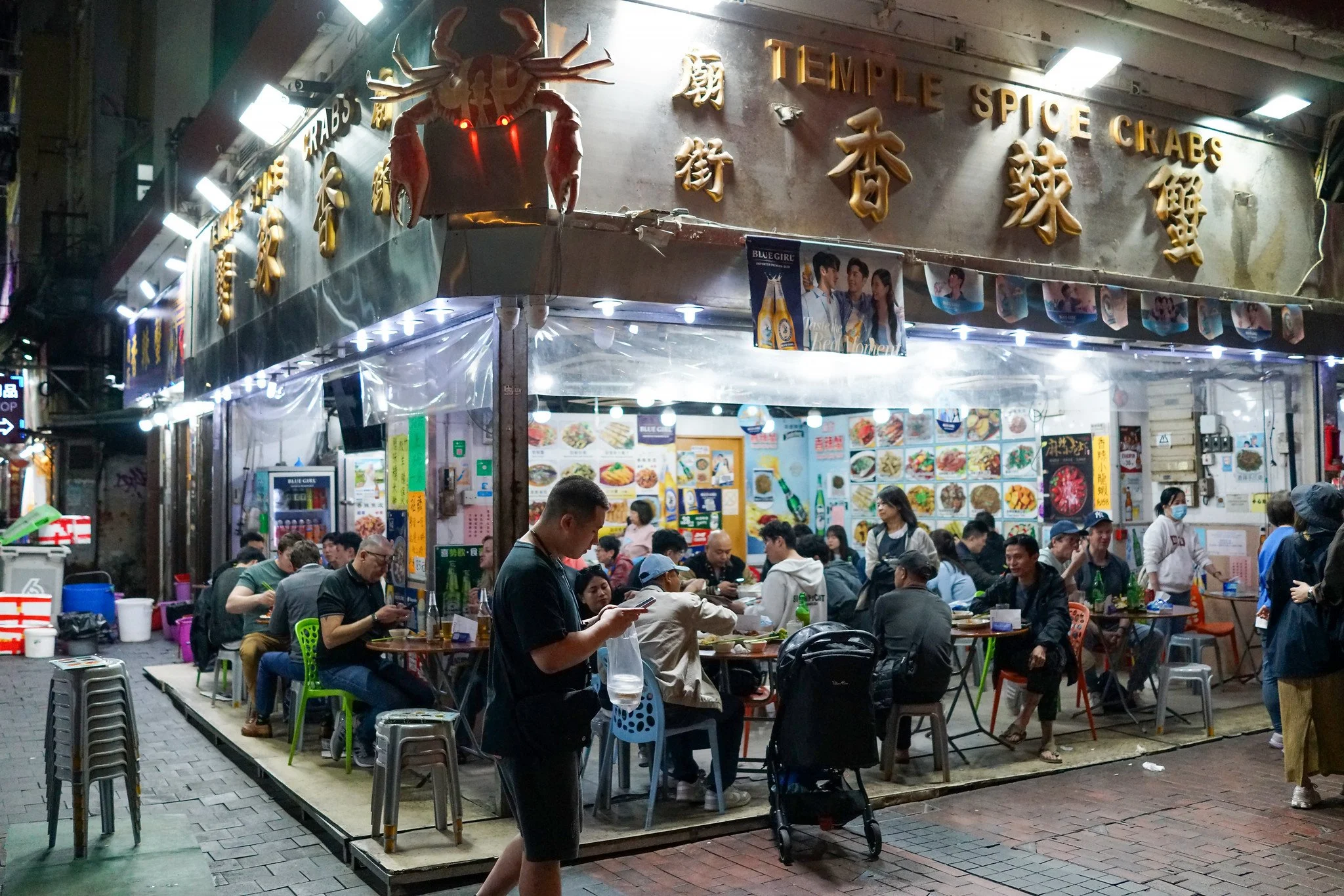
click on any image to enlarge
© Copyright Acknowledged | All rights reserved.| Image taken by Jamie
The Temple Street Night Market | Section 1 Stalls and Such | Hong Kong
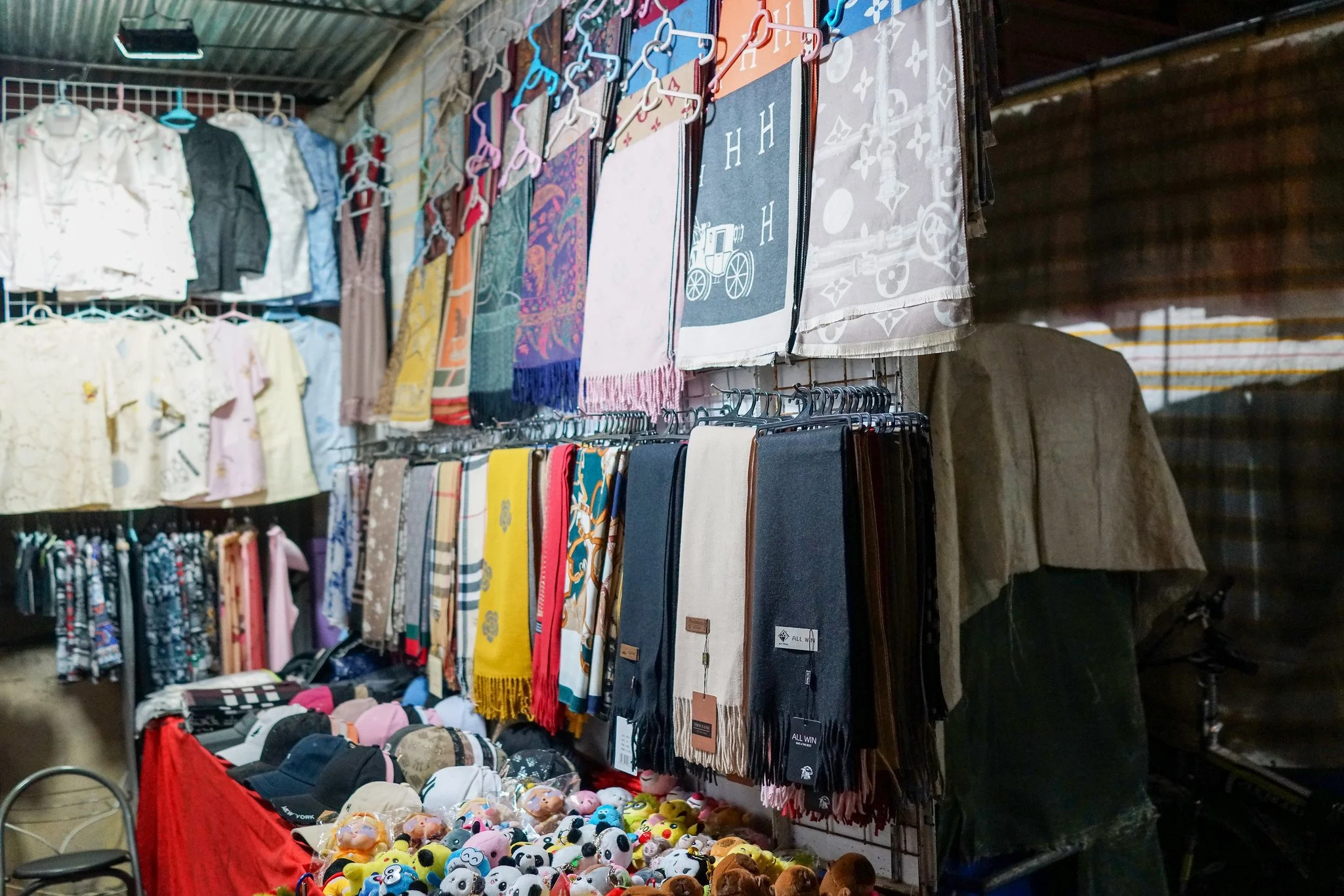
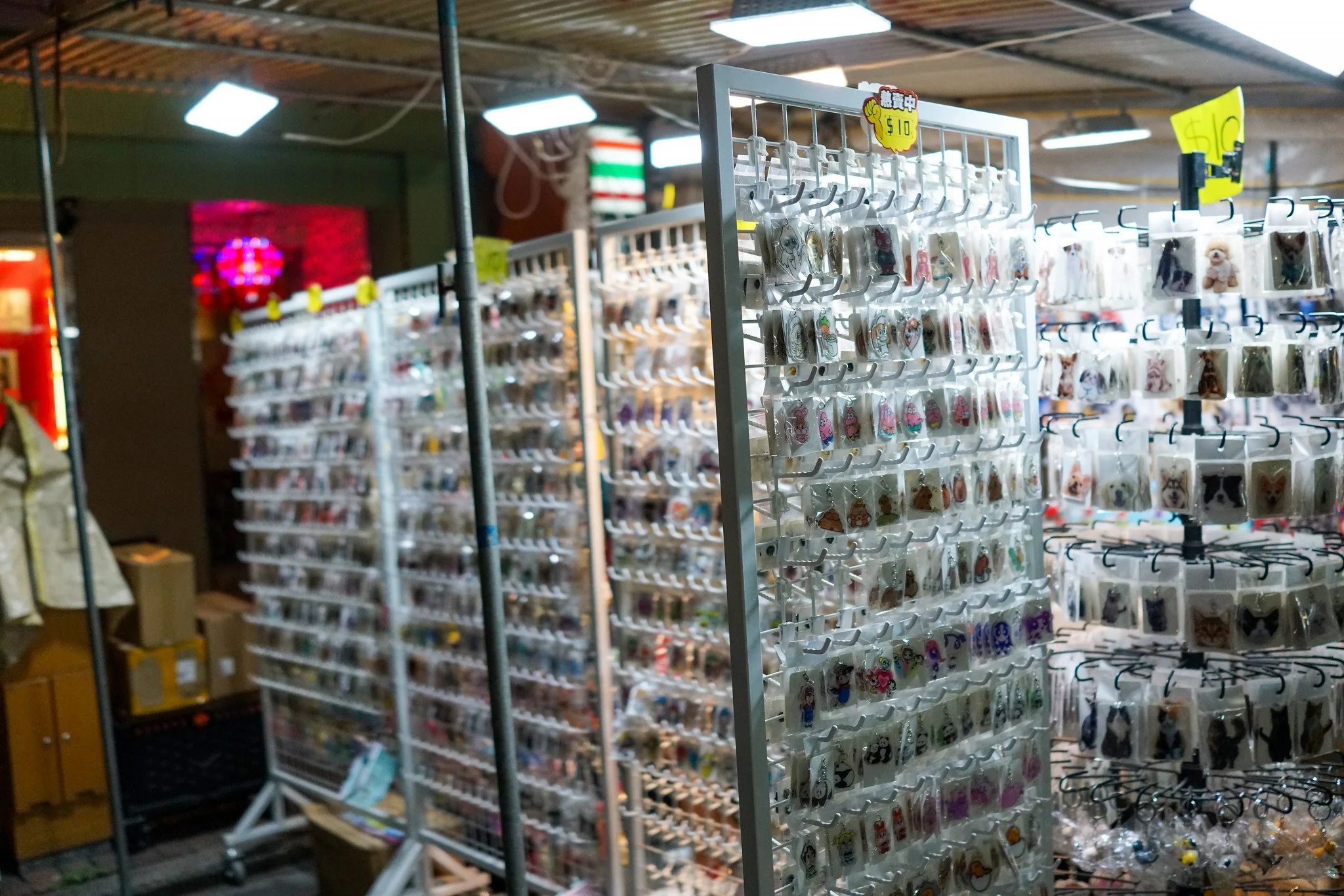
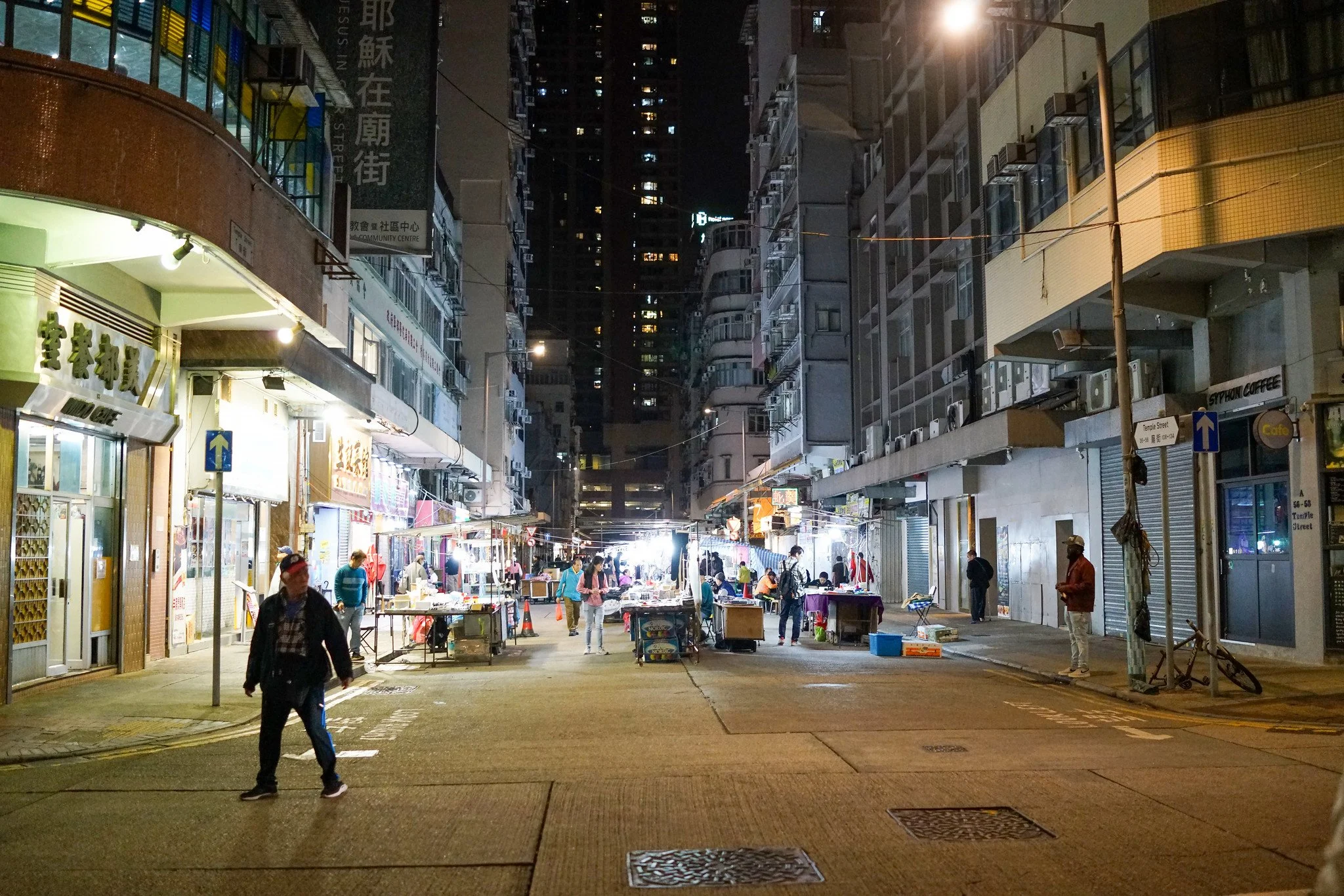
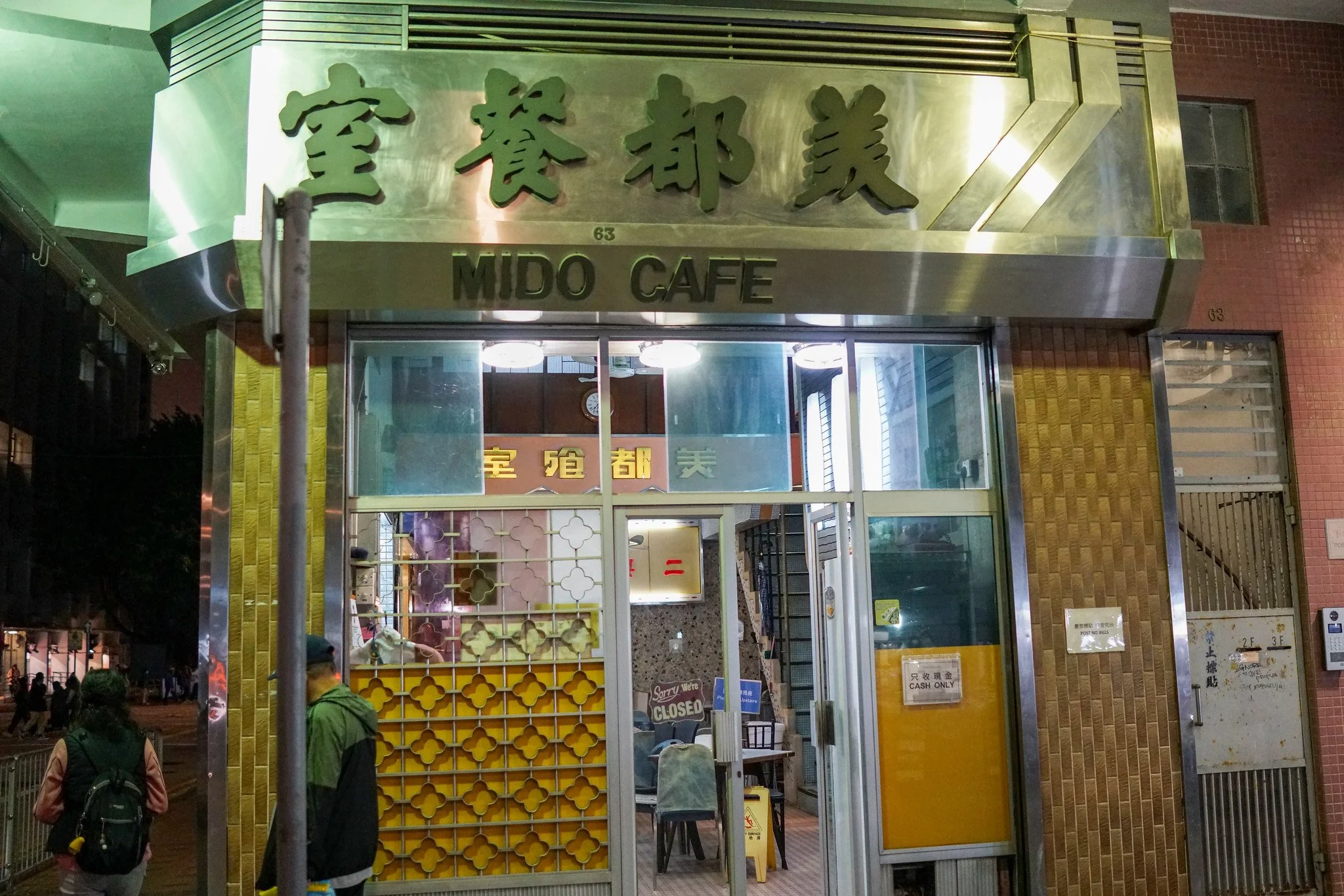
Section 1: The Core Bazaar (~500m Northward – The Heart of the Hustle) Heading north, the street explodes into a sea of 100+ stalls crammed curb-to-curb: Fake designer bags, knockoff watches, toys, silk scarves, and jade trinkets glow under neon. Street performers (often buskers with erhu fiddles) and fortune tellers add chaos. This is peak "Men's Street"—loud, sweaty, and alive with Cantonese banter, crowds thicken around 8pm; it's where the energy peaks. Please be aware that the sidewalks behind the stalls are where the Ladies of the Night ply for business, the sidewalks are not busy and there are shops and restaurants but it is hard to miss the ladies who are pretty much all from Mainland China, it is not a place for a family stroll to escapte the crowds.
click on any image to enlarge
© Copyright Acknowledged | All rights reserved.| Image taken by Jamie
The Temple Street Night Market | Section 2 | Hong Kong
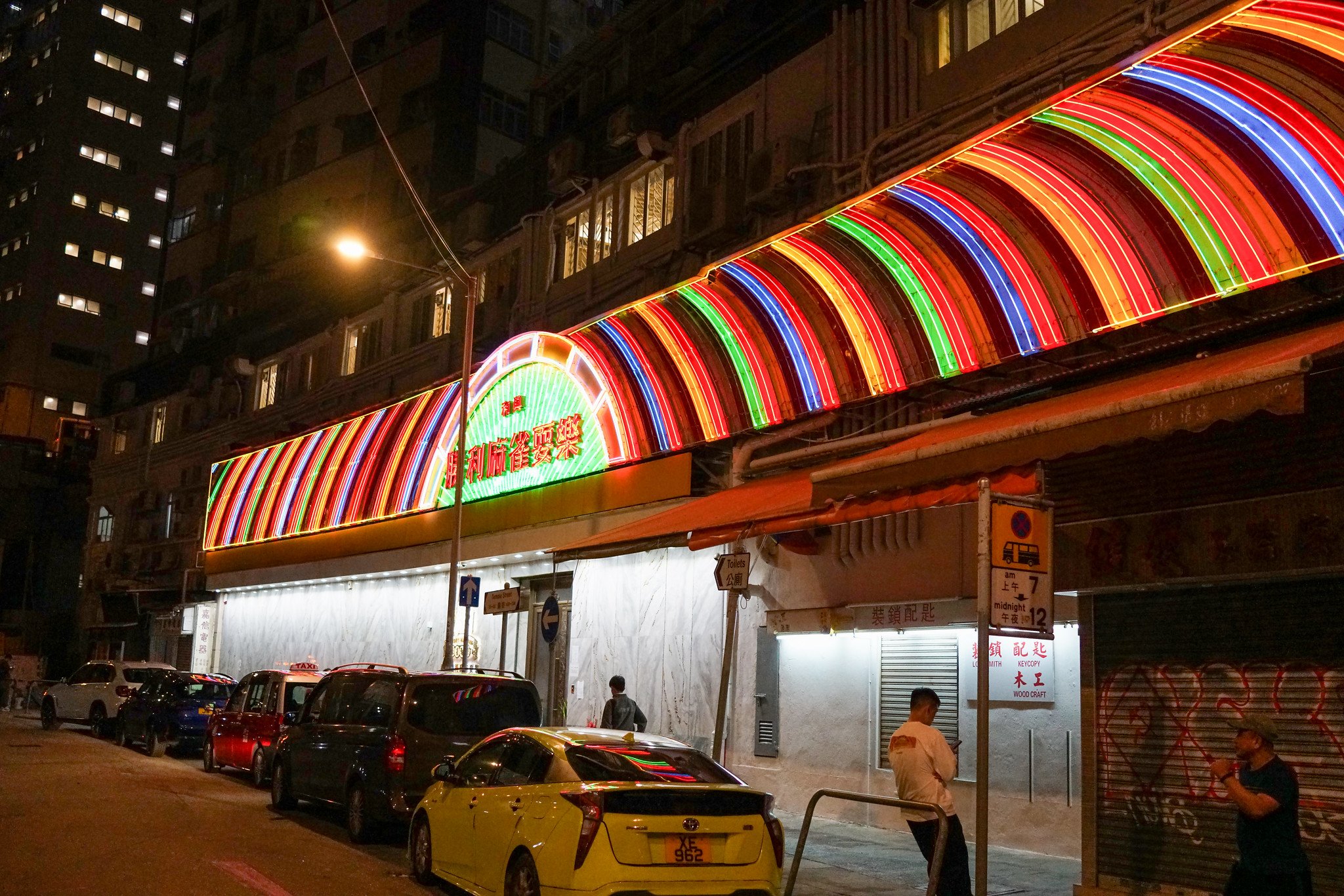
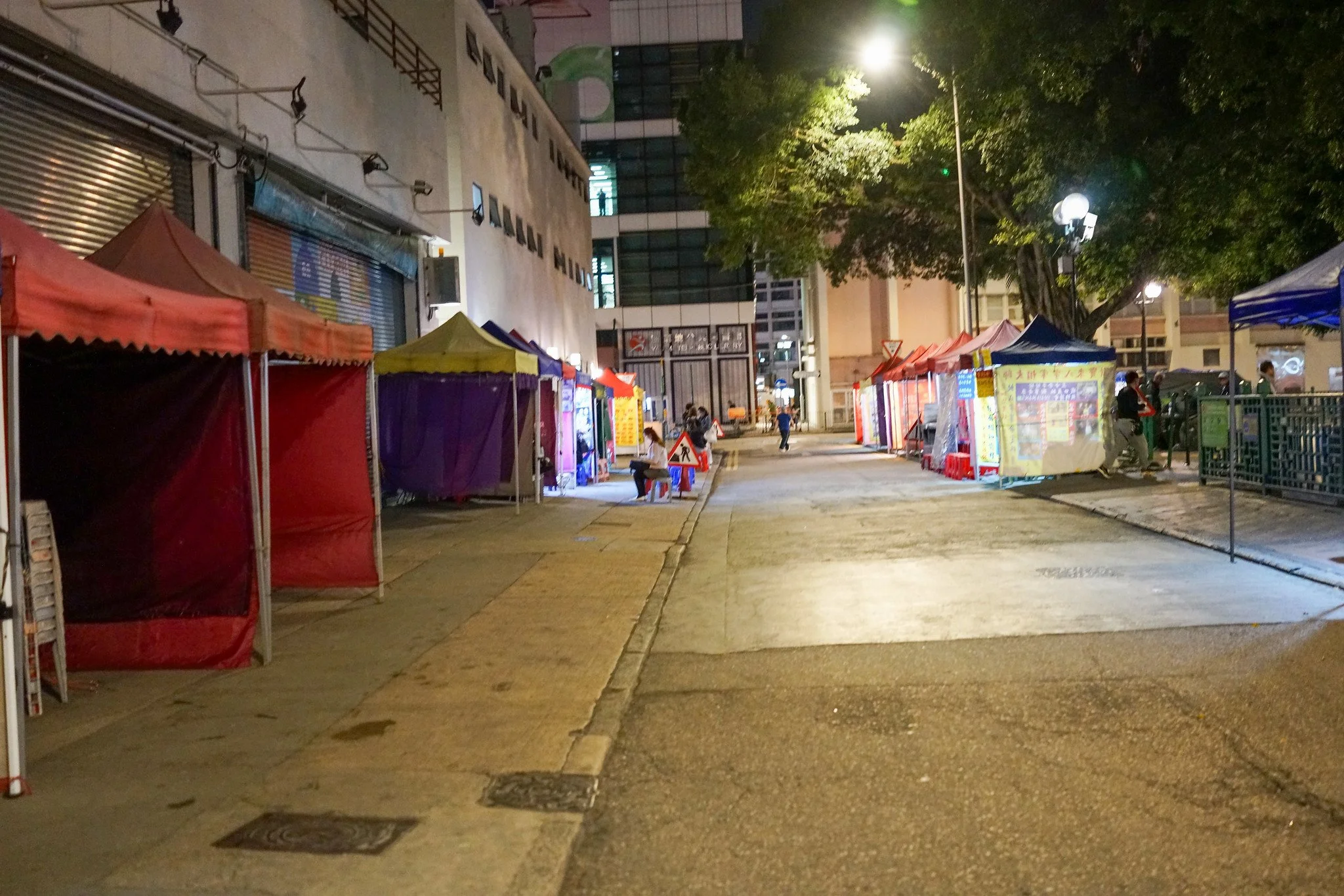
Section 2 is quite long and ends at the small park with the Tin Hau Temple, hence the 2 sets of photographs as it would be easy to think that the market stops at where the fortune tellers are close to the Temple
Section 2: Beyond the Arch (Northern Extension - Hiding in plain sight , ~300m to Yau Ma Tei MTR) At the end of Section 2, resist the urge to turn back - duck under the stone archway, cross the road (watch for traffic), and note a neon-drenched Mahjong Parllour that looks like it was ripped from a Wong Kar-wai film (visible from afar, though not quite from space!). To the left: A cluster of fortune teller stalls under umbrellas, reading palms for HK$50–100. Further up on the right: Open-air karaoke setups blaring off-key Cantopop—earplugs advised, but it's hilariously authentic (amateurs belting "My Way" at top volume). Turn left at the plaza's end onto a quieter stretch: Rows of fortune tellers give way to a small park with the Tin Hau Temple annex (Tin Hau is everywhere here).

click on any image to enlarge
© Copyright Acknowledged | All rights reserved.| Image taken by Jamie
The Temple Street Night Market | Section 3 | Hong Kong
Section 3: Beyond the small park and Temple - A more local section
Stroll through the park (30 seconds) onto Pak Po Street, crossing into the "Temple Street Park" extension—still officially Temple Street. This is the least touristy bit: Fewer Western faces, more elderly locals haggling over herbal remedies and knockoff electronics and nail clippers. "Dodgy" restaurants line the sides - think dimly lit dai pai dongs serving congee or offal stews (hit-or-miss hygiene, but cheap at HK$30–50). Keep walking north; the road curves right at Shanghai Street, dumping you at Yau Ma Tei MTR Exit B. This section feels like old H ong Kong, in a nutshell raw, unfiltered, with whispers of its vice history lingering in the shadows.
So there you, some quick visuals for each section 1 - 3 and should help you navigate the Temple Street Night Market, I absolutely believe that you should do all 3 sections as they are very distinct from each other and have different vibes
Approximate Number of Stalls, Opening | Closing Hours, and What's on Sale
Stalls: Around 200–300 total (100+ shopping, 50+ food), though it varies nightly - fewer on rainy days. Sections 1- 2 dominate numbers; Section 3 has ~50 scattered ones
Hours: Officially 2pm–11pm daily, but stalls trickle in from 4pm. Peak action 6pm - midnight; most pack up by 11:30pm (food first, shopping last). Closed early for typhoons
All sorts of stuff and lots of stuff you don’t actually need but you buy it anyway for family and friends and as a reminder of your visi to Hong Kong
These days it's a grab-bag of affordable knockoffs and curios like many markets in South East Asia
Clothing and Accessories: T-shirts, dresses, hats and caps, handbags, jewellery, and sunglasses .
Souvenirs and Gadgets: Phone cases, keychains, fans, and quirky toys.
Everyday Essentials: Shoes, luggage, watches, and all sorts of fake designer goods.
Street Food Nearby: in section 1 of the market and it is pretty darn good
Quality varies wildly—great for impulse buys, but inspect for durability. It's ideal for tourists seeking "Hong Kong souvenirs under HK$100. or US$12.80”
It is also a fact that these retail shops and market stalls tend to shy away from offering any product that could be seen by the authorities as a “knock off” in other words brand name bags, scarves, jewellery and such, so what to do? well you hit the street markets and yes I have lost count of the number of times I have advised my guests on the procedure for buying fake brand name goods.
Tip - if you are in the market for knock off designer goods, generally these are NOT on display at the stall, perhaps just one or two under the counter, if you are interested the stall holder (who will sell generic handbags) and | or his or her mates will take you to a room in a nearby building where there is a showroom of sorts with all the famous brands, haggling is expected, in the past they actually took you to a whole bunch of dodgy restaurants and had all the products neatly on display in the kitchen annex! I am sure that probably still goes on, the sale of fakes is NOT on the same lever as the Ladies Market
In my experience it is perfectly safe.
Temple Street (all 3 sections) is as long at the Ladies Market up the road but more spaced out and a lot less stalls so the crowds never get to overwhelming levels for the most part.
Safety Concerns
Temple Street is generally safer than many global night markets, with 24 | 7 police patrols and CCTV. As a guide, I've walked it solo at 2am quite a few times without issue. Main worries: Petty theft in crowds (watch bags, no wallets in pockets); scams like overpriced "jade" or rigged fortune tells. Section 3 feels edgier at night - avoid dark alleys alone. Gangs are generally not visible but low-key; they target rivals, not tourists.
Women: Catcalls rare and they do NOT like being photographed, but they are not shy about revealing their assets in a very obvious manner - stick to lit paths. Overall, common sense rules - safer than TST Kowloon bars.or Lan Kwai Fong in Central on Hong Kong Island.
Comments on Stall Holders, What to Expect
Stall holders are Temple Street's soul: Weathered aunties and uncles in their 50s–70s, chain-smoking and yelling prices in thick Cantonese and rudimentary English They're tough negotiators but warm - many are multi-generational hawkers who've seen Hong Kongs upheavals.
Expect chaos: Narrow paths clogged with browsers, Cantopop blaring, kids darting underfoot. It's sensory overload - neon haze, sizzling woks, haggling echoes. Less "polished" than Mong Kok (The Ladies Market(; more authentic sweat. Vendors might push samples (try the free fruit!), but ignore aggressive suits | watch touts—they're scams. With guests, I point out the storytellers: One uncle near Section 2 spins yarns about 1960s riots for a tip. What to expect? A time capsule of working-class Hong Kong, joyful, flawed, unforgettable. Not for the faint-hearted; embrace the mess
… and the best thing, they do not pretend to be anything more than folk selling cheap tat to visitors and you have to admire their work ethic.
Payment Methods at the Temple Street Night Market
Cash is king - most stalls only accept Hong Kong Dollars (HKD) in small bills (HKS10,20,50,100). Octopus cards or mobile payments (AlipayHK/WeChat Pay) are rare here; nearby ATMs are plentiful.i have never met a stall holder yet who will accept US$ which is odd as it is basically a fixed exchange rate so in a nutshell HK$ Cash only
Bargaining Techniques - be prepared for some serious haggling!
Haggling is an art form and in my experience women are much better at it than men! I suck at haggling, my wife could get a 2 carat Graff diamond for less than wholesale!
The vibe at Temple Street is quite different to the Ladies Market, for want of a better phrase it is more gritty and a lot of the stall holders are middle aged men who are pretty savvy.
the price of any product is negotiable and more savvy people than me will start the bidding with a 50% or 60% discount! I do not personally think this works at Temple Street
many stalls have signs that state a “fixed” price with no discounts, just ignore that, everything is subject to a discount
the stall holder will look horrified and in broken English give a million reasons why there price is the cheapest and there are no discounts oh and their husband just died and she has 5 kids to feed (I have heard this a few times myself) - this is a Ladies market tactic, I have not seen much of this at Temple Street
you will then mutter a few words, turn your back and walk away as you know better
sometimes the plainly “shocked” stall holder will shout after you or manhandle you and agree to your discount or an even steeper discount if you reach for your wallet | purse but again, the plainly weary male stall holders just shrug and go back to their phones at Temple Street, they are pretty good at feigning indifference
stay friendly: mile, some people say to use simple Cantonese like "Dīk yàt dik?" (a bit cheaper?). trust me this is useless, it is more likely that if you get the tone wrong then you are insulting their parentage or worse - they have zero expectations that any foreigner can speak Cantonese and you are wasting your time - stick to English .
I repeat again - stick to English
Aggression backfires - vendors mirror your tone and will curse you loudly, questioning YOUR.parentage and frankly most of them are pretty jolly and friendly and there is no need to be rude
Bundle Up: Buy multiples for extra discounts (20-50% off total).
Not all items (e.g., food) are negotiable.
Cash payment for the most, deal done, smiles all around!
Best Time to Visit
Aim for 7–10pm: Stalls are fully lit, crowds electric but navigable, food hot off griddles. Weekdays (Tue–Thu) for elbow room; weekends for vibe (but arrive early). Avoid pre-6pm (half-empty) or post-11pm (dispersing). Rainy evenings? Surprisingly cozy under awnings.
My main gripe is families with large strollers and it is an even bigger issue at the Ladies Market, the stalls are packed close together and strollers just block the way and you get lots of pushing and shoving which can be a little off for some people
Interesting Anecdotes (Including the Hidden Side)
click on any image to enlarge
© Copyright Acknowledged | All rights reserved.| Image taken by Jamie
The Temple Street Night Market | Earning a living | Hong Kong
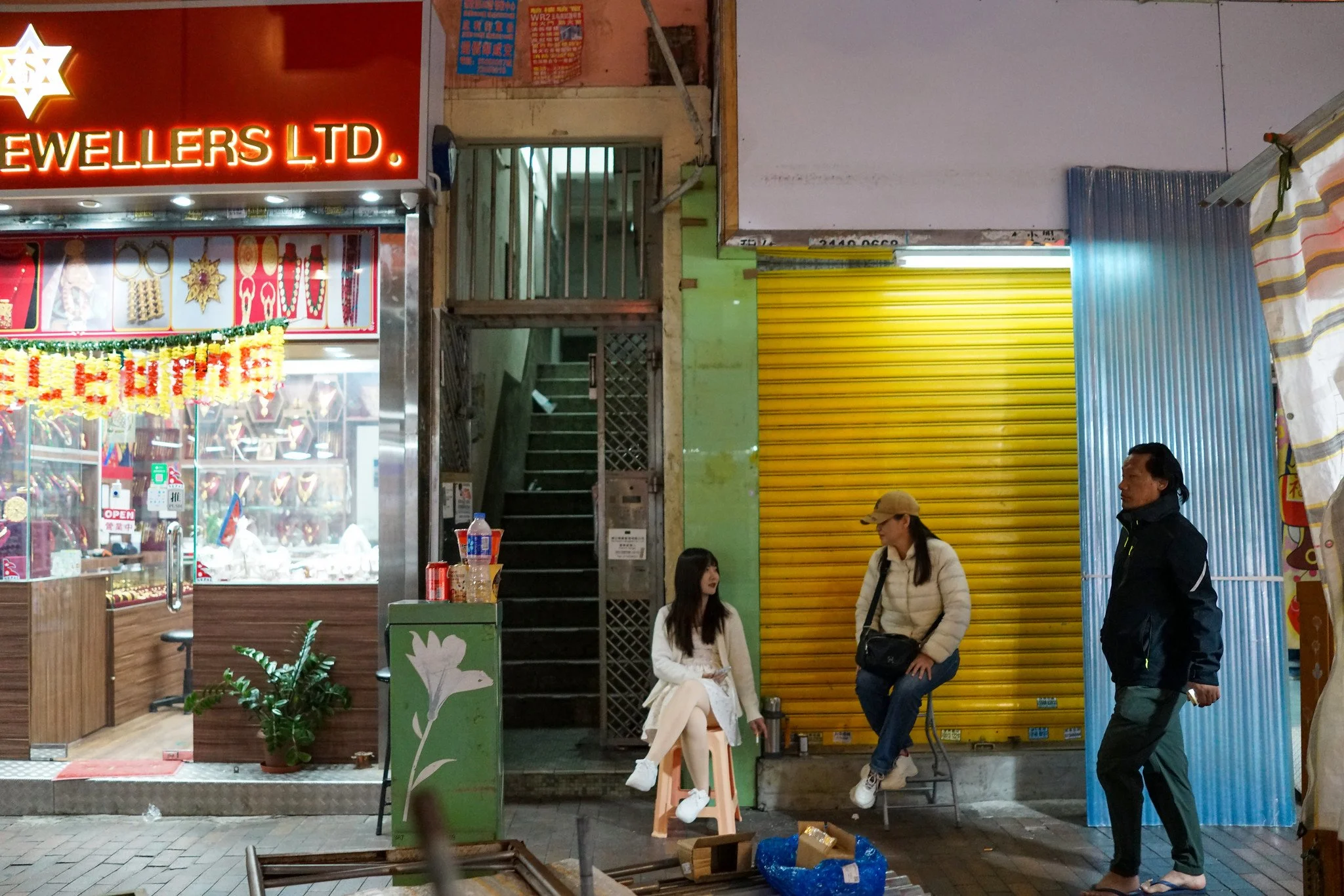
Temple Street brims with tales - like the 1980s "ghost stall" rumor, where a vendor vanished mid-haggle, leaving behind cursed jade (locals still joke about it near Section 2). Or the 1967 riots, when hawkers barricaded the street with carts to protect the temple—earning it "fortress" lore. Families share stories of kids' first bargains here, turning pocket money into treasures.
Sometimes you will see some stalls will have young kids in uniform sat at the back of the stall doing homework!
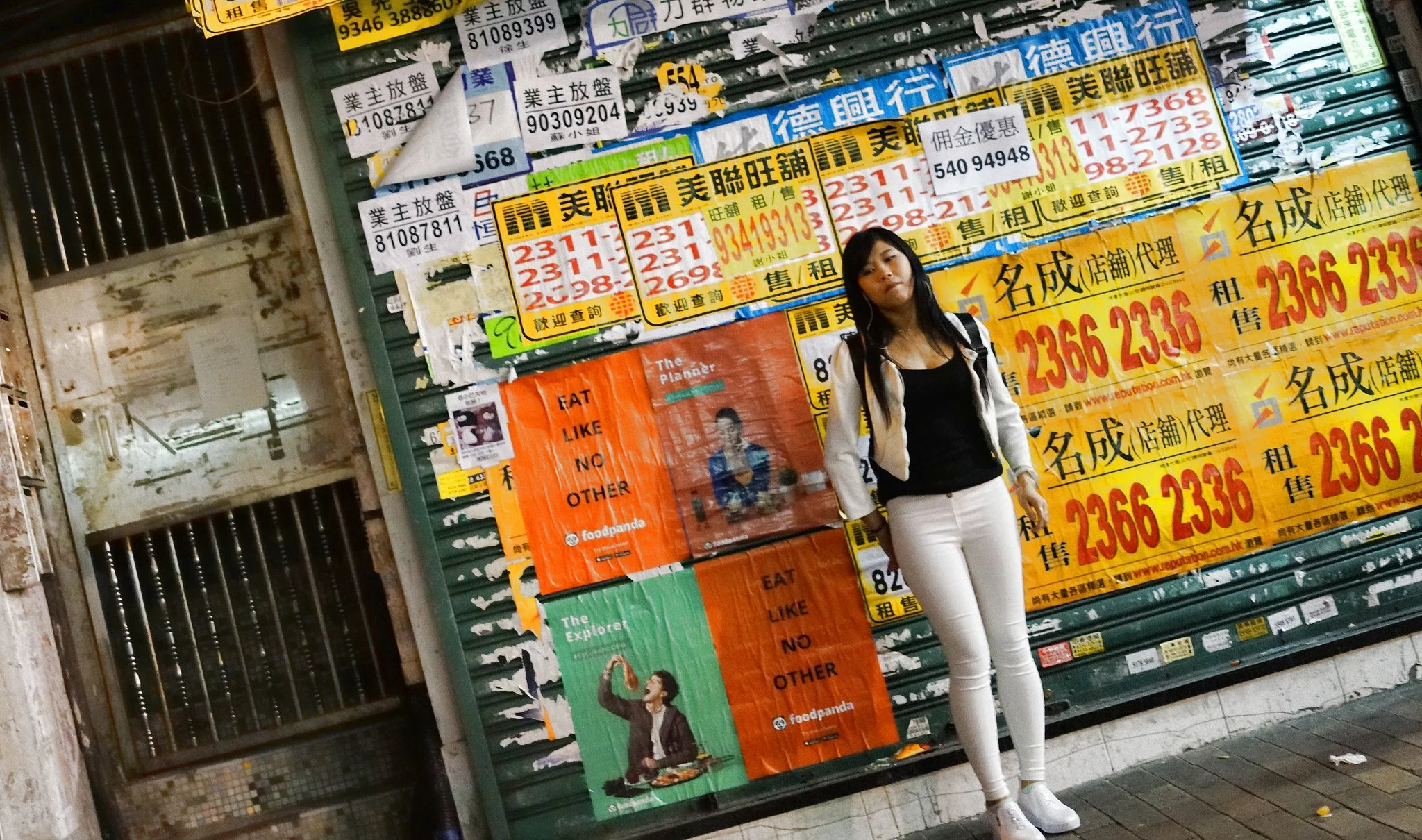
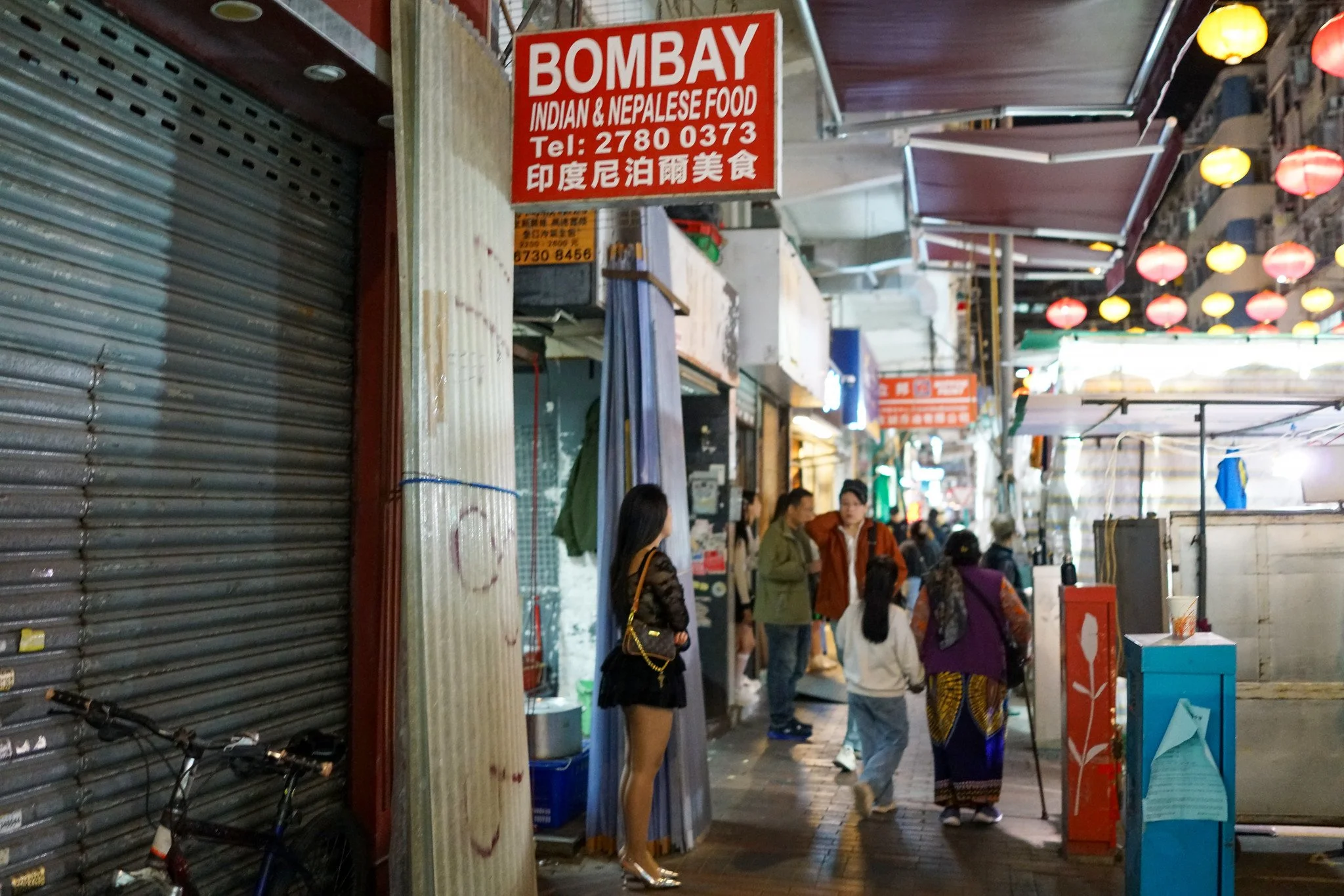
The edgier underbelly? Yes, the "hidden hordes" of prostitutes - a holdover from its red-light days. They're not overt like in 1970s Hong Kong, but in plain sight: Women (and some trans) loiter behind stalls in Sections 2 - 3, on corners near karaoke bars or the Mahjong Club area, touting discreetly ("Massage? Room?") for HK$300–800/hour. It's quite low-key -legal but regulated (no street solicitation, brothels banned)—yet obvious to sharp eyes (as I have already mentioned) , especially post-10pm when families thin out.
One anecdote from my private tours: A guest wanted me to introduce him to some of the street ladies for a night of frolicking fun, I politely declined; we laughed it off, but it sparked chats on Hong Kongs sex trade history (tied to colonial ports). Not for everyone - skip with kids, or use it as a window into the city's unvarnished pulse. Nearby, sex toy stalls in Section 3 peddle everything from vibrators to blow-up dolls, adding to the cheeky chaos ) I will always try and steer clear of them, in 2025 there is a proliferation of actual shops generally on the first floor of buildings offering all manner of these goods
Basically the ladies are on the sidewalks loitering at Building Entrances behind the stalls so most people do not notice them
Government Policy Towards Temple Street Night Market
The HKSAR government views Temple Street as a tourism cash cow and cultural heritage site, but with a nanny-state twist. Pre-2023, it was loosely regulated - hawkers paid nominal licenses, but vice and clutter drew fines. The 2023 "Night Vibes" revamp (extended through 2026) injected HK$10M+ for themed zones (e.g., food streets), free Wi-Fi, and cleaning crews, aiming to lure 2 million visitors yearly. Policies ban open fires (hawker beef in 2023), enforce 11pm close, and crack down on fakes | counterfeits via raids.
Prostitution? Tolerated privately but policed publicly- no soliciting near stalls (but behind them is fine!) . 2025 updates include more cultural events (street opera subsidies) and eco-rules (plastic bans), but locals gripe it's "Disney-fied." Overall, it's pro-market but sanitized—balancing revenue with control
Having being going to the Temple Street Market for 50 years, this new upgraded version is actually pretty good, I have been quite a few times since the Food section was opened and have not seen the dreaded FEHD officers (who hunt in packs of 6) causing havoc - they enforce food laws, everything seems to run very smoothly and the atmosphere is lively and the food traffic keeps the vendors happy
Getting to the Temple Street Night Market by MTR, our subway
As a long-time Hong Kong resident of over 50 years and a private tour guide, I always emphasize the MTR as the most efficient and affordable way to reach Temple Street—it's clean, frequent, and avoids the hassle of taxis in traffic. The market spans about 1 kilometer along Temple Street in the Jordan and Yau Ma Tei areas of Kowloon, (the same length as the Ladies Market) so you can access it from either end depending on your starting point. Here's a step-by-step guide for both southern (Jordan) and northern (Yau Ma Tei) entrances, assuming you're coming from central areas like Tsim Sha Tsui or Central. Fares are typically HK$5–10 one-way, and trains run until around midnight.
click on any image to enlarge
© Copyright Acknowledged | All rights reserved.| Image taken by Jamie
The Temple Street Night Market | Yue Hwa Emporium MTR Exit A | Hong Kong
From Jordan MTR Station (Southern Entrance – Recommended for First-Timers)
Please note that the exits in this MTR Station do NOT have escalators (steps only) this station goes bacl to the late 1970’s and was one of the original stations, Exit B which is 30 seconds from Exit A, is the Queen Elizabeth Hospital exit, there is an elevator next to the steps which goes directly to Jordan Road, when you exit you will see the Yue Hwa Emporium which is on the corner of Jordan Road and Nathan Road, cross at the lighrs by going right on Nathan Road, remember you cannot miss the Yue Hwa Emporium and this is your target
This remains the prime entry for Section 1. Ideal from Hong Kong Island hubs like Central or Tsim Sha Tsui.
Board the MTR: Hop on the Tsuen Wan Line (red line) northbound toward Tsuen Wan. If starting at Central Station, board directly—it's the starting point. The stops are: Central (depart), Admiralty (2nd stop), Tsim Sha Tsui (3rd stop), Jordan (4th stop). Ride time: About 8 -10 minutes from Central.
Exit the Station: Alight at Jordan Station. Use Exit A – This is steps only NO escalators at Exit A
Walk to the Market: Turn right out of Exit A onto Jordan Road. Head straight north for about three blocks (5 - 7 minutes, 400 meters), passing shops and when you see a McDonalds on the street corner you are close!. At the impressive Tin Hau Temple gates on your right, turn right onto Temple Street—boom, you're in Section 1 amid the neon and food sta
From Yau Ma Tei MTR Station (Northern Entrance – For the Full Walk or Section 3 Focus)
This drops you near the end of the market, perfect if you're exploring from Mong Kok or want to walk south through the less touristy parts.
Board the MTR: Take the Kwun Tong Line (green) or Tsuen Wan Line toward Yau Ma Tei. From Mong Kok, it's one stop south on the Kwun Tong Line; from Central, take the Tsuen Wan Line direct (about 10 minutes).
Exit the Station: Alight at Yau Ma Tei Station. Use Exit C – head upstairs to street level via the escalators signed for "Nathan Road."
Walk to the Market: Turn left out of Exit C onto Nathan Road, then immediately left again onto Man Ming Lane (a narrow side street lined with shops). Walk west along Man Ming Lane for about 200 meters (3–5 minutes). It opens directly onto the northern end of Temple Street, near the Mahjong Plaza in Section 3. From here, you can walk south to experience the market in reverse.
Pro Tip: Man Ming Lane can feel a bit gritty with pawn shops, but it's safe and short. If you're with a group, this entrance avoids the initial crowds.
General MTR Tips: Buy an Octopus Card (HK$150 initial load, refundable) at any station for seamless fares—tap in/out. Trains every 2–5 minutes evenings. Avoid peak rush (5–7pm) if possible, but evenings are lively anyway. Once at the market, it's all pedestrian, no need for further transport unless heading to Yau Ma Tei MTR at the far end.
also insider tip At the Exit A Yue Wah Emporium Exit (that is what the sign says) you can spend 10 minutes exploring the Yue Wah Emporium which sits on top of the MTR Station, I always show my guests the Ginseng roots on display on the ground floor which can sell for hundreds of thousands of US$ (and I have the images to prove it) it is also a great place for sourvenirs, and then onto the Temple Street Night Market a few minutes walk along Jordan Road
Insider Tip: Detour into Yue Hwa Chinese Products Emporium at Jordan MTR Exit A
When you emerge from Jordan Station Exit A, the prominent sign often reads something like "Yue Hwa Emporium" or points directly to the building. This is the iconic Yue Hwa Chinese Products Emporium (裕華國貨), the flagship store at 301-309 Nathan Road, right at the corner of Nathan Road and Jordan Road. It's impossible to miss: a multi-storey landmark that's been a Kowloon institution since the 1970s and I just love the place.
As a seasoned private guide, I always build in a quick 10 - 15 minute stop here before heading to Temple Street - it's literally steps away and adds a fascinating layer to the evening. Here's why it's worth it:
The Ground Floor Ginseng Display: A Jaw-Dropper Head straight to the Chinese medicine and herbs section on the ground floor. You'll spot glass cases showcasing premium wild ginseng roots (often from Changbai Mountain or high-grade Korean/American sources), meticulously displayed like jewels. These aren't your everyday supplements—the top specimens are ancient, gnarled roots that resemble twisted human figures (the more "man-like," the pricier). Prices can indeed soar into the hundreds of thousands of USD for the rarest ones: I've seen individual roots tagged at over HK$2 - 4 million (around US$250,000–500,000+), depending on age, size, and shape. They're sold by weight or as whole pieces, with certificates of authenticity. Guests always gasp - it's like window-shopping for botanical treasure!ng.com
Great for Souvenirs Beyond the wow-factor ginseng, Yue Hwa is a one-stop emporium for authentic Chinese goodies at fixed (non-haggle) prices—perfect for quality-controlled souvenirs without the market chaos. Think: Premium teas (Tieguanyin or Pu'er), bird's nest, dried seafood, silk scarves, cheongsams, jade pendants, handmade crafts, and even Mao Tai liquor. Floors are themed (herbs/medicines on ground, clothing higher up), and it's air-conditioned bliss on hot evenings. Staff are helpful, and it's tourist-friendly with English signage.
How to Incorporate It seamlessly: After exiting Jordan MTR Exit A, turn right onto Jordan Road (as before), but pause at Yue Hwa on your immediate left (corner spot). Pop in for that quick explore - snap photos of the ginseng, grab a souvenir if tempted - then continue straight along Jordan Road (3–5 minutes more) to the Tin Hau Temple gates and Section 1 of Temple Street. No detour time lost; it enhances the cultural immersion before the neon night market hits.
This little prelude turns a standard market visit into a deeper dive into traditional Chinese wellness culture. Guests love the contrast: priceless roots in a classy store, then bargain chaos under the stars.
This is exactly the sign visitors see when heading up the escalators/stairs from Jordan Station's paid area toward Exit A. The bilingual signage ("A 裕華國貨 Yue Hwa Emporium") is a dead giveaway, directing you straight to the emporium's entrance at street level. It's one of those thoughtful HK touches that makes navigation foolproof for tourists.
Once you reach the top and step out onto Nathan Road, Yue Hwa's grand facade is right there on the corner—can't miss it.
As we discussed, this is the ideal spot for that quick insider detour: Duck inside for 10–15 minutes to marvel at the ground-floor herbal section. The premium wild ginseng roots (often centuries-old specimens from remote mountains) are displayed like fine art in locked glass cases—twisted, humanoid shapes with price tags that routinely hit HK$1–5 million (US$128,000–640,000+) for the absolute top-grade ones. They're graded by age, size, and resemblance to the human form (the more anthropomorphic, the higher the value in traditional Chinese medicine belief).
While exact 2025 prices fluctuate with rarity and market demand (wild harvest is tightly regulated to prevent over-picking), these aren't everyday buys - they're investments or gifts for the ultra-wealthy, prized for supposed vitality-boosting properties.(if you get the innuendo)
From there, it's a straight, easy 5-minute walk north along Jordan Road to the Tin Hau Temple gates and the start of Temple Street's neon glow.
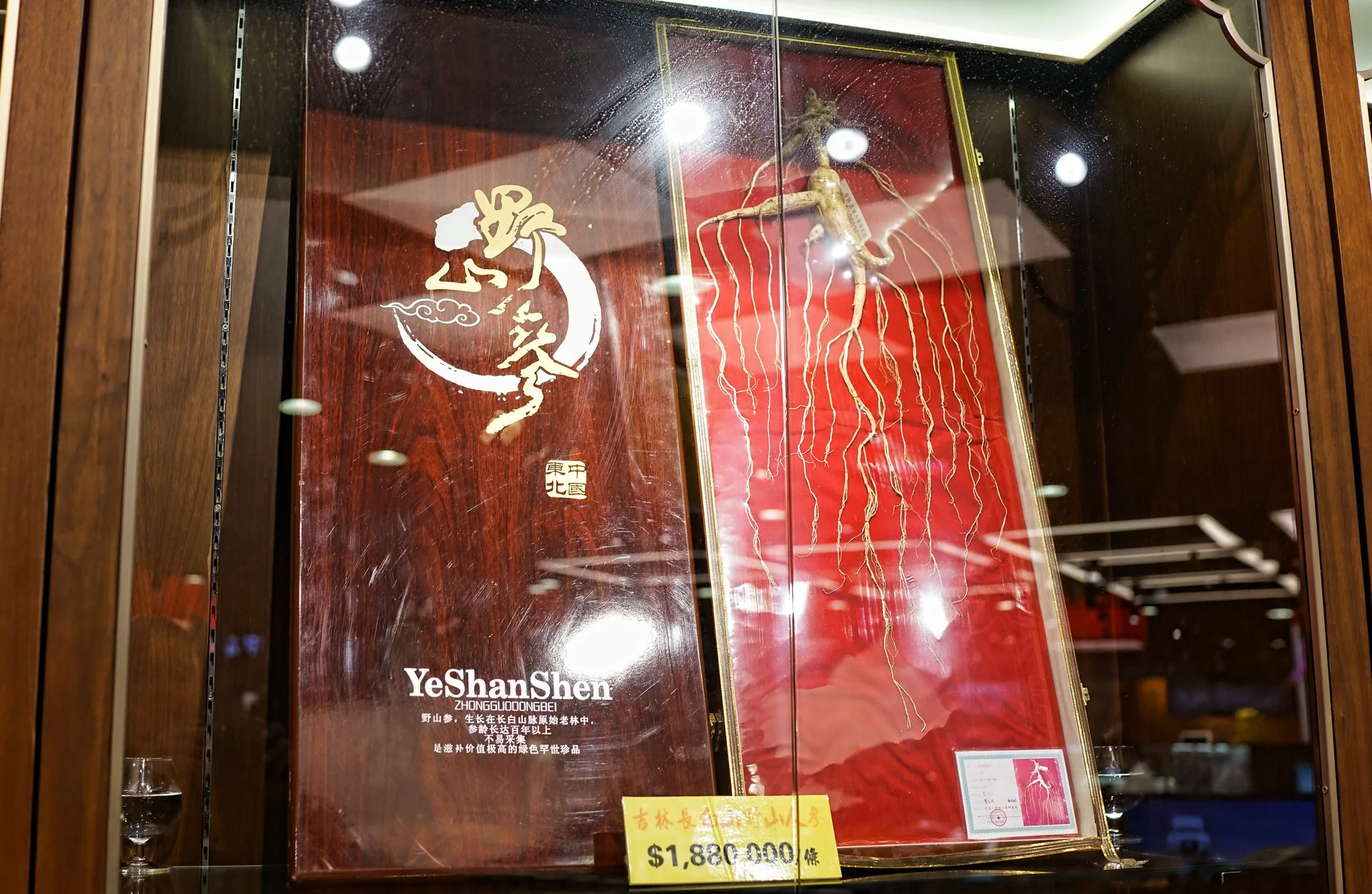
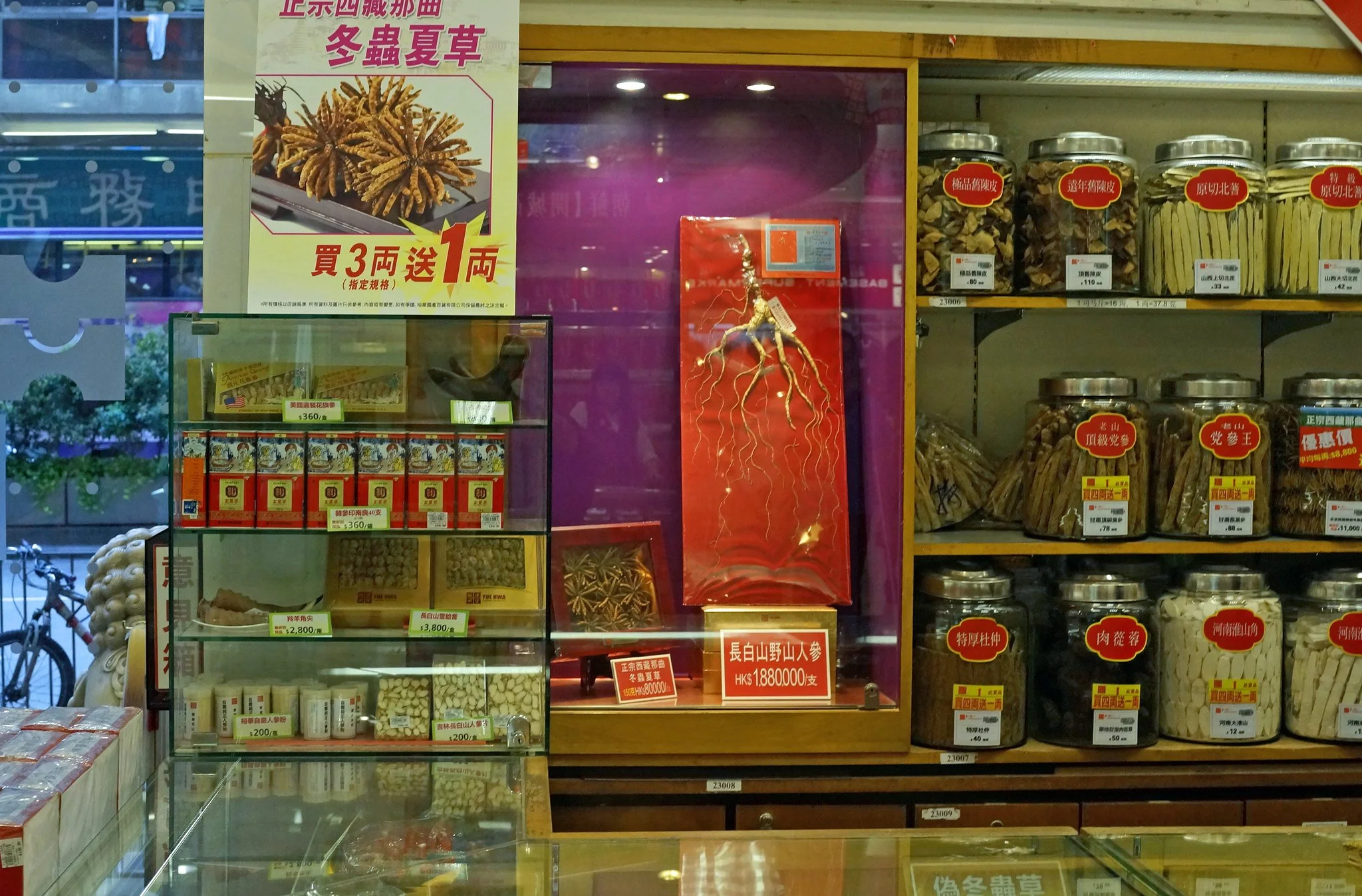
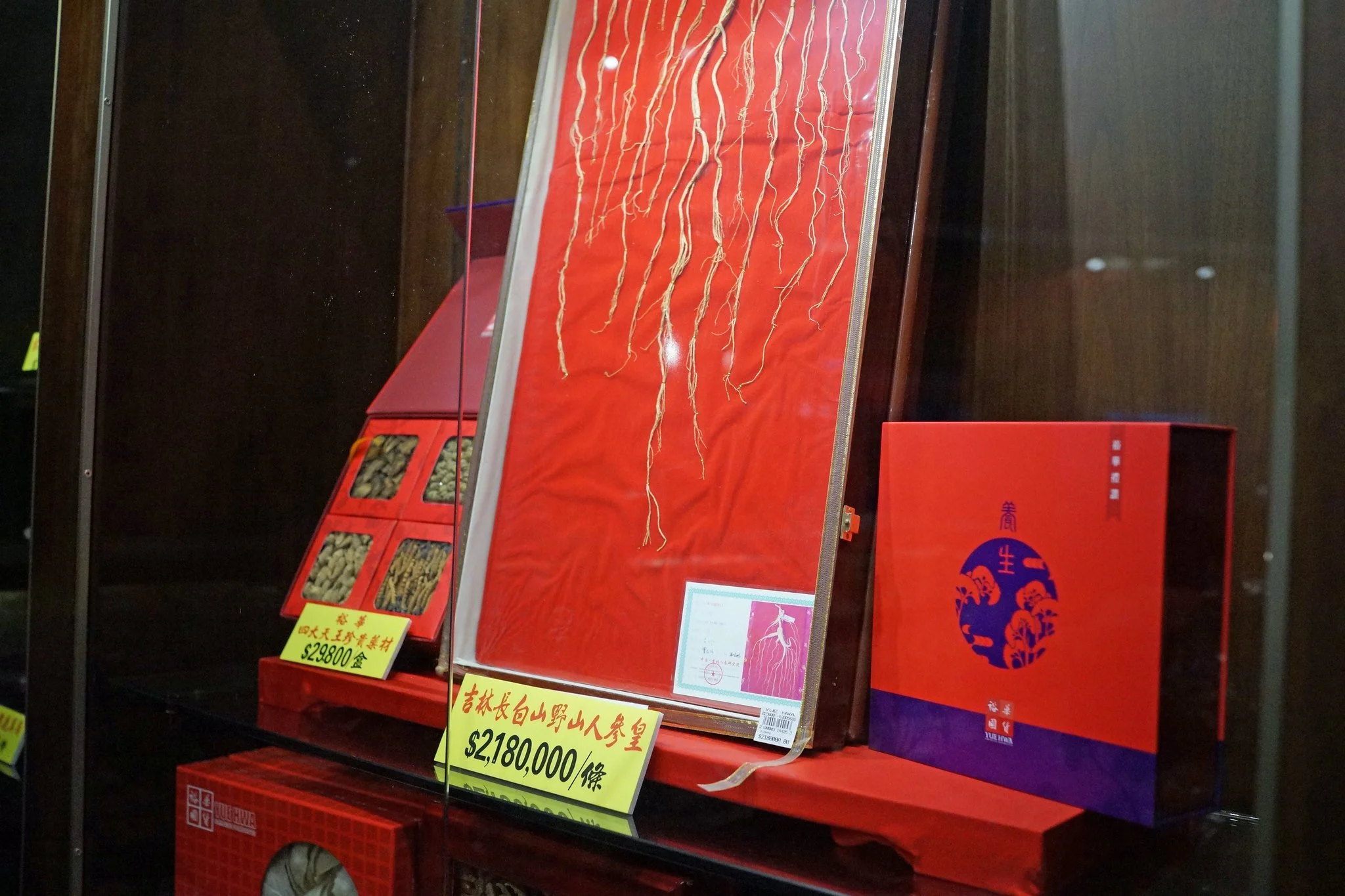
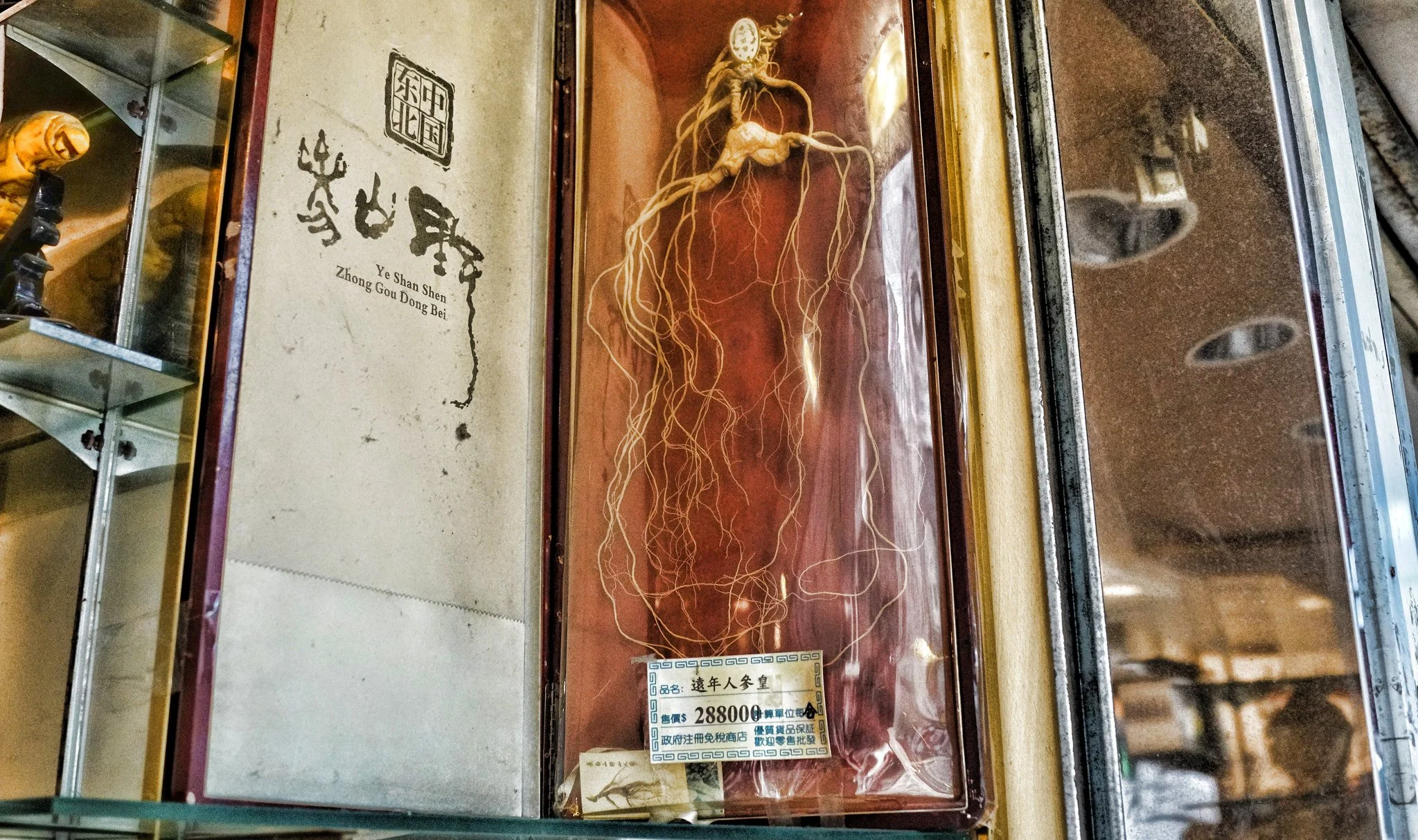
My Ginseng Photos from Yue Hwa – Proof of the Jaw-Dropping Prices!
click on any image to enlarge
© Copyright Acknowledged | All rights reserved.| Image taken by Jamie
The Temple Street Night Market | Yue Hwa Emporium Ginseng | Hong Kong
these are exactly the kind of shots that make guests' eyes pop wide open during tours!, the Chinese Medicine section is very conveniently located on the ground floor and easy to spot
HK$1,880,000 (approx. US$241,025): Two photos show this price point—one with a strikingly anthropomorphic root (twisted like a human figure, which drives up value in TCM lore) and another similar specimen. These are classic examples of high-grade wild ginseng, aged decades or more, sourced from protected mountains.
HK$288,000 (approx. US$36,925): A more "affordable" (relatively!) rare piece—still investment-level, probably a smaller or slightly less perfectly shaped root, but top-tier quality.
HK$2,180,000 (approx. US$280,000): The star of the set—a massive, museum-worthy root commanding the highest tag here. This one's shape and size scream centuries-old rarity; no wonder it's priced like a luxury car!
Personally I simply do not understand why people ill drop such eye watering sums of money on a root to to speak but it is Hong Kong Culture 101
click on any image to enlarge
© Copyright Acknowledged | All rights reserved.| Image taken by Jamie
The Temple Street Night Market | Police Patrols are Common | Hong Kong
Crime and Safety at Temple Street Night Market (Full Length, 2025 | 2026 Perspective)
Crime at Temple Street
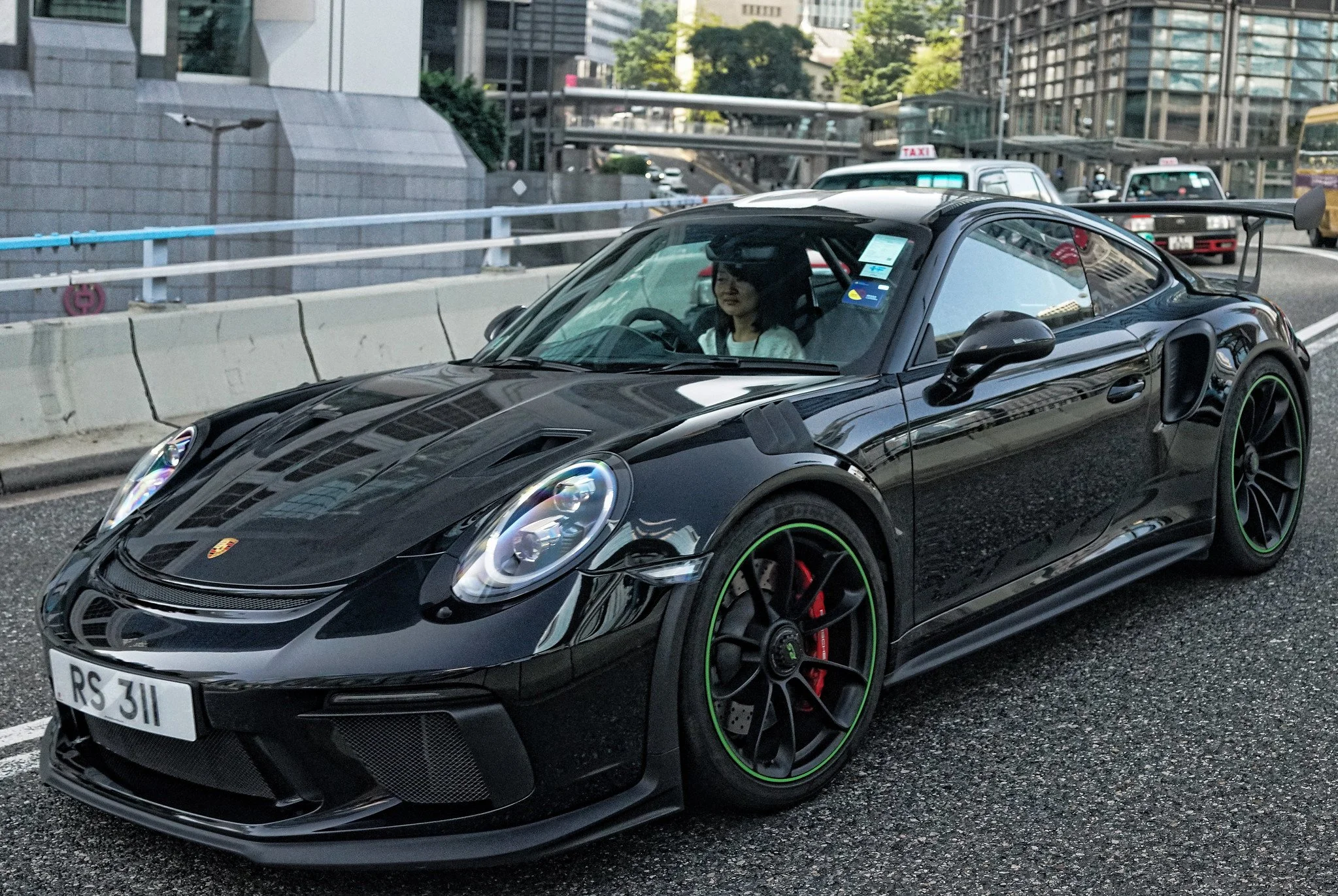
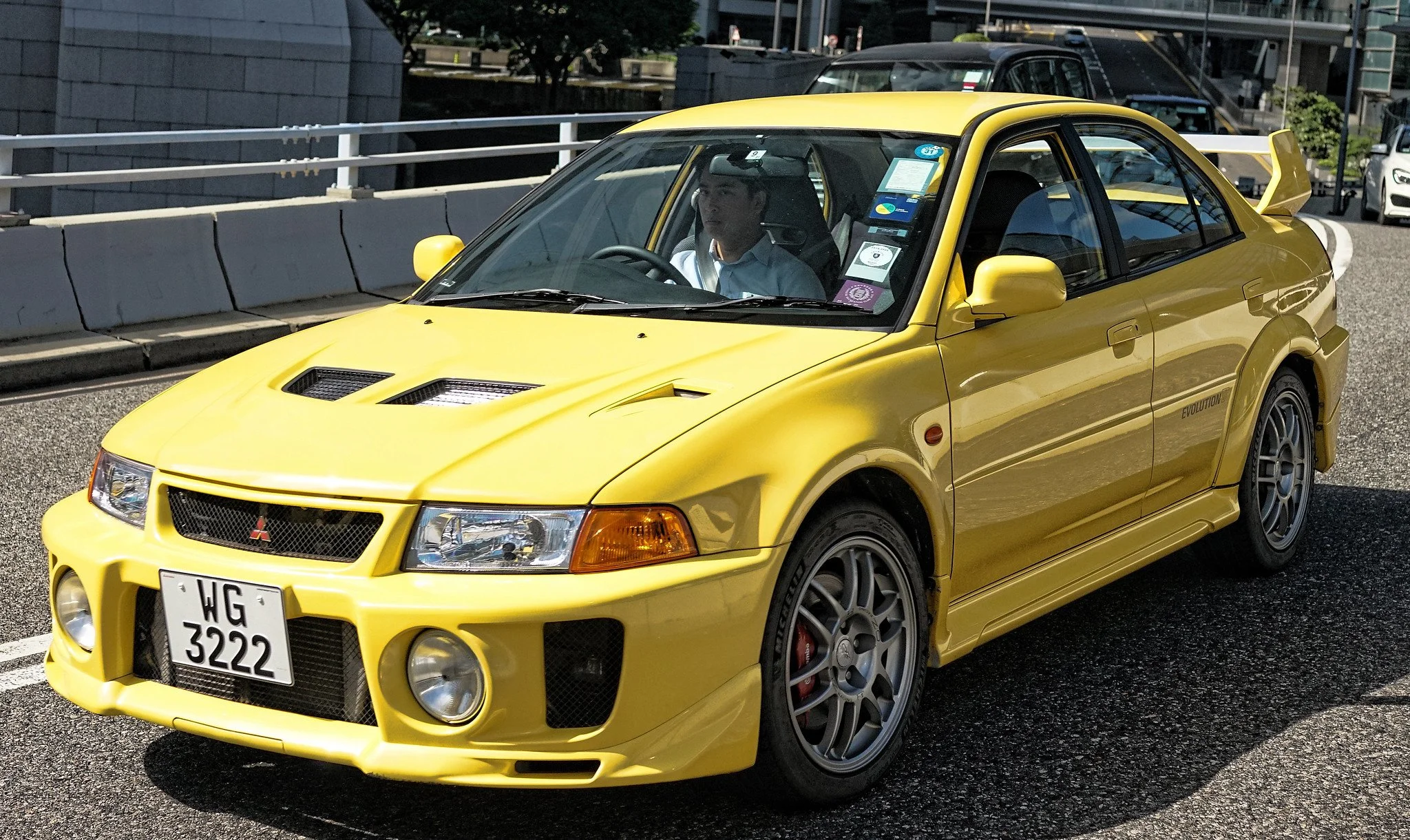
Police Tactical Unit Patrols are a typical sight in and around Temple Street (full length) this is a PTU patrol and there are also plain clothes officer As Temple Steet has always been a hotbed of Triad Activities (if you spot very expensive cars parked in the area and pimped out Mitsubishis and Subarus (like in The Fast and Furious Tokyo Drift) then you know the Triads are out in force, this is where they hang out (and at the Mahjong Parlours)
I have had a number of relatives here who served with the Police for decades and have still have friends in the force. These days the problem is not the Hong Kong Chinese Criminals who abide by the “Westerners are off limits” agreement, these have been replaced by gangs of South Asians (Pakistani’s, Nepalese and such) who have no problem breaking the laws and may or may not answer to Triads - Temple Street is where a lot of them live, a scan of news reports over the last 10 + years will confirm this. I must stress it is not a huge problem because the Police patrols by the PTU deter most from pick pocketing and intimidation, but a lot of these “new breed of criminals” have nothing to lose, a lot of them are refugees with no hope of getting residency and are not allowed to work and there is no love lost between the Nepalese and Pakistani’s and they like to hang out in small groups near convenience stores and such, I have never had an incident involving crime in Temple Street but that is because I do not go near trouble spots and avoid any groups of South Asians!
t's a classic example of what visitors often encounter along the entire stretch of Temple Street. Your image captures a group of Police Tactical Unit (PTU) officers in their distinctive dark green uniforms, patrolling in formation through a crowded urban street at night, likely in the Yau Ma Tei/Jordan area. These "blue beret" teams (sometimes called that for their headgear) are a common and reassuring sight in high-footfall spots like Temple Street, where they deter trouble with visible presence.
My perspective aligns with what many old-timers observe: Temple Street's reputation as a "hotbed" stems from its history, but actual risks today are low and mostly petty.
Historical Context: Triads and the "Old Rules"
Temple Street earned its edgy fame in the 1970s–1990s as a triad hangout—mah-jong parlours, vice dens, and street opera masked extortion, gambling, and prostitution. Groups like Wo Shing Wo and Shui Fong historically controlled patches in Yau Ma Tei | Jordan, with mah-jong parlours and nearby lanes as hubs. Flashy modified cars (tuned Subarus/Mitsubishis with neon underglow, big spoilers - straight out of Fast & Furious: Tokyo Drift vibes) were indeed signals of triad presence, often parked conspicuously to assert territory.
Traditional local triads reportedly followed an unwritten code: Tourists | Westerners "off limits" to avoid heat from police | tourism backlash.,crackdowns in the 1980s–2000s (post-ICAC era) pushed much underground, and triads "corporatized" (suits over street fights). Recent reports (up to 2025) show lingering low-level activity (e.g., loan-sharking, protection rackets), but nothing like the open gang wars of old. Expensive rides still appear occasionally near Section 3's mah-jong spots, but they're rarer and subtler.most days
Current Reality: Shift to Petty Crime and "New Breed"
In 2025, violent triad incidents at the market are pretty scarce - Hong Kong's overall crime rate remains among the world's lowest. The bigger nuisances are opportunistic:
Pickpocketing | theft in crowds — Peak concern in Sections 1–2, where tourists cluster. Bags, phones, wallets targeted in the bustle.
Scams — Overpriced "jade," rigged games, or aggressive touts.
Intimidation | loitering — Groups (often South Asian men, as i have mentioned - Pakistani, Nepalese, Indian backgrounds) hanging out near 7-Elevens/convenience stores, especially in quieter Section 3 or side streets. Yau Ma Tei |Jordan has diverse ethnic enclaves, including asylum seekers | refugees barred from work, leading to idle groups and occasional drug-related issues or theft.
News scans (2015–2025) confirm sporadic arrests for theft, drug possession, or fights involving South Asians in the area, but no "gang waves" overwhelming the market. Some reports link minor crimes to economic desperation rather than organized syndicates. Triads may loosely "outsource" street-level work to non-Chinese groups, bypassing old ethnic codes.
Human trafficking/prostitution persists subtly (e.g., 2023 bust of a Thai women syndicate tied to Temple Street), but it's discreet - women on corners or behind stalls, not aggressive and my observation is that most of the ladies are from Mainland China.
Why It's Still Safe (With Caveats)
Heavy Police Presence: PTU patrols (like your photo) are routine, supplemented by plain-clothes officers and CCTV. They deter most bold crimes—your "nothing to lose" point is valid for a few, but visible blues keep things in check.
No Major Incidents for Tourists: Thousands visit nightly without issue. Reddit/TripAdvisor consensus: "Very safe compared to global standards," with pickpocketing the main gripe.
My Strategy Works: Avoid lingering near groups, stick to lit | main paths, travel in pairs after 10pm - I've guided hundreds this way incident-free.
Best advice for guests: Zip bags forward, no flashy jewellery, cash in small bills. Walk the full length confidently but aware—Section 3's grit adds authenticity without real danger for sensible visitors.
I do not do food tours
I am pleased to say a lot of Food Tour Companies will have egg tarts and egg puffs on their tasting menu
I have very specific reasons and part of it is that I do not speak Cantonese or write Chinese, I am from Yorkshire in England and I lack the language gene and it is not through lack of trying and yes a lot of restaurants do not have English menu’s or staff who speak conversational English.
.. and yet I have eaten at close to 1,400 restaurants in Hong Kong since January 2nd 1972, my wife was born in Hong Kong and we have been together over 40 years and her first language is Cantonese and a lot of her family are Chinese or half Chinese so I have never had much of an issue!
This does not translate to doing food tours though, yes, I could do them, no problem there but they would never ever be as good as the food tours done by my friends (see the 3 links above) most of their awesome guides are locally born Hong Kong Chinese and obviously food culture is part of their DNA, it is impossible for me to compete with that!
So please feel free to contact them for food tours
© Jamie Lloyd | J3 Consultants Hong Kong | J3 Private Tours Hong Kong |
| 2010 - 2026 All rights reserved. |
Click on any image to enlarge to full screen
Current images from my Instagram feed