10 Things you did not know about The Mid Levels Escalator in Hong Kong
How Hong Kong Turned a Steep Hill into a Free Commute

The J3 Group - Premium Quality Private Tours | Experiences and Insider Chats since 2010
Me Jamie, your host, I am English and I have lived in Hong Kong since January 2nd 1972 - I know the place.
A meaningful blog post with a difference - tips on Travel, Tourism, Tours, Daily Life and my personal thoughts on Hong Kong.
Please do visit Amazing Hong Kong
Hong Kong | Pearl of the Orient
Customised Private Tours + Experiences in Amazing Hong Kong
Jamie has lived in Hong Kong - Pearl of the Orient for 50+ years
Carefully Crafted Personalised and Customised Itineraries by Jamie | Hong Kong’s Most Experienced Private Tour Guide for : Solo Travellers Friends Families Seniors Couples Business People MICE Delegates.
Private Tours Cultural Tours Walking Tours Sightseeing Tours City Tours Night Tours Layover Tours Transit Tours Private Shore Excursions Bespoke Tours Personalised Tours Jewish Heritage Tours Luxury Private Tours Day Tours Luxury Boat Tours Themed Tours Private Family Tours Private Day Tours Corporate Tours
Just you, your family or friends and Jamie your personal English private tour guide - over 2,400+ tours completed since 2011 - Jamie offers quality Private Tours of Hong Kong
Tour Group Size 1 - 6 people only
J3 Group Hong Kong | J3 Consultants Hong Kong | J3 Private Tours Hong Kong
Creating Memories That Will Last A Lifetime
Go here for the Hong Kong Michelin Restaurant Guide which includes the Bib Gourmand Category

A Resident since 1972 - Private Tours of Hong Kong with Jamie
The Best Things to do in Hong Kong
click on the image to enlarge
© Copyright Acknowledged | All rights reserved | image taken by Jamie
The Mid Levels Escalator | Free Public Transport | Hong Kong
Foreword by Jamie
10 Things You Did Not Know about The Mid Levels Escalator in Hong Kong
Walk up 782 steps or very steep streets or use the Mid Levels Escalator - a pretty easy decision!
The Central–Mid-Levels Escalator has been part of daily Hong Kong life for more than three decades now. What began as a practical answer to steep hills and clogged roads has become something far more interesting - a covered ribbon of moving walkways that threads through old streets, past markets, temples and restaurants, carrying locals to work and visitors on an unplanned tour of the city’s mid-slope character. It is free, it is long, it is one-way for most of the day, and it still manages to surprise people who think they already know it. After travelling the full length many thousands of times since the day it opened, the quirks and practical realities become clearer with every ride. Here are ten solid points that dig a little deeper than the usual tourist blurb and online travel magazines fluff pieces.
1. The complete history of The Mid Levels Escalator from idea to opening
The idea first surfaced in the early 1980s when the government realised that a large share of the east-west traffic jams in Central actually came from people trying to move north-south up and down the steep hillside. Building proper roads straight up the slope was impossible in many places. Talk at the time included escalators, a monorail or even a cable-car system. In late 1982 consultants Peter Y.S. Pun and Associates together with MVA Asia were asked to study transport needs between Mid-Levels and Central. Their report recommended an “escalator-assisted pedestrian route” linking Mid-Levels to the existing elevated walkway system and a proposed bus terminus near Central Market. The idea was well received by residents.
Detailed design work was later handed to Maunsell Consultants Asia. The Executive Council approved the project on 16th March 1990. Construction started at the end of February 1991 under a joint venture between Hong Kong contractor Paul Y. – ITC Construction and the French firm Sogen. The work took roughly two and a half years. The system opened to the public at 6:00 am on 15th October 1993 (some contemporary reports put the first day of service around 10th or 11th October, yes they could have been test runs). Original cost estimates sat near HK$100 million; the final bill climbed to somewhere between HK$240 million and HK$253 million - roughly six times the early figure - after repeated revisions for difficult ground conditions, land issues and integration with existing buildings.
2. Ownership of The Mid Levels Escalator
The Central–Mid-Levels Escalator and Walkway System is owned by the Hong Kong Government of the Hong Kong Special Administrative Region. It was built as a public works project under the Highways Department and remains a Hong Kong Government asset.
3. Day-to-day operation of The Mid Levels Escalator
Day-to-day management, operation and maintenance sit with the Electrical and Mechanical Services Department (EMSD). EMSD monitors the system from a control room near Caine Road. Since 2014 the department has contracted out the actual management, operation and maintenance work to private companies under successive multi-year contracts. The system is equipped with dozens of CCTV cameras, a public-address system with roughly 200 speakers, and variable-message signs so staff can keep an eye on flow and respond quickly to any stoppages.
4. The exact route of The Mid Levels Escalator
The system begins at the lower end near Queen’s Road Central | Des Voeux Road Central, connecting through the Central Market building and elevated walkways into the Central Elevated Walkway network. From there it climbs primarily along Cochrane Street and then Shelley Street, crossing a succession of narrow streets - Wellington Street, Gage Street, Lyndhurst Terrace, Hollywood Road, Staunton Street, Elgin Street, Caine Road, Mosque Street, Robinson Road - before finishing at Conduit Road in the Mid-Levels, just below Victoria Peak. There are multiple entrances and exits along the way so people can hop on or off at many points rather than riding the entire length.
5. Was there one driving force behind The Mid Levels Escalator?
No single citizen or company can claim the idea as a personal brainwave. It was a Government response to traffic studies. The consultants’ 1982 report put the escalator concept firmly on the table, and the Highways Department then drove the detailed design and construction. Mid-Levels residents supported the proposal, but the project itself was a classic top-down public-works decision rather than the vision of one individual.
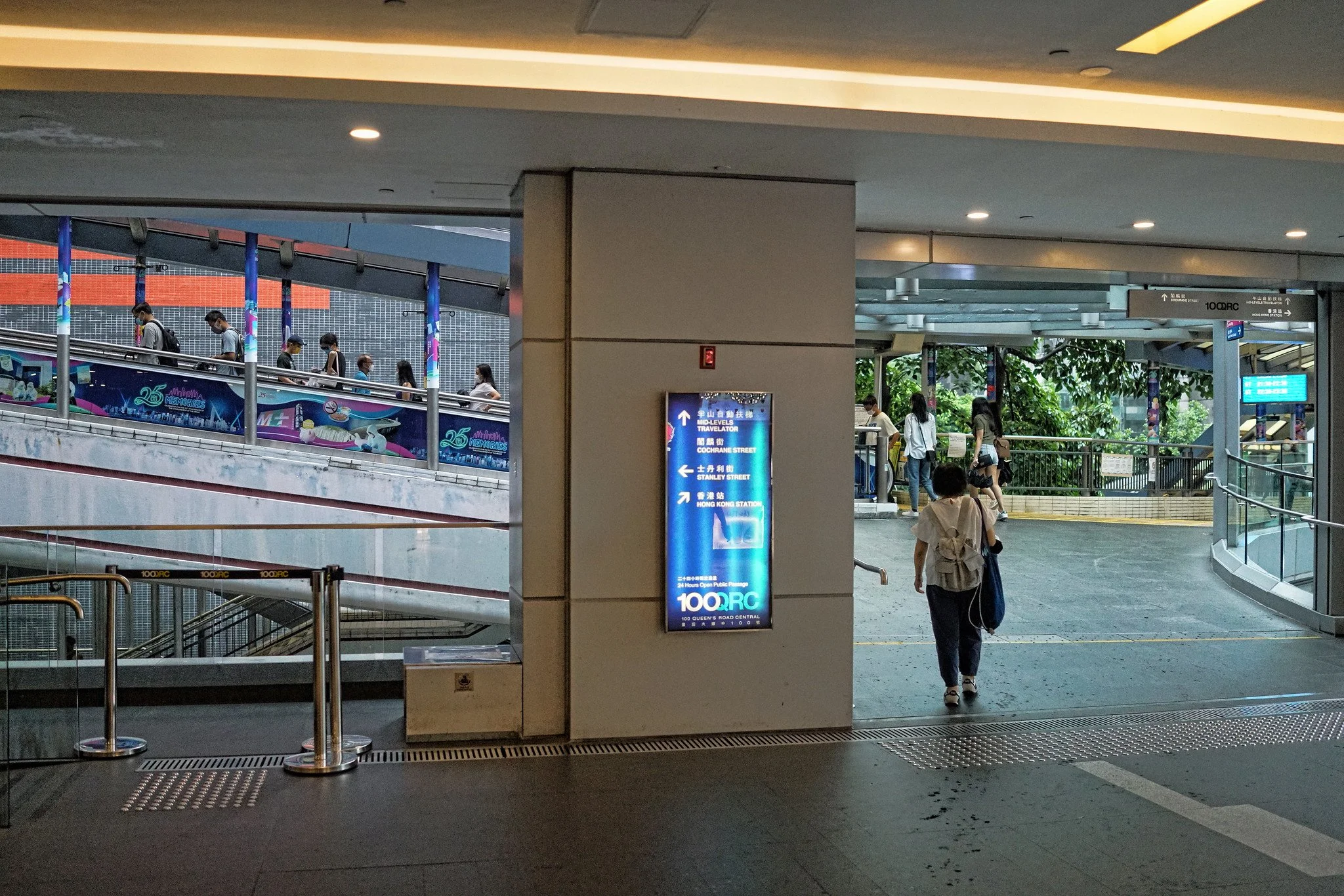
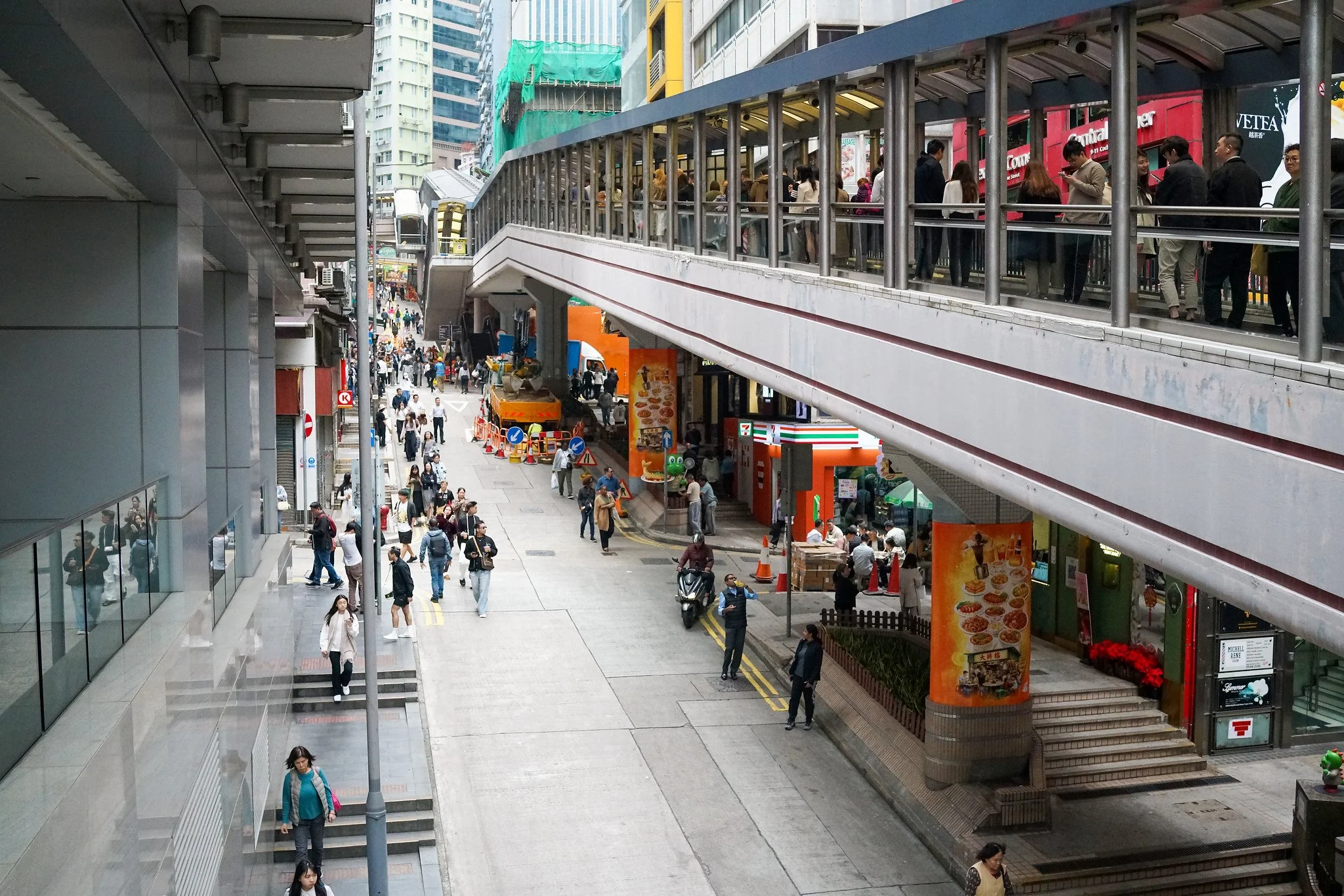
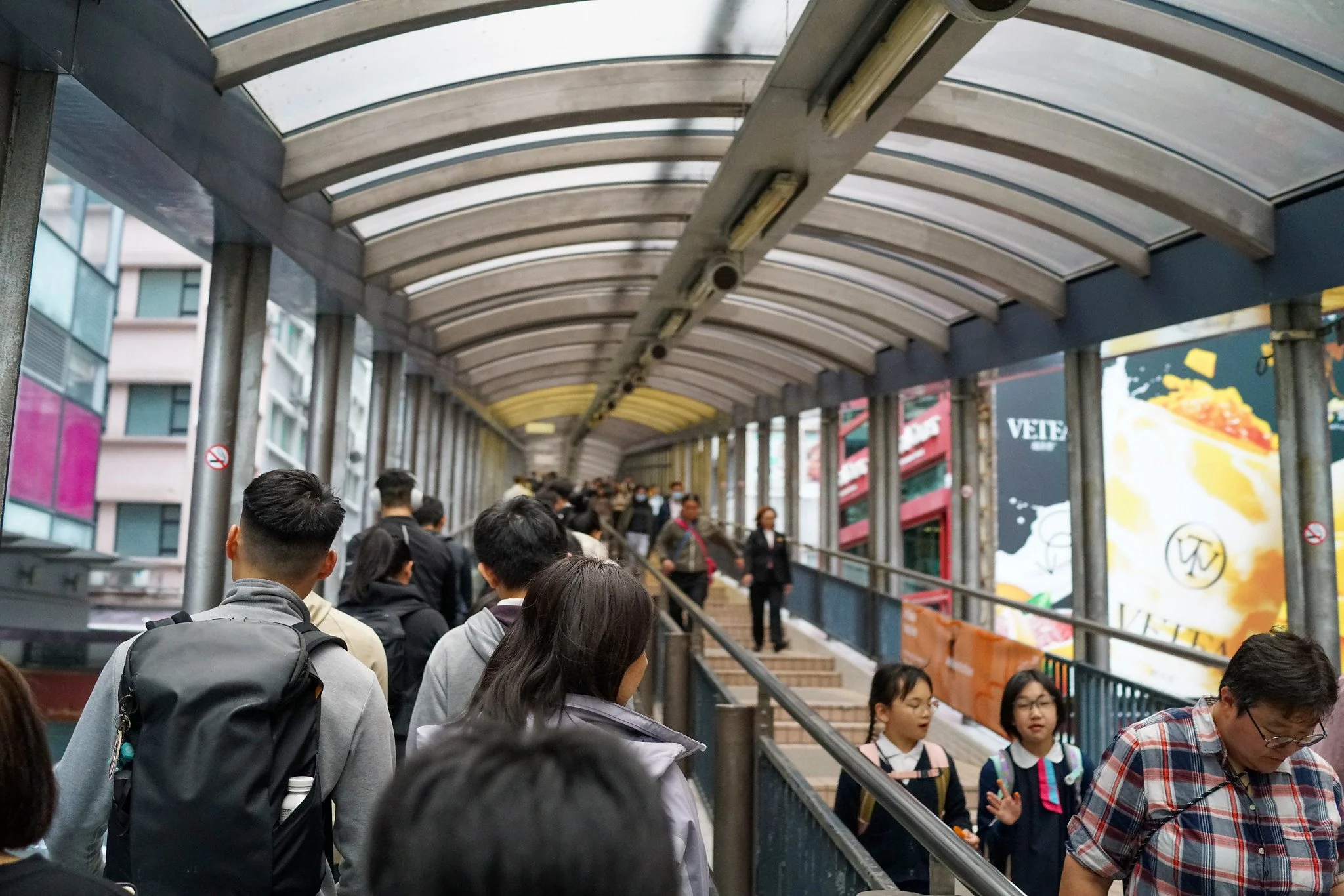
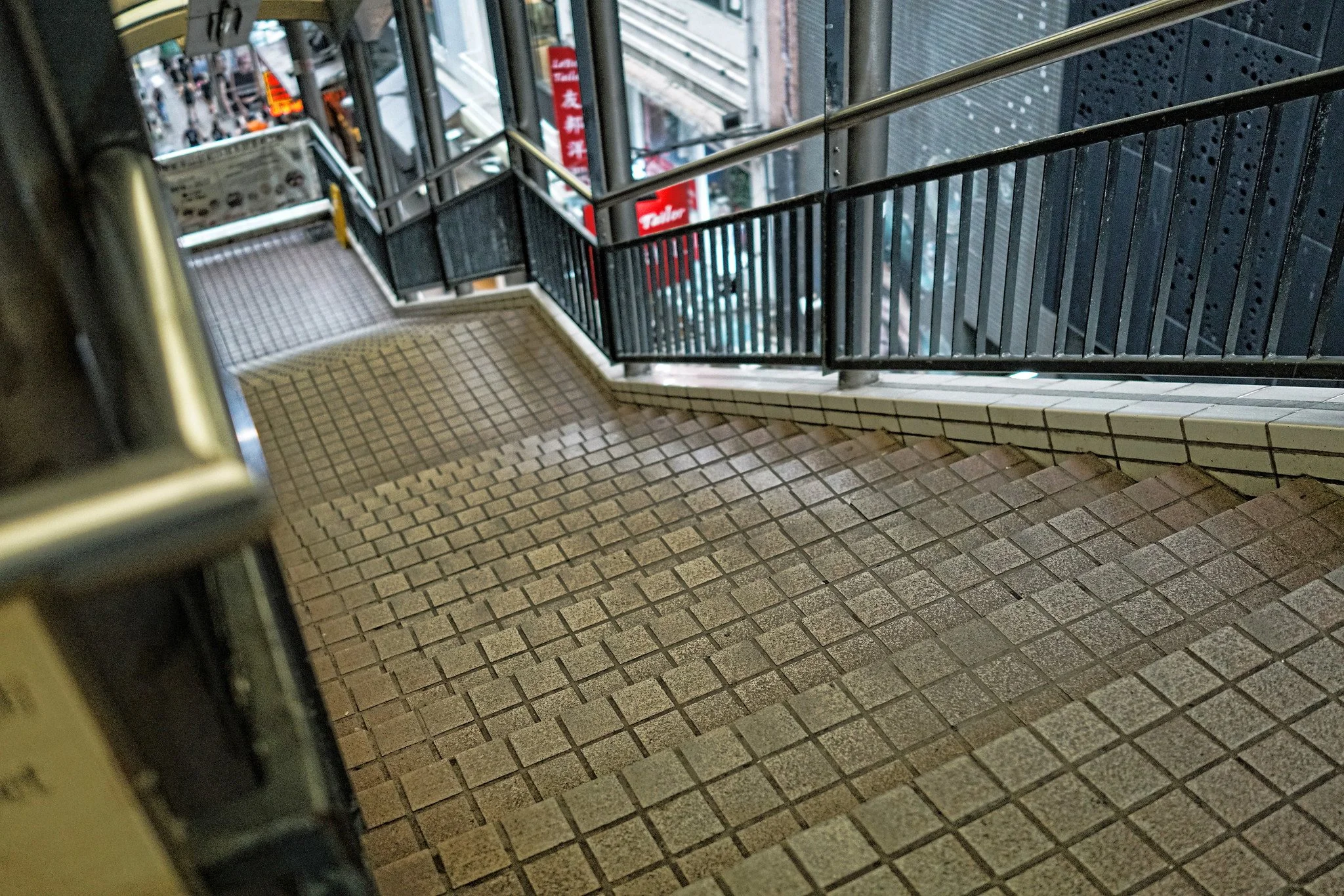
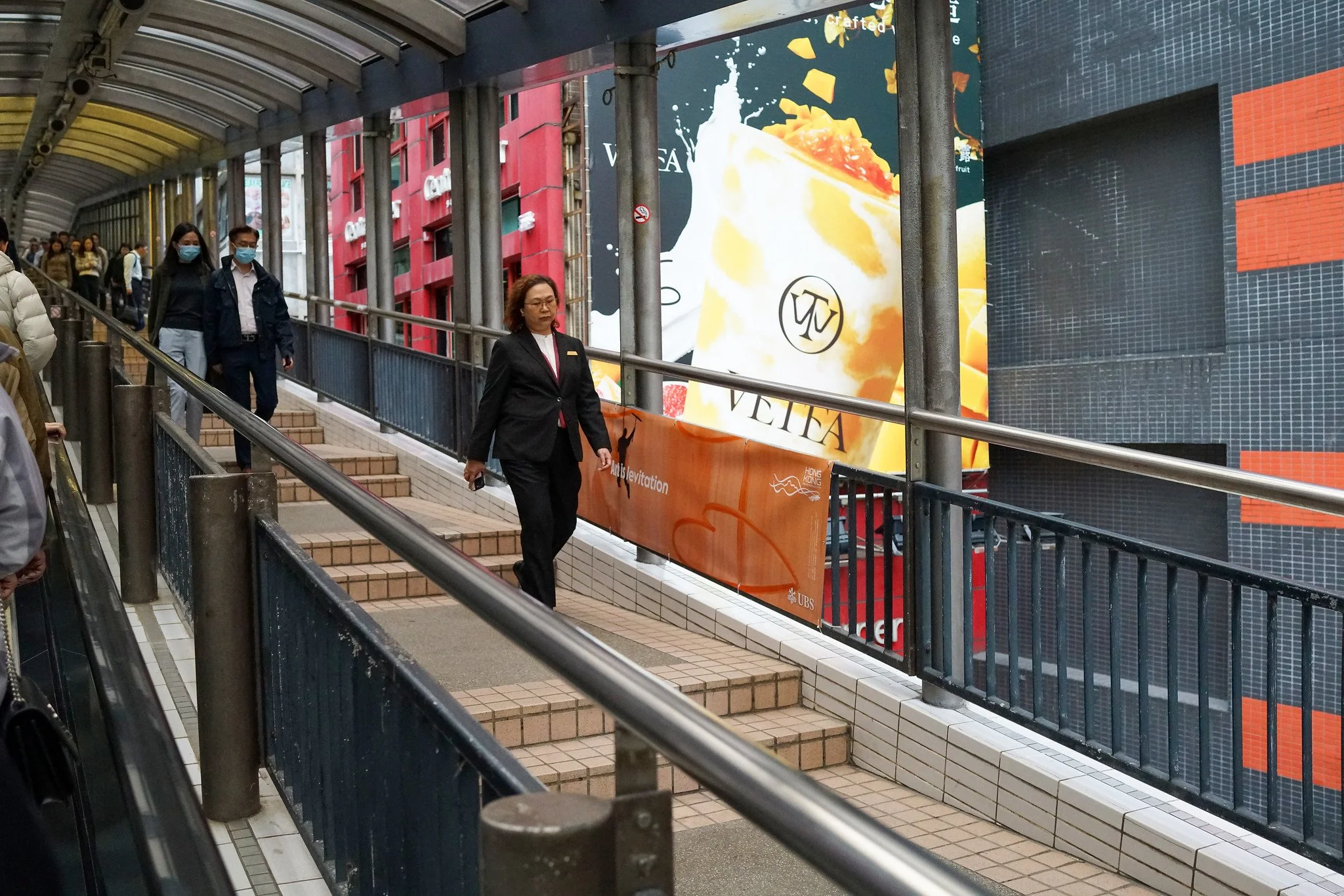
click on any image to enlarge
© Copyright Acknowledged | All rights reserved | images taken by Jamie
The Mid Levels Escalator | Free Public Transport | Hong Kong
6. Actual length of The Mid Levels Escalator
The system covers a little over 800 metres in length and rises more than 135 metres in elevation from bottom to top. That combination of distance and height is what earned it the title of the world’s longest outdoor covered escalator system and to be honest it actually feels longer than that
7. Why does The Mid Levels Escalator run uphill most of the day with only a short morning downhill window
Space was apparently the decisive factor. The streets the route follows are narrow and tightly built-up. There simply was not room to install parallel up and down escalators along most of the length. The practical solution was a single reversible system that follows the dominant pedestrian flow. In the morning the flow is downhill as residents head into Central for work, so the escalators run downward from 6:00 am until 10:00 am. After a short pause for the direction change (usually around 10:20 or 10:30 depending on the section), they reverse and run uphill for the rest of the operating day. That matches the return home and leisure traffic later on.
8. Operating hours of The Mid Levels Escalator
The system operates daily from 6:00 am until midnight.
Downhill (Mid-Levels towards Central): 6:00 am – 10:00 am
Uphill (Central towards Mid-Levels): approximately 10:20 | 10:30 am - midnight
Outside those hours the escalators and travelators are stopped.
For the record and based on the fact I have used it thousands of times, it is usually 10.30am before it goes up and generally their quite a crowd of impatient people waiting!
9. Why only one direction and the problems this creates for elderly people, families with strollers and wheelchair users wanting to use The Mid Levels Escalator
The same space constraints that forced the reversible design also explain the lack of a continuous parallel down route. Parallel stairs and ramps do exist beside the escalators, but they are ordinary steps. The full set of parallel stairs between Conduit Road and the Queen’s Road Central footbridge totals roughly 782 steps. That is a long, steep walk for anyone, and it is particularly difficult for older people, parents with pushchairs, or anyone using a wheelchair. Wheelchair users effectively cannot travel the full length in either direction because of the steps at many access points and the single-direction escalators.
A closer look at those parallel steps reveals something interesting. For many sections the steps were clearly built by the government as part of the original project - they sit under the same continuous roof as the escalator itself. In other stretches the system simply relies on pre-existing public steps that were already in place. Importantly, the width of the parallel steps is larger than the escalator in a number of places. In the busiest lower section, from the start of the system up to Hollywood Road, that extra width is especially noticeable. Photographs of these covered sections show wide tiled steps running right beside the escalator under the same canopy, with clear room that could have accommodated a second moving unit heading the opposite way.
It is hard to escape the conclusion that pure space was not the only factor. Cost almost certainly played a significant role. The original project already overran its budget dramatically, finishing at roughly six times the early estimates. Adding a full set of downward escalators would have pushed the price higher still. Looking at the built form today, particularly those wide parallel stair sections under the shared roof, it seems reasonable to say the government of the time knew the physical room existed in key stretches yet chose the cheaper single-direction solution. Times have changed. A similar hillside link planned in the 2020s, with the scale of infrastructure spending now considered normal, would almost certainly include proper up-and-down escalators from the outset. The limitation that still frustrates elderly residents, families with strollers and anyone needing a wheelchair is therefore partly a product of 1980s and early-1990s budgeting decisions as much as of the narrow streets themselves.
This shift in thinking is visible across Hong Kong’s wider transport infrastructure. For decades the standard solution for keeping traffic flowing on major roads was to build pedestrian footbridges, and those bridges almost always came with a steep flight of steps at each end. Getting up and down was simply accepted as the price of crossing. Over the past thirty years government policy has moved on. New footbridges are now routinely fitted with elevators at both ends. An ageing population has clearly played a part in that change, but so has a more practical recognition that even younger people increasingly balk at the idea of climbing fifty steps just to cross a road. A local example near Sham Tseng illustrates the point. A major road system there has a footbridge that sees perhaps only a hundred users a day. A year ago the government agreed to install new elevators at both ends. The work has taken a full year and the lifts are due to open in early August 2026. No one is complaining about the cost. It is simply a sign that common-sense accessibility has become the default expectation rather than an expensive optional extra.
10. The Mid Levels Escalator - Step count, daily patronage and public opinion
The parallel staircases total about 782 steps end to end. This figure is the complete count for the full walking alternative and therefore includes both the purpose-built stairs constructed with the escalator system and any pre-existing public steps that the route incorporates.
So we are clear
The figure of roughly 782 steps is the total count for the full parallel walking route between Conduit Road and the Queen’s Road Central footbridge.
It covers every step a person would take if walking the entire length against the flow of the escalators. That means it includes both:
the purpose-built staircases constructed as part of the escalator project itself (the ones that sit under the same continuous roof as the moving sections), and
any pre-existing public steps that the route simply incorporates or runs alongside.
The 782 is therefore an end-to-end aggregate of the complete alternative path, not a count limited only to the new government-built stairs.
Daily patronage has grown steadily:
Early estimates at opening: around 26,000–27,000 trips
1996: about 34,000
2005: about 54,000
2010: about 85,000
2016: about 78,000
Late 2024 figures: around 99,000 pedestrian trips per day
It remains completely free to use.
Public opinion has shifted over time. Shortly after opening the Director of Audit labelled it a costly “white elephant” because it failed to reduce car traffic in the way planners had hoped. Motorists largely kept driving. Yet the escalator succeeded in other ways. It became a genuine pedestrian artery, relieved pressure on buses and taxis for many residents, and - almost accidentally - helped turn the streets around it into the lively SoHo restaurant and bar district. Locals still rely on it for the daily commute; visitors treat it as a free elevated sightseeing route. The combination of convenience, free access and the quirky one-way schedule has made it one of the more distinctive pieces of everyday infrastructure in the city, even if the original traffic-reduction goal was only partly met.
Additional notes and out of left-field observations
A few extra observations worth noting: the system includes both escalators (mostly at 30° or a non-standard 17.5°) and three inclined moving walkways. Speed is typically 0.65 metres per second. A pure ride from bottom to Conduit Road, ignoring everything around you, can be done in roughly 20 minutes. In reality an average person does not ignore the surroundings – the markets, the side streets, the people, the occasional closed section for repairs - so a normal full ascent takes a solid 25 to 30 minutes, and much longer whenever any part of the system is out of service. Refurbishment work carried out in stages from 2018 to around 2022 replaced many of the original units to improve reliability and energy efficiency after more than 25 years of heavy use.
oh and in true Hong Kong fashion, stand on the right as many residents love to walk up the escalator and can get quite tetchy of you stand on the left.
So there you go
Jamie’s Hong Kong Insider Chat
Ready to turn your plans into a far more enjoyable reality? Click the yellow button below to learn more about Jamie’s Hong Kong Insider Chat, check pricing and book
I do not do Food Tours in Hong Kong but I know people that do!
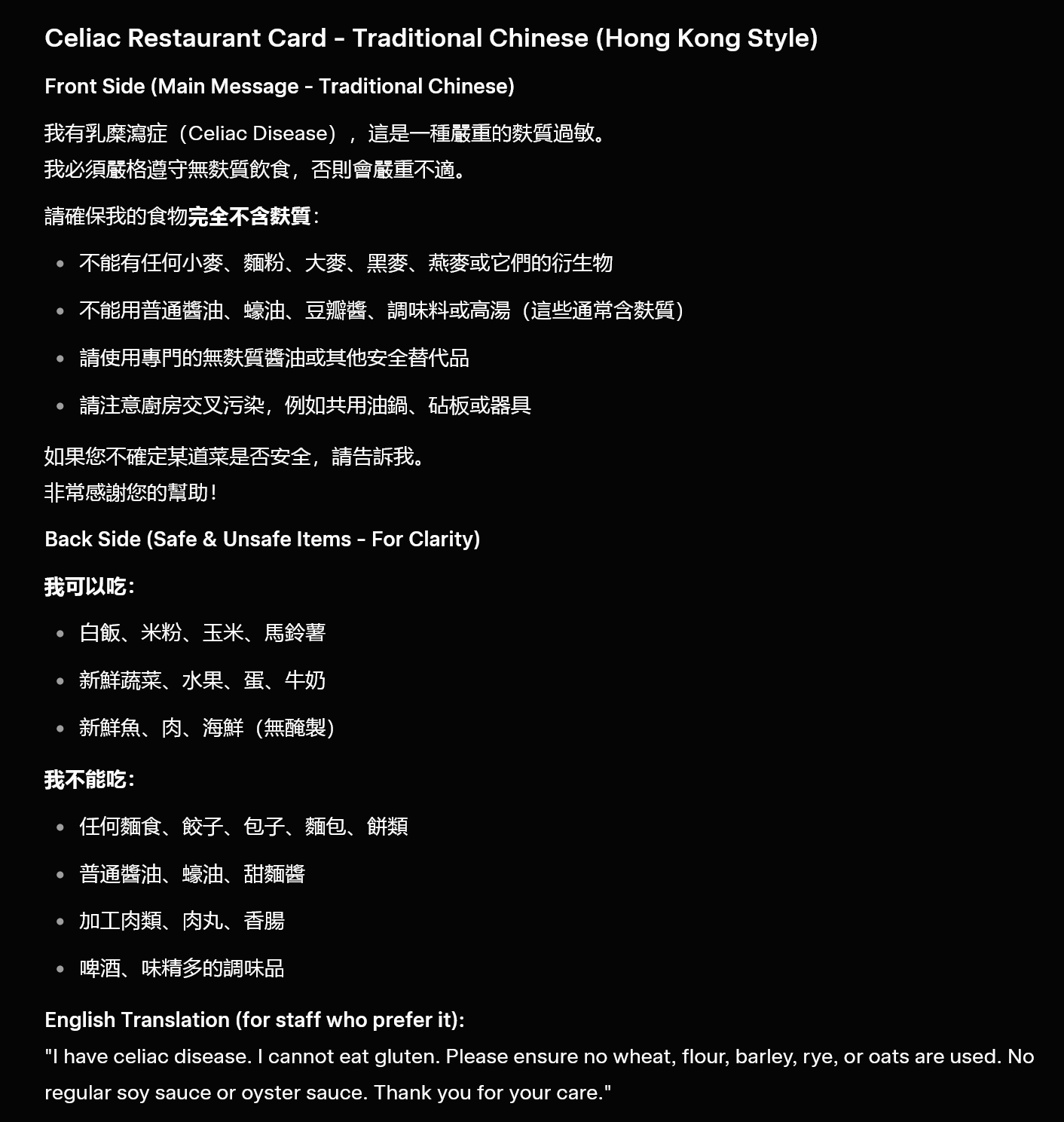

click on any image to enlarge
The information above can be shown to restaurant managers in Hong Kong if you are intolerant to gluten and nuts,
I do not do food tours as mentioned above, I have very specific reasons and part of it is that I do not speak Cantonese or write Chinese, I am from Yorkshire in England and I lack the language gene and it is not through lack of trying and yes a lot of restaurants do not have English menu’s or staff who speak conversational English.
.. and yet I have eaten at close to 1,400 restaurants in Hong Kong since January 2nd 1972, my wife was born in Hong Kong and we have been together over 40 years and her first language is Cantonese and a lot of her family are Chinese or half Chinese so I have never had much of an issue!
This does not translate to doing food tours though, yes, I could do them, no problem there but they would never ever be as good as the food tours done by my friends (see the 3 links above) most of their awesome guides are locally born Hong Kong Chinese and obviously food culture is part of their DNA, it is impossible for me to compete with that!
So please feel free to contact them for food tours
I do not do Hiking Tours in Hong Kong but I know someone that does!
I do not do Hiking Tours, never have and never will even though I used to go Hiking a lot when I was a lot younger, The Hong Kong Government is promoting hiking tours so I urge you to contact my friend Sabrina at Hong Kong Trails and Tours, she is a long time Hong Kong resident and and a very experienced hiker with close to 700 Hikes in 15+ years under her belt, please click on the link below
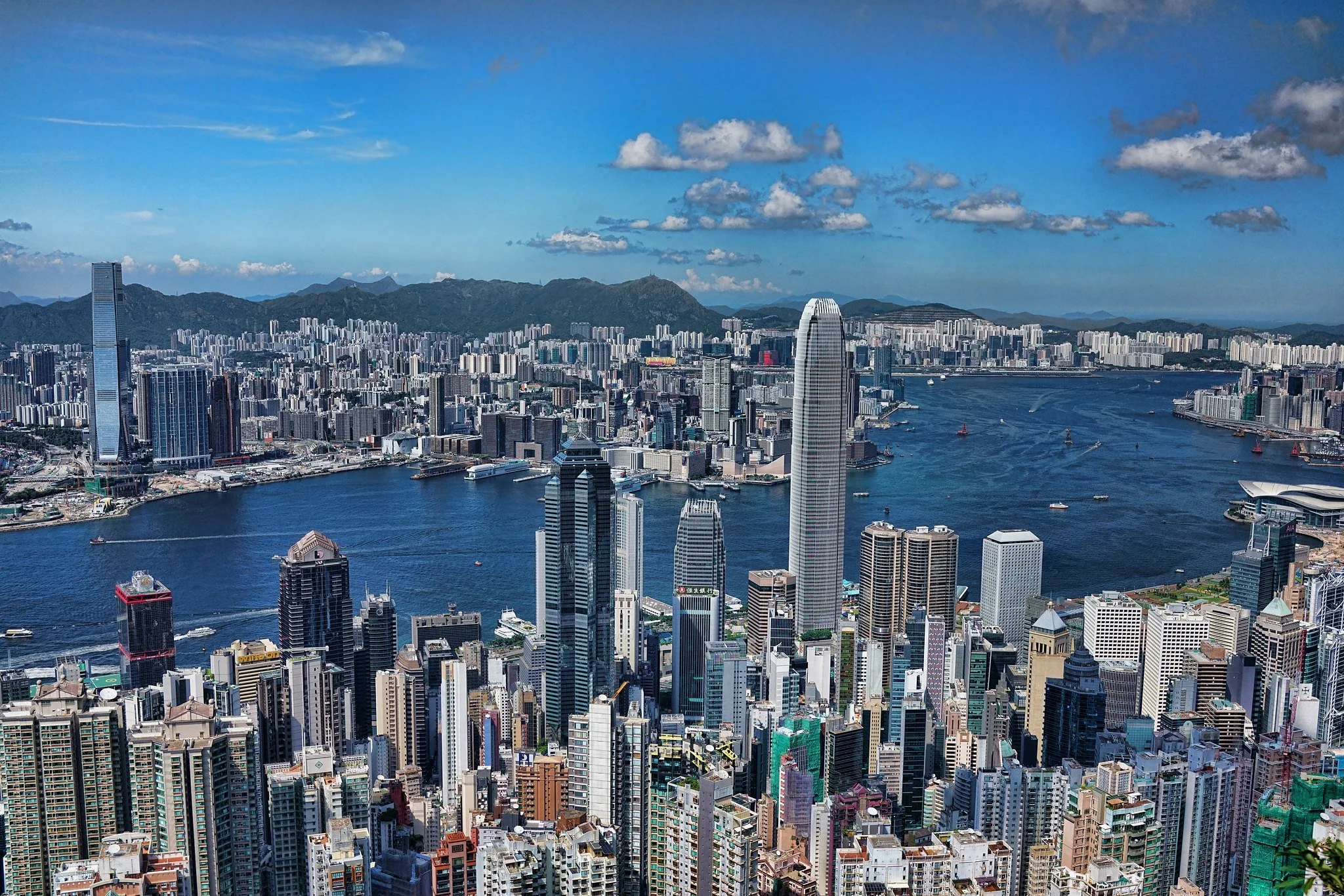


click on any image to enlarge
© Copyright Acknowledged | All rights reserved | all images taken b Jamie
Jamie’s Hong Kong | Some of my favourite images | Hong Kong 101