Hong Kong’s Oldest Gothic Anglican Cathedral on Garden Road

The J3 Group - Premium Quality Private Tours | Experiences and Insider Chats since 2010
Me Jamie, your host, I am English and I have lived in Hong Kong since January 2nd 1972 - I know the place.
A meaningful blog post with a difference - tips on Travel, Tourism, Tours, Daily Life and my personal thoughts on Hong Kong.
Please do visit Amazing Hong Kong
Hong Kong | Pearl of the Orient


A Resident since 1972 - Private Tours of Hong Kong with Jamie
The Best Things to do in Hong Kong
click on the image to enlarge
© Copyright Acknowledged | All rights reserved | image created by Jamie
St John’s Cathedral Hong Kong - Past, Present and Future
Foreword by Jamie
Hong Kong’s Oldest Gothic Anglican Cathedral on Garden Road
I have walked past St John’s Cathedral more times than I can count since I arrived in Hong Kong on 2nd January 1972. It sits there on Garden Road, cream walls and green roofs, looking almost modest against the towers that have grown up around it. After more than 50 years in the city it still catches the eye, and it still feels like a fixed point in a place that changes faster than most people realise. The cathedral is my church. I am Anglican. My wife is Catholic, as are our three sons. That is simply how our family works, and St John’s has been part of my lifr for over 50 years and my sense of the city for a long time.
I am always amazed that thousands upon thousands of people walking to and from the Peak Tram Terminus on Garden Road walk past the Cathedral with barely a glance, it is a real shame, it is real Hong Kong history..
People ask about it on tours from time to time. Some want the colonial history, some want the freehold story, some just want a quiet place in the middle of Central. Wheelchair users and those who need a car usually get passed on to colleagues who run car tours. I do not. That is a practical limit, not a comment on the place itself. What follows is a longer look at the cathedral than the earlier “10 things” blog post I did. The earlier material is still here, expanded and set in a fuller story. No detail is too small if it helps a visitor understand what they are looking at.
The Early Years: From Subscription Church to Cathedral
The foundation stone was laid on 11th March 1847 by Governor Sir John Davis. Fundraising had started even before then. The building opened for its first Sunday service on 11th March 1849 as the Hongkong Colonial Chapel. It was consecrated on 19th September 1852 by Bishop George Smith, the first Bishop of Victoria. For the three years in between, services ran under a licence from the Bishop of London.
The design came out of the Surveyor General’s Office and was built with local labour. The style is a plain, unadorned adaptation of 13th-century Early English and Decorated Gothic. That was the popular revivalist language of the day. The tower is deliberately shorter than a full English Gothic tower, the windows can open, and there are shutters. All of it is an acknowledgement of the subtropical climate. The chancel was extended in 1873, giving the building its cruciform shape. Li Hall went up between 1918 and 1921, replacing an earlier hall. The New Hall (sometimes called the Lodge) was added in 1956 by Leigh & Orange.
It was always intended as both a parish church and a garrison church, sited near Murray Barracks and the Parade Ground. The crenellated parapet on the tower is a quiet reminder of that dual role. The original stained glass, designed by the firm of William Morris, did not survive WW2 and the Japanese Occupation. The present windows are later replacements.
The Freehold Property That Still Matters
The plot at 4- 8 Garden Road is the only freehold land in Hong Kong. Everything else is leasehold. The freehold (fee simple) was secured under the Church of England Trust Ordinance and later statutes. It continues only so long as the land is used for ecclesiastical purposes according to Anglican rites. If that use ever stops, the land reverts. Post 1997 the legal protection remains. In practical terms the cathedral still stands on the one piece of ground in the territory that is not held from the government on a lease.
That status is not abstract. It is one of the reasons the building has survived redevelopment pressure that has removed almost everything else from the same era in Central. It is also why the place still feels like a pause in the middle of the financial district.
The Japanese Occupation and Recovery
On Christmas morning 1941 the Revd Alaric Rose took the service with a congregation of about 100 while shelling continued. Hong Kong surrendered that afternoon after less than three weeks of fighting. During the occupation the cathedral was turned into a Japanese club (the Yamato-Kai). Original fittings were stripped out. The war memorial cross outside was reduced to a plain granite column. In the grounds, near the Celtic Cross, is the grave of Private Ronald Douglas Maxwell, a Roman Catholic killed in the battle for Hong Kong and buried in the nearest suitable ground. He is the only burial in the precinct and is registered by the Commonwealth War Graves Commission.
The first service after the arrival of the Royal Navy was held on 9th September 1945. For years afterwards the Sunday nearest 28th August was marked as Liberation Sunday. Dean Alaric Rose, who had been interned in Stanley with his wife Mary, oversaw the early restoration. A wooden reredos in St Michael’s Chapel is a surviving memento of the internment period. The chapel itself was later rededicated after the death of the young son of a later Dean.
The Grave of the Soldier Near the Front Entrance
If I am repeating myself I apologise - Just yards from the front entrance lies the only grave on the cathedral grounds: that of Private Ronald Douglas Maxwell of the Hong Kong Volunteer Defence Corps (HKVDC). He was killed on 23 December 1941 at age 22 during fighting in Wan Chai, shortly before the British surrender. His Portland stone headstone, maintained by the Commonwealth War Graves Commission, marks his resting place. He also has a commemorative stone at Sai Wan War Cemetery. This solitary grave serves as a poignant reminder of Hong Kong's wartime sacrifices.
What You See When You Walk In to the Church
The west face of the tower carries the large “VR” for Queen Victoria’s reign. The north and south faces carry the coats of arms of Governors Sir John Davis and Sir George Bonham. Inside, the first pew on the south side still bears the royal arms. Before 1997 it was reserved for the Governor or any visiting member of the royal family. There is a mosaic over the west door added in 1968. At its centre is a 13thcentury East Syrian Christian Cross discovered in China. The eagle is a local white-bellied sea eagle (the symbol of St John). Other symbols represent the Trinity. The blue ground stands for the waters of baptism.
The pulpit is thought to have been given in 1898 by Governor Sir William Robinson. The lectern is brass, with an eagle carrying the Word on a sphere. A replica of the 8th century Canterbury Cross was given in 1935. The Bishop’s Chair dates from 1957 There is no air conditioning. The building relies on opening windows, shutters and ceiling fans. The reason is practical air-conditioning condensate would accelerate termite damage in a climate that already treats timber and plaster with little respect. The pews are teak and rosewood with rattan insets, spaced generously for a tropical climate and for the wider clothing of an earlier century.
The cathedral was declared a monument on 5th January 1996. It is the oldest surviving Western ecclesiastical building in Hong Kong and the oldest Anglican church in the Far East. Original seating capacity was planned around 640. It is not the largest church in the territory by seats or footprint.
The Chapels and What Guests Notice Inside
St Michael’s Chapel was established to commemorate those who died defending Hong Kong in 1941. It was later rededicated to St Michael and All Angels after the death of the young son of a former Dean. On the walls are bronze plaques listing names from that defence, and there are books of the dead kept behind glass panels. These are always worth reading. Guests often stop and go through the lists; the names bring the 1941 defence into the room in a way the flags alone do not. The Quiet Chapel sits in what used to be the baptistery and is kept open for silent prayer and a few quiet minutes away from the main space. I always take guests into both. People notice the old military flags hanging from the ceiling almost as soon as they look up. They are faded, have holes in them and look quite plain, but they catch the eye and give the place a different weight from a normal parish church. Most visitors stop and ask about them before they move on.
The Blue Roof Inside the Church
The blue roof I always mention is the internal ceiling inside the church, not the external roof you see from outside. It is quite unusual and distinct once you are standing in the nave and look up. In a building of this age and style the colour stands out against the cream walls and the dark timber. Guests often remark on it before they notice the flags or the royal-arms pew.
The Sir Edward Youde Memorial
There is a memorial plaque dedicated to Sir Edward Youde. He was Governor from 1982 until his death in office in 1986. I always show it to people. It sits quietly among the other tablets and is easy to walk past if you are not looking for it, but it marks a particular moment in the last years of the colonial administration.
The Shape of St. John’s Cathedral
The cathedral is cruciform. The chancel was extended in 1873 to give it that shape. You do not really see the cross from ground level on Garden Road. It only becomes clear when you look down from the Murray Hotel across the road. From that angle the arms of the cross are obvious and the whole layout makes sense in a way it does not when you are standing beside the tower.
Buildings on the Grounds of St. John’s Cathedral
The cathedral itself is the main building for worship. Beside it stands Li Hall, built between 1918 and 1921. It is used for meetings, community events and rehearsals. The Hong Kong Welsh Male Voice Choir has practised there for years on Tuesday evenings and Saturday mornings. The New Hall (also called the Lodge) went up in 1956. It holds the administration offices, the Dean’s residence and a theological library.
On the grounds you will also find the cathedral bookstore, which sells books, gifts, cards and souvenirs. Next to it is Castaways, the nearly-new charity shop that sells second-hand clothes, handbags, shoes and household items. It opens limited hours mid week and on Saturday mornings, and the proceeds go to local charities. There are other smaller rooms and spaces used for counselling, outreach and parish activities. The whole compound sits in a quiet garden with lawns, trees and paths that are worth a slow walk. Most visitors rush past the garden; it is one of the more pleasant open spaces left in this part of Central.
The Old French Mission Building Next Door
The cathedral stands right beside the Old French Mission Building on Battery Path. The original building on that site, Johnston House, went up in 1841-1842, authorised by the first Governor, Sir Henry Pottinger. It was substantially rebuilt in 1917 for the Paris Foreign Missions Society and sold back to the government in 1953. There is no ownership link and no evidence the cathedral site was chosen because of it. St John’s foundation stone was laid in 1847, so the neighbouring building was already there or rising at the same time. Both simply occupy neighbouring plots on what was then the centre of the colonial settlement - Government Hill, close to the barracks and the parade ground. They have sat next to each other for more than 180 years because that is where the early European institutions were placed.
Weddings and Addressing the Clergy
St John’s has long been a popular place for society weddings. The Gothic interior, the Central location and the sense of history make it an obvious choice for couples who want a traditional Anglican service. Demand is high, so the rules are firm: at least one partner must be a baptised Anglican who is a regular member of an Anglican church. Couples from outside Hong Kong need to supply baptism certificates and a letter from their parish priest. The cathedral does not currently marry divorcees but can offer a service of blessing after a civil marriage.
On forms of address, the Dean is The Very Revd Kwok-keung Chan (or simply Dean Chan). The Bishop of Hong Kong Island is The Rt Revd Matthias Der. The Archbishop of Hong Kong is The Most Revd Andrew Chan. Other clergy are addressed as The Revd or The Revd Canon as appropriate. In conversation most people simply say “Dean” or “Bishop” once the formal title has been used.
Present Day Life
Services run in English, Cantonese, Mandarin and Tagalog. The Dean is the Very Revd Kwok-keung Chan. The Bishop of Hong Kong Island is the Rt Revd Matthias Der. The cathedral is the mother church of the Diocese of Hong Kong Island and part of the Province of Hong Kong and Macao (Hong Kong Sheng Kung Hui). Outreach work includes the Mission for Migrant Workers (founded 1981), the Counselling Service, support for the elderly, and the annual Michaelmas Fair. The fair, held on the last Saturday in October, has run almost continuously since the late 1930s (interrupted only by the war years). Proceeds go to a range of local charities. There is a bookstore, a small library, lunchtime concerts, and various fellowships.
In June 2025 Cardinal Stephen Chow became the first Roman Catholic Cardinal to preach in the cathedral, with Bishop Matthias Der celebrating the Sung Eucharist. It was the first time a Catholic Cardinal and an Anglican Bishop had stood together in the building in its 180-year history. On 1st November 2026 the Archbishop of York preached on All Saints’ Day during a visit to the Province.
The place still functions as a parish church, a diocesan centre, a quiet refuge in Central, and a visitor attraction. On Sundays the grounds and the building are busy with worshippers and with domestic workers who treat the area as a meeting point. The freehold and the declared-monument status keep the fabric protected while the congregation and the wider community fund day-to-day life through offerings, the Michaelmas Fair and donations.
A Paragraph on the Future
Maintenance never stops. Recent work has included ceiling repairs (government contractors examining minor defects above the altars) and renewal of floor tiles in Li Hall. The Dean has written that renovation of the administrative building, the cathedral church itself and Li Hall is planned to begin in the coming year. The building is a living structure in a subtropical climate; timber, plaster and roofs need constant attention if the place is to remain usable. The freehold condition continues only while the land is used for Anglican worship, so the future of the fabric and the future of the congregation are tied together. As long as services continue and the community supports the upkeep, the cathedral will keep its unique place in the city. Visitors who want a guided look at the interior or the grounds are welcome; those who need vehicle access for mobility reasons are better directed to operators who run car tours.
The 2002 Cheung Kong Holdings Redevelopment Proposal - A 16-Storey Plan for St John’s Lodge
Here are the details from the two related South China Morning Post reports published on 10th July 2002
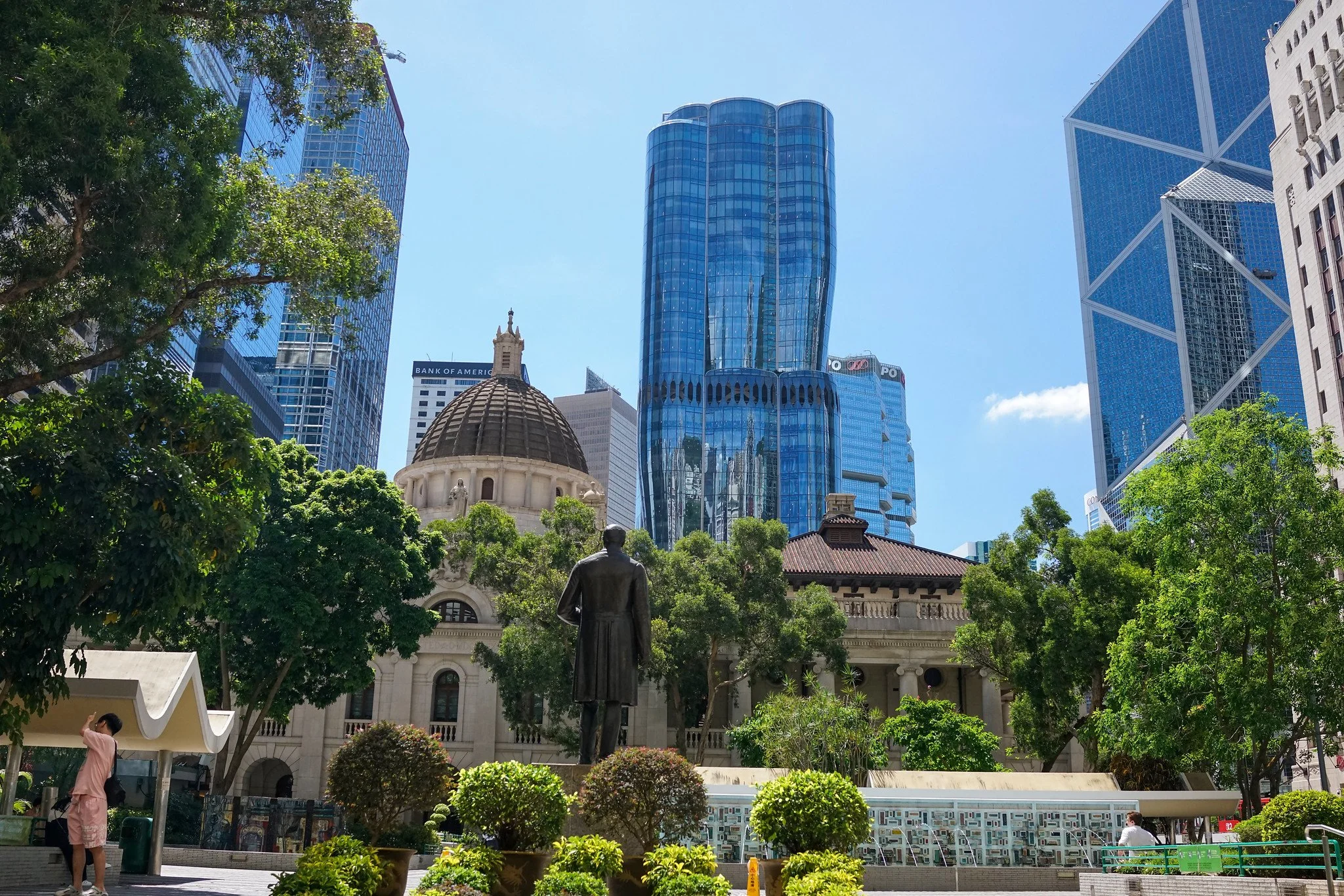
The freehold plot at 4 - 8 Garden Road is small. Published figures put it at about 53,147 square feet in one account and 58,125 square feet in a 2002 South China Morning Post report on a redevelopment proposal which you can read below - Cheung Kong Centre is basically next door to St. John’s Cathedral
Cheung Kong (Holdings) explored redeveloping part of the St John’s Cathedral site next to its own Cheung Kong Centre on Garden Road. The company applied to the government to redevelop St John’s Lodge (the three-storey administrative building added in the 1950s) into a 16 storey building with a basement. Church offices and other congregation facilities would have been housed in the basement, with the upper floors treated as commercial space.
The cathedral itself and St John’s Hall were already protected as declared monuments (the reports use 1995 as the year of declaration; the formal monument declaration for the cathedral is recorded as 5th January 1996). The Lodge was not protected in the same way and could, in principle, be redeveloped under ordinary planning rules. The proposal drew concern from the Planning Department and the Antiquities and Monuments Office because of the proximity to the historic buildings and the freehold status of the whole site.
The site was described as a 58,125 square foot plot at 4- 8 Garden Road, the only freehold land in Hong Kong. All other land is leasehold.
The church rejected the idea. The then Dean, Father Christopher Phillips, was quoted as saying that Cheung Kong had made a proposal more than a year earlier, but after careful consideration the cathedral decided it was not going to redevelop the Lodge in the foreseeable future. A Cheung Kong spokesman later stated that the administration building was not in the company’s current development plans.
Revisiting the Earlier 10 Things Blog Post
The earlier post covered the development timeline, the missing exact build cost (records were never fully preserved because the work was done through the Surveyor General’s Office), the site choice, the Anglican identity, the outreach ministries, and the clarification that a small mortuary chapel in Hong Kong Cemetery (completed 1845) is earlier but served a different, primarily funerary purpose. St John’s remains the oldest purpose built Anglican church for ongoing congregational worship. Those points still stand. The freehold, the occupation damage, the royal-arms pew, the mosaic, the absence of air conditioning, and the dual garrison-and-parish origin are the details that most visitors do not already know.
So there you go.


click on any image to enlarge
© Copyright Acknowledged | All rights reserved | images taken by Jamie