Hong Kong Jewish History- A Detailed OvervIew from 1841 to Present Day
The J3 Group - Premium Quality Private Tours | Experiences and Insider Chats since 2010
Me Jamie, your host, I am English and I have lived in Hong Kong since January 2nd 1972 - I know the place.
A meaningful blog post with a difference - tips on Travel, Tourism, Tours, Daily Life and my personal thoughts on Hong Kong.
Please do visit Amazing Hong Kong
Hong Kong | Pearl of the Orient


A Resident since 1972 - Private Walking Tours of Hong Kong with Jamie
The Best Things to do in Hong Kong
click on the image to enlarge
© Copyright Acknowledged | All rights reserved | image created by Jamie
Jewish Heritage Hong Kong - The Families Who Built the City
Foreword by Jamie
The Families From the Sassoons and Kadoories to Belilios, Nathan and Zeman
I have lived in Hong Kong since 2nd January 1972. That is 50+ years watching the same harbour change shape and listening to the same family names surface in the most unexpected places. Jewish heritage here is not a museum quarter and it is not a ghetto walk. It is a thin, stubborn thread that runs from a handful of Baghdadi merchants in the 1840s through a Grade I synagogue on Robinson Road, a hotel lobby in Tsim Sha Tsui, a road named after the only Jewish Governor this place ever had, and a family that still keeps the lights on for most of the territory.
I am not an old historian and I am not a dry academic. I never went to university. What I do is research, a lot of research, because I am interested. Being a private tour guide is not a job. It is who I am. I want to know the subject properly before I walk it with you. Most visitors never hear any of this. They get a Peak Tram ticket and a photograph and they leave thinking the city began yesterday. This post is the longer story, the one that sits behind the tour I actually give. The more I look, the more the same names keep turning up in places that have nothing obvious to do with each other. Jewish guests in particular often arrive having already done some reading. I have been caught short more than once on the finer points of the history, so I have been filling the gaps.
The Hong Kong Jewish story without the press pack
Jewish people were among the earliest settlers after January 26th 1841 when Hong Kong became part of the United Kingdom so to speak. The first wave was not refugees. It was Baghdadi commercial families who had already moved through India and along the China coast under the British umbrella. The Sassoons were the name that mattered first. They organised services in homes and offices long before there was a synagogue building. They brought other Baghdadi families with them to work in the firms. The Kadoories arrived that way.
The numbers were always small. Around 165 Jewish people in Hong Kong in 1900, against a total population of 221,441 in the 1891 count. Perhaps 300 to 400 by 1939, in a city of about 1.6 million. Anywhere between 4,000 to 5,000 today. Officially the Hong Kong Government does not track religious affiliation in the Census records. That is not a district. That is a community you can miss entirely if nobody brings it up. A lot of Hong Kong people still have no idea it is here. The signs are in plain sight once you know the names.
At the turn of the 20th century, Russian and Eastern European Jewish people arrived, fleeing pogroms. In the 1930s they were joined by German and Austrian Jewish people heading, in the main, for visa free Shanghai. After the war Hong Kong became a transit point again, this time for Jewish people leaving China for Israel, America and Australia. The local Jewish Women's Association and the American Jewish Joint Distribution Committee did the unglamorous work. Horace Kadoorie was the Honorary Representative of the JDC here. Lawrence Kadoorie spent a great many mornings at the Immigration Department on other people's paperwork. That is the part most city tours never reach, because it does not photograph well.
The Sassoon Family - the Rothschilds of the East
The Sassoons were Baghdadi Sephardi Jewish people. Their roots were in the long established Jewish community of Baghdad. They later moved through Bombay before reaching the China coast. Sephardi refers to the tradition that traces back to the Jewish communities of Spain and Portugal, though the Baghdadi families developed their own customs over centuries
David Sassoon left Baghdad in the early 1830s after falling out with the Ottoman governor. He established the family business in Bombay and built an empire on opium, cotton, silk and tea that stretched from India to the China coast. When Hong Kong was ceded in 1841 (and by formal treaty in 1842) the Sassoons moved offices from Canton in China and helped develop the new port. They opened Sassoon, Sons & Co. in 1857 and E.D. Sassoon & Co. in 1867. They staffed the firms with Baghdadi Jewish managers and clerks, which is how the community took root.
The family gave the community its house of prayer. Jacob, Edward and Meyer Sassoon donated the land and put up the Ohel Leah Synagogue in 1901 and 1902. They named it for their mother, Leah. Ohel Leah means Tent of Leah. The building is still there, Grade I listed, and still in use. The family name is now quieter in daily Hong Kong conversation. You will still find Sassoon Road in Pok Fu Lam if you know to look. Other than that all we have left of the Sassoons is a very interesting and colourful history.
Arthur Sassoon served on the provisional committee that established HSBC. Frederick Sassoon sat on the Legislative Council. The family were major players in the early commercial and political world of the colony. They also built the Jewish Cemetery in Happy Valley, consecrated in 1855, which still holds more than 375 graves of those early Baghdadi names: Gubbay, Somech, Sopher, Abraham, Raymond, Ezra, Joseph, Elias. No biography needed. They worked in the same firms, they married into each other, and that is why there are so many grave stones.
Sassoon Road - the last name on the map
Sassoon Road sits in Pok Fu Lam on the south side of Hong Kong Island. It was named in 1924, by Government Gazette, after Sir Victor Sassoon. He was the Shanghai based member of the family who built the Cathay Hotel (now the Peace Hotel) on the Bund and who was known for his high living and his real estate holdings in the 1920s and 1930s. The road was not named because the family lived there. There is no record of a Sassoon residence on that stretch. It was simply a recognition of the name at a time when the family was still visible in the colony’s commercial world.
Today the road is a quiet, upmarket residential street with sea views. Much of the land along it belongs to the University of Hong Kong. The Sassoon Road Campus houses the Li Ka Shing Faculty of Medicine and associated buildings. Private houses remain, including older properties such as Stone Manor at number 33, which was later owned by Henry Fok. The significance of the name is historical rather than residential. It is the only public road in Hong Kong that still carries the family name. Everything else has gone quiet.
The Sassoon family and the opium trade
The Sassoon fortune was built on the legal opium trade of the 19th century. David Sassoon left Baghdad in the early 1830s and established himself in Bombay. From there the firm moved into the China coast trade. Indian opium was sold into China, Chinese tea and silk moved the other way, and British manufactured goods closed the triangle. The Sassoons became one of the largest players. At one point they handled a very large share of the Indian opium that reached China. They opened offices in Hong Kong in 1857 and 1867 and used the colony as a base for the coastal business.
This was not illegal at the time. The British Empire protected the trade after the Opium Wars. The family were merchant princes of the period, not smugglers. The trade began to shrink in the early 20th century. In 1907 Britain, India and China agreed to wind down opium exports. By the 1910s the old volume was gone. The Sassoons had already started to move into cotton, banking, property and hotels, but the original engine of the fortune had been slowed by government agreement rather than by any single scandal. The opium years funded the early expansion. They did not, by themselves, cause the later collapse. The family simply failed to replace that income stream as thoroughly as others did.
Why the Sassoons faded while the Kadoories grew
The two families started from the same Baghdadi networks. Elly Kadoorie began as a clerk in E.D. Sassoon & Co. in 1880. The Sassoons were the senior partners for decades. They brought the people, they organised the early community, and they put up the synagogue. By the early 20th century the balance had already started to shift.
Several practical things happened. More of the Sassoon family moved to England and became absorbed in the aristocratic life. Titles, houses in Belgravia and social acceptance mattered more than the next commercial move. The business split after David’s death into two competing firms. Succession was uneven. Victor Sassoon, who ran the Far East side in the 1920s and 1930s, put heavy weight into Shanghai. He built hotels, bought property on the Bund and lived the high life there. When the Japanese occupied the city in 1937 he had already moved capital east. After the war he tried to sell or hold what he could. When the Communists took power in 1949 they nationalised foreign assets. The Sassoons lost the Cathay Hotel, the Sassoon House complex and the bulk of their Shanghai property portfolio. Estimates of the loss ran into the hundreds of millions in today’s money. Victor left for the Bahamas. The Hong Kong office of the firm closed in 1956. By the 1970s the old companies had been wound up or absorbed.
The Kadoories took a different path. They had already shifted their main weight to Hong Kong before 1949. Lawrence and Horace rebuilt China Light and Power, kept the Peninsula, and acquired the Peak Tram in 1971. They stayed in the place, they diversified into power and property that could not be nationalised from Shanghai, and they kept the next generation in the business. The Sassoons did not. The opium trade had already faded decades earlier. The 1949 losses finished the China side of the empire. The Kadoories, by then well established in Hong Kong, simply carried on.
There is a story I have heard more than once about the Peak Tram. It opened in 1888, the first funicular railway in Asia. One of the reasons given is that the Kadoories and the Sassoons all lived on Victoria Peak and needed a proper means of transport as well as a profitable business. The official history is that Alexander Findlay Smith, a Scotsman who owned the Peak Hotel, pushed the project to open up the hill for residents and visitors. Elly Kadoorie later played a role in turning the private company into a public one in 1905, along with Sir Paul Chater and H.N. Mody. The family association with the tram is long and real, even if the original spark was commercial rather than purely residential.
The Kadoorie Family - the ones who stayed
Like the Sassoons, the Kadoories were Baghdadi Sephardi Jewish people. Elly Kadoorie arrived in Hong Kong in 1880 as a young clerk in the Sassoon firm. The two families came from the same broad community and the same commercial networks.
Elly Kadoorie arrived in Hong Kong in 1880 at the age of 15 to work for the Sassoons. He and his brother Ellis later set up on their own. Elly founded Sir Elly Kadoorie & Sons and took positions in hotels, power and property. The family later focused on Hong Kong after losing most of their Shanghai holdings to the Communists in 1949. Lawrence and Horace Kadoorie rebuilt from here.
Hongkong and Shanghai Hotels owns the Peninsula Hotel Group, the Peak Tram and the Peak Tower. CLP, the old China Light and Power, still supplies electricity to the great majority of the territory. They also hold a serious property book, commercial buildings and a lot of fancy apartment blocks. When I say the family kept the lights on, I am not reaching for a metaphor. I am describing the companies. I tell guests I am in contact with Sir Michael Kadoorie once every 2 months. That is when the CLP electricity bill lands in my letterbox.
The family connection to Ohel Leah is direct. Lawrence Kadoorie became Trustee and later President of the synagogue in the mid 1930s. In 1909 the Kadoories donated a neighbouring plot to enlarge the premises. After the war they continued the philanthropic work that had always marked the family: the Kadoorie Agricultural Aid Association helped Chinese refugees set up small farms, and the brothers were deeply involved in Jewish refugee support.
The Peninsula Hotel Group - the Grand Old Lady of the Far East
The Hongkong and Shanghai Hotels company that owns the Peninsula was incorporated in 1866 as The Hongkong Hotel Company. Elly Kadoorie bought his first 25 shares in 1890. By the early 20th century the family had a major stake. The Peninsula itself was planned as “the finest hotel east of Suez.” Construction started in the mid 1920s on the Kowloon waterfront, opposite the piers where ocean liner passengers came ashore and next to the Kowloon Canton Railway terminus. It was not an obvious choice. Kowloon was still considered the wrong side of the harbour by many on the board. Some called the project a white elephant. The building was even requisitioned by the British Army as temporary barracks before it opened.
It finally opened on 11th December 1928 with 168 rooms. The name came from its position at the tip of the Kowloon peninsula. On 25th December 1941, Governor Sir Mark Young signed the surrender to the Japanese in Room 336 on the third floor. The hotel was renamed the Toa Hotel and used as Japanese headquarters until the end of the war. After 1945 it returned to the Kadoories. With the loss of their Shanghai properties in 1949, the Peninsula became the undisputed flagship. Lawrence and Horace Kadoorie turned it into the core of an international group. Sir Michael Kadoorie still chairs the company today. The family beneficially controls around 60% of the shares. The 1994 tower added a helipad. Guests can be at the airport in seven minutes. Gaddi’s, the French restaurant that opened in 1953, was named after the general manager of the time so he would have a personal stake in making it the best in the city. That is the kind of practical thinking the family has always used.
The Peak Tram and the Peak Tower
The Peak Tram opened on 28th May 1888. It was the first funicular railway in Asia. A Scotsman named Alexander Findlay Smith pushed the idea because he owned the Peak Hotel and wanted easier access for residents and visitors. Before the tram, the only way up was by sedan chair or, in Belilios’s case, by camel. The first cars were wooden, steam powered, and carried about 40 people. First class was 30 cents, second 20 cents, third 10 cents, return half price. On the first day it carried around 800 passengers. In the first year it carried about 150,000.
Who actually owned the Peak Tram from 1888 to 1971
This is not as simple as it seems so let me clarify in more detail about the Peak Tram and the Kadoorie connection
As mentioned the Peak Tram opened on 28th May 1888 under the Hong Kong High Level Tramways Company. It was a private venture driven by Alexander Findlay Smith, the Scottish hotelier who owned the Peak Hotel and wanted easier access for residents and visitors. Around 1905 that company was wound up and a new public company, the Peak Tramways Company Limited, was formed. Elly Kadoorie was involved in the transition, along with Sir Paul Chater and H.N. Mody, and he and later members of the family sat on the board at different times. As board members they almost certainly held shares, which gave them a stake and a voice, but the company remained an independent public company. The Kadoories did not own or control the tram during those years. Hongkong and Shanghai Hotels, the Kadoorie controlled company that owns the Peninsula, acquired the Peak Tramways Company Limited in 1971. That is when the family became the sole owners. From 1888 until 1971 the tram was run first by the High Level Tramways Company and then by the Peak Tramways Company Limited as a public company. The long Kadoorie association is real, but full ownership only began in 1971.
The family still owns it. The tram has been through six generations of cars. The current ones hold 210 people and run on a modern system, but the route is the same steep climb it has always been.
The Peak Tower sits in Victoria Gap, not on the actual summit of Victoria Peak. The first tower opened in 1972, designed by Chung Wah Nan. It housed the upper terminus and a restaurant. By the 1990s it was too small. Sir Michael Kadoorie asked British architect Terry Farrell to design a replacement. The brief was simple and ambitious: make me an Eiffel Tower for Hong Kong. The new building, with its distinctive wok or boat shape, opened in 1997. It has been rebuilt and refreshed since, but it remains the place most visitors think of when they say they went up to Victoria Peak. The family that owns the hotel also owns the tram and the tower. That is not a coincidence. It is the long game they have always played.
Emanuel Raphael Belilios - the third name most lists forget
Belilios came from a Sephardi family with Venetian and Portuguese roots. He was born in Calcutta, which by then had its own long standing Baghdadi and Sephardi Jewish community.
Emanuel Raphael Belilios was born in Calcutta on 14th November 1837 to a Jewish Venetian family with roots that traced back to Portugal via Venice. He arrived in Hong Kong in 1862 at the age of 25 with a cargo of opium and stayed. He became one of the merchant princes of the colony. He served as chairman of HSBC from 1876 to 1882, chaired Hongkong and Shanghai Hotels in the 1870s, and sat on the Legislative Council as Senior Unofficial Member from 1892 to 1900. He was made a Companion of the Order of St Michael and St George.
He was a contentious character who used litigation to get his way. He offered land on Kennedy Terrace for a synagogue but insisted on building a personal residence there as well. When the community rejected the condition he sued, lost, and built a large mansion on the site instead. He kept a pet camel at his summer house called The Eyrie on Victoria Peak. He funded scholarships, gave HK$25,000 (about US$3,200 at the time) to establish what became Belilios Public School, Hong Kong's first government school for girls and the first bilingual school, and left money for a free college for Jewish children in Calcutta. He is buried in Golders Green in London. His wife Sema is in the Jewish Cemetery in Happy Valley.
Belilios and the Old French Mission Building
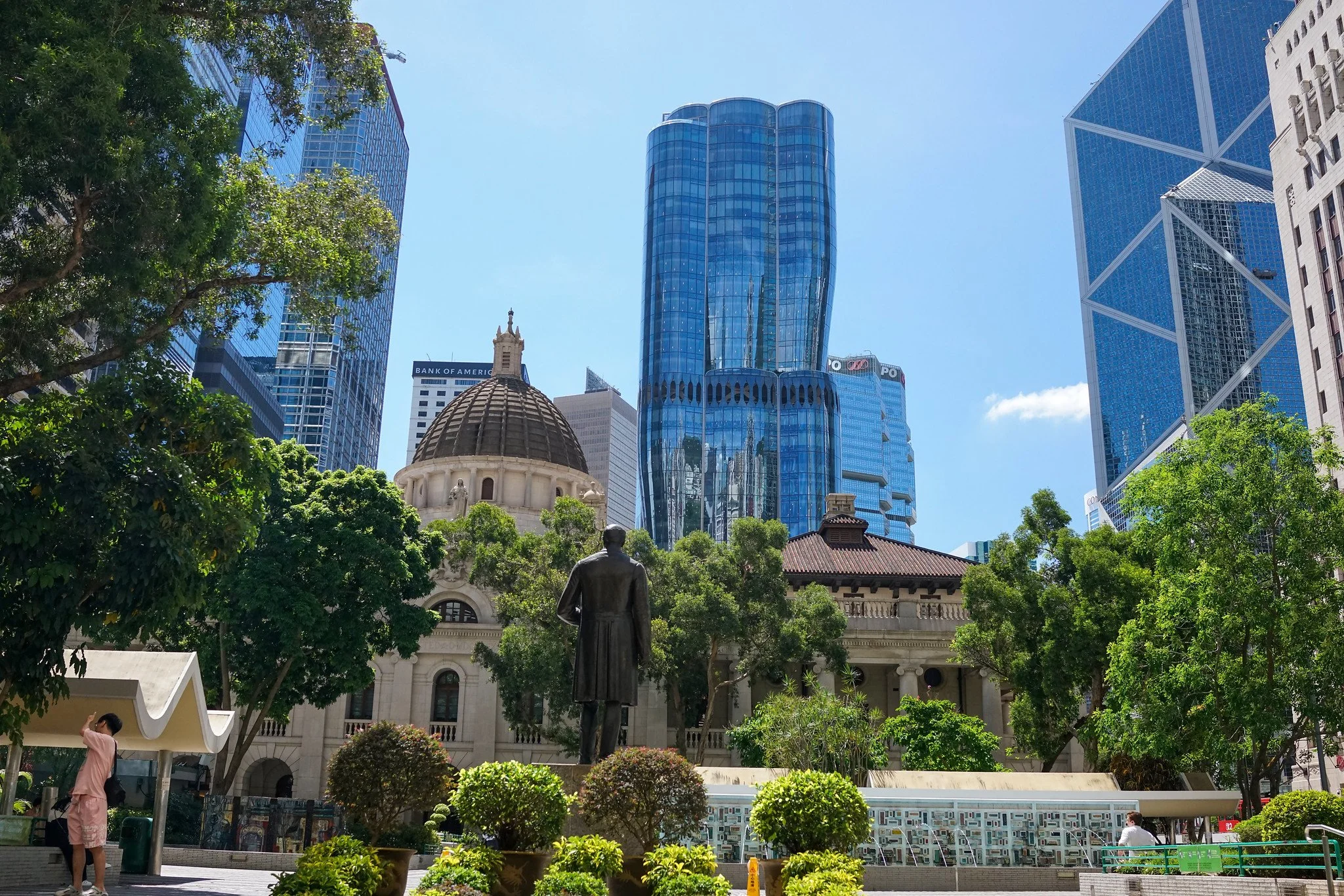
The site of the Former French Mission Building on Battery Path in Central has been occupied since 1842. It started as Johnston House, home to the first Governor Sir Henry Pottinger. Belilios owned the property for a period in the later 19th century. One account says he bought it in 1879 and renamed it Beaconsfield after Disraeli's title. He later sold it on. The building then passed through other hands, including Augustine Heard & Co., before the Paris Foreign Missions Society acquired it in 1915, rebuilt it with a chapel and cupola, and gave it the name that still sticks. Belilios is one of the owners in the long chain that runs from the first Governor's residence to the Court of Final Appeal after 1997. It is a small but solid connection between a Jewish merchant and one of the most recognisable historic buildings on Government Hill.
The early buildings on that site were white or light coloured. The original Johnston House from around 1842, and the later versions through the late 19th century (including the period when Belilios owned it and called it Beaconsfield), had whitewashed or plastered façades. Photographs from that era show a pale building.
When the Paris Foreign Missions Society bought the property in 1915 they commissioned a major renovation. Leigh & Orange carried out the work. In the process they added the chapel and cupola in the north west corner and refaced the building with red brick. The present red brick appearance dates from that French Mission rebuilding, which was completed around 1917. The red brick is not original to the 1840s structure. It is the result of the 1915 to 1917 work.
Sir Matthew Nathan - the only Jewish Governor in Hong Kong’s History
Nathan was Ashkenazi. His family was of German Jewish origin and had settled in London. Ashkenazi refers to the Jewish communities that developed in Central and Eastern Europe. He was the only Jewish Governor of Hong Kong and the only Ashkenazi among the major 19th and early 20th century names.
Sir Matthew Nathan was born in Paddington, London, on 3rd January 1862. He was the second son of Jonah Nathan, a Jewish businessman of German origin, and his wife Miriam. He trained as an engineer at the Royal Military Academy at Woolwich and served in Sudan, Egypt and India before moving into the colonial service. In 1899 Queen Victoria appointed him Governor of Sierra Leone. It was the first time a Jewish man had been given a colonial governorship in the British Empire. He later governed the Gold Coast before arriving in Hong Kong in 1904 as the 13th Governor.
He was 42, unmarried, and an outsider in a colony where the Hong Kong Club and St John’s Cathedral still set the social tone. He did not attend Sunday services and he kept a certain distance from the small Jewish community, though he served as honorary president of Ohel Leah and extended the lease on the Jewish Cemetery. His engineering background shaped his time here. He established the colony’s first proper urban planning office and pushed for the development of Kowloon. The road that later carried his name was originally called Robinson Road, after an earlier governor. There was already a Robinson Road on Hong Kong Island, so in 1909 the Kowloon thoroughfare was renamed Nathan Road to avoid confusion. At the time many people thought a wide road running the length of the peninsula was unnecessary. Kowloon was still sparsely populated. They called it Nathan’s Folly. History has been kinder. Nathan Road is now one of the busiest shopping streets in the world, known as the Golden Mile. Nathan also started work on the Kowloon Canton Railway. His three years were short, but the road remains. He left Hong Kong in 1907 for Natal and later served in Ireland and Queensland. He died in Somerset in 1939 and is buried in the Jewish cemetery at Willesden in London.
Allan Zeman - the Father Of Lan Kwai Fong
Zeman’s parents were Polish Jewish people who survived the Holocaust. That places him in the Ashkenazi tradition. He is the best known living Ashkenazi businessman in the Hong Kong story.
Allan Zeman was born in Regensburg in West Germany in 1949 to Polish Jewish parents who had survived the Holocaust. He was raised in Montreal. By the age of 19 he had made his first US$1 million importing clothes from Hong Kong. He moved here in 1975, built Colby International, sold it for HK$2.2 billion in 2000, and is best known as the Father of Lan Kwai Fong (see below) He chaired Ocean Park from 2003 to 2014 and has advised the Hong Kong Government on tourism for years. He renounced his Canadian citizenship and became a naturalised Chinese citizen. He is the modern public face of Jewish business success in the city, active, visible, and still very much part of the conversation.
Allan Zeman is widely known as the Father of Lan Kwai Fong. The area itself is a small network of steep streets and lanes in Central, just off Queen’s Road Central and close to D’Aguilar Street. For decades it was a quiet backwater of warehouses, linen shops and old tenement buildings. In 1983 Zeman opened California, a restaurant and bar on the ground floor of one of those buildings. It was aimed at expatriates who wanted something more relaxed than the formal hotel bars of the time. The place caught on. Movie stars and local celebrities started using it, and it became the spot to see and be seen.
Zeman did not stop at one restaurant. In 1984 he began buying the buildings on the block. He gradually acquired more of the surrounding properties, moved out the old office tenants, and converted the lower floors into restaurants, bars and clubs. He also pushed for the streets to be pedestrianised in the evenings so people could stand outside with a drink. Through Lan Kwai Fong Holdings, of which he remains chairman, he became the largest property owner in the district. Estimates have put his share of the buildings in the core Lan Kwai Fong area at around 65%. The California Entertainment Building and California Tower are among the properties he developed. What had been a dull alley turned into Hong Kong’s main international nightlife and entertainment district. It is now known worldwide and draws both locals and visitors every night of the week.
The Lan Kwai Fong Group still owns and manages a substantial portfolio of property in the area, along with restaurants and related businesses. Zeman has since expanded the concept to other cities in China, but the original Lan Kwai Fong in Central remains the one that made his name. For most people walking through those streets after dark, the Father of Lan Kwai Fong is not an abstract title. It is the man who bought the buildings and turned them into the place they are standing in.
Other names worth a brief mention
Most of the early Jewish families in Hong Kong were Sephardi, mainly from the Baghdadi community that had moved through India. Sir Matthew Nathan and Allan Zeman are the two clear Ashkenazi names among the public figures. The modern community is mixed. Today you will find both Sephardi and Ashkenazi families, plus people from Israel, America, Britain, France and elsewhere.
Other Baghdadi names fill the cemetery and the early records: the Gubbays, the Ezras, the Josephs. Harry Odell arrived from Japan in 1921, married a local Jewish woman, fought in the Battle of Hong Kong, and survived a Japanese POW camp. Modern Hong Kong has a Jewish population estimated between 4,000 and 5,000, mostly expatriates from the United States, Israel, France, Britain and elsewhere. There is no single dominant family beyond the Kadoories. The community is small, international, and largely invisible unless you know where to look.
The Synagogues of Hong Kong
There is more than one place of Jewish worship in Hong Kong today, though only one building has the long continuous history. The Ohel Leah Synagogue at 70 Robinson Road in Mid Levels is the historic centre. It was built in 1901 and 1902, named for Leah Sassoon, and remains a Grade I listed building still in daily use by the Modern Orthodox congregation. It sits next to the Jewish Community Centre.
On Mody Road in Tsim Sha Tsui East in Kowloon you will find Kehilat Zion, a Sephardi congregation that meets in premises at Wing On Plaza. It is the other active synagogue presence and is home to Mul Hayam, the city’s only fully public Glatt kosher restaurant. There are also Chabad Lubavitch services and the more liberal United Jewish Congregation, which meets at the Jewish Community Centre. Ohel Leah is the one with the 120 year story and the Grade I status. The others serve the modern community.
Where Jewish people worshipped before the Ohel Leah Synagogue was built
There was no purpose built synagogue in Hong Kong before the present Ohel Leah building opened in 1902. The community was formally established in the 1850s and operated mainly from premises leased by the Sassoon family. For the first two decades most services were held in homes or in rooms above the Sassoon offices. The first dedicated space appeared around 1870, when the Sassoons rented a house on Hollywood Road and fitted it out as a synagogue. Around 1881 the community moved to a larger rented premises on Staunton Street. That temporary synagogue was already known as Ohel Leah, named for Leah Sassoon. It remained in use until the permanent building on Robinson Road was finished in 1902. The only permanent communal institution before then was the Jewish Cemetery in Happy Valley, which the Sassoons established in 1855. For more than forty years after the British took possession of the island, Jewish worship in Hong Kong took place in leased rooms organised by the Sassoon firm. The 1902 building was the first one the community owned outright.
A detailed history of the Ohel Leah Synagogue in Hong Kong
The Ohel Leah Synagogue at 70 Robinson Road is the oldest purpose built synagogue in Hong Kong and the only historic synagogue in Greater China that has remained in continuous use for its original purpose. The land was given by the Sassoon brothers Jacob, Edward and Meyer. Construction began when Abraham Jacob Raymond, then the senior member of E.D. Sassoon & Co., laid the foundation stone on 7th August 1901. The building was designed by the local architects Leigh & Orange, the same firm that designed many of Hong Kong’s better known colonial buildings. It was completed in early 1902 and formally dedicated by Sir Jacob Sassoon. The name Ohel Leah means Tent of Leah and commemorates their mother.
The building is an example of Edwardian free classical architecture with Moorish influences, two storeys high, whitewashed, with octagonal towers and arched windows. It has served the Modern Orthodox congregation ever since. There were only three periods when services could not be held. The longest was during the Japanese occupation of Hong Kong, when the building was seized and used as a warehouse and many members of the community were interned. A Roll of Honour plaque inside the synagogue lists members who died in the defence of the colony between 1941 and 1945. Both men and women are named.
After the war the synagogue returned to regular use. By the 1990s the surrounding land had been developed and the old building needed major work. A full restoration began in 1996 and was completed in 1998 at a cost of about US$6 million. The interiors and exteriors were returned to their original state. A formal rededication ceremony was held on 18th October 1998. In 2000 the project received a UNESCO Asia Pacific Outstanding Project Award for Cultural Heritage Conservation. The synagogue is Grade I listed. It remains an active house of prayer, not a museum. Visits are by prior appointment. The entrance is through the driveway of Robinson Place. Most people walk past the high rise towers and never realise the old building is still there, set back from the road.
The Jewish Recreation Club that came before the Community Centre
Before the present Jewish Community Centre there was the Jewish Recreation Club. It opened in 1905 on land next to the Ohel Leah Synagogue. The Kadoorie family provided much of the funding and later expanded the building. For the next several decades it was the social centre of Jewish life in Hong Kong. Members used it for bridge, poker, billiards and ordinary conversation. There was a bar, a large room that could serve as a drawing room or a small hall, and space for community events. It was the place where the small community met outside the synagogue itself.
The original building did not survive the war. It was destroyed near the end of the Japanese occupation. After 1945 the community rebuilt it, again with support from the Kadoorie family. Sir Horace Kadoorie served as president of the club in the early 1950s. The rebuilt club continued as the main social hub until the early 1990s. When the site was redeveloped, the modern Jewish Community Centre that stands there today opened in 1995 on the same site. Older members still speak of the old club when they talk about how the community lived. It is one of the quiet links between the Baghdadi families of the early 20th century and the mixed community that uses the Robinson Road complex now.
The Roll of Honour inside Ohel Leah
Inside the Ohel Leah Synagogue there is a Roll of Honour plaque. It lists members of the Hong Kong Jewish community who died in the defence of the colony between 1941 and 1945. Both men and women are named. The plaque sits below the original dedication stone that records the Sassoon gift of the land and the building. It is a small but clear reminder that the community was not only a group of merchants. People from it served and died alongside the rest of Hong Kong when the Japanese attacked in December 1941. Most visitors never notice it unless someone points it out. For Jewish guests it is often one of the details that stays with them.
Carmel School
Carmel School is the Jewish day school in Hong Kong. It sits within the same Robinson Road complex as the synagogue and the Jewish Community Centre. It educates children from the community and is one of the reasons families choose to stay in the city. For guests who ask whether there is a full Jewish infrastructure here, the school is part of the answer. It is not a large institution by Hong Kong standards, but it has been part of community life for decades and continues to serve the families who live here. Together with the synagogue, the Community Centre and the cemetery, it shows that the community has maintained the basic institutions it needs, even though the numbers have always been small
Where Jewish people can eat in Hong Kong
Kosher options are limited but practical. The Jewish Community Centre at 70 Robinson Road, Mid Levels, has two restaurants that serve members and visiting Jewish guests. Seven Zero is the dairy cafe on Level 2, open for breakfast, lunch and afternoon meals. Sabra is the meat restaurant, open for dinner Monday to Thursday and on Sunday evenings. Both are under rabbinical supervision. The same building houses Kosher Mart, the largest kosher supermarket in Asia, though physical access is mainly for members. Across the harbour, Mul Hayam at Unit 105, 1st Floor, Wing On Plaza, 62 Mody Road, Tsim Sha Tsui East, is the only fully public Glatt kosher restaurant. It serves Middle Eastern and Israeli style food and is open to anyone. Overseas Jewish visitors can usually register at the Jewish Community Centre for short term access to the restaurants. Advance booking is wise, especially for Shabbat meals.
Jewish clubs and associations
The Jewish Community Centre is the main social and recreational hub. It sits next to Ohel Leah and offers the restaurants, Kosher Mart, a swimming pool, sports facilities and event space. The Jewish Women’s Association of Hong Kong was founded in 1947 to help refugees arriving from Shanghai and still runs educational and social programmes for women and children. The Jewish Historical Society of Hong Kong, started in 1984, holds a serious Sino Judaic library and has published work on the local community and the Jewish Cemetery. The United Jewish Congregation is the Progressive congregation. Carmel School is the Jewish day school. Chabad has an active presence. Most of the organised Jewish life in the city still revolves around the Robinson Road complex.
How Hong Kong people view the Jewish community
The general feeling among Hong Kong people is quiet and positive, or at least neutral. A 1989 survey found that 83% of respondents said they were neutral or knew little about Jewish people living in the city, while 15% expressed a positive view. The historical record supports that. The community has always been small. The well known families built hotels, power companies, roads and schools, and they gave money to local causes. There is almost no history of organised antisemitism here. After 1997 the community remained well integrated. Jewish people are not a daily talking point for most residents. When the subject does come up, the usual reaction is curiosity about the old families or simple indifference. That is a better outcome than most places can claim.
The Jewish Cemetery in Happy Valley and why it is closed to the public
The Jewish Cemetery in Happy Valley sits on Shan Kwong Road, tucked behind a Buddhist nunnery rather than on the hillside terraces with the other colonial cemeteries by the racecourse. It is basically flat. The land was acquired by the Sassoon family in the 1850s and consecrated in 1855. The first burial was in 1857. It holds more than 375 graves, including members of the early Baghdadi families and the Kadoorie brothers. For years it was possible to visit with NO notice. That has changed.
In recent years there have been concerns about vandalism at cemeteries across Hong Kong. The Jewish Cemetery is now padlocked. From the main gate you cannot see the gravestones at all. It is hard to believe a large cemetery is sitting there behind the wall. Arranging access means getting permission in advance through the synagogue, and even that is a bureaucratic process. I have heard from a friend that even with permission there is no guarantee the staff will actually let you in on the day. I have visited 5 times over the years. I leave the choice to the guest. Most people who care about the subject are content to hear the story and look at the pictures I have taken myself. I keep an album of photographs of the cemetery and some of the grave stones. The stones are still there. The names are still readable. The gate is simply locked, and getting through it is no longer straightforward.
Interesting facts about the Jewish Community in Hong Kong
Why more of the Shanghai Jewish community did not follow the Kadoories to Hong Kong - Shanghai had a large Jewish population for decades. By the late 1930s it held Baghdadi Sephardi families, Russian Jewish people, and roughly 18,000 to 20,000 European Jewish refugees who had escaped Nazi Europe because Shanghai required no visa. After the Japanese occupation and the end of the war, most of those European refugees left as soon as they could. They went to the United States, Australia, Israel, Canada and Britain. Shanghai had always been a temporary stop for them. The older Baghdadi business families lost most of their assets when the Communists took the city in 1949 and nationalised foreign property. Some, like the Kadoories, already had strong roots in Hong Kong and could rebuild there. Many others did not. Hong Kong was smaller, more expensive, and offered fewer ready made opportunities for people whose money and networks were tied up in Shanghai. Most of the remaining community dispersed rather than moved south in any numbers. The Kadoories were the exception that stayed and rebuilt, not the start of a larger migration.
The Ohel Leah Synagogue is named for Leah Sassoon. The Kadoories have been trustees and presidents. The building was restored in the late 1990s at a cost of about US$6 million and won a UNESCO award. It is still the centre of Jewish life in the city.
The Peak Tram opened on 28th May 1888. First class was 30 cents, second 20 cents, third 10 cents, return half price. Elly Kadoorie was involved in making the company public in 1905. Hongkong and Shanghai Hotels acquired the Peak Tramways Company in 1971. The family still owns it.
Belilios Public School is still going strong, more than 135 years after the gift that renamed it. That is a concrete legacy from a man most visitors have never heard of.
The eruv on Hong Kong Island - An eruv is a symbolic boundary that turns a larger public area into one extended private domain for the purpose of Shabbat. Under Jewish law, carrying objects outside the home is restricted on the Sabbath. That includes everyday things such as house keys, a handbag, a walking stick, or pushing a pram or wheelchair. An eruv is created by linking existing walls, fences, roads and overhead wires so that the whole enclosed area is treated as one private space. Once it is in place, observant Jewish people can carry those items and move more freely within the boundary. The Hong Kong eruv, which became operational in 2024, covers much of the western side of Hong Kong Island, including Central, Mid Levels and the approach to Victoria Peak. It is the first eruv in East Asia. Most visitors will never notice the wires or the boundary markers. For Jewish guests who keep Shabbat it makes a practical difference to how they can move around that part of the city on a Saturday.
The thread is thin but it is stubborn. It runs from Baghdadi merchants in the 1840s to a family that still supplies the electricity, a synagogue that has been in continuous use since 1902, a governor who built a road, a merchant who funded a girls' school, and a Canadian German who turned a flower market into a nightlife district. Most people walk past all of it. Once you know the names the city looks different.
So there you go.

click on any image to enlarge
© Copyright Acknowledged | All rights reserved | images taken by Jamie