A Detailed Modern History of Statue Square in Central, Hong Kong

The J3 Group - Premium Quality Private Tours | Experiences and Insider Chats since 2010
Me Jamie, your host, I am English and I have lived in Hong Kong since January 2nd 1972 - I know the place.
A meaningful blog post with a difference - tips on Travel, Tourism, Tours, Daily Life and my personal thoughts on Hong Kong.
Please do visit Amazing Hong Kong
Hong Kong | Pearl of the Orient


A Resident since 1972 - Private Tours of Hong Kong with Jamie
The Best Things to do in Hong Kong
click on the image to enlarge
© Copyright Acknowledged | All rights reserved | image created by Jamie
Statue Square Hong Kong - Past, Present and Future
Foreword by Jamie
A Detailed Modern History of Statue Square in Central, Hong Kong
I have always been drawn to Statue Square in Central. It was one of the first places we visited as a family when we arrived in Hong Kong on 2nd January 1972, and I felt at home immediately. The version of the square I know was completed in the mid 1960s and, apart from a few trees that have grown considerably larger and the addition of the MTR (Subway) Exit K, it has not changed all that much. Surrounded even then by some of the most important buildings in the territory the Court of Final Appeal, the Hongkong and Shanghai Banking Corporation headquarters, the old Bank of China, Standard Chartered, Princes Building, the Mandarin Oriental Hotel, City Hall and the Hong Kong Club this little patch of open ground has always felt like the heart and power centre of Hong Kong. You can sit here and watch the city go about its business. It is one of my favourite places in Hong Kong and has been for more than 50 years.
The story of how this square came to exist, why nobody has ever been allowed to build on it, and what happened to the collection of statues that once filled it is longer and more interesting than most people realise. Over the years I have written several shorter pieces about different parts of the story. This is an attempt to pull the whole thing together in one place, with as much detail as I can manage and without repeating myself.
The Beginnings - Reclaimed Land and Royal Square
Statue Square sits on land created by the Praya Reclamation Scheme in the late 19th century. There was never a single formal opening day for the original square. It developed gradually on the newly reclaimed ground. The idea of a formal civic square filled with statues of royalty and important colonial figures was largely the work of Sir Catchick Paul Chater, the Armenian born businessman who did so much to shape Central. It was originally known as Royal Square, later as Queens Statue Square, and eventually simply as Statue Square. The name changes alone tell you something about how the place evolved.
The purpose was straightforward and deliberate. It was meant as a visible statement of British presence and authority in the heart of the colony, a ceremonial space for official occasions, and a formal civic open space in a rapidly growing Central. Chater and the colonial government drove that vision. HSBC played an important supporting role rather than originating the square itself. The bank was granted the key 999 year lease in 1895, and in 1901 (under Sir Thomas Jackson) it agreed with the government that the land in front of its building would stay open forever. That covenant locked the space open, gave HSBC the unobstructed view and prestige it wanted, and protected the civic character of the square once the statues began to appear.
In its earliest form the square was not a closed garden. Wardley Street, later shortened and absorbed into what became Bank Street, ran straight through the middle of it on a north south line. That street linked the entrance of the Hongkong and Shanghai Bank directly to Queen’s Pier on the waterfront. The whole layout was designed as a processional axis from the bank to the harbour. That central street disappeared when the square was redesigned in the mid 1960s, which is one reason the place feels more enclosed today than it did before the war.
The first and grandest of the statues was that of Queen Victoria. It was a bronze sculpture by the Italian sculptor Mario Raggi, cast in Pimlico, London, showing the elderly Queen seated on a throne in crown and coronation robes under a domed canopy. The original commission had called for marble, but by the time the mistake was noticed the bronze had already been cast and the work went ahead in bronze. It was unveiled on 28th May 1896 by Governor Sir William Robinson to mark the Golden Jubilee of 1887. That unveiling is the closest thing the original square had to a ceremonial opening. The statue stood at the centre of the square facing the waterfront and was the clear focal point of the whole layout. Chater and others saw it as a powerful statement of British presence on the China coast.
The Lease That Locked It Open: HSBC and the 999 Years
One of the more remarkable things about Statue Square is that nobody has ever been allowed to build on the land in front of the HSBC headquarters, despite its prime location. The story goes back to 1895. Inland Lot 1841, and a related lot I.L. 7414 covering part of what became the square, was granted to the Hongkong and Shanghai Banking Corporation on a 999 year lease commencing on 20th November 1895. Even in colonial Hong Kong, where 75 year and 99 year leases were the norm, a 999 year term was exceptional. It was effectively a near perpetual interest.
In 1901, under the leadership of Sir Thomas Jackson, HSBC and the Hong Kong Government reached a formal understanding. Both sides agreed that their respective lots in the area would never be developed commercially and would remain open public space in perpetuity. It was a practical colonial era deal. The government secured a civic open space in a rapidly growing city without having to bear the full cost of reclamation and maintenance alone, while HSBC gained prestige and the unobstructed view across to the harbour that it has enjoyed ever since. That covenant is why the square has never been built over.
On 26th July 1965 HSBC granted a sub lease for the residue of the 999 year term (less the last three days) to The Colonial Treasurer Incorporated. In practical terms this transferred day to day possession and management to the public sector while HSBC retained the head lease interest. The square is now maintained by the Leisure and Cultural Services Department. Ultimate title remains with the Hong Kong Government, as with all land in Hong Kong. The arrangement has survived the 1997 handover and continues to lock the space open for the foreseeable future essentially until around 2894.
A short note on Bank Street, the narrow road that runs between the current HSBC building and the old Bank of China. It was originally called Wardley Street, after Wardley House, HSBC’s first premises from 1865. When the third generation HSBC building was constructed in the 1930s, part of the old street was absorbed or realigned. The present Bank Street is a shortened replacement of roughly 200 yards. It has never really been a street in the ordinary sense; it has always been secondary to the two banking buildings that flank it.
The Statue Square Statues That Came and Went
At its peak before the Japanese occupation there were around 10 statues in Statue Square. The exact number has always been a bit of a mystery some accounts say 9, some 10, some 11 because a couple of statues that appear in old photographs or lists were actually in the Zoological and Botanical Gardens rather than the square itself. Sir Arthur Kennedy’s statue and the later statue of King George VI were never in Statue Square. The following is the best consolidated list of those that were:
• Queen Victoria (unveiled 28th May 1896 by Governor Sir William Robinson; sculptor Mario Raggi). The grandest of them all. Relocated after the war to Victoria Park in Causeway Bay.
• Duke of Connaught (Prince Arthur, third son of Queen Victoria; donated by Sir Catchick Paul Chater, erected 1902). Relocated in 1907 to the waterfront at Connaught Road Central near Blake Pier. Lost.
• Sir Thomas Jackson (unveiled 24th February 1906 by Governor Sir Matthew Nathan; sculptor Mario Raggi). The only original statue still standing in the square.
• King Edward VII (by George Edward Wade; donated by Chater; unveiled 6th February 1907 by the Duke of Connaught). Lost.
• Prince of Wales, later King George V (donated by John Bell Irving of the Hongkong Electric Company; unveiled 6th February 1907 by the Duke of Connaught). Lost.
• Queen Alexandra (consort of Edward VII). Added later, probably in the 1930s. Lost.
• Queen Mary or Princess of Wales (consort of George V). Added around 1909 or later. Lost.
• Sir Henry May (Governor of Hong Kong 1912 to 1918; unveiled 3rd May 1923). Lost.
• Fame, the HSBC First World War memorial statue (unveiled 24th May 1923). Lost.
Most of these were bronze and most were donated by prominent local figures or institutions as expressions of loyalty. The square was deliberately filled with royalty and a few key colonial administrators to project British authority. For decades it also served as the main ceremonial space for official occasions. Royal birthdays, coronations and Empire Day events were staged here, and after 1923 the annual Remembrance service took place in front of the Cenotaph that stood on the northeastern edge of the square.
The Cenotaph itself was unveiled on 24th May 1923 by Governor Sir Reginald Stubbs. It is a near exact replica of the Whitehall Cenotaph in London, designed by Sir Edwin Lutyens. Originally it carried only the words “The Glorious Dead” and the dates 1914 to 1918. The 1939 to 1945 dates were added after the Second World War, and the Chinese characters 英魂不朽浩氣長存 were carved later. Although it is often treated as a separate monument today, it was always part of the same civic layout as Statue Square.
A brief note on the royal statue that still stands in the Hong Kong Zoological and Botanical Gardens. That is the bronze of King George VI by Gilbert Ledward, erected in 1958. It was never in Statue Square. It was put up as a belated commemoration of Hong Kong’s 100th anniversary (1841 to 1941), delayed by the war. It stands on the same spot that once held the statue of Sir Arthur Kennedy, the seventh Governor, which the Japanese removed and melted. The George VI figure arrived in Hong Kong after the war and was eventually sited in the gardens rather than Central.
War and What Survived WW2
When Hong Kong surrendered to the Japanese over Christmas 1941, the occupying forces systematically removed the statues. They were sent to Japan with the intention of melting them down for munitions. Most were never recovered. Two were. Queen Victoria’s statue survived, was returned, and in 1952 was restored and relocated to Victoria Park in Causeway Bay, where it still stands. The ornate canopy that once sheltered it in Statue Square was not reinstalled. In 1996 an artist named Pun Sing lui vandalised it by tipping red paint over it and damaging the nose an act that reflected some of the tensions surrounding the approaching handover.
Sir Thomas Jackson’s statue was also recovered. It was found in Kobe in September 1946 among the Osaka Army’s arsenal, scratched and dented but intact. It was returned to Hong Kong and reinstated in Statue Square. It remains the only freestanding statue from the pre war period that is still in the square. The two famous HSBC lions, Stephen and Stitt, were also returned, but they stand outside the bank building itself, not in the square.
While the new HSBC headquarters was being built in the early 1980s the lions were temporarily relocated to Statue Square. They left the old building in 1981- The lions did not however go straight from the old building to Statue Square in 1981. There was an interim step.
On 19th June 1981 they were moved to the annexe that stood beside the 1935 headquarters. The old building closed a week later, on 26th June 1981, and demolition began on 6th July 1981. The lions stayed in that temporary position at the annexe for almost a year. On 4th June 1982 they were lifted and taken across to Statue Square, where they remained until they returned to the completed Norman Foster building in June 1985.
For those interested - They sat on temporary plinths at the bridge just inside Statue Square, when you enter from the main Chater Road entrance, looking across toward the bank site
The move was handled with considerable care. A feng shui master (complete with Rolex watch in images I have seen) was consulted and both lions were lifted at the same time by separate cranes so that neither took precedence. They spent those years looking across at the rising steel structure that would become the current headquarters.
The 1966 Makeover of Statue Square
After the war the government decided not to restore Statue Square as a formal ceremonial space. Most of the statues had gone and the canopy over the Queen Victoria site had been removed. Through the 1950s large parts of the open ground were used as a car park. Photographs from that period show cars parked across the area in front of the Supreme Court and the banks. By the mid 1960s the square had become rather tired and the decision was taken to turn the car park back into a proper public garden.
In 1965 to 1966 it was comprehensively redesigned by the Public Works Department under architects Szeto Wai and Alan Fitch, in a joint project with HSBC. The new layout was intended to create better spatial and visual connections with the newly completed City Hall (opened 1962) and the reconstructed Queen’s Pier. It was part of a wider push to provide more green space in a rapidly growing city. The old north south axis of Wardley Street disappeared completely in the process.
The redesigned square was officially opened by Governor Sir David Trench on 26th May 1966. It introduced the modern garden we know today: planting beds, seating areas, small pavilions with abstracted Chinese roof forms, and the distinctive ornamental ceramic fountains. Those fountains were created by the Italian artist Antonio Casadei, who lived in Hong Kong for about 20 years from around 1960. He had already done substantial work for the Mandarin Oriental Hotel and Princes Building next door. The Statue Square fountains are two large relief panels of concrete and glass mosaic tiles. One has a lighter palette of irregular squares and rectangles in red, white, ochre, turquoise and black. The other is darker, with abstract architectural forms in brown red and ochre. Casadei’s signature is visible on the bottom right corner of one panel, partly lapped by the water. The fountains were considered important enough at the time to appear on the cover of the colonial government’s 1966 annual report. They remain one of the more distinctive pieces of public art in Central.
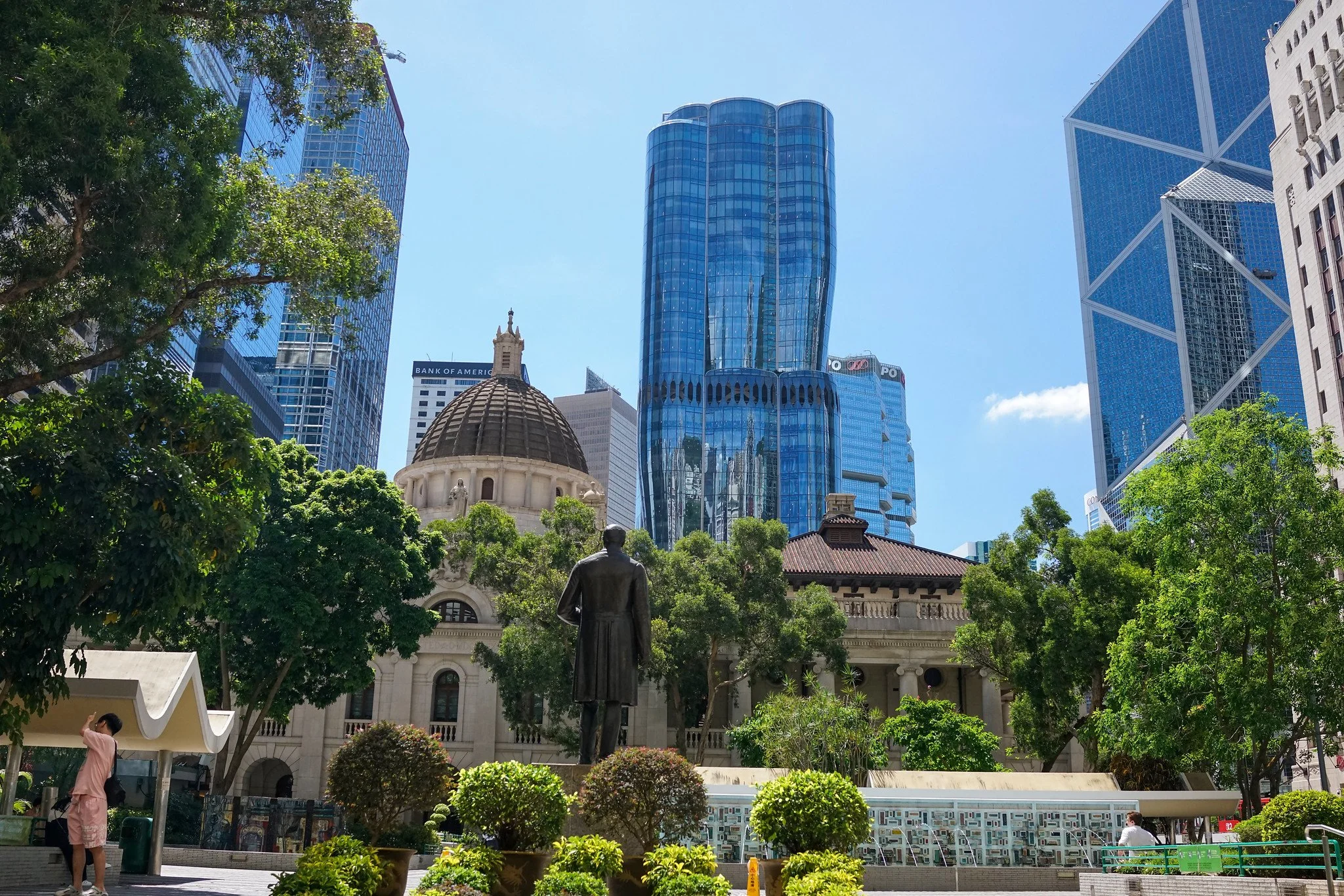
As part of the redevelopment the statue of Sir Thomas Jackson was given a new plinth and reoriented. Before 1966 it faced the HSBC headquarters directly and stood roughly 30 yards from its present position. After the revamp it was turned to face the Court of Final Appeal building (the former Supreme Court, completed in 1912). No official explanation was ever published. Aesthetic reasons, pedestrian flow, and the new layout of fountains and seating almost certainly played a part. Some people, including me, have wondered whether feng shui considerations were involved. HSBC has a long history of taking feng shui seriously the Norman Foster headquarters of 1986 is full of deliberate features for that reason and an open view to the harbour is one of the benefits the 1901 agreement preserved. Facing the Court of Final Appeal, with its statue of Themis on the pediment, may have been seen as balancing energy rather than obstructing it. There is no documentary proof, but it is a plausible reading in Hong Kong.
The Man Who Still Stands - Sir Thomas Jackson
Sir Thomas Jackson (1841 to 1915) was the third Chief Manager of the Hongkong and Shanghai Banking Corporation. He served as Chief Manager in three separate stints between 1876 and 1902 and is widely regarded as the man who put HSBC firmly on the map in Asia. The first began in 1876 when he was still only in his mid thirties, after earlier postings in Shanghai and Yokohama. There were breaks when he returned to London to run the bank’s office there, before being called back to Hong Kong for further periods that took him through to his retirement in 1902. He was created a Baronet the BART that appears on the plaque. The brass plaque on the statue incorrectly states that he was Chief Manager from 1870 to 1902. Official HSBC records make clear the three stints ran between 1876 and 1902. Someone at the bank ought to have a new plaque made, and for the record I have been communicating with HSBC for 18 months on this incorrect plaque, they agree it is wrong but no new plaque yet!
The statue has been repolished in recent years after looking rather weather worn. It remains the clear focal point of the square. On a practical note, I have never understood why the Leisure and Cultural Services Department decided to surround it with four traffic cones. Mainland Chinese visitors have occasionally tried to climb on it for photographs, and the cones are apparently meant to deter them. They look ridiculous. A discreet metal sign, or better still a low fence in the same style as the green railings already in the square, would do the job without spoiling the ambience of one of Hong Kong’s most visible historic monuments. The cones appeared after a major renovation of the statue around 2023. It is a small thing, but small things matter when you walk past the same statue several times a week for more than 50 years.
There is an urban legend that Sir Thomas Jackson’s ghost occasionally climbs down from the statue at night. I have heard it from a Chinese tour guide who said the story has been passed down among local people. There is no credible contemporary evidence for it, and I treat it as one of those atmospheric tales that attach themselves to old places. The square can feel quite different after dark, and that may be enough to keep the story alive.
Everyday Life in Statue Square
Monday to Saturday the square is usually quiet and pleasant. Office workers sit and eat lunch, people cut through on their way somewhere, and it remains a rare patch of open ground in the middle of Central. On Sundays and public holidays it is transformed. Domestic helpers, primarily young women from the Philippines, take over every available space for their well earned day off. They picnic, chat, play cards, and occupy both halves of the square, the pavement in front of HSBC, and often Chater Road itself, which is closed to traffic. It is one of the most distinctive weekly scenes in Hong Kong and has been going on for decades. Not everyone likes it. Some residents and nearby office workers object to the noise which frankly needs to dealt with with competing groups blaring music at ear splitting levels, the crowds and the temporary loss of the square as a quiet public space. Whether you find it chaotic or vibrant depends on your point of view, but it is undeniably part of the life of the place.
The square is still divided by Chater Road into a northern and a southern section. Exit K of Central MTR (Subway) Station brings you straight into the northern part. The southern section, closer to the Mandarin Oriental, feels slightly more detached. Trees have grown much larger since the 1960s, which some people feel makes the square look more enclosed than it used to. I still prefer it on a weekday morning when you can sit near the Jackson statue and watch the city go about its business.
On Chater Road, roughly where the Queen Victoria statue once stood under its canopy, there is still a working post box. It is number 239. It is an oval cast iron box made by the Lion Foundry in Kirkintilloch near Glasgow and it carries the Scottish Crown rather than the usual English royal cypher. It is the only one of its kind still in service in Hong Kong. Most people walk past it without a second glance. A few stop and photograph the crown. It sits in the middle of modern Central doing the same job it was made for.
The section of the square nearer the Mandarin Oriental is currently subject to major works. Plans include a new pedestrian tunnel linking Central MTR (Subway) Station to the harbourfront development, together with a sunken plaza, new seating and landscaping. Large parts of that area will be closed until around 2031. The Jackson statue and the Court of Final Appeal side are expected to remain largely unaffected.
A Note on Events and Better Spaces
In recent years the Hong Kong Tourism Board has used Statue Square for seasonal events such as Halloween and Christmas displays. I understand the desire to put activities in a central and recognisable location, but it is not ideal. Chater Garden is a two minute walk away and is a much better venue for temporary installations of that kind. It has more open space, better circulation, and the events do not disrupt the everyday use of Statue Square or the views that the 1901 covenant was designed to protect. Statue Square works best as the quiet, historic breathing space it has been for more than a century. Temporary themed events tend to clutter it without adding much that could not be done better elsewhere.
Chater Garden itself sits just the other side of the Court of Final Appeal building. It was never a commercial site waiting to be developed. The land was the Hong Kong Cricket Club ground from 1851 until the club moved to Wong Nai Chung Gap in 1975. In 1970 the Town Planning Board zoned the area as open space for government, institution and community uses. The government chose to turn it into a public garden rather than sell it for offices or a hotel. The garden opened on 20th October 1978. In a Central that was already filling with high rise buildings, the decision kept a second patch of breathing room next to the historic square and the Court of Final Appeal. It was a deliberate choice for public amenity over commercial return, and it has stayed that way.
Statue Square has been part of my Hong Kong for more than 50 years and part of the city’s story for well over 100. The 999 year lease, the 1901 open space agreement, the lost statues, the single survivor facing the Court of Final Appeal, the 1966 redesign, and the weekly transformation on Sundays all make it more interesting than a simple patch of paving and trees. It is still one of the best places in Central to sit for a while and watch Hong Kong being Hong Kong.
So there you go.

click on any image to enlarge
© Copyright Acknowledged | All rights reserved | images taken by Jamie