Why a Bridge Was Rejected, How It Was Built and Why It Is Still the Preferred Crossing

The J3 Group - Premium Quality Private Tours | Experiences and Insider Chats since 2010
Me Jamie, your host, I am English and I have lived in Hong Kong since January 2nd 1972 - I know the place.
A meaningful blog post with a difference - tips on Travel, Tourism, Tours, Daily Life and my personal thoughts on Hong Kong.
Please do visit Amazing Hong Kong
Hong Kong | Pearl of the Orient


A Resident since 1972 - Private Tours of Hong Kong with Jamie
The Best Things to do in Hong Kong
click on the image to enlarge
© Copyright Acknowledged | All rights reserved | image created by Jamie
History, Traffic Figures, Feng Shui Talk, and How Long the Tunnel Can Last
Foreword by Jamie
The Cross Harbour Tunnel sits under Victoria Harbour like a quiet fact of life. Most people who use it every day never give it a second thought. For me it has always been more than a pair of tubes on the seabed. My father was a telecoms engineer with the Hong Kong Telephone Company, later Cable and Wireless. His first posting after we landed on 2nd January 1972 was a six month or so job that had something to do with overseeing and helping to install the communications systems for the new tunnel. (well that is what we where told!) as a family we where all to excited about living in Hong Kong to wonder what Dad did on a daily basis! he was with the Hong Kong Telephone Company for over 20 years and to this day (and to my regret) I have never figured out what he did, what his title was, he was a typical Yorkshireman - blunt and gruff and I was never close to him, however we where living in Hong Kong and living it large and for that I will always be eternally grateful
If memory serves phones back in 1972 where pretty basic and nothing like the systems that would be used today but the Cross Harbour Tunnel needed specialist systems
Without that project there would have been no transfer, no family move from Yorkshire, and no fifty four years of living in this city. In the simplest terms, no tunnel, no me in Hong Kong.
That personal thread is why I have always wanted to set down the full story in one place: how the idea grew in the 1950s and 1960s, why a grand bridge across the harbour was considered and then discarded, the official engineering arguments, the unofficial cultural ones that still circulate among people who have lived here a long time, the construction itself, the opening-night chaos, the traffic figures from those first exciting days in 1972 to the crowded reality of 2026, and the awkward but fair question of how long a structure like this can last. This is that account.
The Cross Harbour Tunnel Hong Kong - The Full History From 1972 to 2026
How the idea took shape
Talk of a fixed crossing between Hong Kong Island and Kowloon goes back to the early twentieth century. After the war the pressure became impossible to ignore. Vehicular ferries were already handling around 16,700 vehicles and more than 650,000 passengers on a busy day. Queues stretched, typhoons stopped services, and the colony’s economy was expanding too quickly for boats alone.
In 1955 the government formed a committee to look at long-term alternatives. Four years later a group of local businessmen, with official blessing, set up the Victoria City Development Company. They hired Scott Wilson Kirkpatrick & Partners to produce a proper traffic survey and economic study. The 1961 report examined both a bridge and a tunnel and concluded that demand would justify a fixed link by the late 1960s. Early cost estimates put a tunnel at around HK$140 million and a build time of roughly 72 months. An inter-departmental committee had already leaned toward a tunnel as early as 1956 for practical reasons that would only grow stronger.
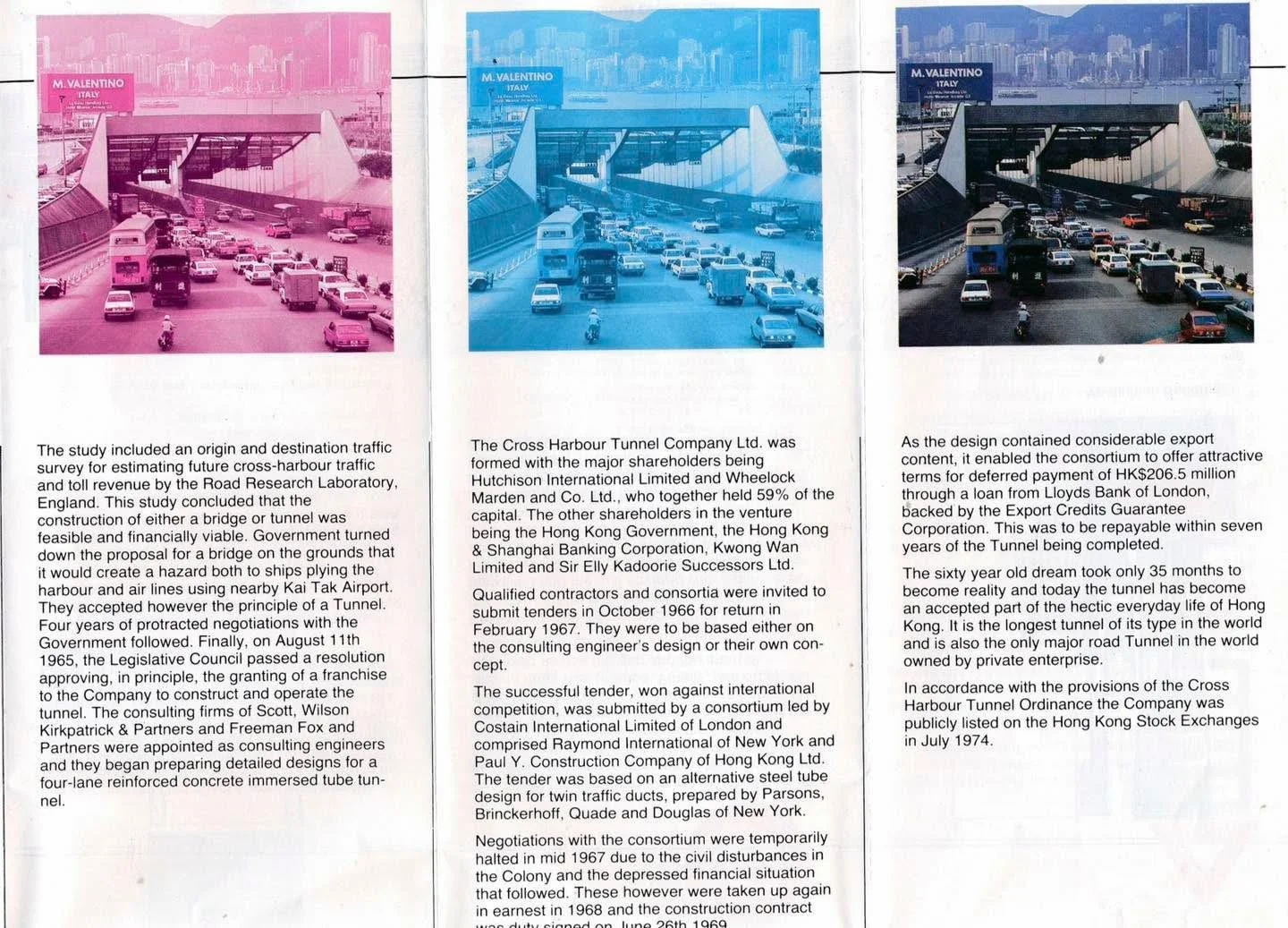
By 1965 the consultants were back to produce detailed designs for an immersed-tube tunnel, now estimated at HK$280 million. That same year the Legislative Council approved a thirty-year build-operate-transfer franchise - the first of its kind in Hong Kong - with the newly formed Cross-Harbour Tunnel Company. The terms included a 12.5 per cent royalty on gross receipts for the first ten years, a 5 per cent equity option for the ferry companies, and HK$12 million from the operator toward the new approach roads the government would have to build. The government later took a modest stake so it would not lose all say in the project.
Negotiations stalled in 1967 because of the riots and the financial uncertainty that followed. They restarted in 1968. A £14.75 million loan from Lloyds Bank, repayable within seven years of completion and backed by the UK Export Credits scheme, made the numbers work. The fixed-price construction contract of HK$272,533,333 was signed on 26th June 1969 with a consortium led by Costain International. Work began on site at Hung Hom on 3rd September 1969.
The bridge that was never built
The 1961 study and earlier discussions treated a bridge as the cheaper option. Some estimates put it at HK$100 - 140 million against HK$280 million for a tunnel. A bridge would have been simpler to assemble above water, easier to widen later, and would have given Hong Kong a visible landmark. Supporters pointed to London, New York and Sydney. Why should Hong Kong not have the same?
The objections piled up quickly. Victoria Harbour was already one of the busiest ports in the world. A bridge would have needed enormous clearance - 60 to 70 metres or more - so that ocean-going ships could pass underneath. That height meant steep approach ramps that would have chewed up scarce land on both shores and lifted the road high above the existing streets. Typhoons were a constant threat. A damaged span could close the harbour itself. Kai Tak’s flight path crossed the water. Towers tall enough for shipping would have sat directly in the way of low-flying aircraft.
Personally I have always thought that these “barriers” where hogwash particularly the one about being in the Airports flight path and Typhoons are NOT a constant threat, we average 3 or 4 a year and most do not cause any damage, If the bridge structure ever failed or was struck, the main shipping channel from Lei Yue Mun to Tsim Sha Tsui could have been blocked, indeed but people forget that you can enter Victoria Harbour from the east and the west and that has always been the case! so yes the shipping channel to the East might have an issue but sea traffic could simply come in via the Western channel.
After much argument the government stated in 1963 that a bridge would be an unacceptable hazard to aviation. It was prepared to offer a franchise for a four-lane tunnel instead. The tunnel would cost more and take longer to maintain, but it would not obstruct ships or planes and it would sit out of the weather. Those were the reasons written down.
One final point about the hazard to aviation, I live under the flight path of Hong Kong International Airport, my view is the airport bridge which is massive and guess what, planes all day and night fly over the bridge and next to the bridge at a very low altitude and yes I concede that things where different in the 1960’s no computers and such - I always felt that these where excuses not reasons and that there was something else in play, something unspoken and I have written about this in earlier blog posts.
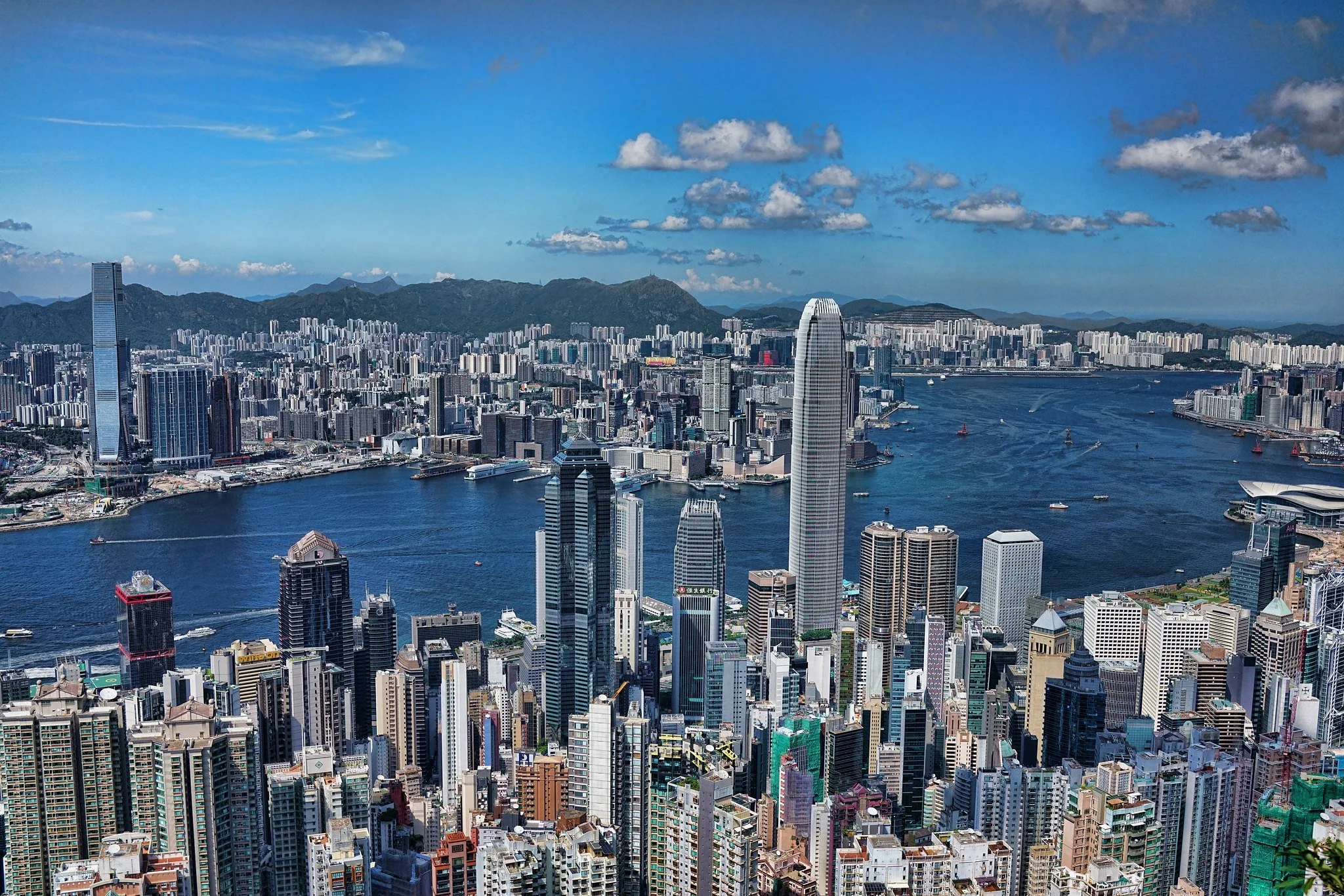
Hong Kong later built some of the largest bridges on earth - Tsing Ma, Ting Kau, Stonecutters, Kap Shui Mun, and the Hong Kong - Zhuhai - Macao crossing. The question people still ask is a fair one. If those spans were acceptable over open water and outlying channels, why was a bridge never allowed to connect the Island to Kowloon at the one place that mattered most? The official answer remains engineering, aviation, shipping and typhoons. The unofficial answer has never gone away.
The unspoken factor: feng shui and the harbour
Official papers never mention feng shui. That does not mean it was irrelevant.
Feng shui is not a side interest in Hong Kong. It is woven into property, architecture and even large public projects. Developers hire masters as a matter of course. Buildings include dragon gates - openings that let the mythical dragons travel from the mountains to the sea. Sharp corners are avoided because they produce “killing energy,” or shar chi. The city’s geography itself is considered unusually strong: mountains behind for support, water in front for wealth.
Victoria Harbour is regarded as the gathering point where the dragons of Kowloon - the Nine Dragons - descend to meet the water and pool prosperous energy. A bridge spanning that water could be read as a barrier, a cut across the dragon’s path, or a dam across a river of fortune. Some have always said it would choke the “mouth” through which wealth enters the city. Tunnels, being invisible beneath the surface, leave that flow undisturbed. A visible span would loom in the skyline and the seascape. That is why it would have attracted objections that a buried tube never did.
The idea has circulated for decades among residents and guides. People remember being told as children that a bridge would bring bad luck or interfere with the dragons’ movement. The same logic appears in later debates about other crossings. The long curves of the Hong Kong - Zhuhai - Macao Bridge have been called snake like rather than dragon like by critics who worry about the energy they introduce. Those projects went ahead because they sit on the edge of the city, not across its symbolic heart.
I have never seen an official document that says feng shui decided the matter. I have also never believed that the official reasons were the whole story. Hong Kong is pragmatic and superstitious at the same time. Masters are consulted on skyscrapers. Compensation is paid when a project is thought to disturb a grave or a hillside. A high-profile bridge across the harbour would have drawn intense attention from geomancers, businessmen and the public. It is not hard to believe that officials preferred to avoid that argument altogether.
I do not disparage the belief. Chinese culture goes back a very long way, and after fifty four years here I take the local reading of the harbour seriously even when the logic is not the logic I grew up with in Yorkshire. I was born on Friday the 13th. People in Hong Kong understand that kind of date as well as anyone. It is what it is. Practically, engineering and economics ruled the bridge out. Culturally, the feng shui of the harbour has real weight in local belief. That combination is one of the reasons the water between the Island and Kowloon still has no span across it - only tunnels doing the job below the waves and yes there are 7 tunnels under the harbour
click on any image to enlarge
© Copyright Acknowledged | All rights reserved
The Hong Kong Cross Harbour Tunnel opened 1972
Building the tunnel
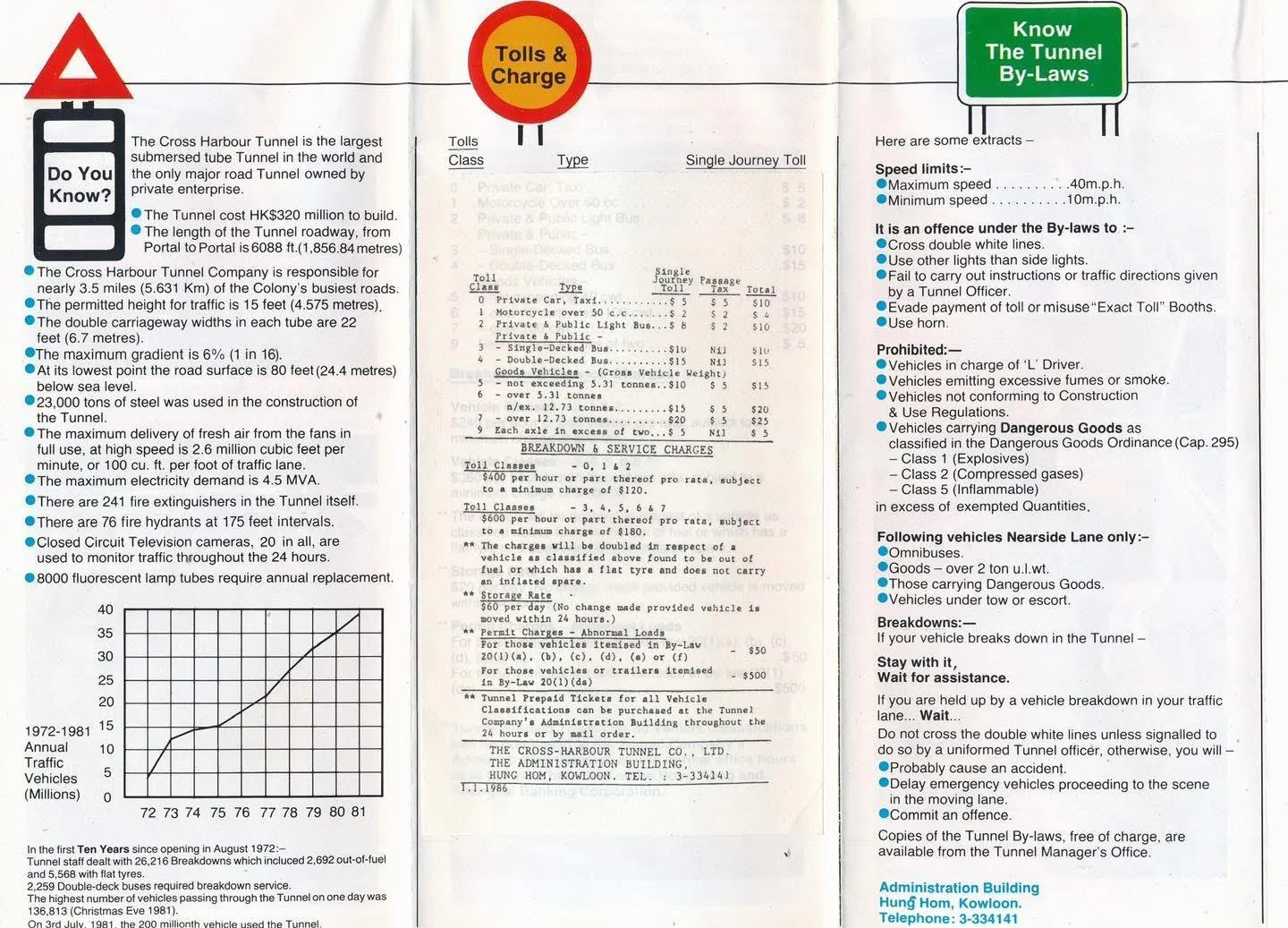
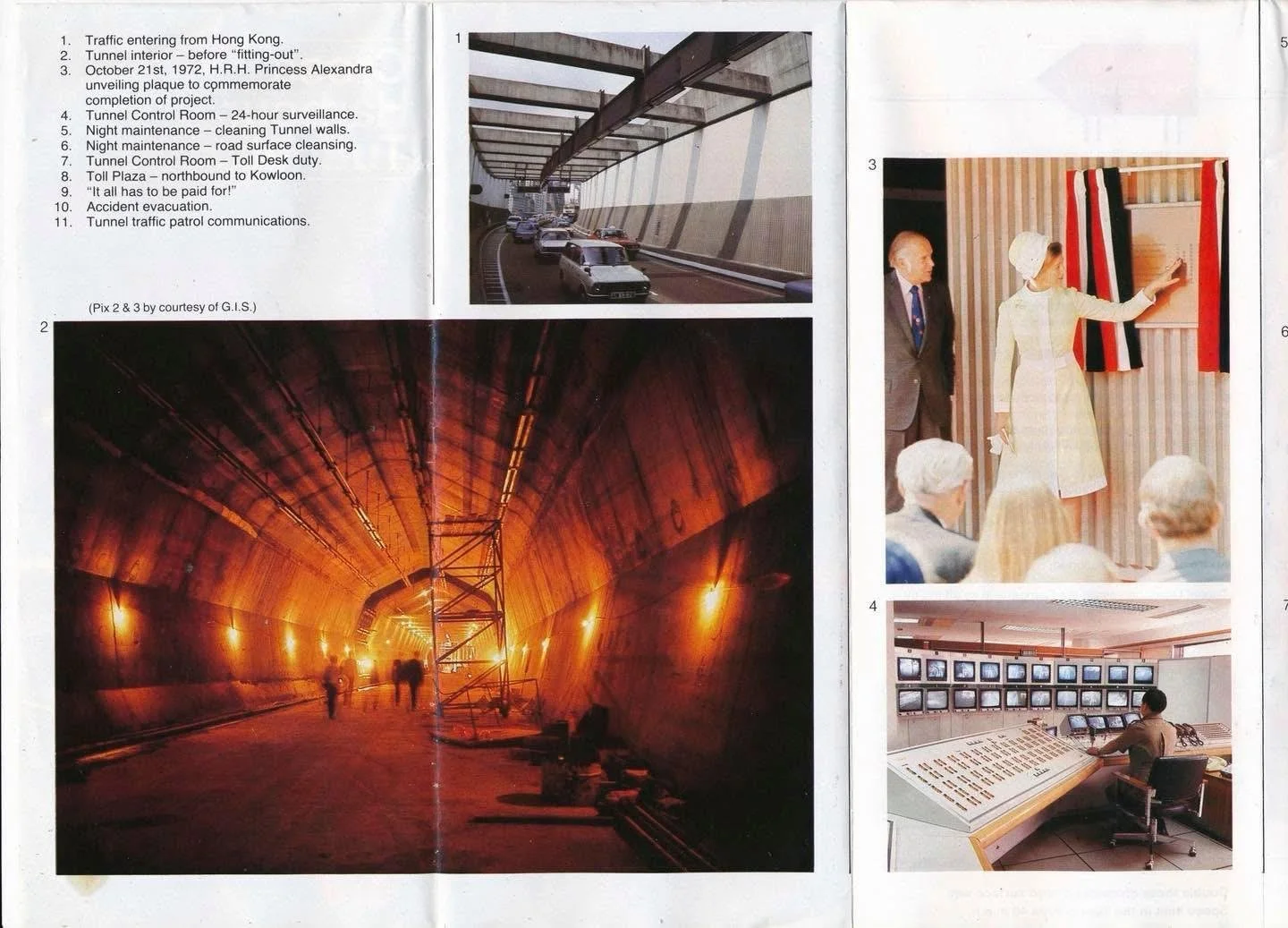
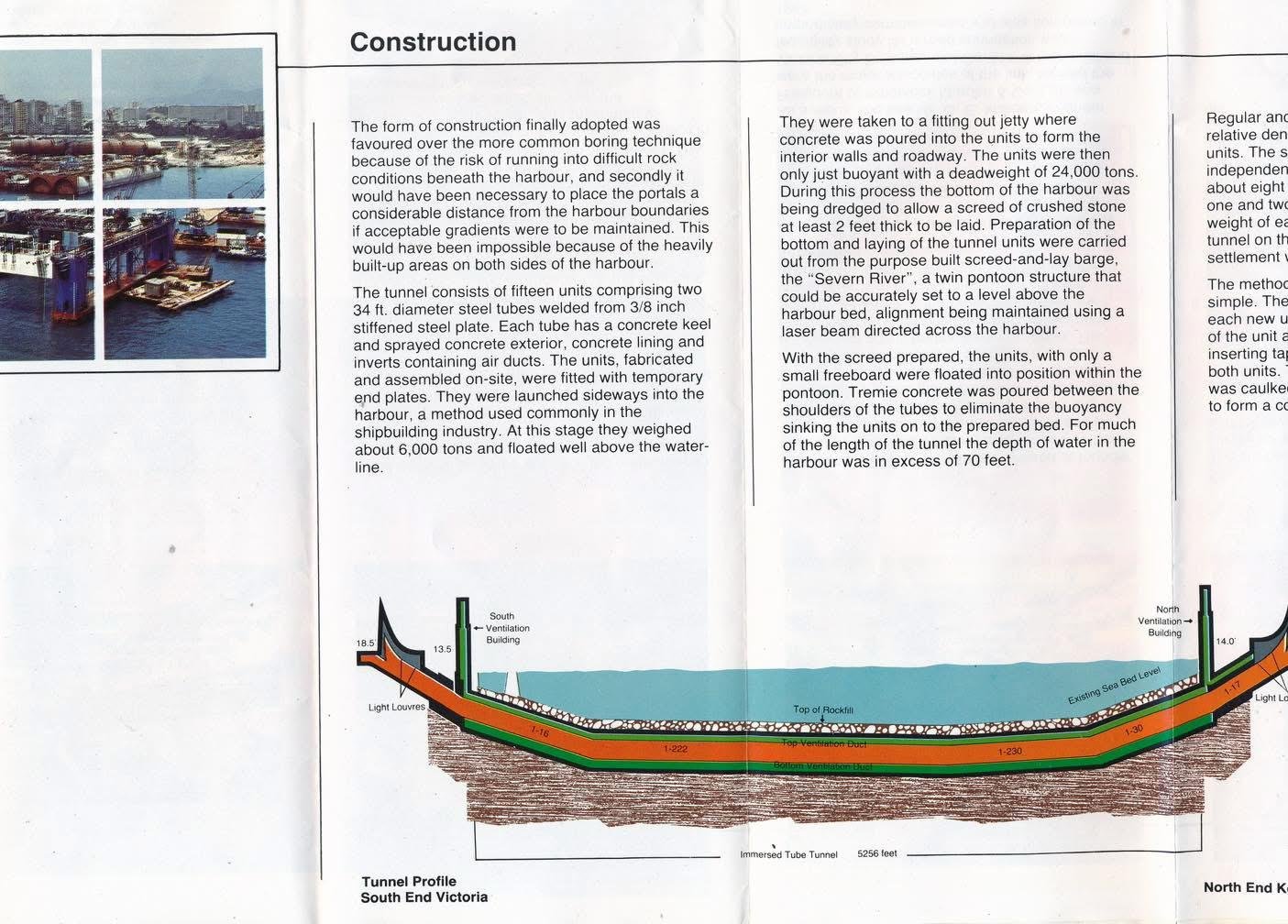
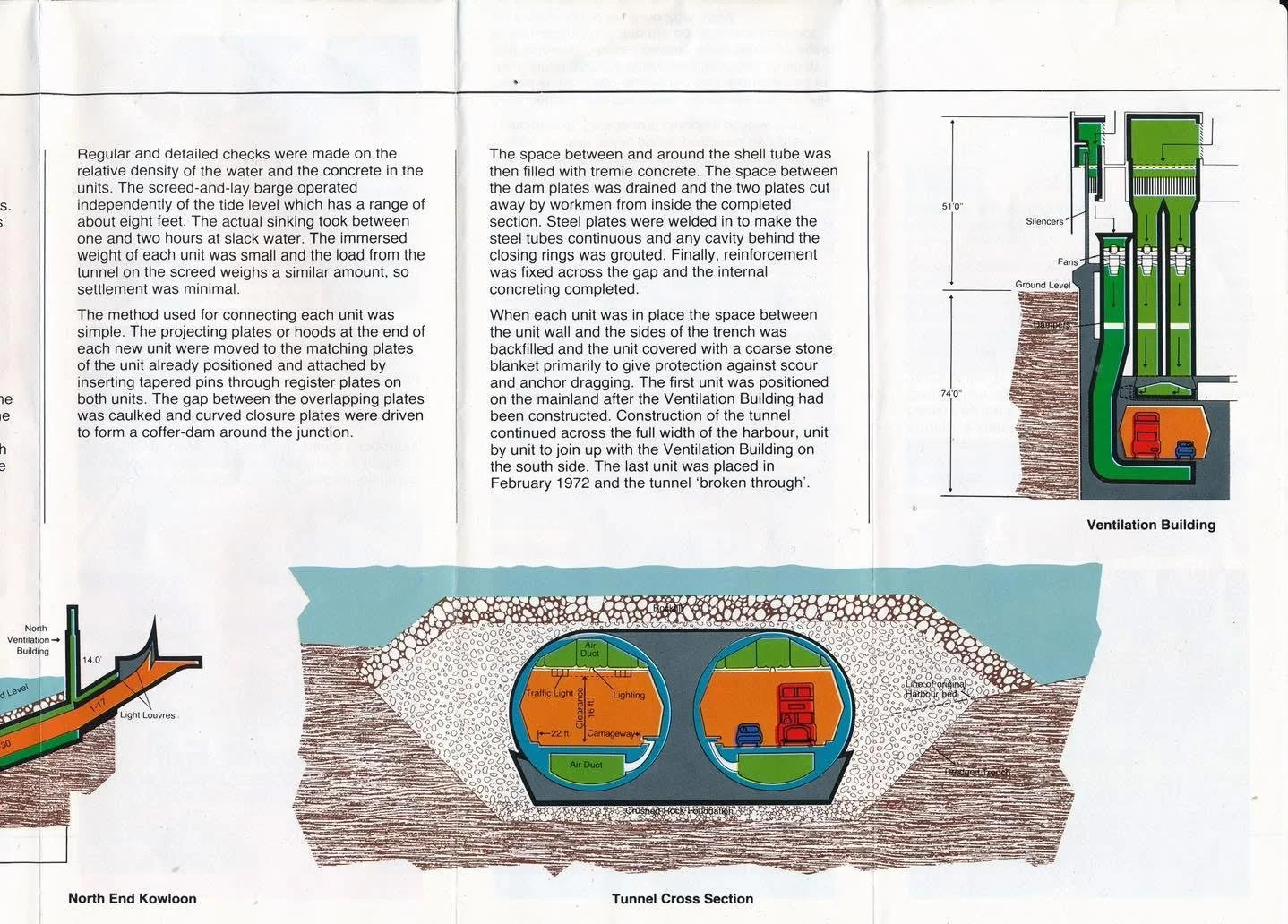
The design that went forward used two parallel steel tubes, each 10.4 metres in diameter, carrying two lanes on a 6.7 metre carriageway. Total length is 1.86 kilometres, of which 1.6 kilometres is submerged. Fifteen immersed-tube units, each about 107 metres long, were prefabricated, floated into position, sunk into a dredged trench as deep as 30 metres, and sealed. Temporary works included a slipway, a jetty and a specialised barge that cost £500,000 on its own. Equipment worth £2 million had to be mobilised and a quarry developed for materials.
The first unit was placed on 29th December 1970. The last went down in February 1972. By then it was possible to walk from one side of the harbour to the other inside the unfinished tubes. Road connections on both sides were finished by June. Despite the 1967 interruption and the usual difficulties of working in a busy harbour, the project was completed in two years and eleven months - one month ahead of the contract period. The finished cost was in the region of HK$320 million.
Opening night and the first traffic
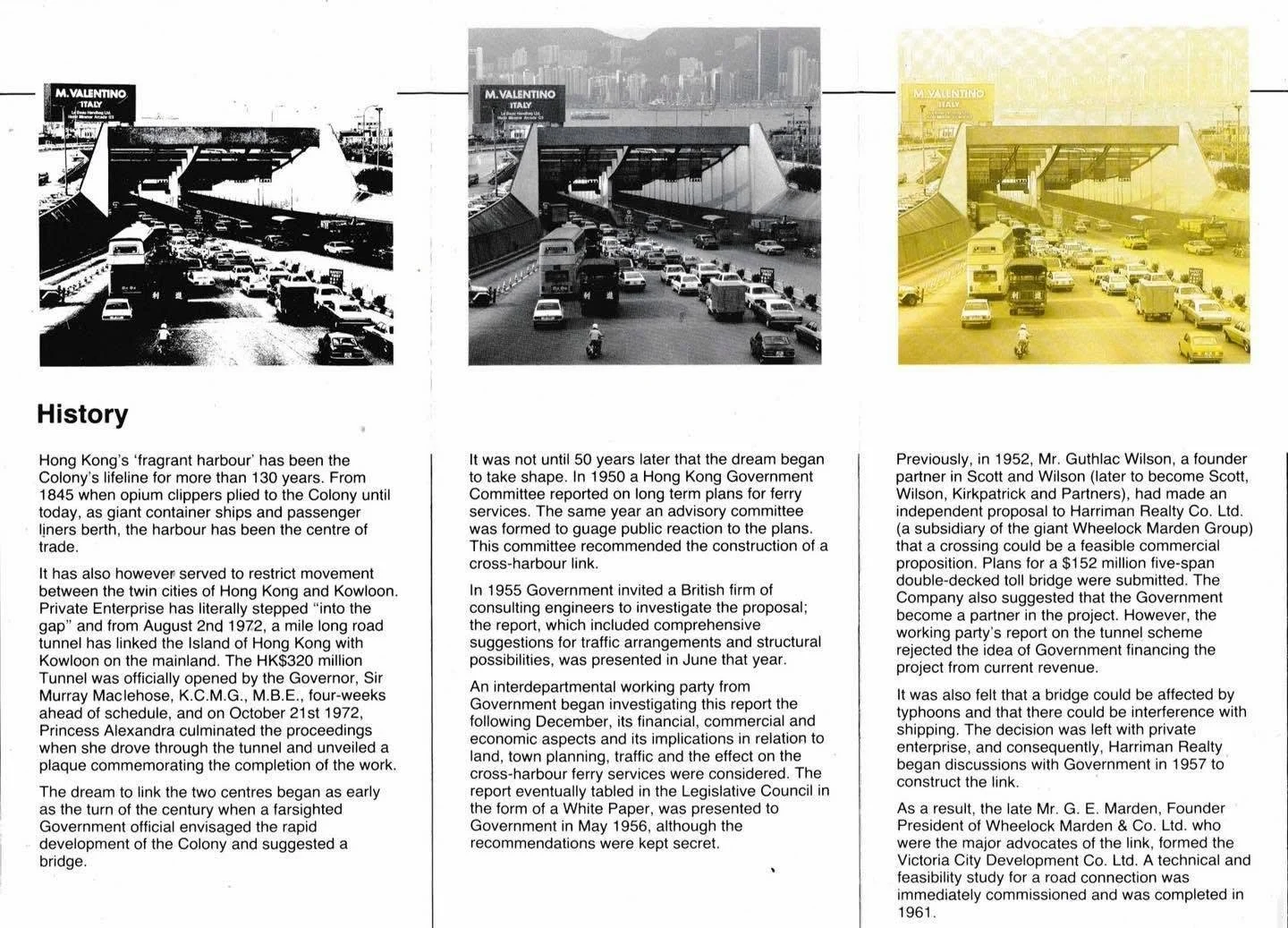
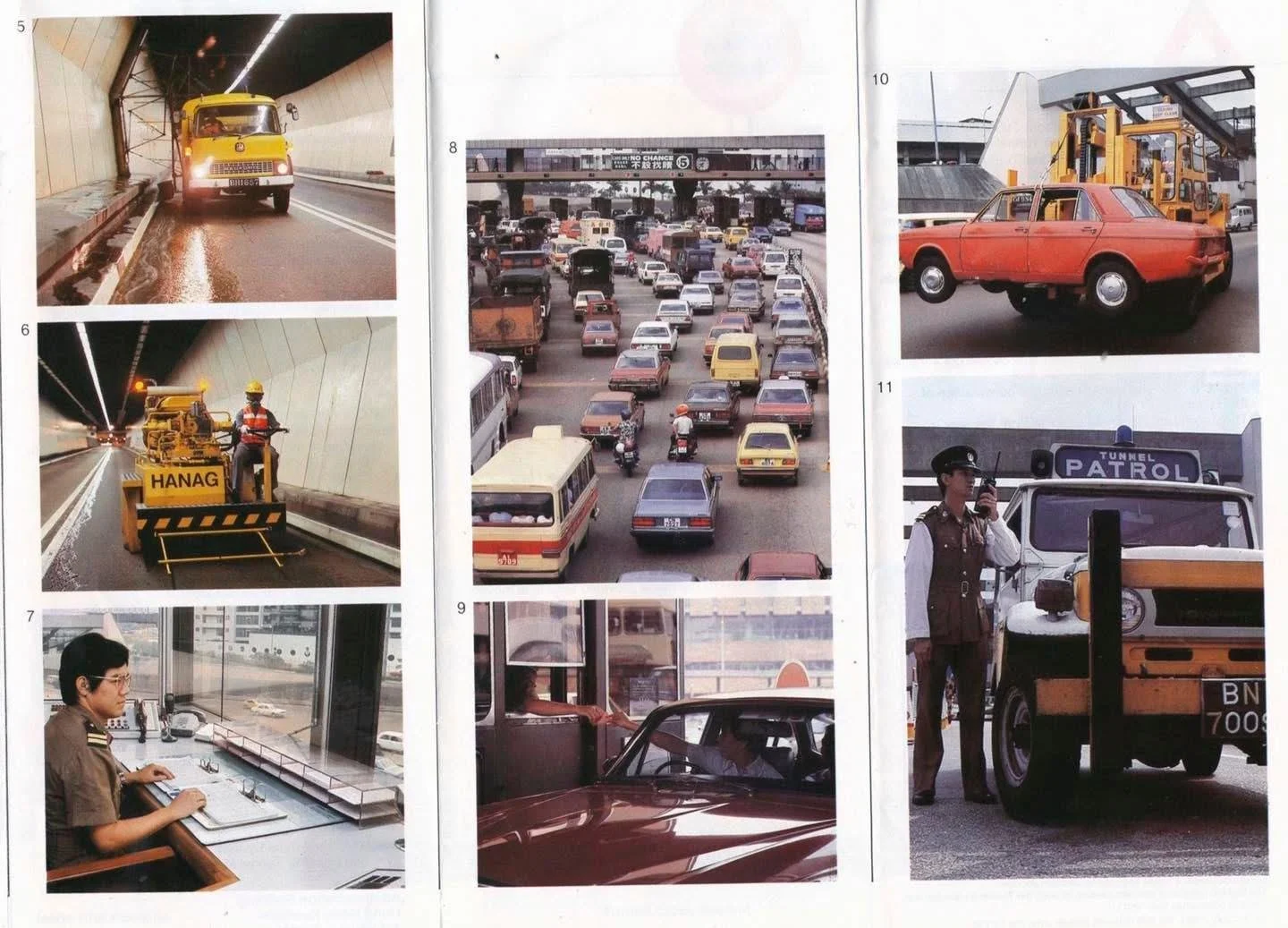
Governor Sir Murray MacLehose opened the tunnel on 2nd August 1972. Public traffic began late that night. At 11.39 pm - six minutes before the official public opening - construction superintendent M. McMillan drove through from the Island side. He told reporters he simply wanted to feel what it was like to drive through the tunnel he had helped build. Anxious drivers on the Kowloon side started revving their engines the moment the first cars appeared. Guards let them through three minutes early. Within fifteen minutes more than 700 vehicles had passed.
The first full month, September 1972, averaged about 22,000 vehicles on weekdays and 30,000 on Sundays. One early count put the first day’s total above 40,000 before the novelty faded and daily numbers settled around 25,000. The original private-car toll was HK$5. Princess Alexandra performed the royal opening and unveiled the plaque on 21st October 1972.
The operator recouped the construction cost in three and a half years. That success confirmed the BOT model and set the pattern for the later harbour crossings. The franchise ran until 1st September 1999. Ownership then passed to the government, and management has been contracted out ever since.
Stories that still travel well
A few details never lose their flavour. McMillan’s late-night drive is the one most people remember. Entertainment personality Lydia Shum was driven through in a vintage car as part of the opening celebrations. The tunnel was, at the time, Asia’s longest underwater road tunnel and one of the longest immersed-tube tunnels in the world. It was built by a British-led team using British design and a British contractor, finished in the shadow of the 1967 riots, and paid for without a direct charge on the public purse.
In November 2019 the tunnel was closed completely for two weeks during the protests - one of the few times the city has been forced to remember how much it still depends on those four lanes. Locals still call it the red tunnel because of the colour of the signs. Divers working on the seabed during construction are said to have come across old wrecks. And the telephone cables my father helped install are still carrying conversations under the harbour more than fifty years later (although I imagine the cables have been upgraded!)
Traffic then and now
The tunnel was designed for 80,000 vehicles a day. Reality overtook the design almost immediately.
1972 opening period: first-day excitement above 40,000, then a settled average around 25,000; September weekdays about 22,000, Sundays about 30,000
Mid-1970s: annual traffic already in the tens of millions
Peak years around 2006 - 2007: daily averages near 123,000
2013: about 116,750 a day
2023: roughly 104,000 a day
2024: about 93,000 a day after time-varying tolls were introduced in December 2023 to spread traffic across the three harbour tunnels
2025 - 26: most recent figures remain in the low-to-mid 90,000s on an average day, with weekday peaks still heavy toward Hong Kong Island
The three road harbour crossings together now carry well over 250,000 vehicle trips a day. The original tunnel is no longer the cheapest, but its central position between Causeway Bay and Hung Hom keeps it the default choice for many drivers. Congestion toward the Island side remains a daily fact of life.
Two more immersed-tube tunnels followed: the Eastern Harbour Crossing in 1989 and the Western Harbour Crossing in 1997. Together they ended the old ferry era for vehicles. The Star Ferry and a handful of other passenger services remain, but the days when a car had to queue for a boat are gone.
How long can the tunnel last - and what happens if it cannot?
The Cross-Harbour Tunnel is now more than fifty years old and is still the crossing many drivers reach for first. That is not because it is the newest or the roomiest. It is because it sits in the right place, between Causeway Bay and Hung Hom, and habit is a powerful thing in this city. The question that follows is obvious: do structures like this have a finite life, and what would Hong Kong do if this one began to fail?
Tunnels and bridges are not immortal, but they are not disposable either. A modern road tunnel in Hong Kong is now designed for a working life of around 120 years. Older immersed-tube tunnels around the world were often planned with a shorter horizon in mind - fifty to a hundred years - and many of them are still in daily use after mid-life repairs. The original design life of the Cross-Harbour Tunnel itself was never clearly recorded. When the government was asked in 2008, officials said they did not have those papers from the late 1960s. What they did have was a 2003 engineering assessment of the immersed-tube structure. That report found the tubes in good condition and judged that they could remain in service for more than seventy years from that date - which, if the judgement holds, takes the structure well into the 2070s.
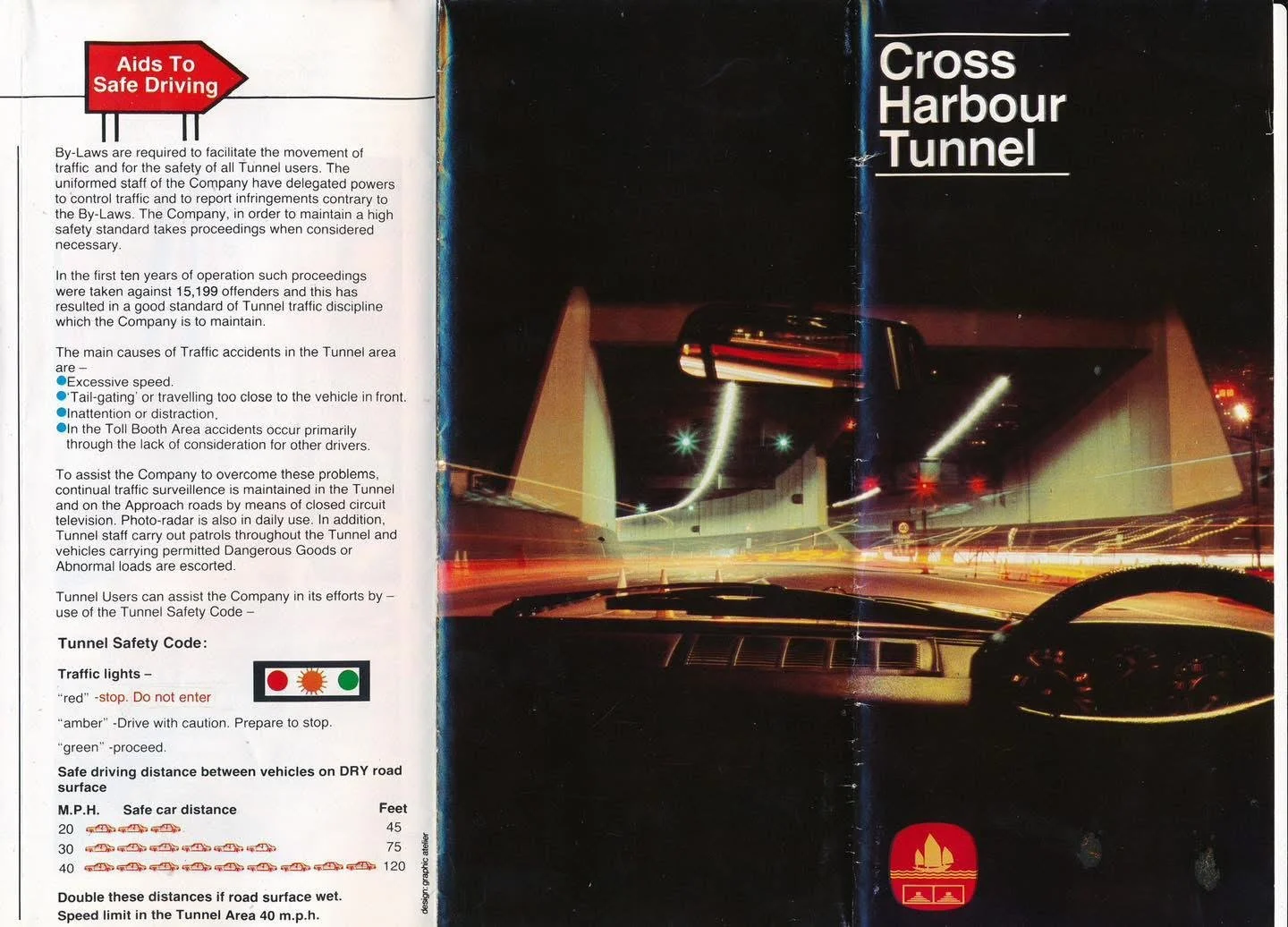
The distinction that matters is between the shell and everything inside it. The steel tubes on the seabed, the joints, the protective blanket of stone and the alignment of the whole crossing are inspected on a fixed cycle: daily checks of the road and fittings, quarterly inspections of the concrete, annual surveys of movement and cover, and a fuller structural inspection every two years. What ages faster is the kit the public never sees - ventilation, fire systems, cameras, control rooms and the traffic control and surveillance system. Those parts are already being replaced while the tunnel stays open. Night after night one bore is closed so work can be done; the other runs two-way at a reduced speed. That routine is the real proof that the crossing is being treated as a long-life asset, not a relic waiting to be written off.
A bridge would face the same question, only more publicly. Steel and concrete above water are easier to inspect and harder to hide when they rust or fatigue. Typhoons, salt air and ship impact are constant risks. The reason Hong Kong never built a harbour bridge in the first place - aviation, shipping, weather and the shape of the shores - has not gone away. A replacement bridge in the 2030s or 2040s would still have to clear the port, sit in a crowded skyline and survive the same storms. That is why any Plan B is far more likely to be another tunnel than a sudden conversion to a span across the harbour.
If the day ever came when the original tubes could no longer be kept safe or useful, the first response would not be to close the crossing and hope. It would be a mixture of heavy rehabilitation - joints, lining, waterproofing, fire protection - and a new crossing already planned and, ideally, already open. Hong Kong cannot afford a multi-year shutdown of the Hung Hom to Causeway Bay link without a substitute. In 2026 the government is already studying a fourth harbour crossing after the Kau Yi Chau artificial island timetable slipped. The options on the table include a new immersed tube or a bored tunnel on a different alignment, extra capacity at existing portals where land allows, a western route toward Lantau and the Island west, or an eastern route serving the growing eastern side of the city. Finance would almost certainly follow the same pattern as 1969: some form of private build-operate-transfer or public-private partnership, because the bill would be large and the need would be obvious.
The honest speculation is this. The Cross-Harbour Tunnel is more likely to be patched, upgraded and kept in service for decades yet than to be declared finished. What will force a Plan B is not a sudden crack in a 1972 steel tube. It will be the same pressure that built the tunnel in the first place: too many vehicles, not enough lanes, and a city that cannot function if the shortest path between the two sides of the harbour is taken away. Until that new crossing exists, the old red tunnel will remain what it has been since August 1972 - the one most people still choose, whether the engineers like the numbers or not.
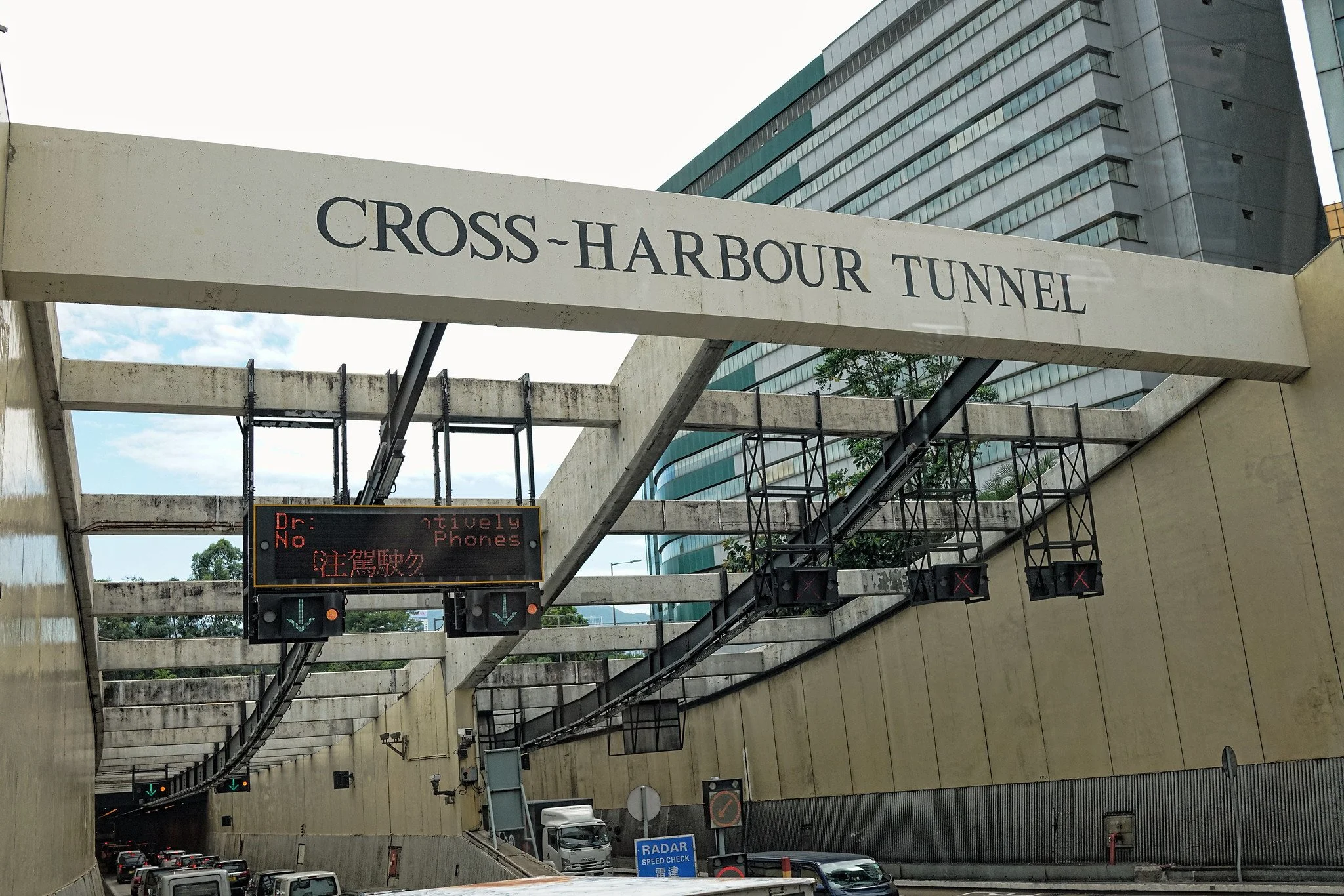
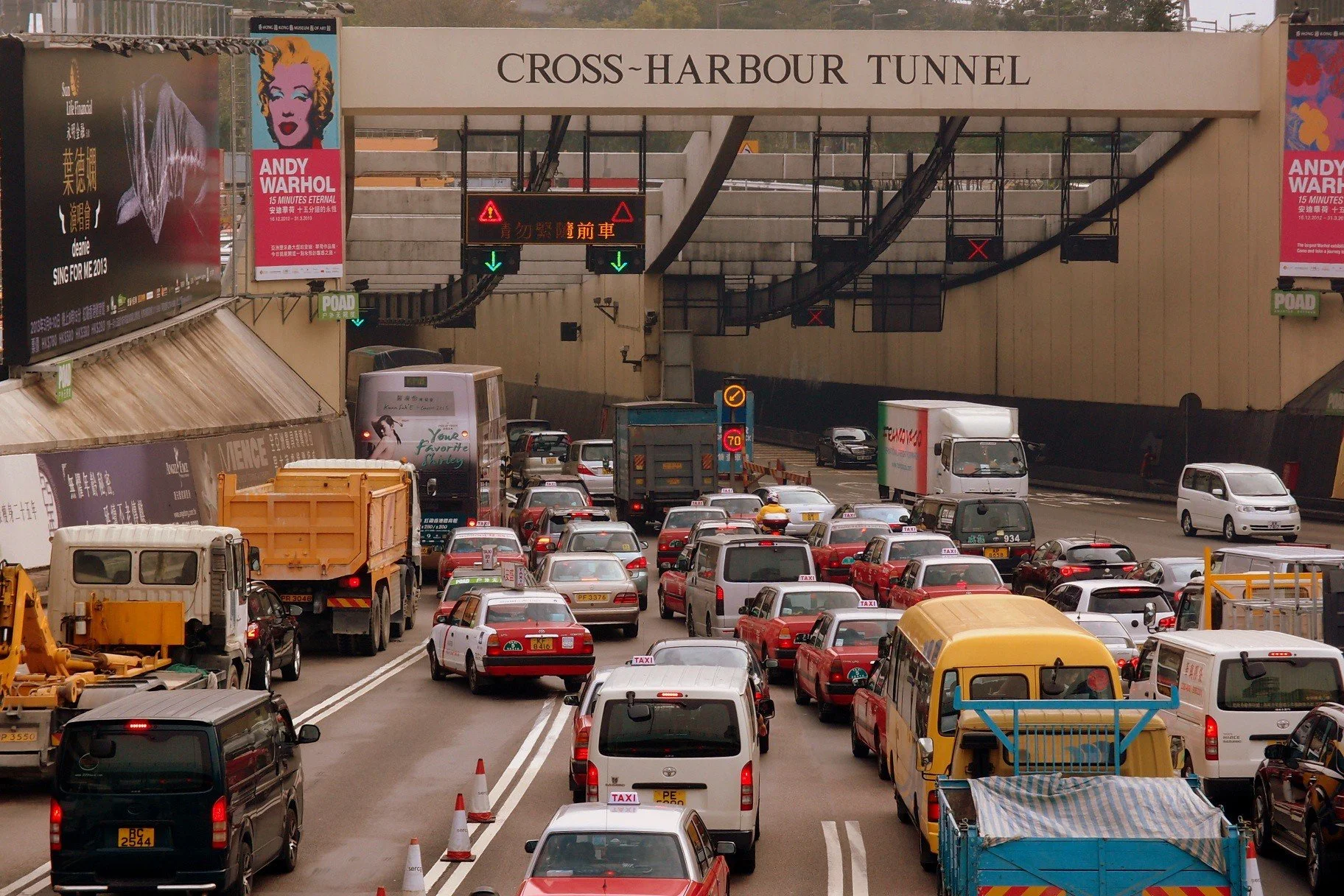
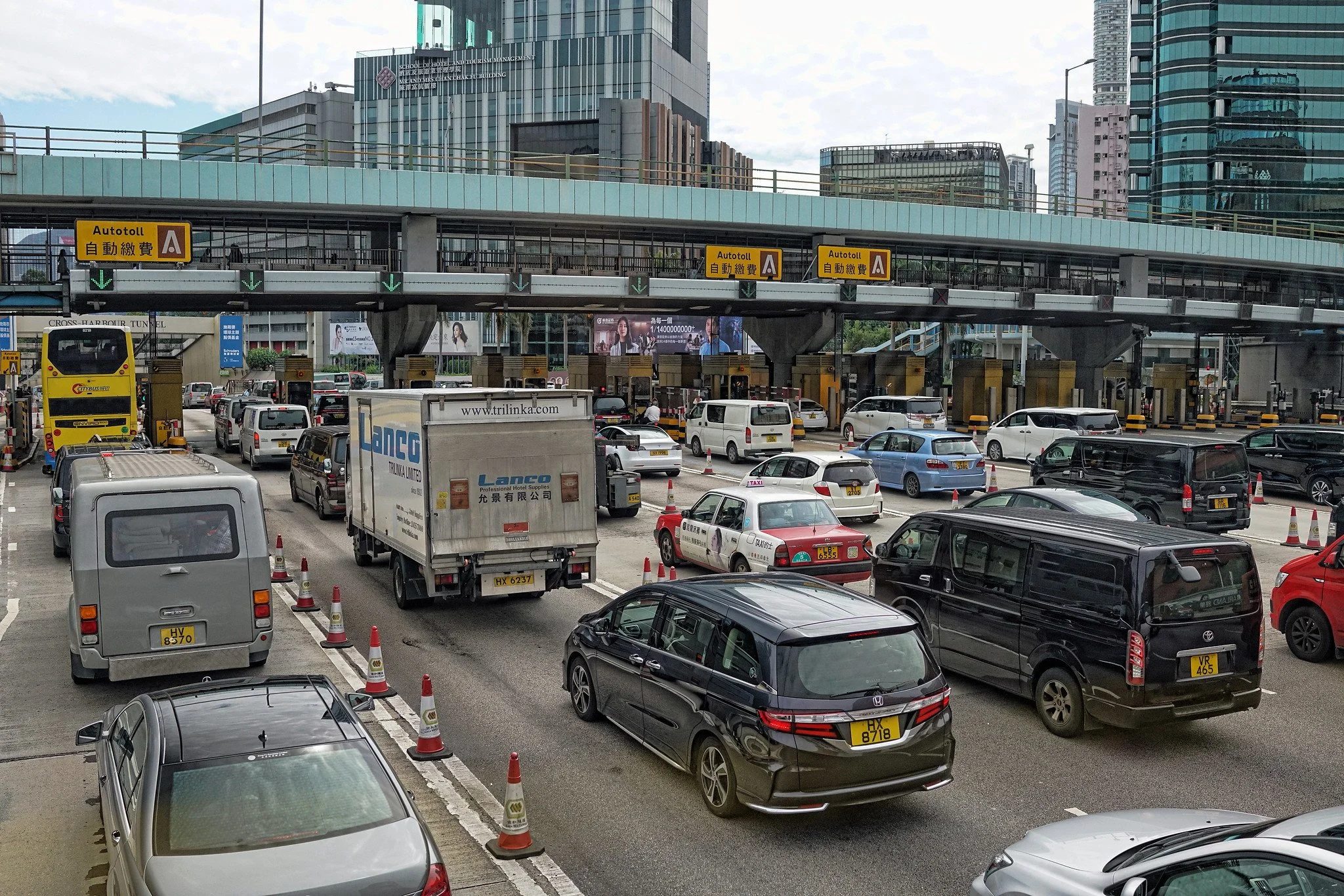
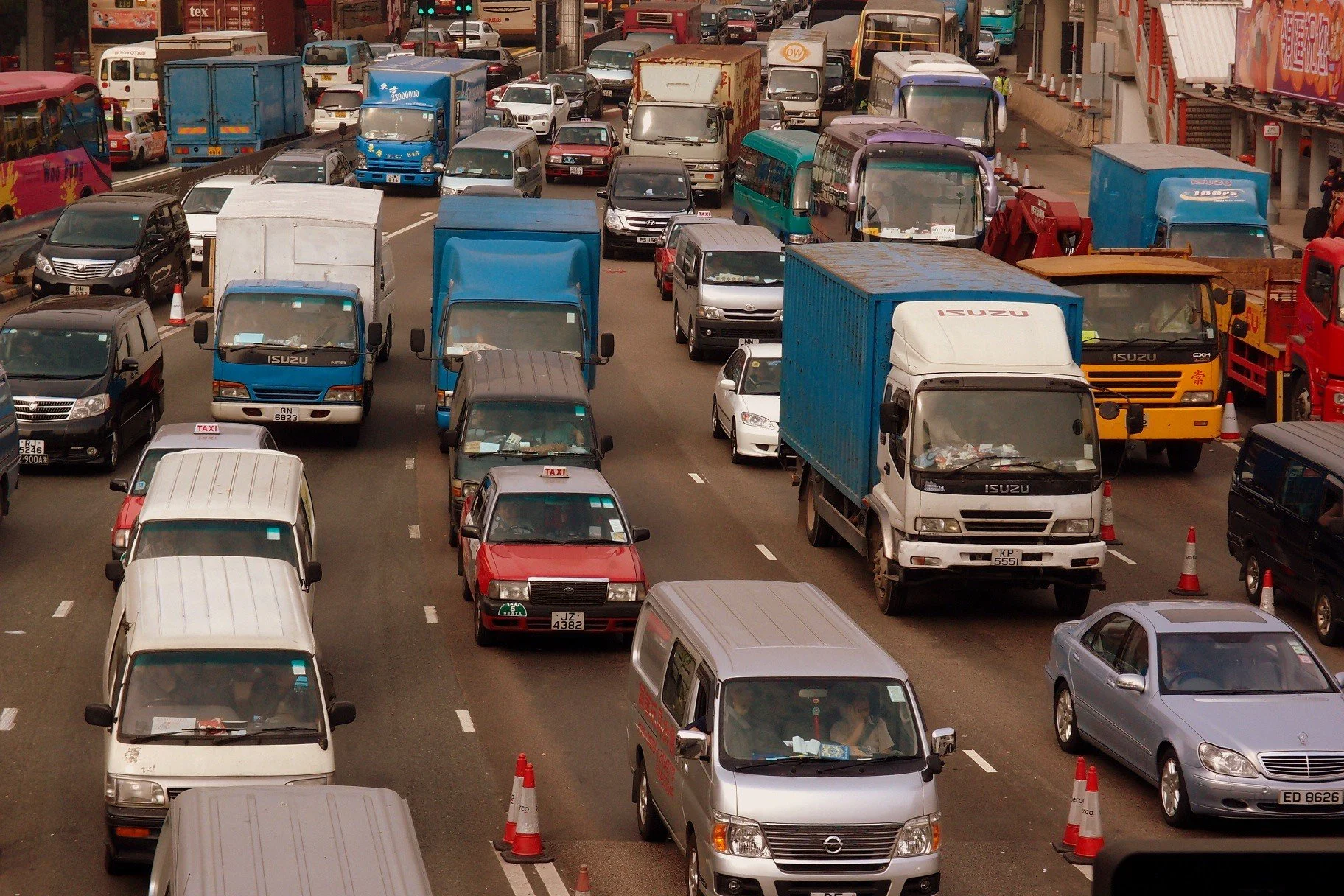
click on any image to enlarge
© Copyright Acknowledged | All rights reserved | images taken by Jamie
The Hong Kong Cross Harbour Tunnel opened 1972
What the tunnel became and the human nature factor
I have often wondered about the human nature factor when it comes to infrastructure in Hong Kong
Government planners rarely allow enough room for human nature, and the three harbour tunnels are the proof. They got the first one right. The Cross-Harbour Tunnel runs from the centre of Hong Kong Island to the centre of Kowloon - a straight, obvious line that matches the way people actually live and work. The Eastern and Western tunnels were added to take the strain off that original tunnel, and on a map they look like a tidy solution
On the road they are something else.both sit off the natural path. Using them means a real detour, extra junctions, and the same traffic jams on the approach roads once you get there. Hong Kong logic then takes over. Drivers would rather sit for thirty minutes in a queue they know, at a tunnel that drops them where they want to be, than add miles and uncertainty for the privilege of sitting in a different traffic jam. Habit beats a spreadsheet. The newer tunnels have eased some of the load, especially since the time varying tolls, but they have never broken the convenience of the first crossing. That is not a failure of engineering. It is people choosing the shortest route between two points, even when the shortest route is slow.
The Cross-Harbour Tunnel is not elegant. It is four lanes of steel and concrete sitting on the harbour floor, watched by cameras and washed down at night. It is also the reason Hong Kong Island and Kowloon stopped feeling like two separate places. It is the reason a Yorkshire engineer brought his family here in January 1972. And it is still, after all these years, the crossing most people think of first when they say they are going over the harbour.
That is the story I tell when the subject comes up, and the story I wanted to set down in full.
So there you go

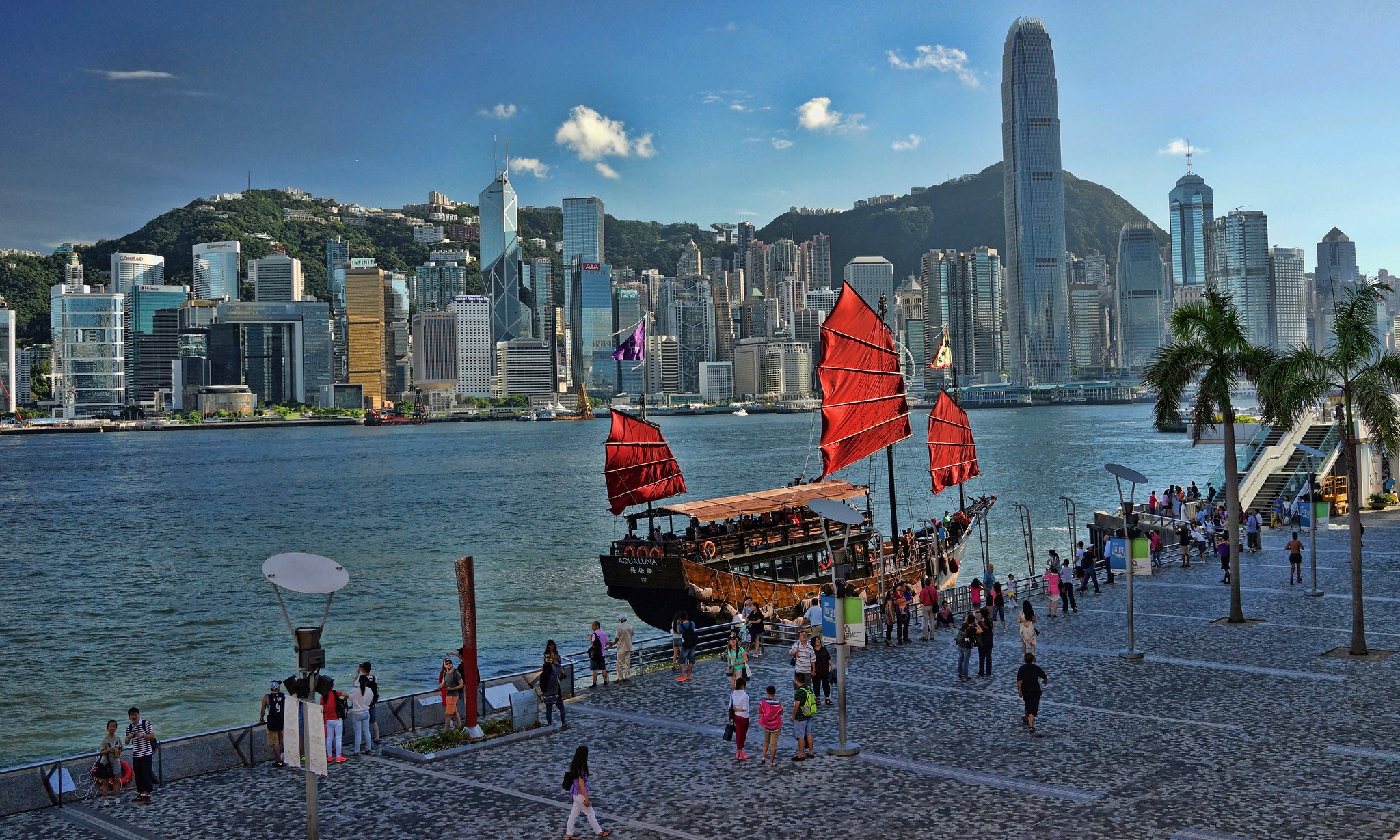
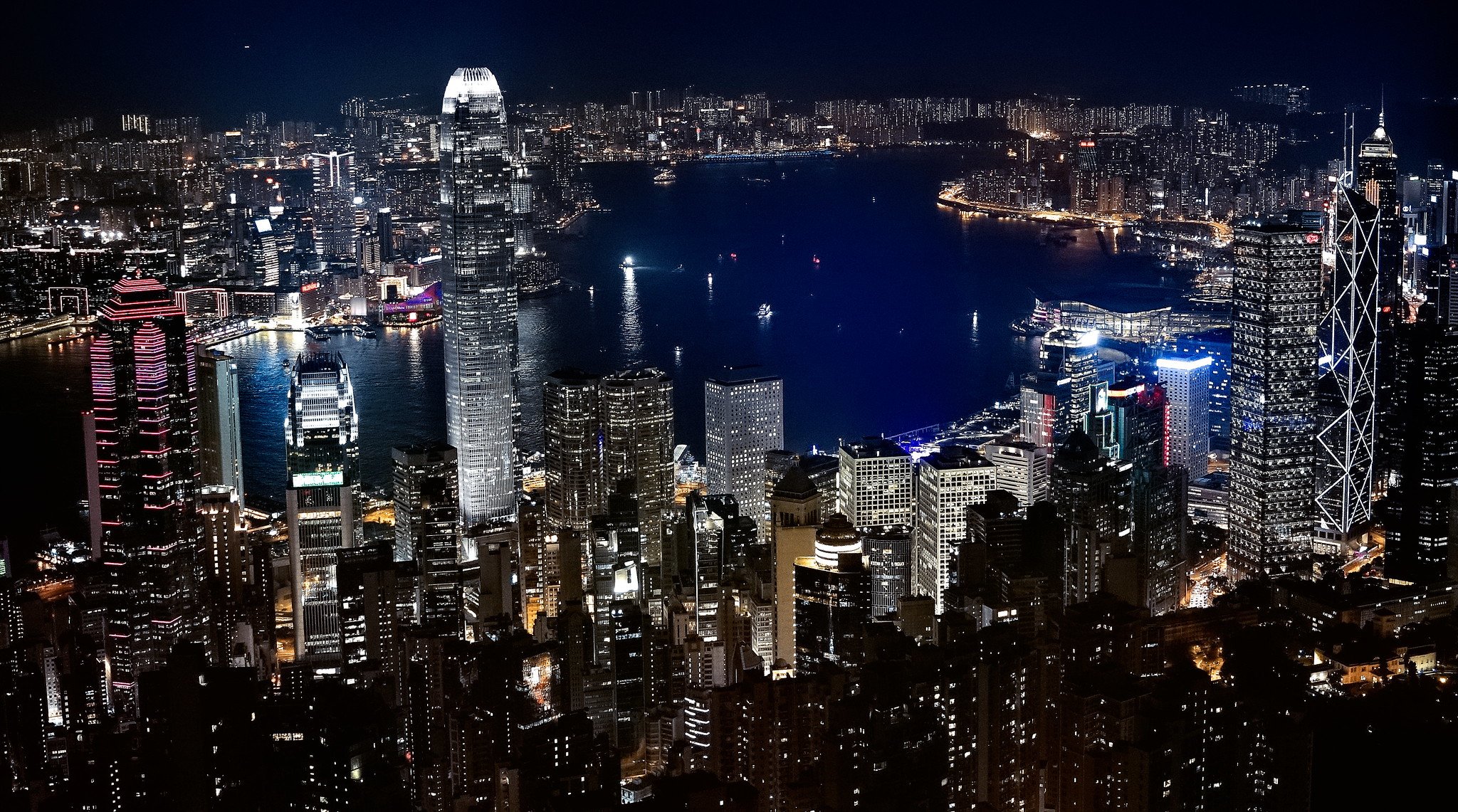
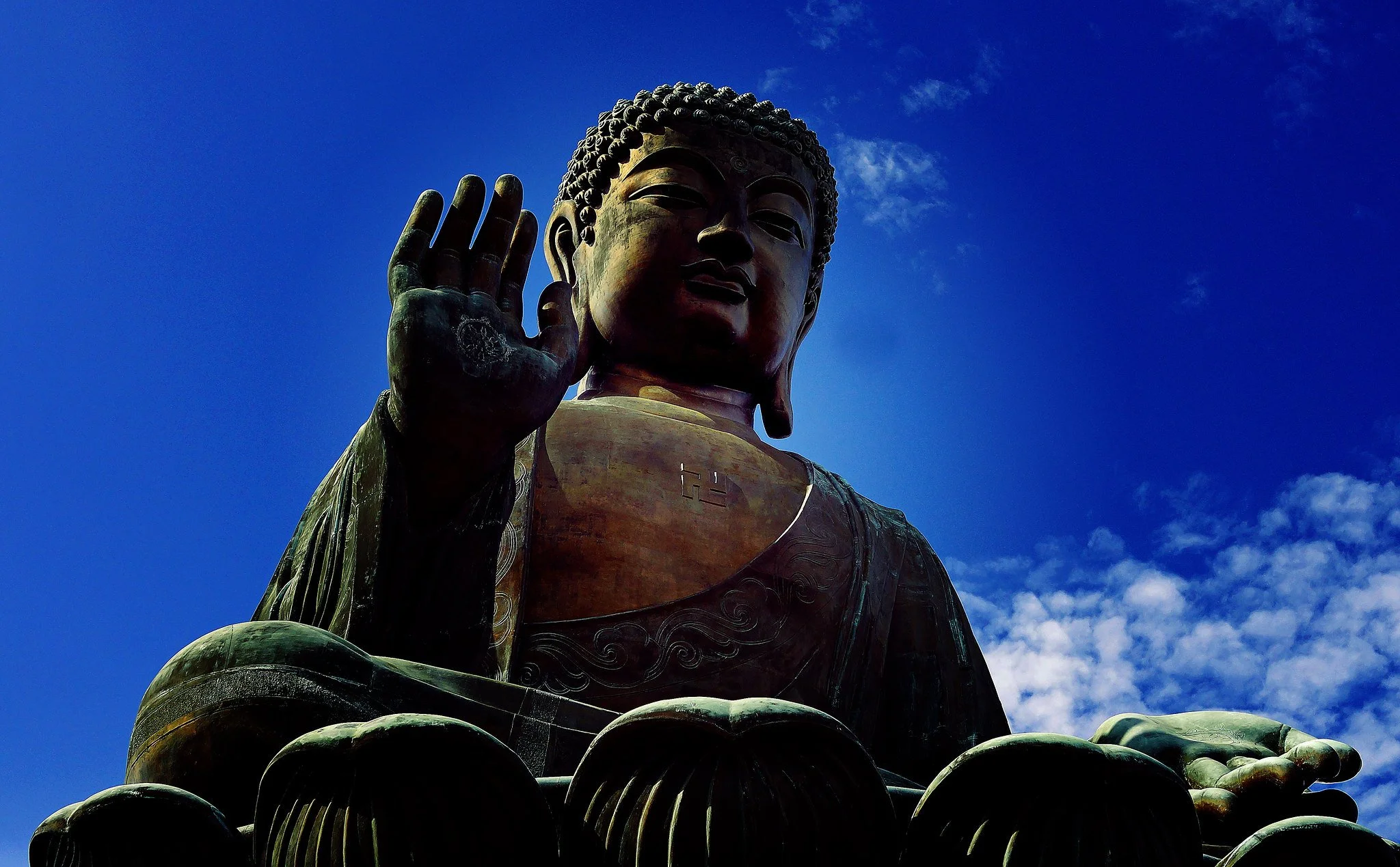
click on any image to enlarge
© Copyright Acknowledged | All rights reserved | images taken by Jamie