The Quiet History of Hong Kong's Post Boxes + the Royal Markings That Remain

The J3 Group - Premium Quality Private Tours | Experiences and Insider Chats since 2010
Me Jamie, your host, I am English and I have lived in Hong Kong since January 2nd 1972 - I know the place.
A meaningful blog post with a difference - tips on Travel, Tourism, Tours, Daily Life and my personal thoughts on Hong Kong.
Please do visit Amazing Hong Kong
Hong Kong | Pearl of the Orient


A Resident since 1972 - Private Tours of Hong Kong with Jamie
The Best Things to do in Hong Kong
click on the image to enlarge
© Copyright Acknowledged | All rights reserved | image created by Jamie
Street Post Boxes of Hong Kong - Victorian Red to Viridian Green
Foreword by Jamie
The Quiet History of Hong Kong's Post Boxes + the Royal Markings That Remain
Friends of mine in the business seem to have developed a bit of an obsession with the street post boxes in Hong Kong, especially the old ones that still carry a crown or some other royal marking from the colonial days. After more than 50 years living here I understand the pull. These boxes are quiet survivors on the pavement, green now but with stories that go back to the earliest days of the colony. I have walked past hundreds of them on tours and on my own walks, and the ones with the old cyphers always catch the eye. They stand there doing the same job they have done for decades, while everything around them has changed beyond recognition
I have made the odd mention of them in previous blog posts going all the way back tp 2013, time to do write something more substantial!.
The Beginning of the Postal Service in Hong Kong
The postal service in Hong Kong started almost as soon as the British arrived. The department was founded on 28th August 1841, and the first General Post Office opened on 12th November 1841. It was a small building on the slope above what is now St John's Cathedral, put up mainly for military use but quickly used by civilians as well. Early mail was collected and delivered from that office, and people had to take their letters there in person. There were no street boxes yet. Wooden letter boxes appeared later in suitable places around town and the suburbs, and some were fixed to police boxes, but the proper pillar boxes came later.
The First Postal Pillar Boxes of 1878
The first proper pillar post box was put up in Bonham Strand in Sheung Wan in April 1878. It was an experiment, placed there to make life easier for the Chinese community who were sending letters to Australia, San Francisco and Singapore. Stamps could be bought at a nearby shop. A second box went up at the West Point Police Station. They were not an instant success. The Postmaster General reported that collections were small and that people still preferred to take their mail to the General Post Office, especially once late fees and opening hours changed. Still, the idea had arrived, and the boxes were painted red, just as they were in Britain.
The Expansion of 1892
By 1892 the service had grown enough for a proper network. Fourteen British pillar boxes were installed that year. The locations included Kowloon near the wharf and godowns, Magazine Gap, several spots on Victoria Peak such as Victoria Gap, Mount Kellett and Plantation Road, and various points in Victoria from Queen's Road East to Bonham Strand West and up to the level of Robinson Road. Clearances were more frequent in town than up on the high ground. These early boxes carried the royal cypher of the reigning monarch. For Queen Victoria that was VR for Victoria Regina. Some of those original Victorian boxes survive today, though not on the streets.
Types of Street Post Boxes in Hong Kong
Over the years Hong Kong imported its cast-iron boxes from Britain until the 1980s, when local production of fibreglass boxes took over. The old cast-iron ones come in three main shapes: pillar type, wall type and oval type. The modern ones are mostly rectangular fibreglass, in sizes such as AA type, S-AA type, round top versions and large letter packet boxes. Today the majority of the roughly 1,170 street posting boxes are the rectangular fibreglass sort, with only a small portion still the old cast-iron survivors.
The Colour Change from Red to Green
Before the handover the boxes were red, the same colour used by the Royal Mail. In May 1997 Hongkong Post announced a corporate revamp. The territory's roughly 800 post boxes would turn viridian green over the following months, and a large purple and white hummingbird logo would appear on them and on the mail vans. The Postmaster General said it was a choice between building on the old red or making a statement that things really were different. Green was described as fresh and a sign of new starts and new initiatives. The change also coincided with the Post Office becoming a trading fund. Interestingly, the original British pillar boxes of the 1850s were green before they turned red in the 1870s, so the colour has come full circle in a way. The purple base that many of the boxes still have is part of the Hong Kong scheme and is not used the same way on the mainland.
The Royal Markings that Remain
After 1997 the crowns and royal cyphers stayed on the old boxes even as the colour changed. The markings show which monarch was on the throne when the box was made. VR for Victoria, GRV for George V, GRVI for George VI, and ERII for Elizabeth II. There is also one unique box, number 239 on Chater Road in Central, that carries the Scottish Crown rather than the usual English design. It was made that way to avoid controversy in Scotland after Elizabeth II became queen, since she is the first Elizabeth to rule Scotland. No boxes were made for Edward VIII because his reign was so short. In 2015 Hongkong Post considered covering the royal insignia on the remaining boxes with plates, saying the markings were inappropriate and might cause confusion. The idea met strong opposition from heritage groups who argued that the colonial past is still part of Hong Kong's history. The plan was dropped. In 2018 the government confirmed there was no need to remove the cyphers or change colonial street names.
The Scottish Crown Box 239 on Chater Road
Of all the old boxes that still stand, the one that stops people in their tracks is number 239 on Chater Road beside Statue Square. I have pointed it out more times than I can count on tours through Central. It sits right in the middle of the city, surrounded by banks and modern towers, yet it looks and feels different from every other post box in Hong Kong. The shape is oval rather than the usual round pillar or rectangular fibreglass, and the crown on the front is not the standard royal cypher you see on the Elizabeth II boxes. It is the Scottish Crown, the Crown of St Andrew, and this is the only one of its kind still in service here.
The box was cast by the Lion Foundry in Kirkintilloch, near Glasgow. You can still read the foundry mark on the base if you crouch down. These Scottish-made boxes were produced for use in Scotland after 1954. When Elizabeth II came to the throne she was the second Elizabeth in England but the first to rule Scotland, and that difference caused real trouble north of the border. Some boxes carrying the ordinary EIIR cypher were painted over or even attacked. To avoid further rows the Post Office ordered a batch made with only the Scottish Crown and no royal initials. A couple of those boxes found their way to Hong Kong in the mid-1970s, and 239 is the one that remains in daily use.
It started life painted the usual pillar-box red. After the handover it received the same green coat as the rest of the fleet, and the purple base that marks the Hong Kong boxes. The two posting slots are still there, and the last collection is at 3pm on weekdays and Saturdays. Hongkong Post has looked after it. I remember seeing it under a green tent one time while they carried out conservation work, with a temporary locked box chained nearby so people could still post. That sort of attention tells you they know what they have got.
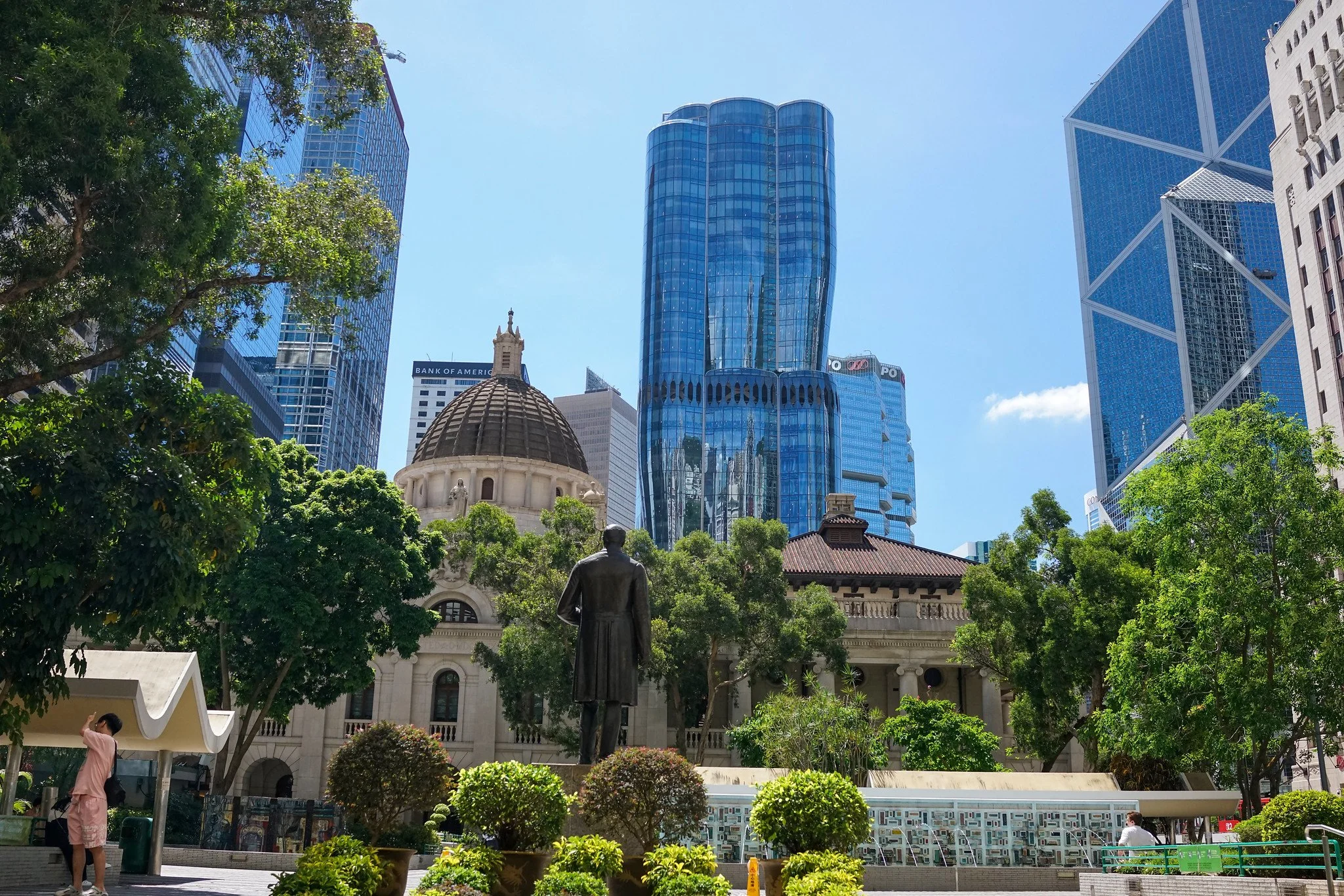
Standing next to it on a busy morning in Central you notice how ordinary and extraordinary it is at the same time. Office workers walk past without a second glance, tourists stop and take pictures, and the occasional local who knows the story will point out the crown to a friend. Statue Square itself has changed beyond recognition since the days when royal statues stood there, yet this cast-iron piece from a Scottish foundry keeps doing the job it was made for. It is not a museum object. Letters and postcards still go in, and the collection van still stops. In a city that rebuilds itself every few years, that kind of quiet continuity is worth pausing for.
I do not turn every tour into a post-box lecture, but if we are already on Chater Road I will mention it. Guests who have been reading about colonial remnants usually light up when they see the different crown. It is a small, concrete reminder that Hong Kong’s connection to Britain was never just one simple story, and that some of the odd details from that period are still sitting on the pavement where anyone can find them. Next time you are walking through Statue Square, take a moment with number 239. Drop a postcard in if you like. It has been collecting mail for roughly 50 years and shows no sign of stopping.
Post Box Numbers Then and Now
The figures have changed over the years, but the old boxes are a tiny fraction of the total.
• There are about 1,170 street posting boxes in Hong Kong today. • In October 2015 there were 1,148 free-standing boxes, of which 59 still carried royal insignia and were in service. • Of the surviving colonial-era boxes, roughly 64 remain in service and another 9 are on display. • Two Victorian VR boxes are on display in museums. • Seven GRV boxes from the reign of George V are still in service, with one more in a museum. • Two GRVI boxes from George VI are in service, and one sits unused at Stanley Post Office. • Around 49 ERII boxes from Elizabeth II are in use, with several more on display. • One box carries the Scottish Crown. • A handful of older boxes have no royal insignia at all. • Hongkong Post restored nine old posting boxes in October 2013. • Four old boxes are now on permanent display: two at the Postal Gallery in the General Post Office, one at the Postal Gallery in the Hongkong Post Building in Kowloon Bay, and one on the external wall of Stanley Post Office.
A Few Obtuse Facts and Figures
The first two pillar boxes of 1878 averaged only about 60 letters a week at the start, almost all on mail days, and numbers dropped when clearance times improved. In 1892 the Iin town boxes were cleared five times a day, the suburban ones three times, and the Peak and Kowloon ones only twice. Some of the oldest working boxes are more than 70 years old and still cast iron from British foundries. One of the George V boxes sits near Shek Pik Reservoir on Lantau, another at Sok Kwu Wan on Lamma. The Scottish Crown box on Chater Road is the only one of its kind in Hong Kong. Retired boxes used to be auctioned off. In the mid-1990s a few pillar boxes fetched tens of thousands of Hong Kong dollars, with one George V example going for HK$50,000 (about US$6,410 at the time). The hummingbird logo was chosen because it looked friendly, fast and efficient, with the body shaped like a letter P and the wings suggesting a franking mark. Green remains the colour today, and the old cast-iron boxes with their crowns still stand among the modern fibreglass ones, doing the same quiet job they have always done.
What Happens Next
The post boxes and the service behind them are not what they once were. Letters have largely disappeared. Most people now send a message on their phone rather than put paper in an envelope. Online shopping has grown, but the parcels that arrive at the door almost always come from private couriers, not the Post Office. Hongkong Post has recorded continuous losses in recent years, the largest being HK$821 million (about US$105 million) in the 2024-25 financial year. Overall mail volumes fell by roughly 7% a year between 2019-20 and 2024-25, a cumulative drop of 44%. Even the e-commerce side has not filled the gap the way many hoped.
The Government has acknowledged the problem. It is reviewing the long-term operating model of Hongkong Post, and it has said it will keep an open mind on options. A cash injection of HK$4.6 billion (about US$590 million) has been approved to keep services running for the next few years while that review takes place. Plans to rebuild the Air Mail Centre were scrapped because projected volumes no longer justified the cost. Collection times and delivery patterns are already being looked at, and the network of post offices is under pressure. The universal service obligation remains, so the boxes and the basic service will not simply vanish overnight, but the shape of that service is likely to change.
For the street boxes themselves the picture is quieter but clearer. The old cast-iron ones with their crowns will not be replaced when they finally wear out. The modern fibreglass boxes will stay for as long as there is still something to collect, which for ordinary letters is not much. Some may end up as heritage items rather than working boxes. Others will simply become less frequent on the pavement as collection rounds are thinned out. The Scottish Crown box on Chater Road will almost certainly be one of the last of its kind still standing, not because it is specially protected, but because it is solid, distinctive, and still useful enough that no one has yet found a reason to take it away.
None of this is unique to Hong Kong. Postal services everywhere are dealing with the same shift from letters to parcels and from public to private. What is different here is how much of the colonial street furniture is still in daily use. The green boxes with their old markings have already survived one big change in 1997. They may not survive the next one in quite the same form. For now they remain, doing a smaller job than they were built for, on streets that have changed around them many times before.
The status of the General Post Office in Hong Kong October 2026
The Central General Post Office at 2 Connaught Place is not closed for good yet, but its days in that building are numbered and the main headquarters function has already left.
The building that stands there now opened on 11th August 1976. It is the fourth generation of General Post Office in Hong Kong. The first was a small structure above what is now St John’s Cathedral in 1841, the second was on Queen’s Road near Pedder Street from 1846, and the third (the well-known Edwardian one) stood at Pedder Street and Des Voeux Road from 1911 until it was pulled down in 1976 to make way for the MTR. The 1976 building was put up on reclaimed land and was deliberately kept low so it would not block the view from Jardine House.
Headquarters operations have already moved. The fifth-generation Hongkong Post headquarters is now in the new Hongkong Post Building at 8 Wang Kee Street, Kowloon Bay. That building was commissioned in full in March 2024 and houses the headquarters, the Kowloon Bay Post Office, a new Postal Gallery, the Kowloon Bay Delivery Office and other support units. So the big organisational role has already left Central.
What remains at Connaught Place is mainly the local counter service, post office boxes and some delivery functions that serve the Central and Western district. It still operates, but the building feels quieter than it used to because the volume of ordinary letters has fallen and the headquarters staff have gone. That is why it can look as if it has closed when you walk past.
The building itself is scheduled for demolition. It sits inside the Central Yards redevelopment (Henderson Land) on the harbourfront site. Local postal facilities will be reprovisioned in a new building north of Lung Wo Road and south of Yiu Sing Street, on the ground floor and basement levels of Phase 1 of Central Yards. Those new facilities are expected around the second quarter of 2027. Once they are open, the existing General Post Office building will be demolished under the lease terms. The demolition itself is expected to take six to eight months. The original site then becomes part of Phase 2 of Central Yards, currently targeted for completion in 2032.
In short, the Connaught Place building is still standing and still offering some services, but it is in the final chapter. The headquarters has already relocated to Kowloon Bay, and the Central counters will move to the new Central Yards facilities around mid-2027 before the old building comes down. It is not closed for good at this moment, but the end of the 1976 building is clearly in sight.
So there you go.

click on any image to enlarge
© Copyright Acknowledged | All rights reserved | images taken by Jamie