The Xiqu Centre Story - Hong Kong's home for Chinese Opera
West Kowloon Cultural District Authority - The Visionary Hong Kong Hub

The J3 Group - Premium Quality Private Tours | Experiences and Insider Chats since 2010
Me Jamie, your host, I am English and I have lived in Hong Kong since January 2nd 1972 - I know the place.
A meaningful blog post with a difference - tips on Travel, Tourism, Tours, Daily Life and my personal thoughts on Hong Kong.
Please do visit Amazing Hong Kong
Hong Kong | Pearl of the Orient
Customised Private Tours + Experiences in Amazing Hong Kong
Jamie has lived in Hong Kong - Pearl of the Orient for 50+ years
Carefully Crafted Personalised and Customised Itineraries by Jamie | Hong Kong’s Most Experienced Private Tour Guide for : Solo Travellers Friends Families Seniors Couples Business People MICE Delegates.
Private Tours Cultural Tours Walking Tours Sightseeing Tours City Tours Night Tours Layover Tours Transit Tours Private Shore Excursions Bespoke Tours Personalised Tours Jewish Heritage Tours Luxury Private Tours Day Tours Luxury Boat Tours Themed Tours Private Family Tours Private Day Tours Corporate Tours
Just you, your family or friends and Jamie your personal English private tour guide - over 2,400+ tours completed since 2011 - Jamie offers quality Private Tours of Hong Kong
Tour Group Size 1 - 6 people only
J3 Group Hong Kong | J3 Consultants Hong Kong | J3 Private Tours Hong Kong
Creating Memories That Will Last A Lifetime
Go here for the Hong Kong Michelin Restaurant Guide which includes the Bib Gourmand Category

A Resident since 1972 - Private Tours of Hong Kong with Jamie
The Best Things to do in Hong Kong
click on the image to enlarge
© Copyright Acknowledged | All rights reserved | image taken by Jamie
The Xiqu Centre | Iconic Chinese Opera | Hong Kong
Foreword Part 1
I can’t say I am a fan of Chinese Opera, in fact in 50+4 years here I have seen 2 performances only and frankly newer again, each to their own, however I respectful of it’s place in Hong Kong society. I should also point out that I am not a fan of Wesern Opera, I am not a fan of stage plays in theaters and I hate live music - my wife reckons it is because I am from Yorkshire in the UK where thee highlight of culture is going to the pub (something else I don’t do)
In a nutshell my mind is a bit of a cultural wasteland.
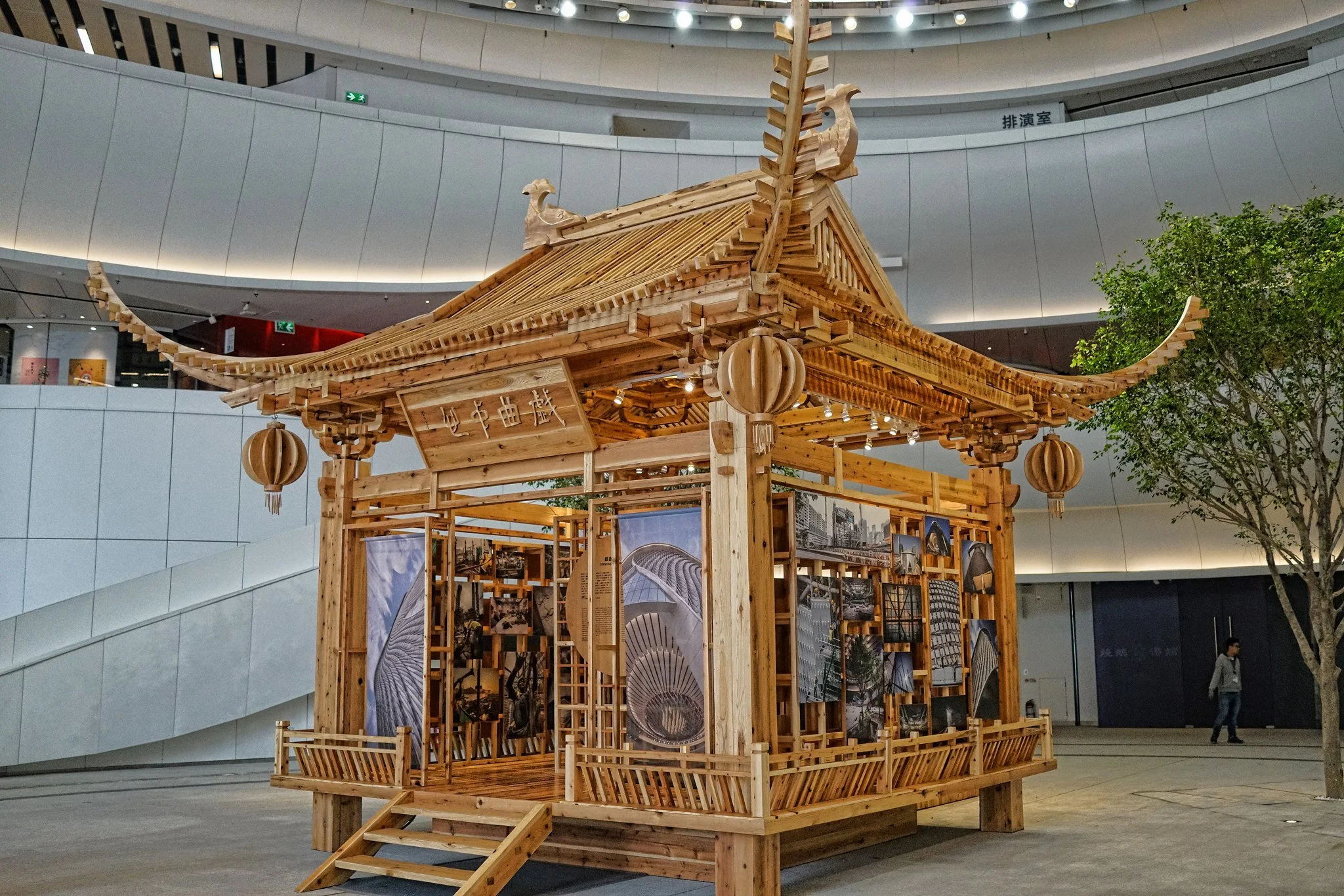
Of the 2 Chinese Opera’s I went to neither was in what you would call a formal setting, they where out in the boonies with traditional hand built bamboo structures and stages and a very rustic opera house with room for a few hundred people only, I really admired the make up and costumes but the actual “singing” made me cringe so that was that.
As a long-time Hong Kong resident with a deep passion for the city's cultural heritage, I have always believed that preserving and celebrating traditional arts like Chinese opera is essential to maintaining our unique identity amid rapid modernisation. The Xiqu Centre stands as a shining example of this commitment, serving as a dedicated home for xiqu in one of the world's most dynamic cities.
So, the Centre is quite an interesting design to put it mildly
In this detailed overview, I explore its history, architecture, operations, and reception, drawing on its role as both a performance venue and a cultural beacon. Whether you are a seasoned opera enthusiast or a curious newcomer, this centre offers layers of experience worth discovering.
Literal Translation of Xiqu
Xiqu (戲曲) is the standard Mandarin term for traditional Chinese opera.
Xi (戲) literally translates as "drama", "play", or "theatre".
Qu (曲) literally translates as "tune", "melody", or "song".
So the literal translation of Xiqu is "dramatic tunes" or "theatre of melodies" / "melodic drama".
It refers to the comprehensive art form that combines singing (tunes/melodies), acting, dialogue, acrobatics, and martial arts in traditional Chinese theatrical performances. The term encompasses hundreds of regional styles, including Cantonese opera (Yueju), Peking opera (Jingju), Kunqu, and many others.
Overview and Primary Purpose of the Xiqu Centre
The Xiqu Centre is Hong Kong's premier venue dedicated to Chinese opera, or xiqu, which encompasses a rich tapestry of traditional musical theatre forms, with a strong emphasis on Cantonese opera. Located at the eastern edge of the West Kowloon Cultural District at 88 Austin Road West, Tsim Sha Tsui, it opened as the first major performing arts facility in the district. Its primary purpose is to preserve, promote, and develop the heritage art of Chinese opera by hosting high-calibre performances, educational programmes, workshops, and research initiatives. The centre blends traditional elements with contemporary innovation, making xiqu accessible to both local audiences and international visitors while nurturing emerging talent.
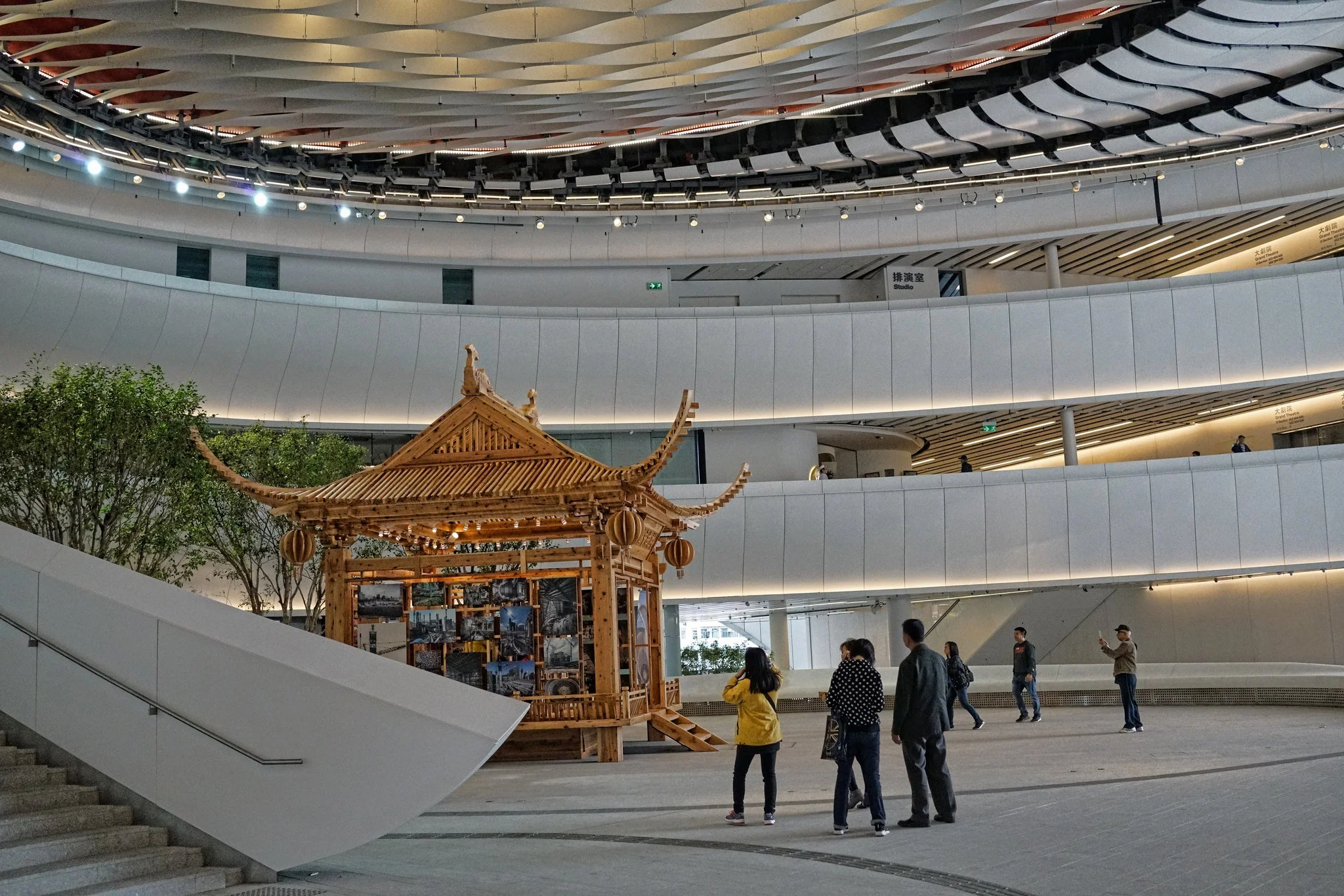
Spanning approximately 28,164 square metres across eight storeys, the building includes a 1,073-seat Grand Theatre for large-scale productions, a more intimate 150-200 seat Tea House Theatre for smaller performances, eight professional studios, a seminar hall, and extensive public spaces such as a large open atrium for exhibitions, demonstrations, and free events. It serves as a hub not only for performances but also for training, community engagement, and cultural exchange across the greater Chinese-speaking world, where over 250 regional xiqu traditions exist.
Timeline of Development
Early Planning and Design Competition: The project emerged as part of the broader West Kowloon Cultural District initiative. An international design competition selected the winning proposal in the early 2010s.
Construction Phase: Building took around six years, with construction involving significant engineering challenges, including 6,700 tonnes of steel. The centre was completed in late 2018.
Official Opening: The Xiqu Centre welcomed the public in January 2019, marking a milestone as the first completed major venue in the district and a gateway to the cultural area.
Post-Opening Years: Since 2019, it has hosted regular programming, including the Black Box Chinese Opera Festival, resident troupe performances, and collaborations with troupes from Hong Kong, Mainland China, and beyond. Operations adapted during the pandemic, with full activities resuming in subsequent years.
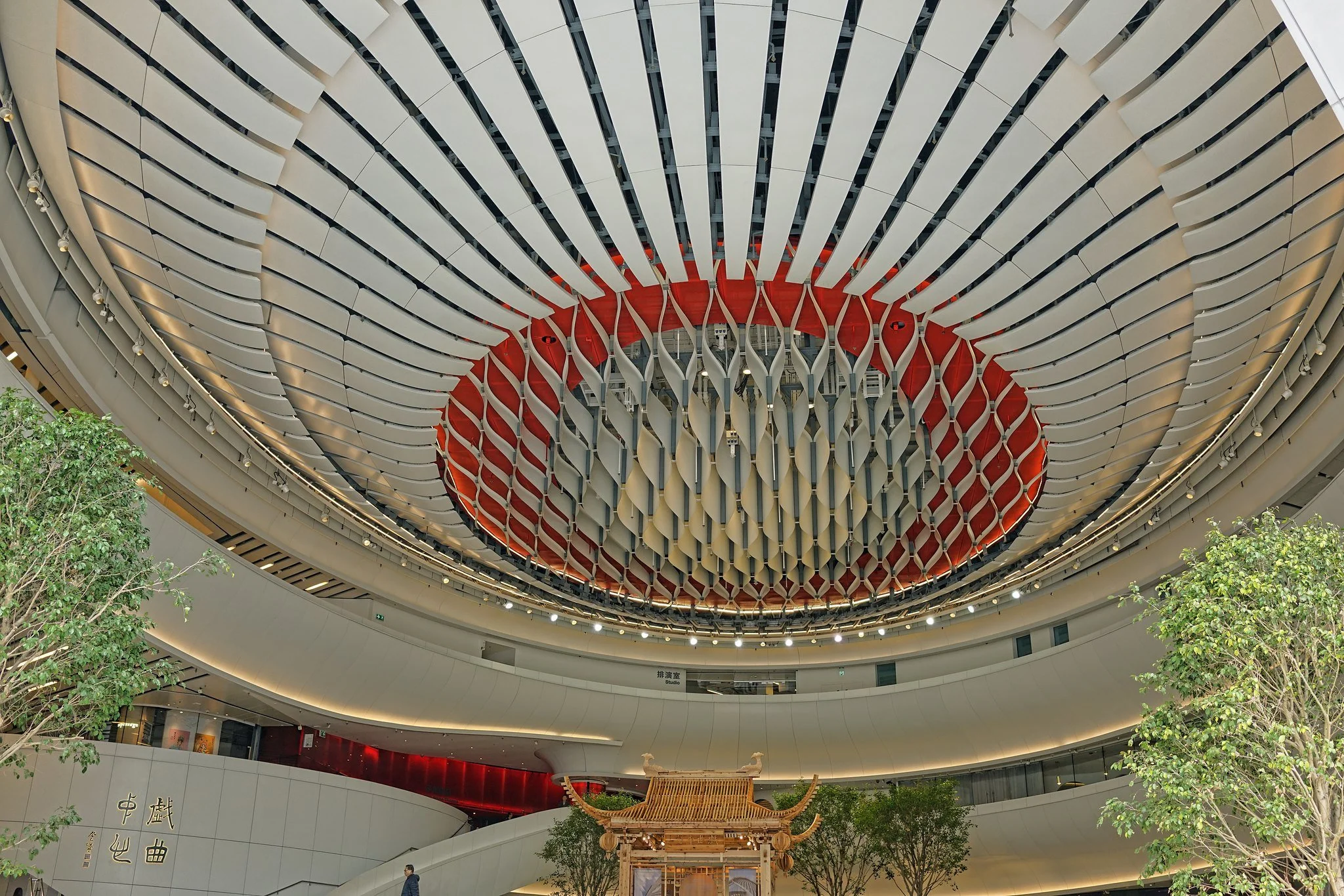
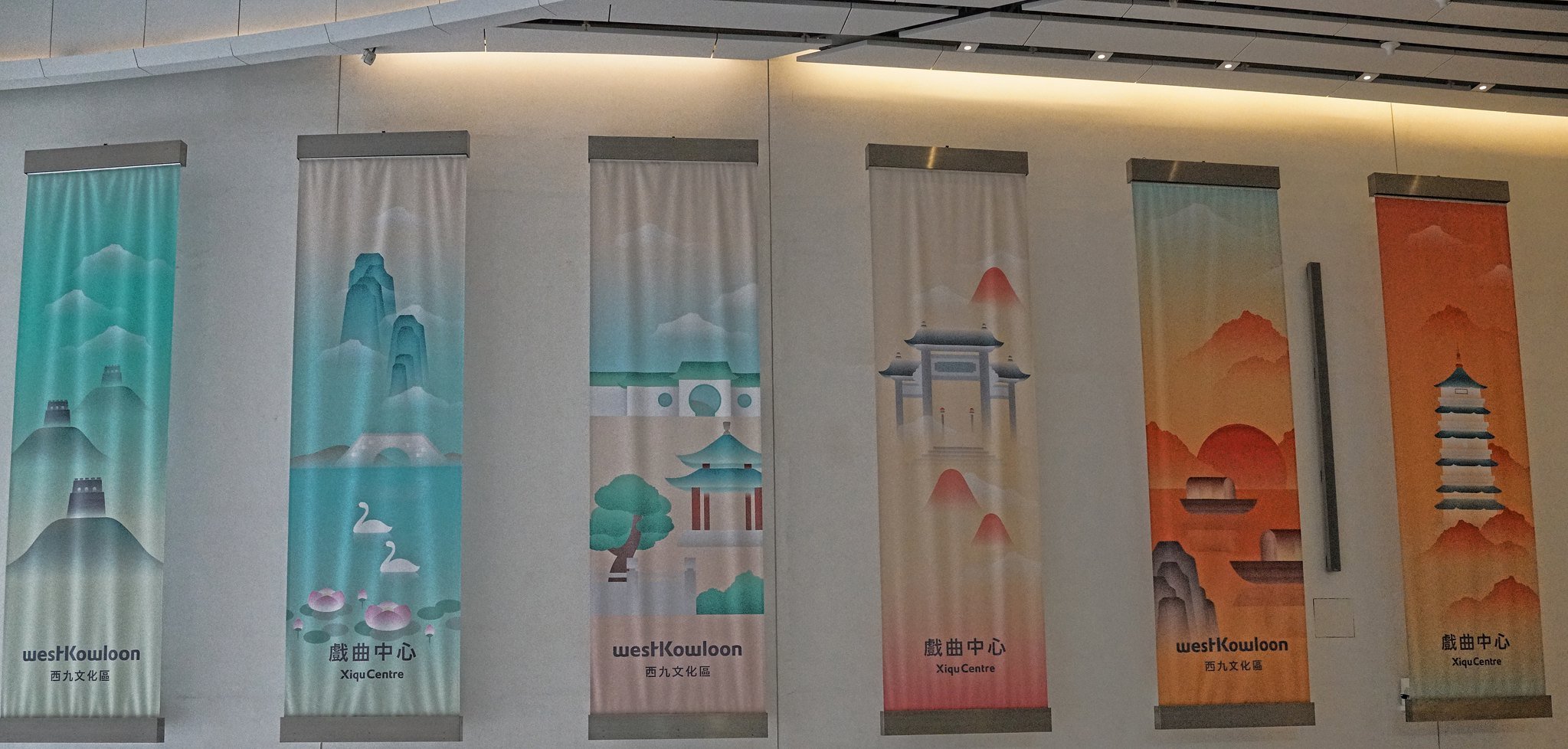
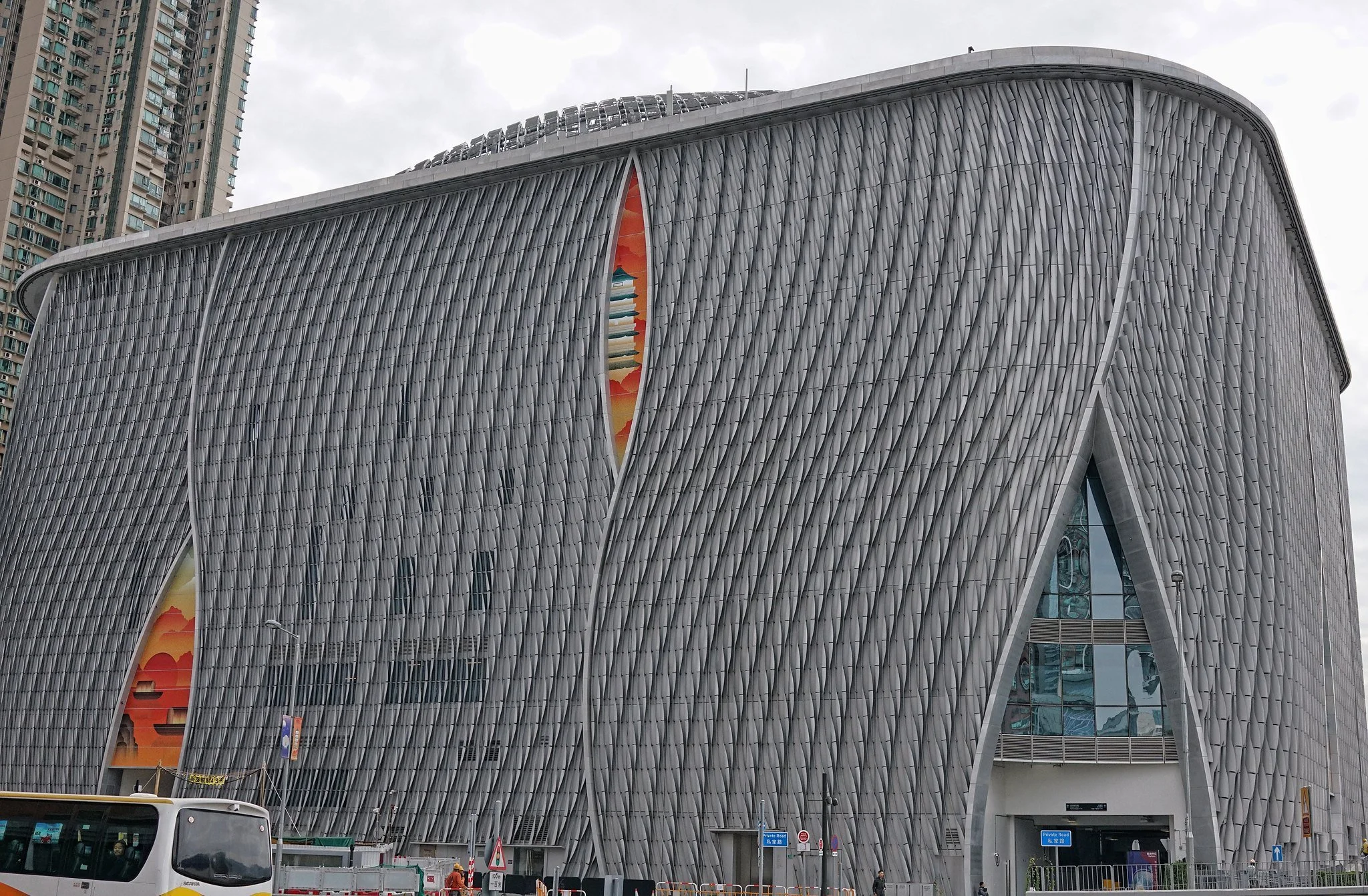
click on any image to enlarge
© Copyright Acknowledged | All rights reserved | images taken by Jamie
The Xiqu Centre | Iconic Chinese Opera | Hong Kong
Architect and Design Inspiration of the Xiqu Centre
The Xiqu Centre was designed by Revery Architecture (formerly Bing Thom Architects, based in Canada) in joint venture with the local firm Ronald Lu & Partners. The late Bing Thom was a key figure in the conceptual phase.
The building's distinctive appearance draws inspiration from traditional Chinese lanterns, glowing stage curtains, and the fluid "Qi" energy flow concept central to Chinese philosophy and performing arts. The dramatic curvilinear façade features curved aluminium fins arranged in flowing waves, creating a shimmering, lantern-like effect that appears to move like a parting theatre curtain at the entrances. This design symbolises the opening of cultural doors and the dynamic evolution of xiqu.
Inside, the Grand Theatre is elevated high above ground level, allowing for a spacious public atrium below filled with natural light and activity. Moon gate motifs, drawn from traditional Chinese gardens, feature in the theatre interiors, while the overall layout promotes a sense of sanctuary blending performance, education, and public interaction. The design has earned praise for its sustainability credentials and its sensitive fusion of heritage with modernity.
Opening Hours and Admission Fees for the Xiqu Centre
The Xiqu Centre is open daily from 10am to 10.30pm, with the ticket office operating from 10am to 9pm
Admission to the building and many public areas, exhibitions, atrium events, workshops, and guided tours is generally free, making it accessible for casual visits. Performance tickets vary:
Tea House Theatre Experience (90-minute Cantonese opera with tea and dim sum): HK$318 to HK$380 (approximately US$41 to US$49).
Grand Theatre performances: Typically range from HK$200 to over HK$1,000 (US$26 to US$128+), depending on the production and seating.
Discounts are often available through official channels or for certain audience groups.
Funding, Operating Budget, and Events - The Xiqu Centre
The Xiqu Centre is operated by the West Kowloon Cultural District Authority, a statutory body funded primarily through a one-off government endowment granted for the entire district project. This endowment has faced depletion pressures over time, leading to operating deficits and ongoing discussions about sustainable funding models. Specific figures for the Xiqu Centre alone are not always separated out, but it contributes to the broader authority's operations, which have reported annual deficits in the hundreds of millions of Hong Kong dollars.
Since opening in 2019, the centre has hosted dozens of events annually, including full productions, festivals such as the Black Box Chinese Opera Festival, workshops, and free atrium performances. It maintains a steady programme with resident troupes and visiting companies, aiming for regular weekly activities alongside major seasonal events.
Key Statistics:
Building size: 28,164 square metres
Grand Theatre seats: 1,073
Tea House Theatre seats: 150-200
Steel used in construction: 6,700 tonnes
Sustainability rating: BEAM Plus Gold
Public Opinion and Reception - the Xiqu Centre
Visitors and critics generally praise the Xiqu Centre for its stunning architecture, professional facilities, and role in revitalising interest in Chinese opera. Many highlight the Tea House Theatre as an excellent, approachable introduction for newcomers, with subtitles, narration, and refreshments enhancing the experience. Reviews frequently describe it as world-class, immersive, and a must-visit for cultural depth, with strong appreciation for the free events and educational aspects.
Some early criticism focused on high rental costs for troupes and the choice of the Mandarin-derived name "Xiqu", but these have largely given way to positive recognition of its contribution to Hong Kong's arts scene. It is widely seen as boosting the city's international cultural profile, though challenges remain in broadening audience demographics beyond traditional fans.
Would it be accurate to say that Chinese opera is not universally liked by Western people.
It is a niche interest rather than a broadly popular art form among general Western audiences. This does not mean it lacks admirers - there are dedicated enthusiasts, scholars, and travellers who deeply appreciate it - but it is far from enjoying widespread appeal or mainstream acceptance in Europe, North America, Australia, or similar regions.
Why This Is the Case
Chinese opera (xiqu), whether Peking Opera, Cantonese opera, or other regional styles, presents several barriers for many Western viewers:
Vocal Style: The distinctive high-pitched, nasal, or "shrill" singing (especially the jing and dan roles) often strikes untrained Western ears as grating or unpleasant, in contrast to the smoother, more rounded bel canto tradition of Western opera.
Stylised Conventions: Heavy reliance on symbolic gestures, elaborate makeup and costumes, acrobatics, and non-realistic storytelling can feel alien without prior knowledge of the cultural codes and historical stories.
Language and Context: Performances are usually in Chinese, with cultural references rooted in Chinese history, literature, and philosophy. Even with subtitles, the emotional and narrative resonance can be harder to access.
Acquired Taste: Like Western classical opera, ballet, or experimental theatre, it demands patience and repeated exposure. Most casual Western audiences have little daily contact with it.
Many sources note that Westerners who encounter it for the first time (often as tourists in Hong Kong, Beijing, or at festivals) may enjoy the visual spectacle (which is quite something) and acrobatics but struggle with the vocal delivery and length of full productions.
Important Nuances
Not Universal Dislike: Plenty of Westerners admire Chinese opera. Historical tours by masters like Mei Lanfang in the 1930s received positive responses in the US. Today, fusion productions, short excerpts for tourists, and performances at venues like the Xiqu Centre attract appreciative international visitors. People with backgrounds in world music, Asian studies, or theatre often find it fascinating.
Comparison to Western Opera: Even in the West, traditional opera is not "universally liked." Many Europeans and Americans find Mozart or Wagner equally inaccessible or boring. Chinese opera faces the added challenge of cross-cultural distance.
Growing Interest: Younger Western audiences exposed through social media, video games, or cultural exchange sometimes develop curiosity. However, this remains a small segment.
As I mentioned above, it is not my cup to tea but to emphasise I am not a fan of Western Opera, Ballet or live music, I guess everyone has their own likes and dislikes..
It is fair and truthful to say Chinese opera is not universally liked by Western people - just as most traditional art forms are not universal anywhere. Its beauty lies in its depth and cultural specificity, which is precisely what makes it challenging for outsiders. Efforts to adapt it (shorter formats, English elements, fusion works) help broaden appeal, but the core traditional form will likely remain a specialised taste. This is not a flaw; it is the nature of rich, heritage-based arts. For those willing to invest time, it offers rewarding insights into Chinese aesthetics and storytelling.
.. and one final point on cultural heritage, in 1975 we took a family holiday (cruise) for 6 weeks and for me the highlight was when we visited South Africa and we where taken to a traditional Zulu village and we where totally captivated by the beating of drums and the singing and leaping 6 feet into the air, just the sheer joy of the event… maybe there is hope for me yet.
My Considered Opinion and Suggestions
In my view, the Xiqu Centre is a triumph of thoughtful cultural infrastructure - a place where tradition meets innovation without losing its soul. Its lantern-like design not only catches the eye but invites exploration, making opera feel vibrant rather than museum-like. As Hong Kong navigates its cultural future, this venue reminds us of the value in safeguarding intangible heritage while adapting to contemporary tastes.
Out-of-left-field comment:
Imagine pairing a performance with a dim sum tasting tour in nearby streets - it would create the perfect full-day sensory journey through Cantonese culture.
Suggestions:
Attend a guided tour to appreciate the architectural details and xiqu history.
Try the Tea House experience for an engaging, low-pressure entry point.
Check the atrium for free music or demonstrations on weekends.
Combine a visit with other West Kowloon Cultural District attractions for a broader cultural day.
Participate in workshops to try hands-on crafts inspired by opera costumes or prop
click on the image to enlarge
© Copyright Acknowledged | All rights reserved | image taken by Jamie
West Kowloon Cultureal District | WKCDA purview | Hong Kong
Foreword Part 2
i quite like the image above however it does not show the full scope of the West Kowloon Cultural District (in the image from the far left to the right where the Xiqu Centre is which is not shown in the image, the focal point is naturally ICC which is Hong Kong’s tallest building at 118 floors but the have done a fabulous job building all the museums and such
As someone who has spent decades exploring and sharing Hong Kong’s cultural landscape through my work as a private tour guide, I have watched with great interest as the West Kowloon Cultural District has taken shape. The West Kowloon Cultural District Authority plays a central role in this ambitious project, acting as the driving force behind one of Asia’s most significant cultural developments. In this detailed overview, I examine the organisation’s background, responsibilities, funding challenges, and the wide range of attractions under its management. Far from managing just a single venue, the Authority oversees a vibrant, multifaceted cultural hub that continues to evolve.y
Overview of the West Kowloon Cultural District Authority
The West Kowloon Cultural District Authority (WKCDA) is a statutory body established by the Hong Kong SAR Government under the West Kowloon Cultural District Authority Ordinance. Its primary mission is to develop, manage, and promote the West Kowloon Cultural District (often referred to as WestK) as a world-class arts and cultural hub. Spanning approximately 40 hectares of reclaimed land along Victoria Harbour, the district aims to blend performing arts, visual arts, education, tourism, and public recreation into a dynamic destination that fosters creativity, cultural exchange, and audience building between Hong Kong, Mainland China, and the international community.
The Authority operates on a self-financing model while receiving initial government support. It is responsible for planning, constructing, and operating the district’s facilities, organising programmes, nurturing talent, and ensuring long-term sustainability. WKCDA also manages commercial elements such as retail, dining, and property developments to generate revenue.
Key Responsibilities and Activities
Planning and development of cultural infrastructure
Curating and presenting high-quality exhibitions, performances, and events
Promoting cultural exchange and talent development
Managing public open spaces and promoting tourism
Overseeing venue hiring for external organisations
Commercial operations to support financial sustainability
The Authority hosts well over 1,000 exhibitions, performances, programmes, and events each year, making WestK a busy calendar of activity, quite amazing really
Funding and Operating Budget
The WKCDA was initially funded by a one-off government endowment of HK$21.6 billion (approximately US$2.77 billion). This capital has been used for construction and early operations, but it has been largely depleted in recent years, leading to ongoing operating deficits. In recent financial years, the Authority has reported underlying operating deficits in the range of HK$578 million to HK$769 million (US$74 million to US$99 million), while maintaining strict fiscal controls on expenses and staff costs.
To address long-term sustainability, the Authority has pursued commercial developments, property sales (with recent government approvals for residential portions), loans, sponsorships, and ticket sales. It continues to seek a balance between its public cultural mission and financial prudence.
Key Statistics:
District size: 40 hectares
Public open space: Approximately 23 hectares, including a 2-kilometre harbour-front promenade
Annual events and programmes: Over 1,000 (in recent years, reaching 1,300 in FY2024/25)
Initial endowment: HK$21.6 billion (US$2.77 billion)
Recent annual operating deficit: Around HK$578 - 769 million (US$74 - 99 million)
Attractions and Venues Under WKCDA Purview
The Xiqu Centre is not the only attraction under the Authority’s management. The WKCDA oversees a growing collection of major cultural facilities, public spaces, and supporting venues. Here is a breakdown of the main ones currently open or in advanced development:
Xiqu Centre: Dedicated to Chinese opera, with Grand Theatre and Tea House Theatre.
M+: World-class museum of contemporary visual culture, featuring extensive collections of art, design, and moving images from Asia and beyond.
Hong Kong Palace Museum: Showcasing Chinese cultural heritage with artefacts from the Palace Museum in Beijing.
Freespace: A centre for contemporary performing arts, including The Box (a flexible black-box theatre) and outdoor performance spaces.
Art Park: An 11-hectare urban oasis with lawns, waterfront promenade, gardens, and spaces for open-air events, exhibitions, and recreation. It serves as the green heart of the district.
Arts Pavilion: Additional space for exhibitions and events.
Cultural Plaza and other public areas: Open gathering spaces for free activities and community engagement.
Future developments include the WestK Performing Arts Centre (Lyric Theatre Complex), scheduled for completion later in 2026, along with hotels, offices, retail, and residential components.
The Authority manages these venues both directly and through partnerships, offering hiring opportunities to external arts organisations while curating its own flagship programmes.
My Considered Opinion
In my view simply as a resident, the West Kowloon Cultural District Authority has undertaken an enormously complex and important task. Creating a sustainable cultural district of this scale in a dense, fast-paced city like Hong Kong is no small achievement. While financial pressures are real - as the initial endowment runs dry - the breadth of venues now open demonstrates real progress. The integration of world-class museums, specialised performing arts spaces, and generous public parkland creates a rare balance of high culture and everyday accessibility.
Out-of-left-field comments
The district feels like Hong Kong’s modern answer to historical cultural quarters such as Beijing’s 798 Art District or London’s South Bank, but with a distinct harbour-front personality that could become even more magical when fully completed and connected by future transport links.
One of the problems of doing a blog like this is to come up with stuff that makes you think,, a lot of people think that the Hong Kong Island skyline as viewed from Kowloon side is one of the worlds great views, it is, but somehow the view in the opposite direction is not quite on the same wow factor scale, basically it is dominated by ICC at 118 floors, this will change when they finally finish all the construction at West Kowloon and it will be another worlds class view we have,
Suggestions for Visitors and Cultural Explorers:
Start with the Art Park for a relaxed waterfront stroll before diving into specific venues.
Combine a visit to M+ and the Hong Kong Palace Museum for a full day contrasting contemporary and classical Chinese art.
Check the Freespace schedule for innovative contemporary performances that contrast nicely with traditional xiqu.
Look out for free atrium events and outdoor programmes, which offer excellent low-commitment entry points.
Follow the Authority’s calendar closely, as large-scale festivals and international collaborations appear regularly.
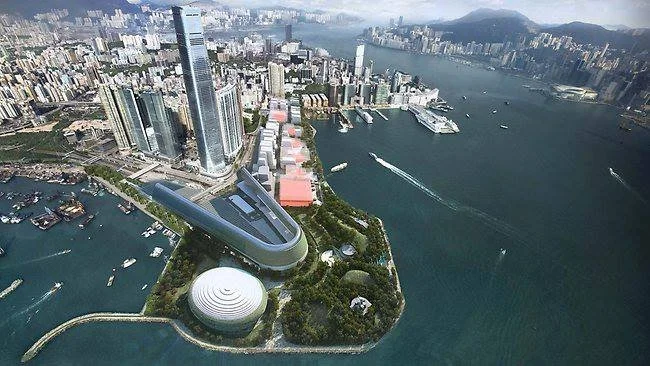

click on any image to enlarge
© Copyright Acknowledged | All rights reserved |
West Kowloon Cultureal District | Initial Designs | Hong Kong
Foreword Part 3
As a Hong Kong resident with a keen interest in how our city evolves architecturally and culturally, I have followed the development of the West Kowloon Cultural District closely over the years.(our oldest son has a bunch of degrees in Architecture!)
The story of its master planning involves high-profile international architects, public consultation, and some bold, even controversial ideas. In this overview, I address your specific question about the designer and the glass roof proposal, while providing context on how the district came to be., and at the end of this section I will expand on my ideas of what they should have done and this is strictly a point of view of someone that has no concept of architecture or city planning
The Master Planner for West Kowloon Cultural District
Yes, Sir Norman Foster (through his firm Foster + Partners) is the architect who ultimately designed the master plan for the West Kowloon Cultural District., his company has done some fantastic projects in Hong Kong.
Above are just 2 of the designs for West Kowloon that where put forward and rejected
In March 2011, Foster + Partners was officially selected by the West Kowloon Cultural District Authority to create the overall master plan, known as "City Park". This followed a competitive process that included public consultation. Foster’s firm beat out proposals from other notable practices, including OMA (Rem Koolhaas) and Rocco Design Architects.
Foster + Partners’ involvement brought significant international prestige, especially given Sir Norman Foster’s strong connection to Hong Kong through earlier landmark projects such as the HSBC Headquarters in Central and Chek Lap Kok Airport.
The Famous Glass Roof | Canopy Proposal
In an earlier phase of the project (around 2001–2002), Norman Foster submitted a bold conceptual design that featured a massive 15-metre-high glass canopy covering a large portion of the 40-hectare site. This enormous canopy was intended to provide shade, create a unified microclimate, and serve as a dramatic architectural statement over much of the cultural district.
The idea proved highly controversial at the time:
Critics argued it would be extremely expensive to build and maintain.
Many felt it would block natural light, views of the harbour, and create an overly enclosed feeling in a waterfront location.
Environmental and practical concerns were also raised.
Because of the strong public and expert feedback, the full glass canopy concept was ultimately dropped. When Foster + Partners returned with the winning "City Park" master plan in 2011, the design had evolved significantly. It focused instead on a more open layout with a large 23-hectare public park, a 2-kilometre harbour-front promenade, integrated cultural venues, and a strong emphasis on pedestrian-friendly spaces and sustainability - without the overarching glass roof.
Current Status of the Master Plan
The plan that was implemented emphasises:
Cultural buildings set like “jewels” within generous green space
A carbon-neutral vision (though this has been challenging in practice)
Mixed-use development combining arts venues, public areas, retail, and residential components
Strong connectivity to the harbour and the rest of the city
Individual buildings within the district, such as the Xiqu Centre, M+, and the Hong Kong Palace Museum, were designed by other architects, but the overall urban framework and layout stem from Foster’s master plan.
My Considered Opinion
Sir Norman Foster’s involvement was a logical choice given his track record in Hong Kong and his expertise in large-scale cultural and urban projects. The original glass canopy idea was visionary and typically Foster - ambitious and technically impressive - but perhaps too radical for the site and the public mood at the time. The revised City Park approach feels more appropriate for Hong Kong’s subtropical climate and love of open harbour views. It has allowed the district to develop as a more breathable, people-oriented space, even if some of the original drama was lost.
Out-of-left-field comments
Had the giant glass canopy been built, West Kowloon might have become known as “Hong Kong’s Crystal Palace” – spectacular but potentially overwhelming in our humid summers., (I could live with that)
3 other thing they should have done-
built a pedestrian bridge from West Kowloon Cultural District to Central District on Hong Kong Island
relocated the Observation Wheel (Ferris Wheel) from Central District to West Kowloon Cultural District and made it 3 times the size
built the Cruise Ship Terminal at the West Kowloon Cultural District instead of out in the boonies at Kai Tak
But heck what do i know!
click on any image to enlarge
© Copyright Acknowledged | All rights reserved | images taken b Jamie
West Kowloon Cultureal District | MTR Stations | Hong Kong
Foreword Part 4
Getting around Hong Kong by MTR (Subway) is usually straightforward, but the West Kowloon Cultural District presents a slightly different picture. While the venues are served by two main stations, the walk from either can feel longer than expected, especially in hot or humid weather. In this detailed guide, I break down the practical options for reaching the M+ Museum, Hong Kong Palace Museum, and Xiqu Centre by MTR (Subway) including nearest exits, estimated walking times, and tips to make the journey smoother.
Please bear in mind I deal with reality, yes some young fit people could walk quicker but for your average person, the times stated are conservative, it could well take longer particularly if you are a visitor and not a resident, the best example is Kowloon Station which is massive but to get to the Museums you have to navigate a huge station, walk through a massive shopping mall and cross a major road via a bridge
I will be honest with you, I rarely go to the West Kowloon Cultural District simply because it is a pain to get to, for the life of me I cannot understand why they did not build a new small station right in the middle of the complex or even better, a network of walking tunnels (airconditioned) which is very common in Hong Kong, if you want people to visit you make it simple transport wise and West Kowloon Cultural District is not user friendly at all.
Nearest MTR (Subway) Stations Overview
The two primary MTR stations serving the West Kowloon Cultural District are:
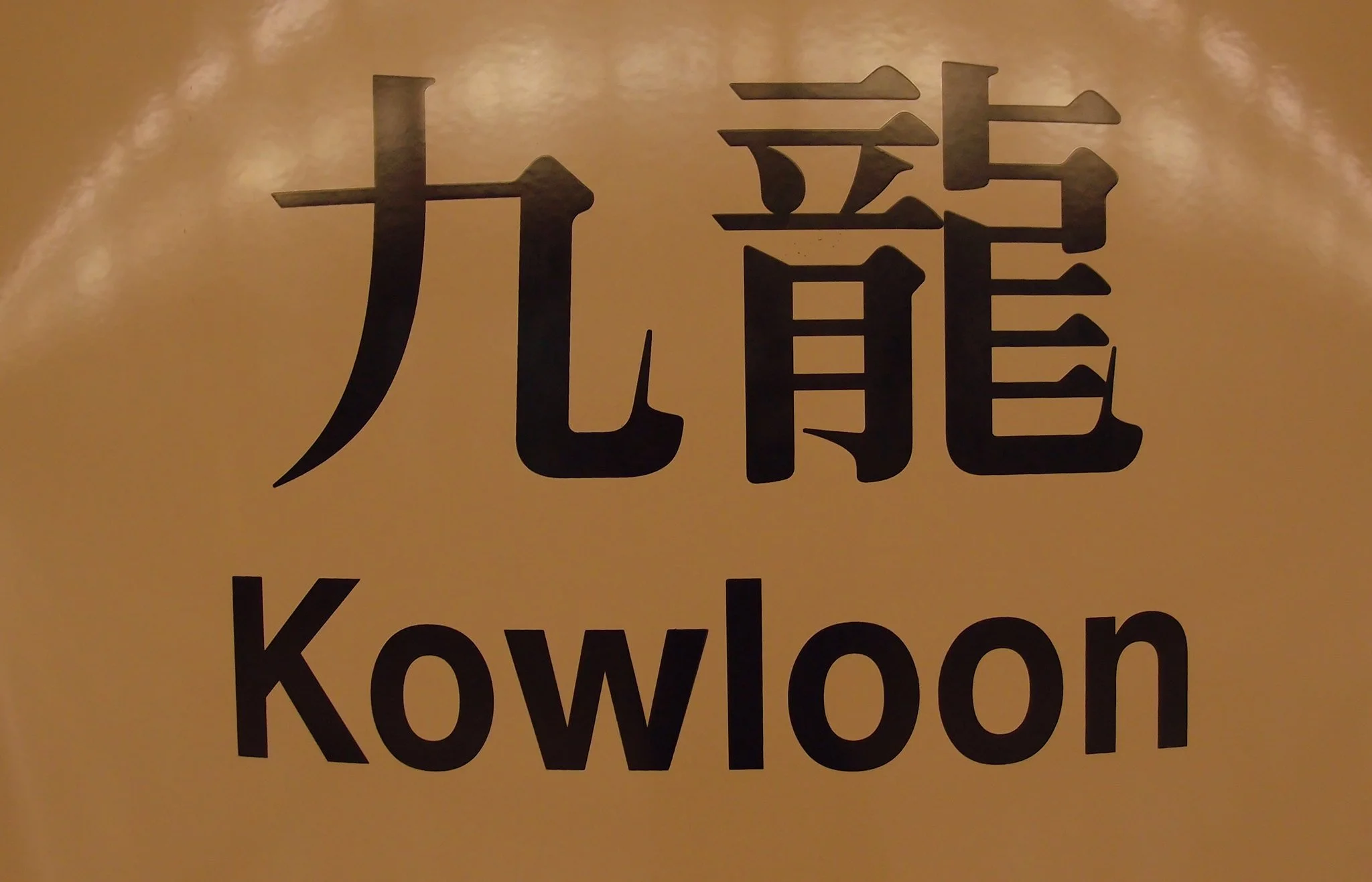
Kowloon Station (Tung Chung Line and Airport Express) - Best overall for M+ and Palace Museum.
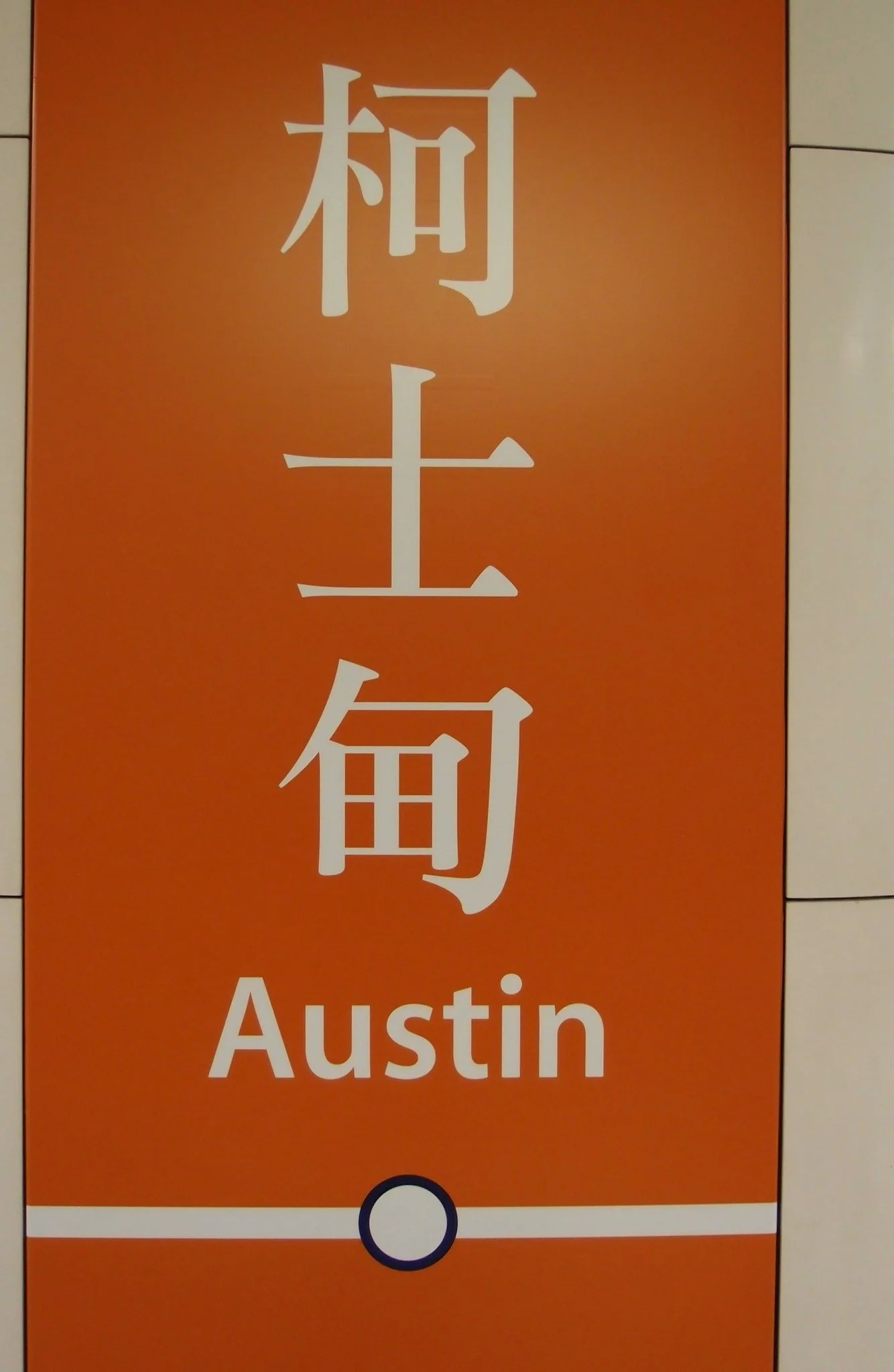
Austin Station (Tuen Ma Line) - Closest for Xiqu Centre.
There is no single MTR station right at the heart of the district, so walking (or using free shuttles where available) is necessary. Walking times typically range from 12 to 20 minutes (or longer) depending on the venue and exit chosen.
Getting to Xiqu Centre by MTR (Subway)
Best Station: Austin Station
Take the Tuen Ma Line to Austin Station.
Use Exit E (or Exit F) - This is directly connected to the Xiqu Centre via an underground walkway and escalators.
Walking time: Approximately 2 - 3 minutes - one of the most convenient accesses in the entire district.
Alternative:
Kowloon Station - Walk about 12 - 15 minutes across the district.
Jordan Station - Around 20 - 30 minutes along Austin Road (less convenient).
Getting to M+ Museum by MTR (Subway)
Best Station: Kowloon Station
Take the Tung Chung Line or Airport Express to Kowloon Station.
Recommended Exits and Routes:
Exit C1 or D1: Take the escalator up to Elements Mall (1/F), follow signs through the mall to the Artist Square Bridge on 2/F, then continue to West Kowloon Cultural District.
Walking time: Approximately 12 - 15 minutes.
Exit E4 or E5: Walk along Nga Cheung Road, cross the footbridge, and follow signs to Museum Drive.
Walking time: Around 12 - 15 minutes.
Alternative:
Austin Station - Around 12–15 minutes walk to M+.
Getting to Hong Kong Palace Museum by MTR (Subway)
Best Station: Kowloon Station (slightly preferred) or Austin Station.
Recommended Routes:
From Kowloon Station (Exit E4 or E5): Walk along Nga Cheung Road, cross the footbridge into the district, then head towards Museum Drive.
Walking time: Approximately 12 -15 minutes.
From Austin Station (Exit D2): There is a free Cultural Express shuttle (CX1) available at certain times.
Walking time (if not using shuttle): Around 12 - 15 minutes.
The Palace Museum sits close to M+, so the routes overlap significantly once inside the Art Park area.
Comparative Walking Times Summary
Xiqu Centre: Austin Station (2 - 3 min) - by far the easiest.
M+ Museum: Kowloon Station (12 - 15 min) - most practical.
Hong Kong Palace Museum: Kowloon Station (12 - 15 min) or Austin Station (12 - 15 min).
No matter which station you choose, you should expect a 12 - 15-minute walk on average to reach the main venues. The district is large and spread out, with generous open spaces and promenades.
Key Tips:
Follow clear signage once you exit the stations - the district is well-marked.
Free shuttle buses operate within the district on weekends and holidays.
In hot weather, the walk can feel tiring; consider taxis from the stations if carrying heavy bags or travelling with elderly visitors.
The entire cultural district is pedestrian-friendly with covered walkways in some sections.
My Considered Opinion
Access by MTR (Subway) is perfectly doable and remains the most efficient public transport option, but it does require a bit more planning and physical effort than many other Hong Kong attractions. The lack of a station directly inside the core of the district is to me a huge drawback, but once you arrive, the beautiful waterfront setting makes the walk worthwhile.
Out-of-left-field comments
On a clear day, that 12 - 15 minute walk across the Art Park feels more like a pleasant cultural warm-up than a chore, yes the views are pretty darn good as well but I repeat again, the times I have stated for getting to all these great places are conservative, for visitors it could take significantly longer if you are not familar with the subway, the exits and navigating shopping malls.
So there you go
Jamie’s Hong Kong Insider Chat
Ready to turn your plans into a far more enjoyable reality? Click the yellow button below to learn more about Jamie’s Hong Kong Insider Chat, check pricing and book a convenient time
I do not do Food Tours in Hong Kong but I know people that do!
click on any image to enlarge
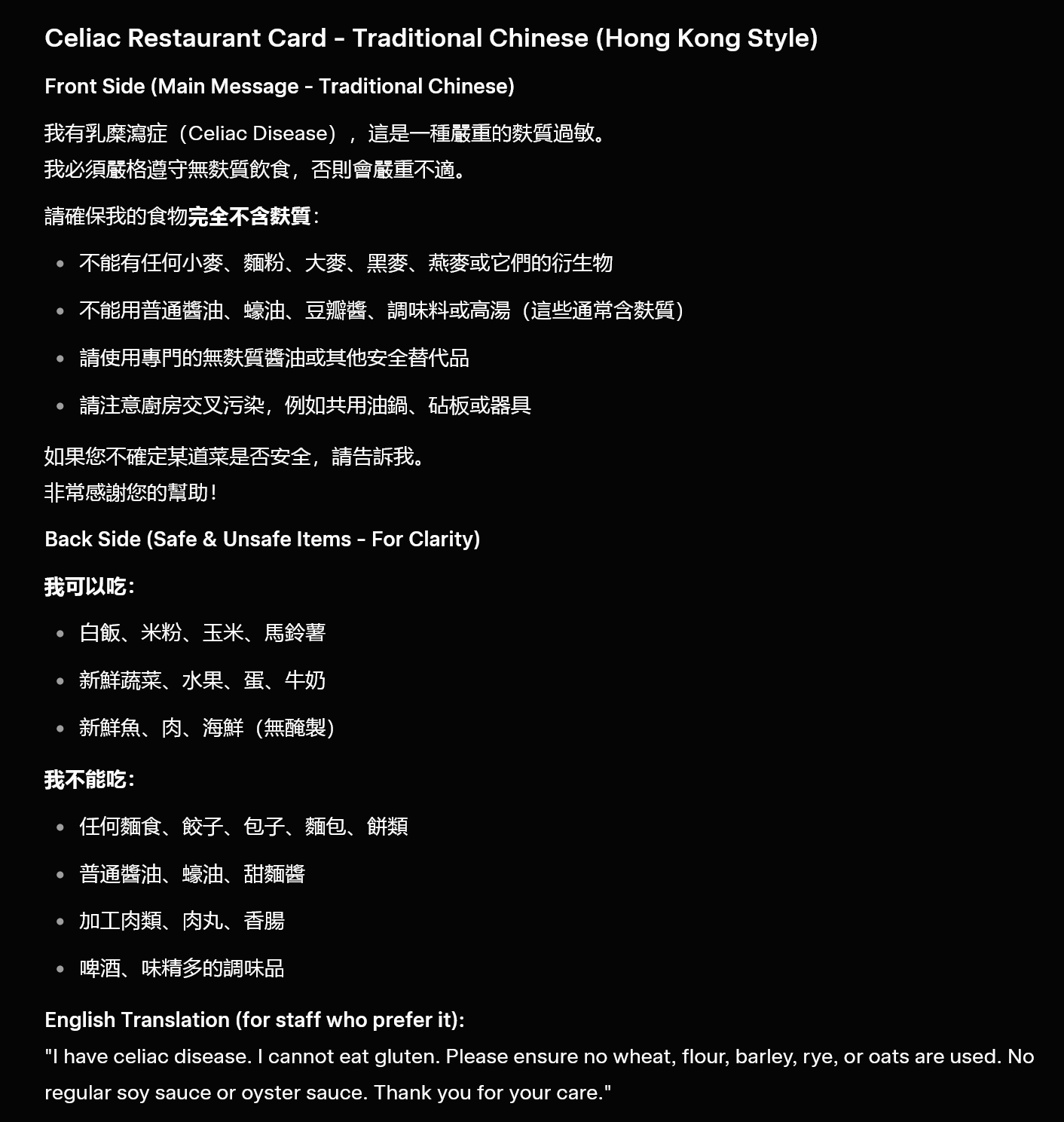
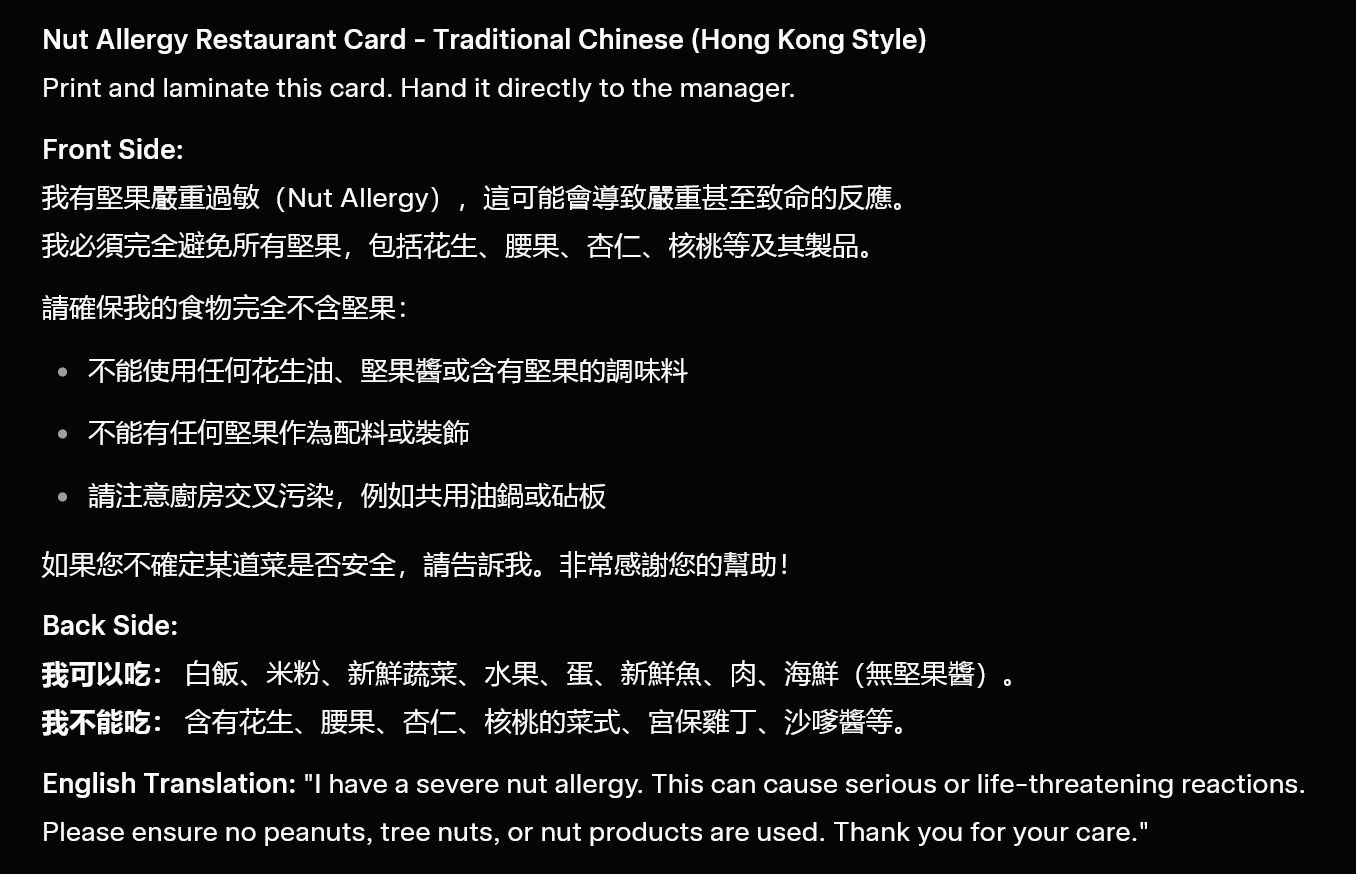
The information above can be shown to restaurant managers in Hong Kong if you are intolerant to gluten and nuts,
I do not do food tours as mentioned above, I have very specific reasons and part of it is that I do not speak Cantonese or write Chinese, I am from Yorkshire in England and I lack the language gene and it is not through lack of trying and yes a lot of restaurants do not have English menu’s or staff who speak conversational English.
.. and yet I have eaten at close to 1,400 restaurants in Hong Kong since January 2nd 1972, my wife was born in Hong Kong and we have been together over 40 years and her first language is Cantonese and a lot of her family are Chinese or half Chinese so I have never had much of an issue!
This does not translate to doing food tours though, yes, I could do them, no problem there but they would never ever be as good as the food tours done by my friends (see the 3 links above) most of their awesome guides are locally born Hong Kong Chinese and obviously food culture is part of their DNA, it is impossible for me to compete with that!
So please feel free to contact them for food tours
I do not do Hiking Tours in Hong Kong but I know someone that does!
I do not do Hiking Tours, never have and never will even though I used to go Hiking a lot when I was a lot younger, The Hong Kong Government is promoting hiking tours so I urge you to contact my friend Sabrina at Hong Kong Trails and Tours, she is a long time Hong Kong resident and and a very experienced hiker with close to 700 Hikes in 15+ years under her belt, please click on the link below
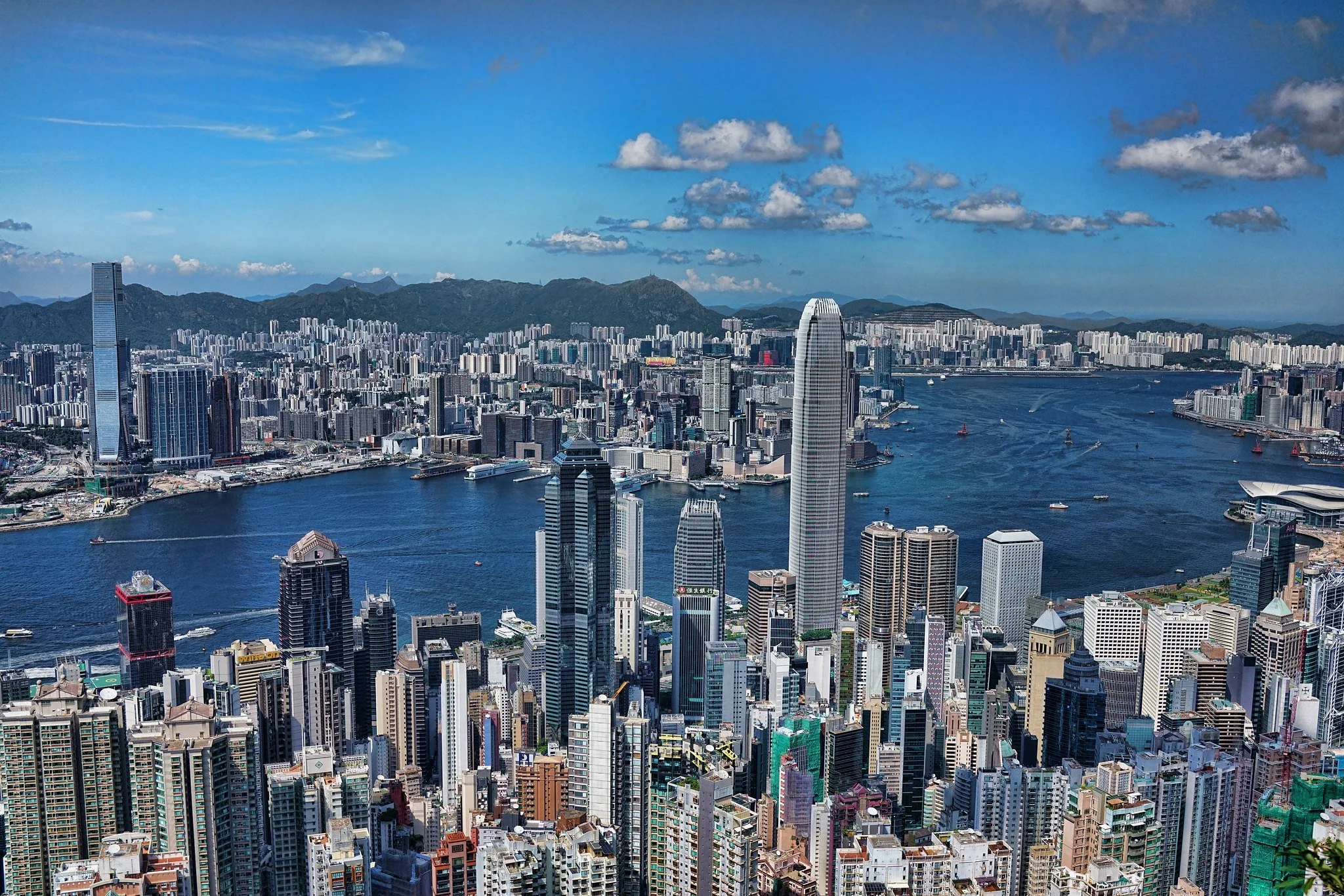
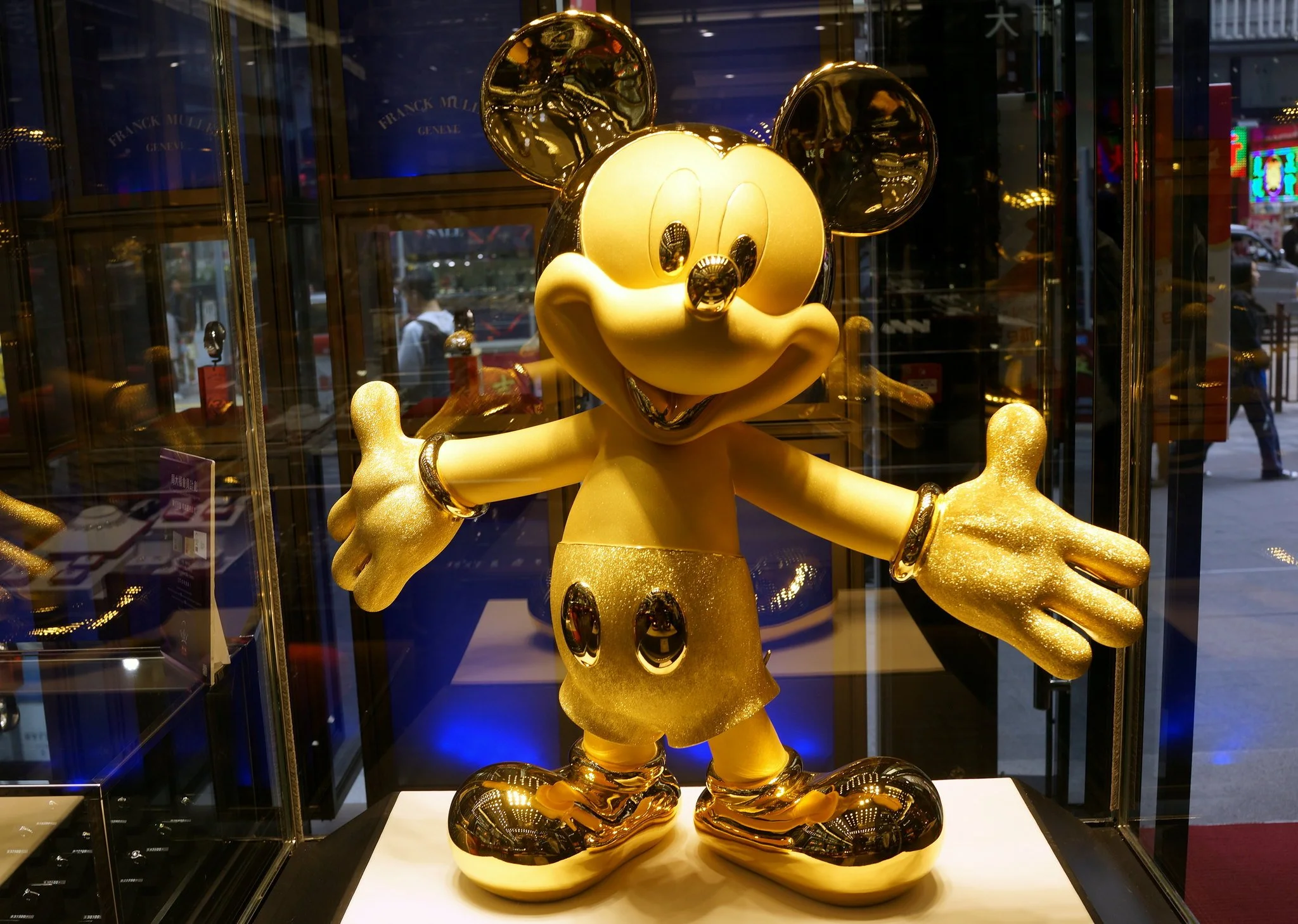
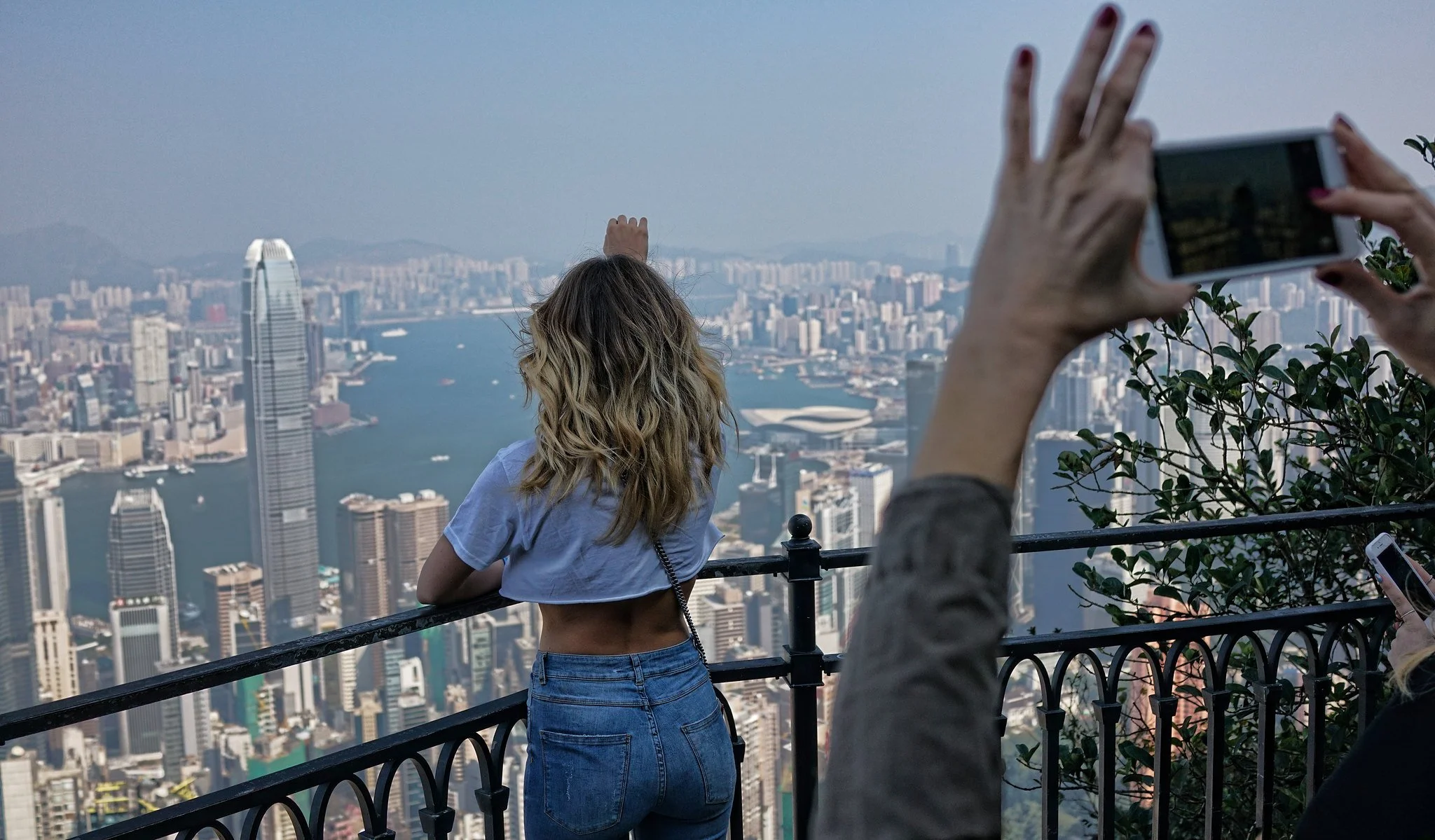
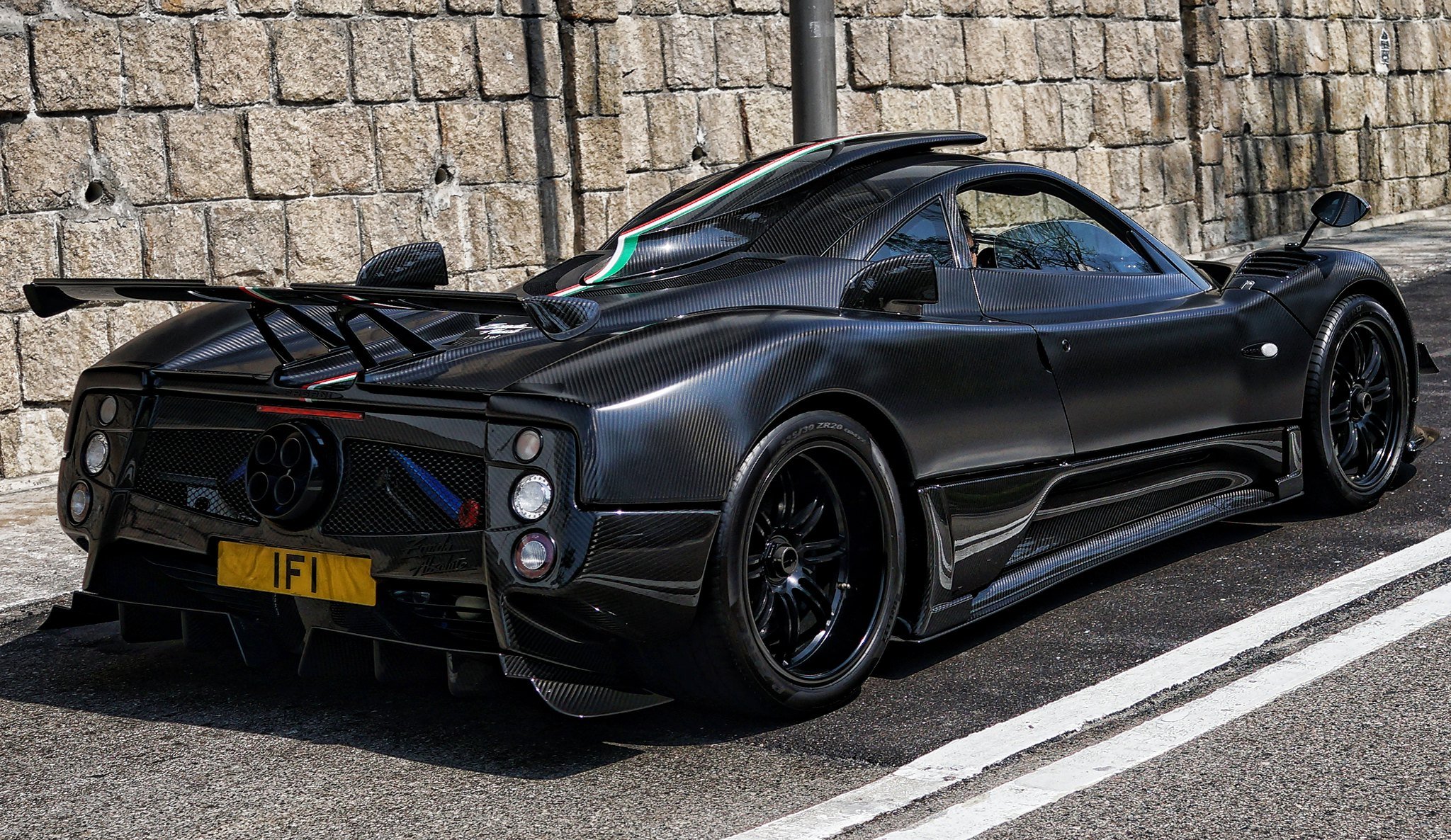
click on any image to enlarge
© Copyright Acknowledged | All rights reserved | all images taken b Jamie
Jamie’s Hong Kong | Some of my favourite images | Hong Kong 101
© Jamie Lloyd | J3 Consultants Hong Kong | J3 Private Tours Hong Kong |
| 2010 - 2026 All rights reserved. |
Click on any image to enlarge to full screen
Current images from my Instagram feed