Hong Kong Islands Eco-Tourism Dreams - Beyond Buzzwords
Facing Reality - Hong Kong’s Remote Island Hopping Plans

The J3 Group - Premium Quality Private Tours | Experiences and Insider Chats since 2010
Me Jamie, your host, I am English and I have lived in Hong Kong since January 2nd 1972 - I know the place.
A meaningful blog post with a difference - tips on Travel, Tourism, Tours, Daily Life and my personal thoughts on Hong Kong.
Please do visit Amazing Hong Kong
Hong Kong | Pearl of the Orient
Customised Private Tours + Experiences in Amazing Hong Kong
Jamie has lived in Hong Kong - Pearl of the Orient for 50+ years
Carefully Crafted Personalised and Customised Itineraries by Jamie | Hong Kong’s Most Experienced Private Tour Guide for : Solo Travellers Friends Families Seniors Couples Business People MICE Delegates.
Private Tours Cultural Tours Walking Tours Sightseeing Tours City Tours Night Tours Layover Tours Transit Tours Private Shore Excursions Bespoke Tours Personalised Tours Jewish Heritage Tours Luxury Private Tours Day Tours Luxury Boat Tours Themed Tours Private Family Tours Private Day Tours Corporate Tours
Just you, your family or friends and Jamie your personal English private tour guide - over 2,400+ tours completed since 2011 - Jamie offers quality Private Tours of Hong Kong
Tour Group Size 1 - 6 people only
J3 Group Hong Kong | J3 Consultants Hong Kong | J3 Private Tours Hong Kong
Creating Memories That Will Last A Lifetime
Go here for the Hong Kong Michelin Restaurant Guide which includes the Bib Gourmand Category

A Resident since 1972 - Private Tours of Hong Kong with Jamie
The Best Things to do in Hong Kong
click on the image to enlarge
© Copyright Acknowledged | All rights reserved | SCMP
Island Hopping Tourism | SCMP Article | Hong Kong
Foreword 1
This is the exact text of a newspaper article from mid 2025 in Hong Kong
SCMP Article - Hong Kong
How Hong Kong can tap the potential of its island economies-in-waiting
Hong Kong’s islands and stunning coastline could be a major tourist draw with the right infrastructure, policy reforms and marketing
Andrew Lam Siu-Lo
Mr Andrew Lam is a veteran town planner involved deeply in professional research and education in parallel with his practice.
Published: 9:30am, 13 Apr 2025 Updated: 12:27pm, 13 Apr 2025
Recent discussions in Beijing over Hong Kong’s tourism have emphasised the potential of its islands and coastal resources for the development of distinctive experiences.
Returning from her visit, Hong Kong’s Secretary for Culture, Sports and Tourism Rosanna Law Shuk-pui said Xia Baolong, director of the Hong Kong and Macau Affairs Office, spoke of how Hong Kong could innovate within the tourism sector. Indeed, Hong Kong’s islands and coastline hold vast tourism potential, their breathtaking natural wonders blending with the city’s rich cultural heritage.
Hong Kong’s Unesco Global Geopark showcases dramatic geological formations.
Our diverse ecosystems offer ever-changing landscapes. Quaint fishing villages dot the shoreline, preserving unique traditions, while the vibrant intangible cultural heritage – from festivals to folk arts – adds to the charm. Pristine beaches and world-class fishing spots cater to leisure seekers while the thriving seafood scene promises culinary delights. This seamless fusion of nature and culture lays a solid foundation for a flourishing, multifaceted island tourism industry.
It sets the scene for business travellers to experience both the bustling city and the tranquil islands – a Hong Kong of dual charms, as both a city of neon lights and a calm resort, and all within a short stay. The government should fully leverage Hong Kong’s tourism resources to offer island-hopping, particularly in relation to business tourism.
Hong Kong’s islands boast a mix of well-developed tourist destinations like Cheung Chau and Lamma Island, and secluded but emerging spots such as Tap Mun and Green Egg Island, providing diverse offshore experiences. However, in promoting island tourism and coastal development, careful consideration must be given to the carrying capacity and supporting infrastructure of each location.
Tap Mun, also known as Grass Island, has struggled in recent years with overcrowding during the holidays due to its limited facilities. Insufficient ferry services often result in long queues of tourists at Ma Liu Shui Ferry Pier, highlighting the strain on existing facilities.
When developing Hong Kong’s island and coastal tourism resources, priority consideration should be given to areas that combine exceptional natural landscapes, profound cultural heritage and a relatively well-developed infrastructure. Route planning should adopt a “trunk line-feeder line” network design inspired by island-hopping, where main trunk routes connect major tourist islands while feeder lines extend to surrounding islets, effectively distributing tourist flows across multiple destinations.
For ecologically sensitive spots or those with geographical constraints that make on-site construction challenging and costly, specialised marine sightseeing routes should be established, using environmentally friendly vessels with expert interpretation services to enable appreciation while minimising disturbance.
This approach would manage visitor numbers with environmental considerations in mind while creating interconnected island chains that stimulate comprehensive regional marine development, achieving sustainable tourism growth through scientific zoning, real-time monitoring systems and intelligent management protocols that balance ecological protection with economic development objectives.
Key locations should serve as transport and service hubs. Potential candidates include Sha Tau Kok, Sai Kung, Mui Wo, Penny’s Bay, Tai O, Lau Fau Shan and Stanley on the outskirts of Victoria Harbour, as well as Hung Hom, North Point and Tung Chung near the airport. These hubs, with well-developed public transport networks and adequate hinterlands for the provision of various supporting facilities, could improve visitor flow and enhance travel experiences, ultimately benefiting local economies.
Given Hong Kong’s limited land resources, the development of aquatic tourism is an emerging trend. Taking inspiration from the successful transformation of Tai O from a fishing village into a tourist attraction, visitors can be offered chances to engage in aquaculture experiences, savour freshly harvested seafood and immerse themselves in the heritage of local fishermen through curated maritime cultural tours.
Cutting-edge technology could further elevate the experience – drones could monitor marine safety, provide aerial guided tours or even create nighttime light shows and augmented reality-enhanced explorations of marine ecological and historical sites via smart devices. The introduction of drone delivery services to islands or cruise ships would add a futuristic touch, allowing tourists to enjoy hi-tech convenience while dining on the waves.
Meanwhile, repurposing idle fishing boats into floating markets like in Pattaya, or houseboats like in Amsterdam, could offer unique ecotourism experiences, blending low-carbon travel with community revitalisation. Such an innovative model, weaving together tradition, technology and sustainability, would not only maximise fisheries resources but also carve out a distinctive tourism niche for Hong Kong.
The government has made notable strides in promoting island tourism, upgrading piers, streamlining approval and designing themed itineraries. To cement these islands as must-visit destinations while boosting peripheral economies, a multipronged approach is essential. Infrastructure must come first – expanding ferry networks with greener, faster vessels like electric ferries or catamarans, introducing island-hopping routes and ensuring reliable utilities and 5G mobile coverage.
Policy reforms should follow. They could build on the Countryside Conservation Office’s efforts to simplify licences for village eateries and homestays, thereby accelerating commercial development in coastal areas. Fishing villages like Kat O and Lai Chi Wo could serve as cultural satellites, offering local delicacies and heritage workshops to complement island-hopping adventures. Strategic promotion is key: marketing Hong Kong’s islands as hidden gems and collaborating with other Greater Bay Area cities on cross-border itineraries could attract global travellers.
Together, these measures would transform island tourism into a sustainable, high-value ecosystem, unlocking the full potential of the city’s coastal treasures.
click on the image to enlarge
© Copyright Acknowledged | All rights reserved | image taken by Jamie
Island Hopping Tourism | Sunset View | Hong Kong
Foreword 2
Let me be clear, I am not taking a pop at Mr. Lam, it is a very well written article and it has certainly got me thinking, the issue I see is that simply Mr. Lam is a town planner and whilst his input is very valuable you have to question why the SCMP did not get input from actual professionals involved in Hong Kong Tourism (and I do not mean the HK Tourism Board or Academics)
For the life of me I cannot understand how I missed this article, however even one year on, the message is still being repeated so it is still a very current subject
My credentials, I have lived in Hong Kong for 54 years and I have done 2,390+ private tours in Hong Kong since 2011so I have a fair understanding of what tourists would like to do when they visit Hong Kong.
In the world of tourism promotion, it is all too easy to get swept up in grand visions of untapped potential, especially when it comes to Hong Kong’s many islands and coastline. Andrew Lam’s 2025 SCMP piece on developing these “island economies-in-waiting” is a textbook example: full of buzzwords like sustainable tourism, island-hopping, eco experiences, and futuristic tech such as drones and augmented reality. (and mote on AI Tour Guide Robots later)
With all due respect to the author, a veteran town planner rather than someone immersed daily in the practicalities of guiding visitors, the article paints an overly optimistic picture that overlooks the hard realities faced by the very audience it targets – business travellers. Having guided hundreds of specific business travellers over the years through private tours, I see a clear disconnect between these lofty proposals and what actually works for time-poor professionals here on tight schedules. This post offers a grounded counterpoint, drawing on real-world experience to explore why eco-tourism for business visitors needs a dose of practicality alongside the vision, while also considering the wider visitor landscape and the actual role of sustainability claims in decision-making. (and if it is one word that drives me nuts it is sustainability - a bit like hidden gems, an overused cliche that everyone mentions but no one has the slightest clue of what it means in the real world of tourism)
The Business Traveller Reality: Time Is the Ultimate Constraint
Business travellers coming to Hong Kong are typically here for meetings, conventions, trade shows, or MICE events, often for three to seven days. These visitors frequently combine work with limited leisure, but fitting even a half-day excursion is challenging. A standard four-hour city tour already strains many schedules; suggesting island-hopping ignores the packed agendas filled with back-to-back sessions, networking dinners, and jet lag recovery. In truth, targeting this group for ambitious island experiences was always going to be impractical due to these fundamental time pressures and what was the criteria for choosing this group of travellers well I am guessing they might be well off and can afford nice hotels and will pay top dollar for tours and such.
Average overnight MICE visitors spend significantly more per capita than general tourists (around HK$7,800 or US$1,000 in recent figures), but their time is tightly allocated.
Many arrive via long-haul flights and prioritise Central, Kowloon, or airport-adjacent areas.
Bleisure (business plus leisure) is growing, yet extensions are usually just one or two extra days, not enough for multi-island adventures. (and yes, I have written a blog post about BLeisure)
click on the image to enlarge
© Copyright Acknowledged | All rights reserved
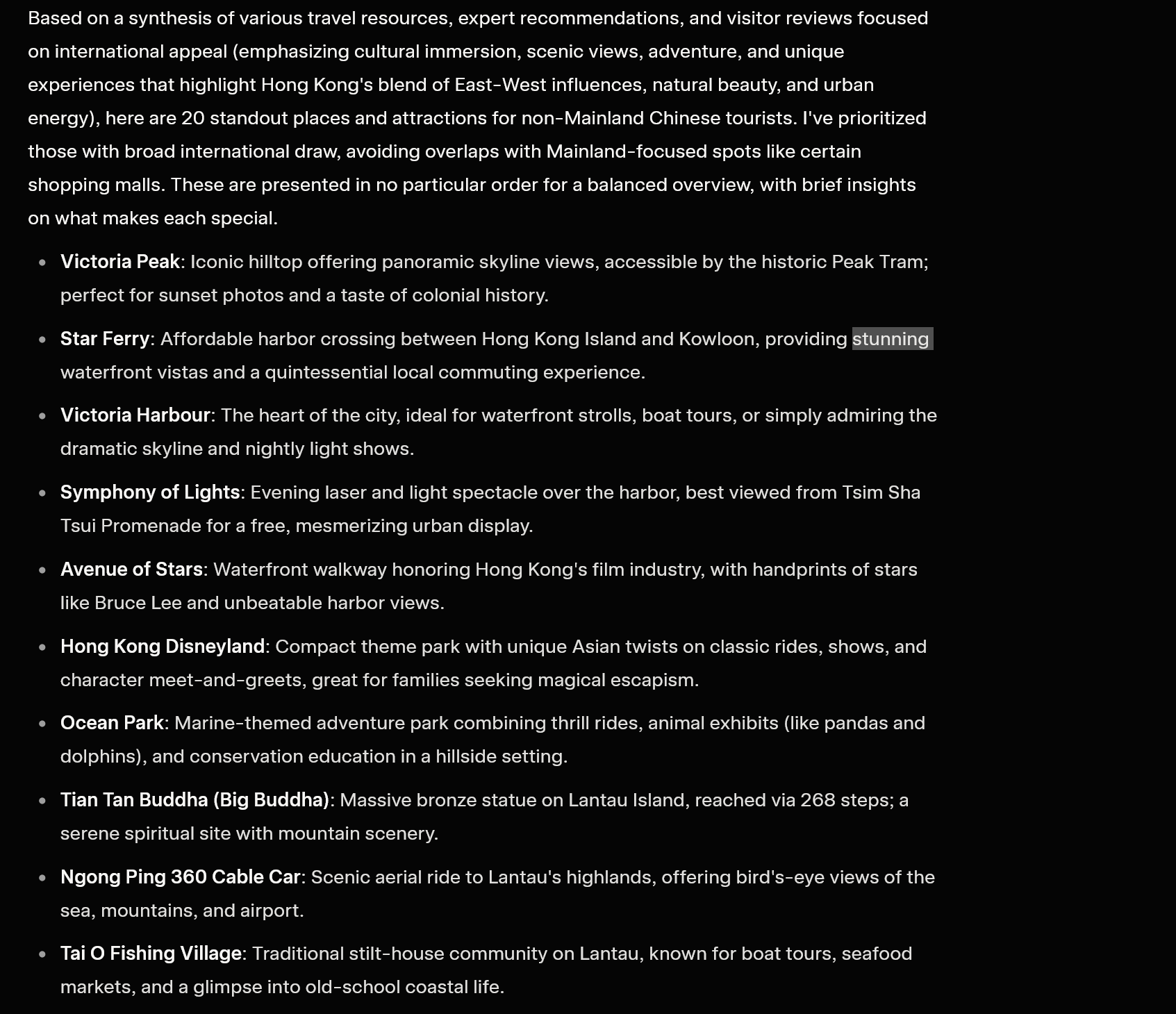
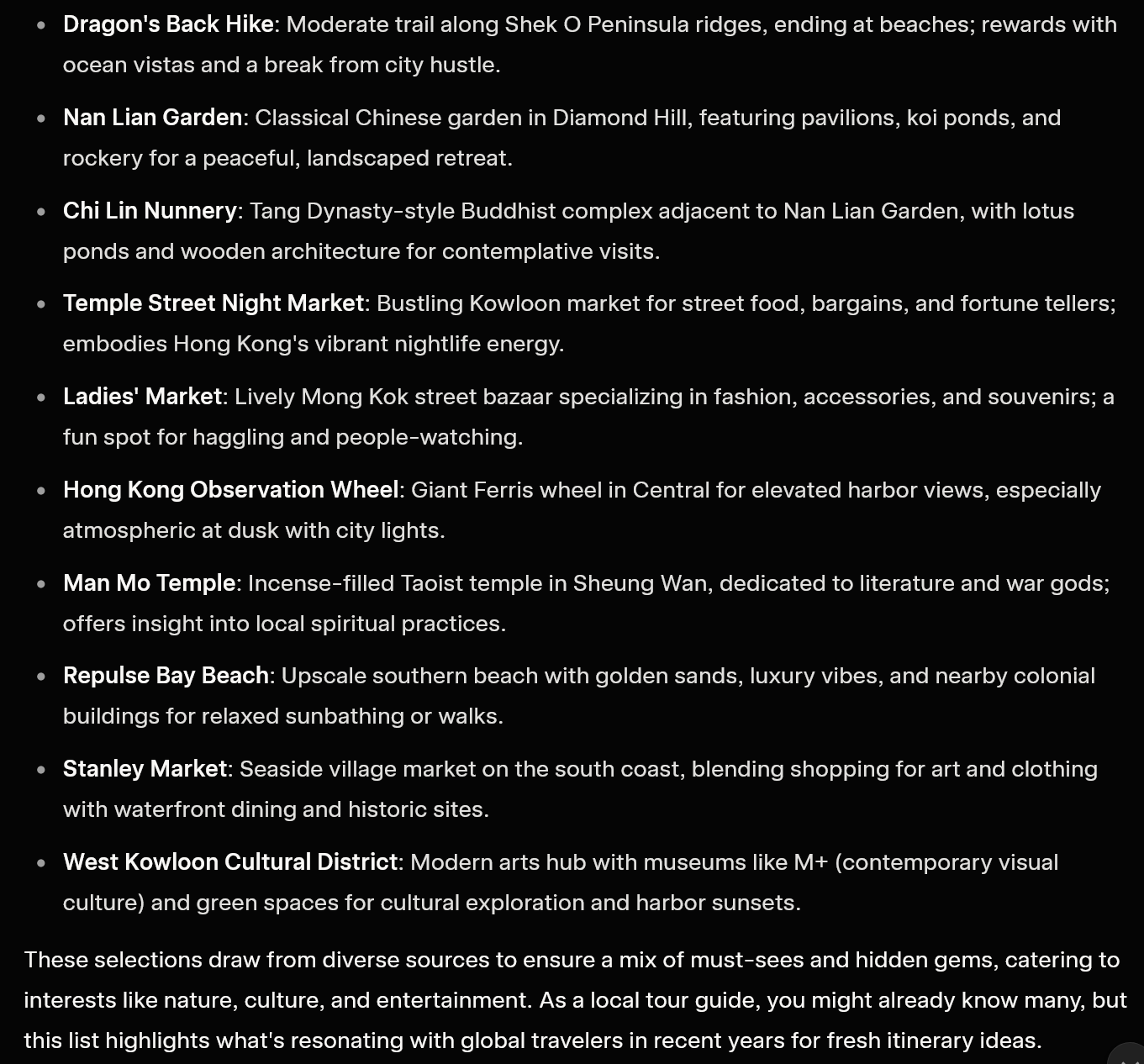
The Top 20 Attractions | What people want to see | Hong Kong
Broader Visitor Realities: Time Constraints Across All Segments
The article would have carried more weight had it avoided singling out business travellers as a key target sector as this group faces the most acute scheduling challenges. Yet the issue runs deeper across the entire visitor spectrum. Around 80 percent of Hong Kong’s arrivals are essentially day trippers from across the border in Mainland China, many of whom visit Hong Kong multiple times a month from the Greater Bay Area across the border in China, the combined population of the Greater Bay Area is 88 million people, that is a lot of day trippers.
The problem is of course many of them are young folk, they are not staying in hotels, eat the cheapest food possible and love social media and they are quite obsessed with the great outdoors and taking selfies and when the find a nice view, well the place is then swamped after folk see it on social media.
For the average overseas tourist coming to Hong Kong, stays are typically just two to three days, during which they must choose from at least 20 major attractions - (see list above) from Victoria Peak and the harbour to temples, markets, and theme parks. Even with annual visitor numbers reaching 10 to 13 million, (this is the number of NON Mainland Chinese Tourists) the same time crunch applies: fitting island-hopping into already packed itineraries is a tall order for most. Grand totals sound impressive in policy discussions, but they do not magically create extra hours in the day or overcome the logistical hurdles of reaching remote spots.
The reality, you would be hard pushed to do all these attractions even with 4 - 5 days at your disposal.
Transport Realities: Ferries, Schedules, and the Island Grind
One of the biggest gaps in the article is the assumption that reaching remote islands is straightforward. Ferry services to places like Tap Mun (Grass Island), Kat O, or more distant spots in the Geopark are limited, especially on weekdays. Kaito ferries often run only a handful of times daily - for example, from Ma Liu Shui to Tap Mun, services might be as infrequent as twice on weekdays, with long waits and queues during peaks. Travel times add up quickly: from a Central hotel, reaching a pier alone can take 45-90 minutes by MTR or bus, followed by 30-90 plus minutes on water, depending on conditions. Return journeys face the same issues, plus risks of missing the last boat or ferry
Even for the more popular and better-served islands such as Cheung Chau, Lamma and Peng Chau, which have benefited from decades of promotion and relatively adequate ferry sailings, visitor numbers remain modest overall. Most visitors to these spots are locals, particularly on weekends, while residents of the larger islands rely on the ferries for trips into town. This demonstrates that when ferry services are reliable and frequent enough, people will make the effort - but the same cannot be said for more remote islands where transport options are far more limited and time-consuming.
Even popular routes like Central to Cheung Chau Island involve 35-60 minute sailings (ordinary versus fast ferry), with fares around HK$15-30 (US$2-4) one way, but remote spots demand far more planning. Private guides can smooth logistics with taxis or chartered options, yet the fundamental time sink remains. Infrastructure upgrades are welcome, but expanding frequencies requires viable demand - a classic chicken-and-egg problem the government and operators face. Buzz about electric ferries or catamarans is fine, but without reliable, frequent service, uptake stays low.
To be honest, articles written by experts and published in the press would carry a lot more weight if they actually backed up their ideas and comments with a written article about their day out Island Hopping and timing it, real world timing would give them credibility, I have been to many remote locations over the decades and they all have one thing in common, it is not a half day jaunt, travelling time there and back can consume 4 to 5 hours and then add in all the time you spent there and your timing is limited by ferry schedule and public transport schedules.
A lot of the planning would revolve around working with reality and time, if for example 500 people visit one remote island on a Sunday then extrapolate that to 1,000 2,500 5,000 10,000 visitors and then look at the Ferry Schedules and Public Transport schedules and all the infrastructure that needs to be in place to receive an increase in visitors. not as easy it looks
The Cautionary Tale of Tai O Fishing Village
Tai O Fishing Village on Lantau Island stands as a textbook case of what happens when improved transport infrastructure opens up a once-remote location without adequate planning for the consequences. A round trip from central areas typically demands at least four hours of travelling time, making it a significant commitment even for those with some flexibility. In my experience visiting since childhood and guiding there regularly between 2011 and 2014 - the best years when it retained that authentic sleepy fishing village atmosphere - one could truly feel transported back in time amid the stilt houses and traditional life. It has been all downhill from 2015 onwards, with the vibe steadily eroding. Even in 2026 I still visit Tai O but rarely, the transformation is stark and I have largely stopped including it in private tours because the buses are perpetually jammed, taxis very hard to get and the unique character has vanished under the weight of mass visitation.
Visitors to Tao Fishing Village now arrive predominantly through 5 channels:
cheap package coach tours operated by companies holding special and rare Lantau Permits; up to 50 people on the coach
tie-in deals with the NP360 cable car company so a coach from the Big Buddha to Tai O and back
larger “tours” using public transport where groups of 20 to 40 people create mayhem as guides shout into microphones;
independent travellers or small groups relying on public transport
…. and the minority on private tours, using public transport (and sometimes private cars with the special permit)
The result is a circus-like atmosphere with crowds overwhelming the narrow walkways, eroding the very tranquillity and heritage charm that drew people there initially. For any visitor - business traveller or otherwise - who might carve out the time to go Island hopping the shock would be considerable - arriving at a supposedly pristine remote spot only to encounter hundreds of tents on beaches during peak periods and facilities like toilets struggling under the strain. This is precisely what occurs when tourism is expanded for expansion’s sake without thoughtful management of carrying capacity and visitor flows
I should point out that these issues are well documented in the Western Press in Hong Kong like the SCMP, Hong Kong Standard and Dim Sum Daily particularly in the past 2 years.
Again, this is not a pop at people like Mr. Lam and our esteemed Politicians but ideas on the back of a napkin or uttered at a press conference rarely work out and in this case just to compound the issues Government regulations and such also have to be factored in, that could take years before a site is approved with all the logistics in place.
Boat Charters as an Alternative Option
For time-stretched visitors seeking a more personalised coastal and island hopping experience, private boat charters offer a viable alternative to public ferries, allowing direct access to select islands or scenic routes without the hassles of timetables. Numerous companies in Hong Kong provide such services, ranging from smaller vessels suitable for two to four people up to larger traditional junk boats that can handle 30 - 45 guests
A review of Tripadvisor’s Hong Kong Boat Rentals category shows around 40 results listed, with the top 15 prominently featured operators including Island Junks, Charter Junks HK, Hong Kong Junks, Sai Kung Boating, Hong Kong Yachting, and others. Additional companies appear across related categories and many more are bookable via OTAs such as GetYourGuide and Viator. However, island-hopping remains inherently time-intensive even by boat, with weather, routing, and docking considerations adding to the day and yes, there is the small matter of cost.
My youngest son recently joined a Sunday private junk charter to Clearwater Bay and Sai Kung in Hong Kong, a long way from town - a seven-hour outing with 30 of his friends, well that cost HK$600 (US$77) per person. The group brought their own food and drinks to keep costs down, and they thoroughly enjoyed the experience. This illustrates how larger group charters can be more accessible, though still a meaningful expense.
For smaller private charters tailored for 2 - 4 passengers over six to eight hours, costs are considerably higher due to fuel, crew, and vessel expenses, often ranging from HK$10,000 to HK$25,000 or more (approximately US$1,280 to US$3,200), depending on the boat type and inclusions and the exact passenger count, These options provide flexibility and comfort but do not magically solve the broader time constraints for ambitious multi-island itineraries and the unspoken issue is always the weather when it comes to boat charters particularly in our hot, humid and rainy summer rain can make for a misterable experience.
Local Residents’ Perspectives: The Risk of Losing What Makes the Islands Special
Remote islands have long served as weekend escapes or day trips for Hong Kong residents, who have the time and familiarity to navigate limited transport options. For locals, the appeal lies in the quiet, unspoiled character - a chance to reconnect with nature and traditional ways of life away from the urban pace and I have done this on a regular basis over the decades
One of my favourite quotes I have used is, yep, imagine the thrill at going out to a remote hiking trail on an unspoilt island and when you get there. there are 10,000 people on the trail with the same idea! it happens
The article’s vision of ramped-up island-hopping and tech enhancements, such as drones for monitoring or aerial tours, risks alienating these very communities. Many locals would likely seek alternatives once hordes of visitors arrive, finding buzzing drones and crowded paths defeat the object of a peaceful getaway. Past experiences with popular spots show residents feeling pushed out or frustrated by noise, litter, 500 tents on a pristine beach and pressure on shared facilities. While economic benefits from tourism are welcome, unchecked growth could erode the local support that sustains these places year-round.
Sustainability Buzzwords vs Real Traveller Behaviour
A fair question arises with all the emphasis on eco-tourism, sustainability, and green innovations like electric ferries: do these factors actually drive destination choices or decisions to visit off-the-beaten-path locations? Multiple industry reports and surveys provide a clear picture. Awareness is high - over 80 percent of global travellers in recent years say sustainable travel is important to them. Booking.com’s reports consistently show 75-85 percent expressing a desire to travel more sustainably, with many willing to consider certifications or lower-impact options. Younger travellers (Gen Z and Millennials) are particularly vocal about this.
Now, lets get real, I have never trusted surveys as a viable indicator of pretty much anyting, people will say one thing and do another. read on.
However, the gap between stated intentions and actual behaviour is well-documented. A 2025 WTTC report surveying over 10,000 people found that cost remains the dominant factor (over 50 percent across segments), followed by quality (around 30 percent), while sustainability is a primary consideration for 7-11 percent, even among the most eco-conscious groups. Barriers for off-the-beaten-path or eco-focused spots include higher perceived costs, limited options in chosen destinations, inconvenience, and the simple fact that other attractions appeal more. For remote islands, time and transport realities often trump green credentials. In practice, buzzwords and certifications help at the margins for niche segments, but they rarely override core practicalities like schedule, price, and ease of access for the majority of visitors.
… and that ladies and gentleman is actual reality, being from Yorkshire in the UK I can be a little blunt, do you really think that people going to a 5 star resort in the Bali jungle care that the curtains where hand sewn by local villagers or the wood used in the room has a green sustainability sticker, not likely
Floating Markets: Vision versus Reality
Among the innovative ideas floated in the article is repurposing idle fishing boats into floating markets, drawing inspiration from places like Pattaya. Hong Kong’s most famous historical example was always Aberdeen, but we all know that story - the floating market there effectively vanished decades ago. Setting up anything similar today would be no mean task, involving heavy regulation, licensing, food safety compliance, and operational challenges.
On remote islands, the prospects look even bleaker: operators would be lucky to attract one or two customers a day. Hong Kong is simply not Thailand, where different visitor flows, cultural contexts, and tourism volumes support such ventures.
Without reliable transport bringing steady crowds, these concepts risk becoming expensive white elephants rather than vibrant attractions., but hey you get a nice selfie!
The Human Touch: Why AI Robots Are No Substitute for Real Guides
There has been plenty of chatter lately in Hong Kong about AI robots arriving from Mainland China and one day replacing human private tour guides. It is a slightly ridiculous notion at present - this might become mainstream in fifty years or so, but right now AI robots would make terrible tour guides. Yes, they could dutifully recite obscure facts from the Big Bang episode that created the Universe, but they would struggle to tell visitors their own life story or share genuine personal Hong Kong anecdotes that bring history and culture alive.
The other thing, didn’t anyone watch the Terminator Movies and to a lesser exten i Robot and a recent crop of killer female robot movies (great CGI by the way)
This is not a pop at AI, which represents inevitable progress and technological leaps, but it is still a long way off from replicating authentic human connection. A shiny AI robot standing outside a five-hundred-year-old walled village on a remote island in Hong Kong might look cool to younger visitors and make for a great selfie, but as an actual tour guide delivering meaningful, adaptive experiences? I do not think so - not yet.
What Merits Attention in the Article
To be fair, the piece does highlight some sensible ideas that deserve attention. The emphasis on carrying capacity, careful zoning, and using transport hubs like Mui Wo, Tai O, or Stanley to manage flows is pragmatic. Suggestions for specialised marine sightseeing routes with expert interpretation on environmentally sensitive spots, combined with greener vessels, align with genuine sustainability goals. The call for policy reforms to simplify licences for village eateries and homestays could genuinely help peripheral economies if implemented thoughtfully.
Government efforts on pier upgrades and themed itineraries are positive steps already underway. These elements show an understanding that development must balance ecology and economics - concepts worth building upon with input from those who know the on-the-ground realities.
I am somewhat more cynical, policy changes and legisation takes years to implement in Hong Kong, UBER in Hong Kong is still not legal despite setting up shop in 2012 and offering ride hailing services from 2014, enough said.
Bureaucracy and Practical Implementation Challenges
From long experience, I know how these initiatives often unfold. Bureaucracy tends to step in heavily: every aspect of island-hopping could become heavily legislated, with permits required at multiple levels, daily tourist quotas imposed, and fines tripled for various offences to manage behaviour. Ensuring sufficient toilet facilities and waste management on remote islands could take years amid planning, funding, and construction delays. While such measures aim to protect resources, they can stifle spontaneity and add layers of complexity that deter both visitors and operators. Reality cannot be fixed by buzzwords alone - detailed studies on actual travel times, resident consultations, and close collaboration with ferry and public transport companies would be far more effective than top-down visions.
Eco-Tourism Potential vs Practical Delivery
Hong Kong’s UNESCO Global Geopark, fishing villages, and coastal heritage offer genuine charm for those with time. Sites blending nature and culture like Tai O’s stilt houses or Sai Kung’s marine areas can provide refreshing contrasts to neon cityscapes. Yet for most visitors - whether business travellers, short-stay overseas tourists, or repeat day trippers - shorter, high-value experiences near hubs (for example, Stanley, Mui Wo, or accessible parts of Lantau) make more sense than full island-hopping. Curated half-day options with expert narration deliver depth without exhaustion. Tech like AR could enhance the experience but no one actually knows how!, but basics - reliable transport, rest facilities, and clear timetables - must come first.
One other thing I always wanted to say was this thing about technology which comes up all the time, I love my tech but it is not a cure all, it is not a tourism replacement, image going out to a remote island with a 500 year old temple, drones buzzing around the temple, go inside and instead of an ancient statue you have a 6ft AI generaled God spouting words of wisdom.. when people go out into the boonies, the history and rituals are not something you want to view on a large scree.
Infrastructure and Policy: Grounded Suggestions
Prioritising hubs with existing public transport links is sensible. Expanding greener vessels and 5G coverage helps, as does simplifying licences for homestays and eateries. Cross-border Greater Bay Area packages could appeal, but success hinges on addressing the viability gap for operators. Private sector input from guides and small businesses should shape plans, ensuring they align with actual visitor behaviour rather than theoretical models.
At the end of the day I am a nobody but I know a fair bit about Hong Kong tourism, it would never occur to the Government to actually consult an expert in tourism, a professor teaching tourism to bright young students is an academic and from where I am standing Academics make lousy tour guides and faced with the questions raised above, well they would bluster and pontificate in an academic manner to cover their lack of real world experience dealing with actual tourists.
Balancing Vision with Realism
All the innovative ideas - floating markets, houseboats, drone deliveries - add flair, but they must not distract from core challenges: time scarcity, transport bottlenecks, and environmental pressures. Hong Kong’s strength remains its dual identity as a dynamic city with accessible nature escapes, best experienced in measured doses. For business travellers and the wider visitor base alike, targeted, efficient eco-offerings will convert better than ambitious multi-day hops.
This reality check does not dismiss potential; it urges smarter, demand-driven development that respects schedules, logistics, and local voices. True sustainability comes from experiences that leave visitors and residents alike refreshed, not overwhelmed.
So there you go
Jamie’s Hong Kong Insider Chat
Ready to turn your plans into a far more enjoyable reality? Click the yellow button below to learn more about Jamie’s Hong Kong Insider Chat, check pricing and book a convenient time
I do not do Food Tours in Hong Kong but I know people that do!
click on any image to enlarge
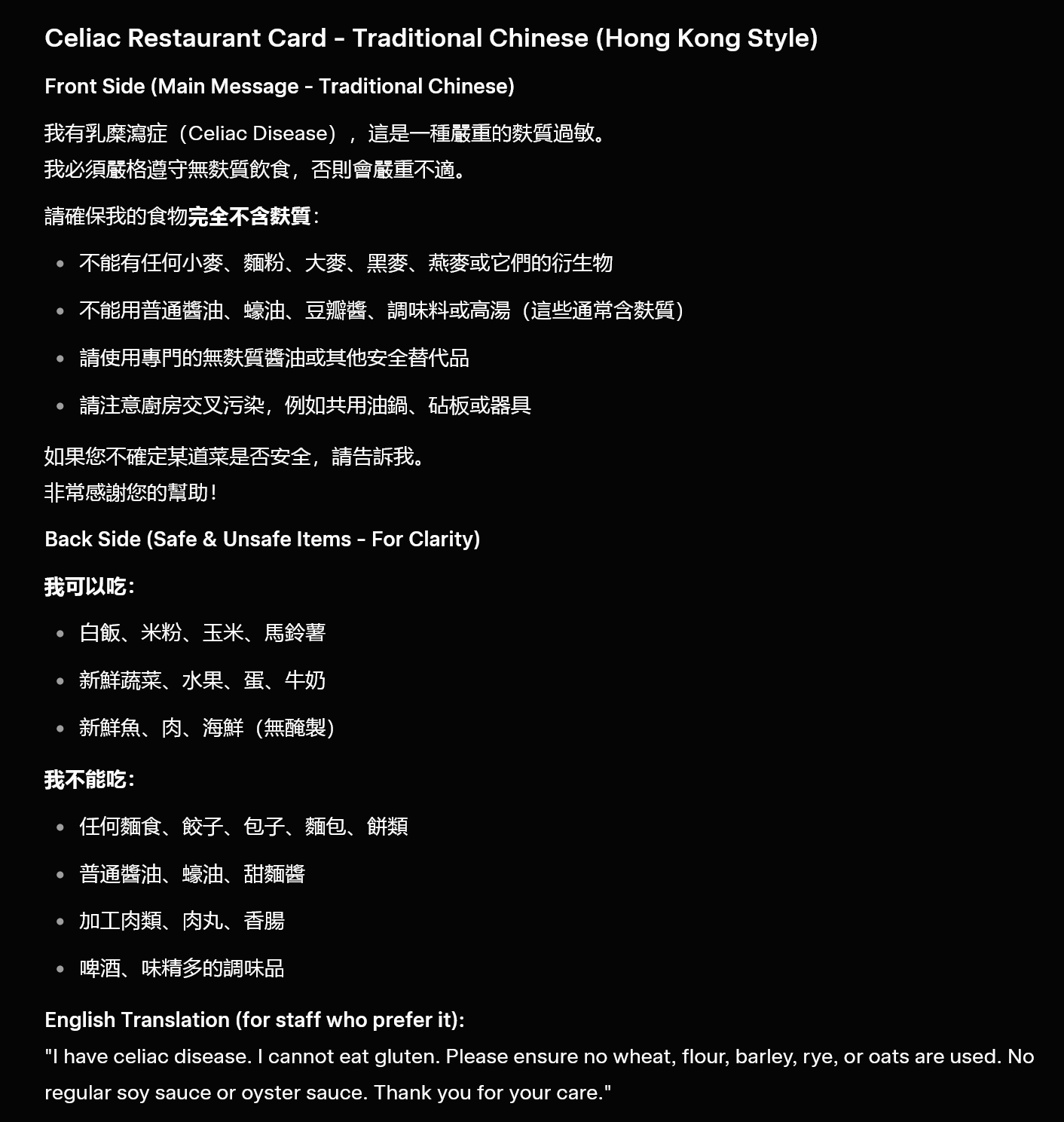
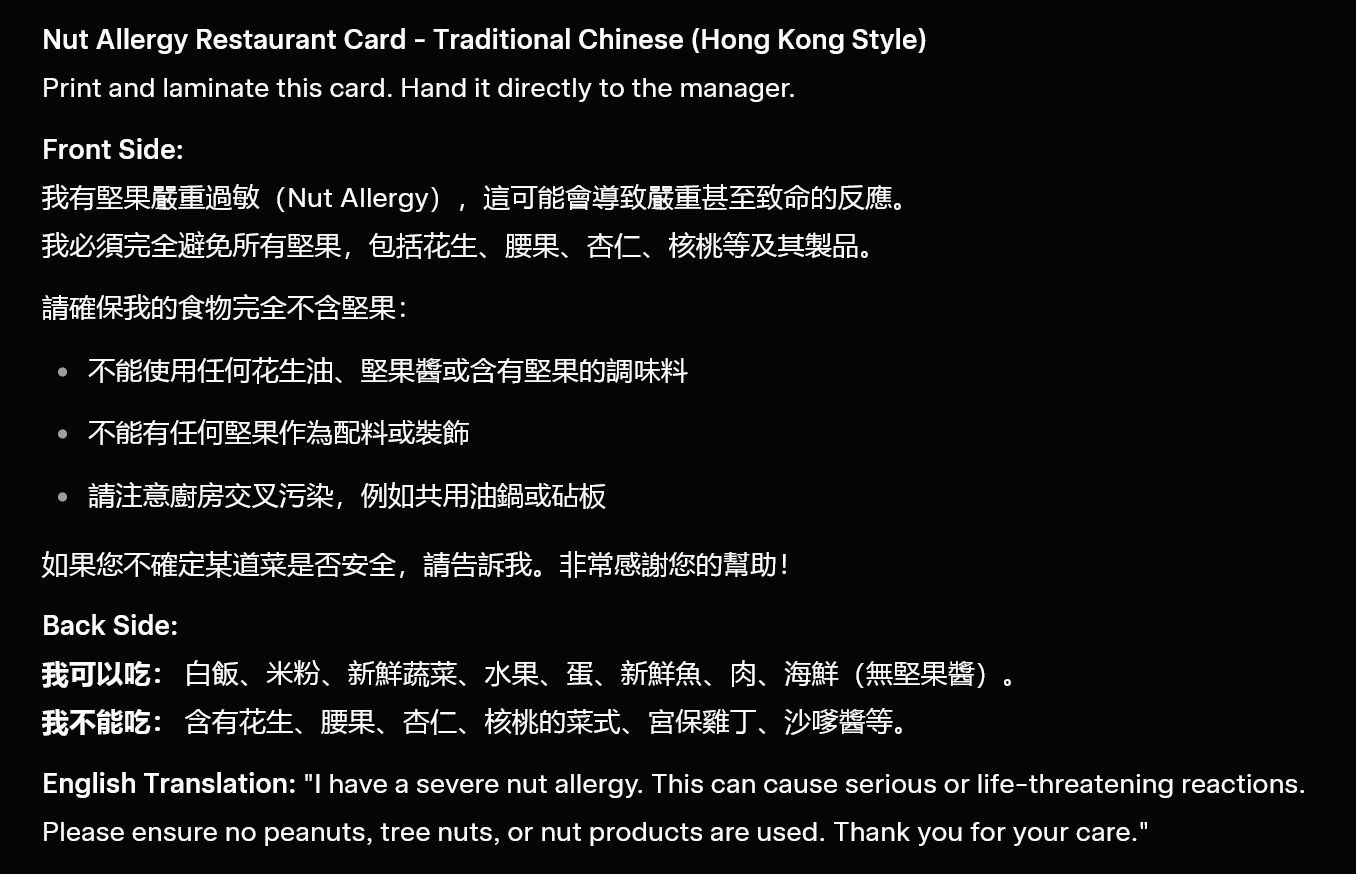
The information above can be shown to restaurant managers in Hong Kong if you are intolerant to gluten and nuts,
I do not do food tours as mentioned above, I have very specific reasons and part of it is that I do not speak Cantonese or write Chinese, I am from Yorkshire in England and I lack the language gene and it is not through lack of trying and yes a lot of restaurants do not have English menu’s or staff who speak conversational English.
.. and yet I have eaten at close to 1,400 restaurants in Hong Kong since January 2nd 1972, my wife was born in Hong Kong and we have been together over 40 years and her first language is Cantonese and a lot of her family are Chinese or half Chinese so I have never had much of an issue!
This does not translate to doing food tours though, yes, I could do them, no problem there but they would never ever be as good as the food tours done by my friends (see the 3 links above) most of their awesome guides are locally born Hong Kong Chinese and obviously food culture is part of their DNA, it is impossible for me to compete with that!
So please feel free to contact them for food tours
I do not do Hiking Tours in Hong Kong but I know someone that does!
I do not do Hiking Tours, never have and never will even though I used to go Hiking a lot when I was a lot younger, The Hong Kong Government is promoting hiking tours so I urge you to contact my friend Sabrina at Hong Kong Trails and Tours, she is a long time Hong Kong resident and and a very experienced hiker with close to 700 Hikes in 15+ years under her belt, please click on the link below
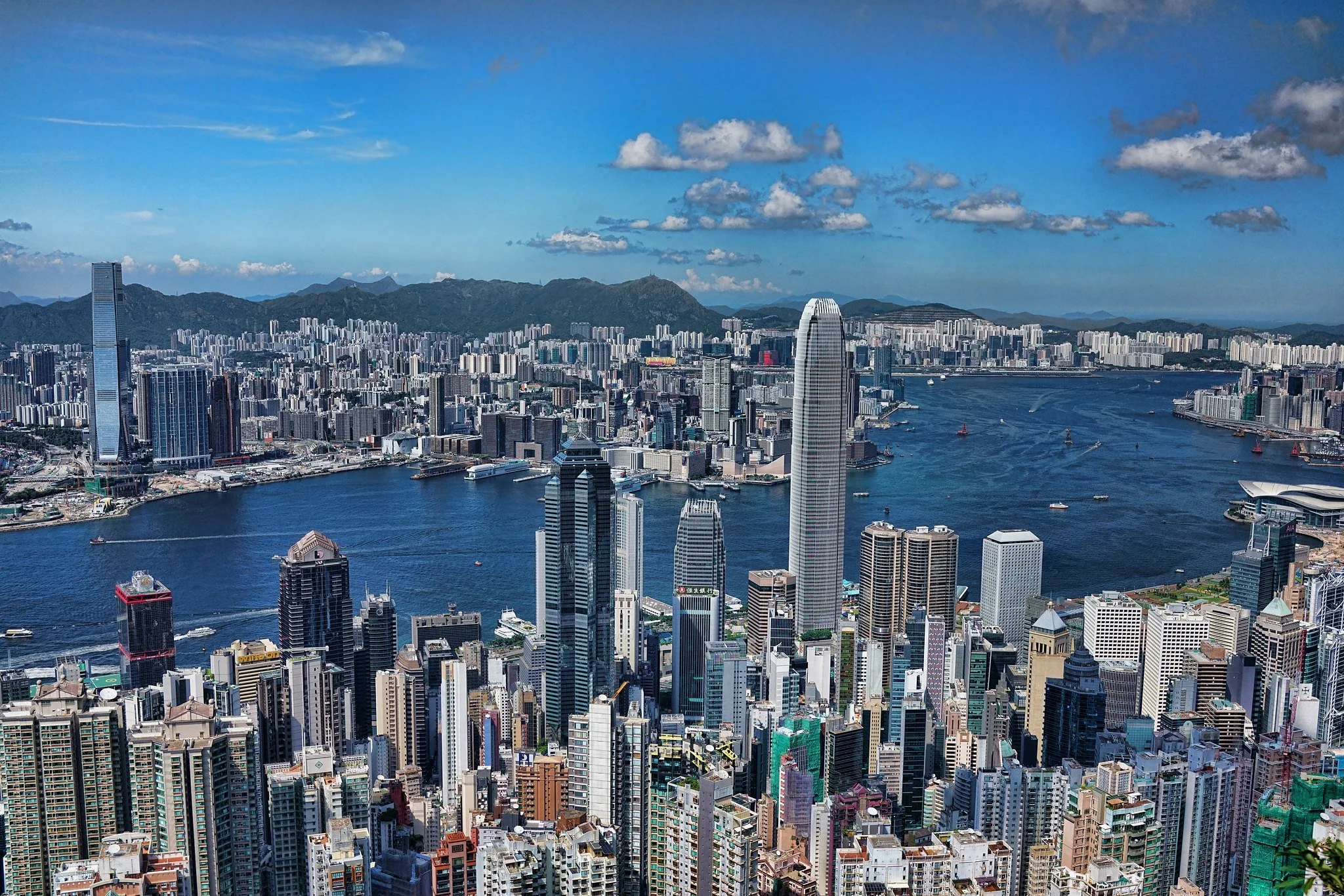

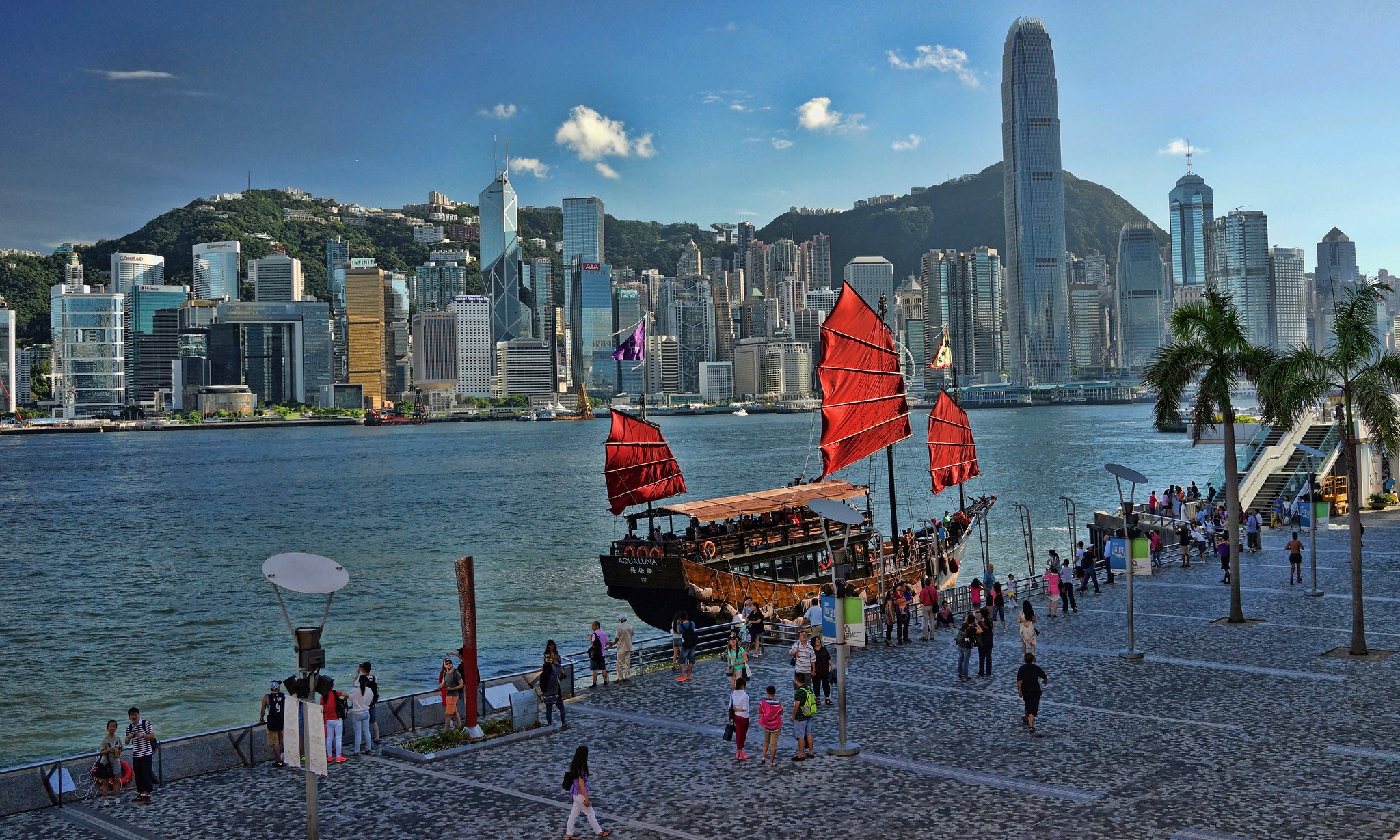


click on any image to enlarge
© Copyright Acknowledged | All rights reserved | all images taken b Jamie
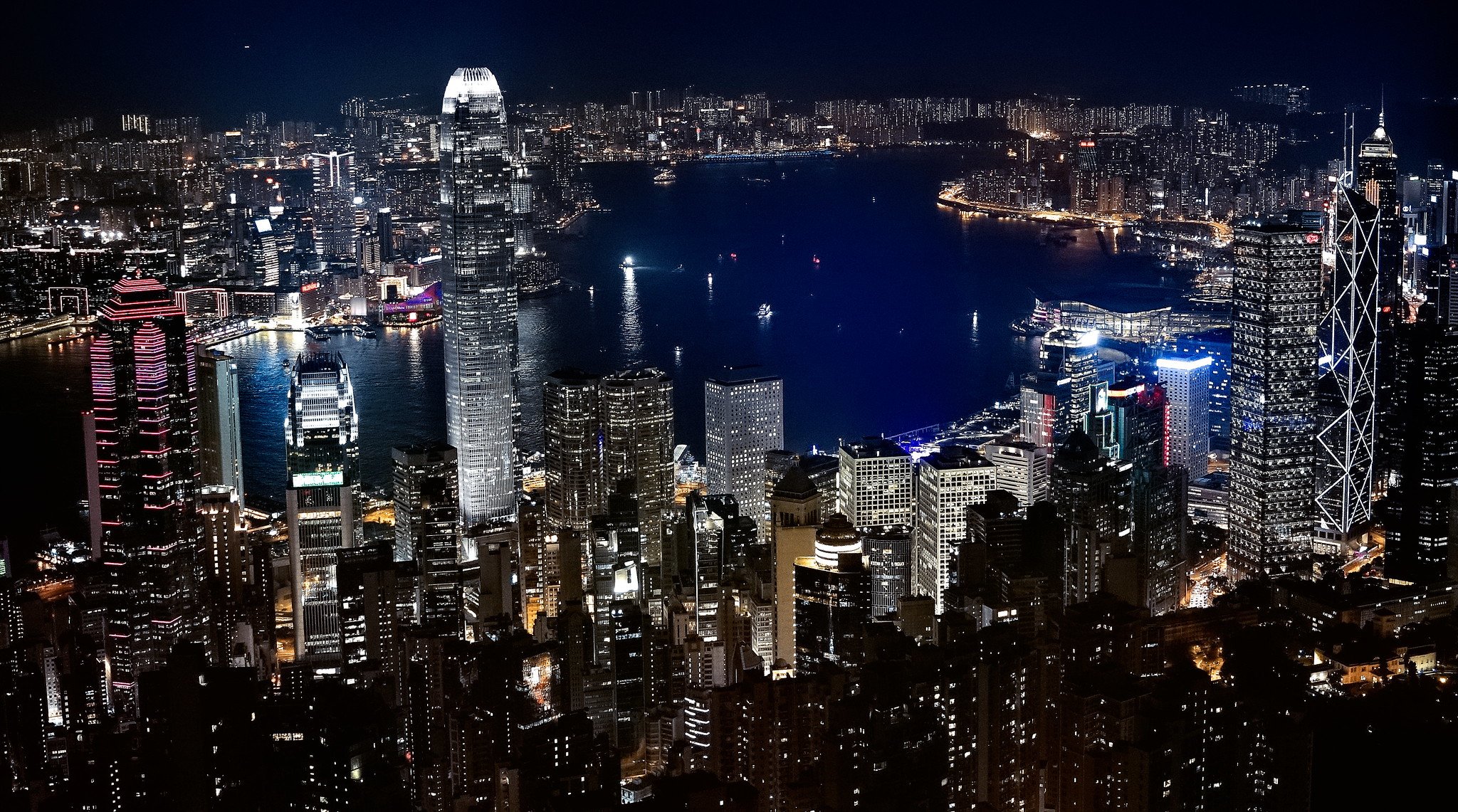
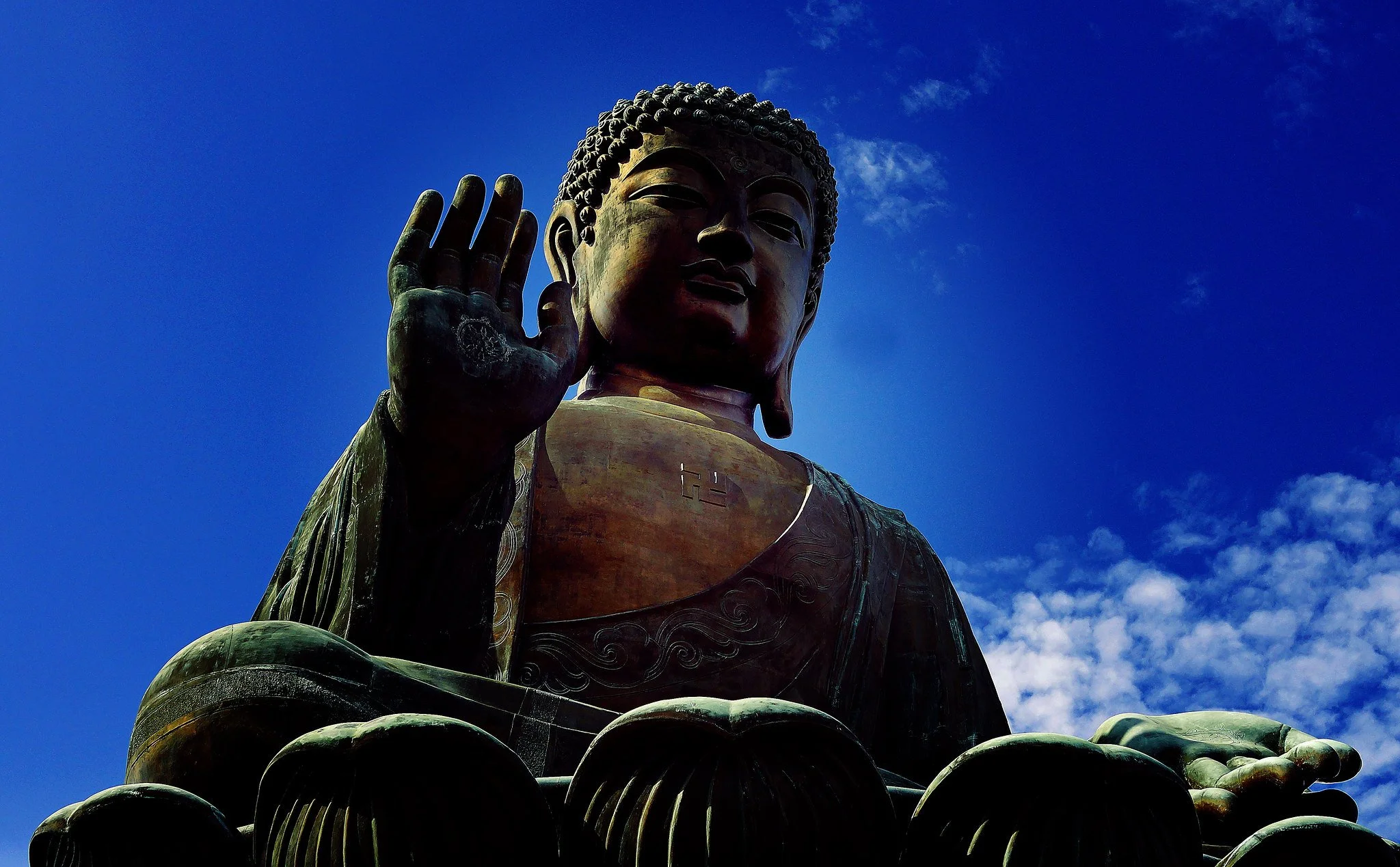
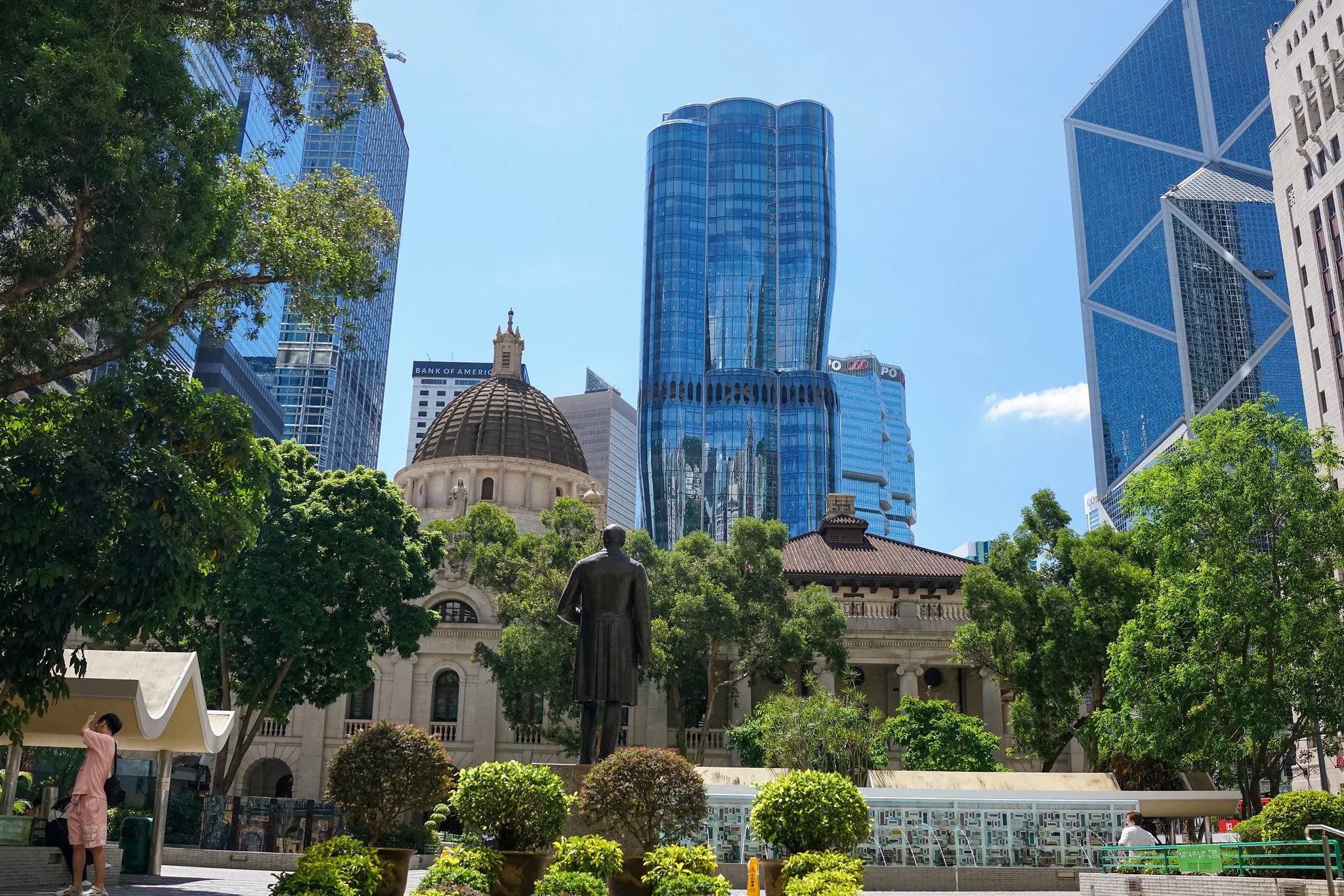
Jamie’s Hong Kong | Some of my favourite images | Hong Kong 101
© Jamie Lloyd | J3 Consultants Hong Kong | J3 Private Tours Hong Kong |
| 2010 - 2026 All rights reserved. |
Click on any image to enlarge to full screen

Current images from my Instagram feed