Feng Shui Overview of HSBC Headquarters in Hong Kong
And the very real Feng Shui war with the Bank of China in Hong Kong
The J3 Group - Premium Quality Private Tours | Experiences and Insider Chats since 2010
Me Jamie, your host, I am English and I have lived in Hong Kong since January 2nd 1972 - I know the place.
A meaningful blog post with a difference - tips on Travel, Tourism, Tours, Daily Life and my personal thoughts on Hong Kong.
Please do visit Amazing Hong Kong
Hong Kong | Pearl of the Orient
Customised Private Tours + Experiences in Amazing Hong Kong
Jamie has lived in Hong Kong - Pearl of the Orient for 50+ years
Carefully Crafted Personalised and Customised Itineraries by Jamie | Hong Kong’s Most Experienced Private Tour Guide for : Solo Travellers Friends Families Seniors Couples Business People MICE Delegates.
Private Tours Cultural Tours Walking Tours Sightseeing Tours City Tours Night Tours Layover Tours Transit Tours Private Shore Excursions Bespoke Tours Personalised Tours Jewish Heritage Tours Luxury Private Tours Day Tours Luxury Boat Tours Themed Tours Private Family Tours Private Day Tours Corporate Tours
Just you, your family or friends and Jamie your personal English private tour guide - over 2,400+ tours completed since 2011 - Jamie offers quality Private Tours of Hong Kong
Tour Group Size 1 - 6 people only
J3 Group Hong Kong | J3 Consultants Hong Kong | J3 Private Tours Hong Kong
Creating Memories That Will Last A Lifetime
Go here for the Hong Kong Michelin Restaurant Guide which includes the Bib Gourmand Category

Your Private Personal Tour of Hong Kong Begins Here
A Resident since 1972 - Sharing Hong Kong as Only a Local Can
click on the image to enlarge
© Copyright Acknowledged | All rights reserved | image taken by Jamie
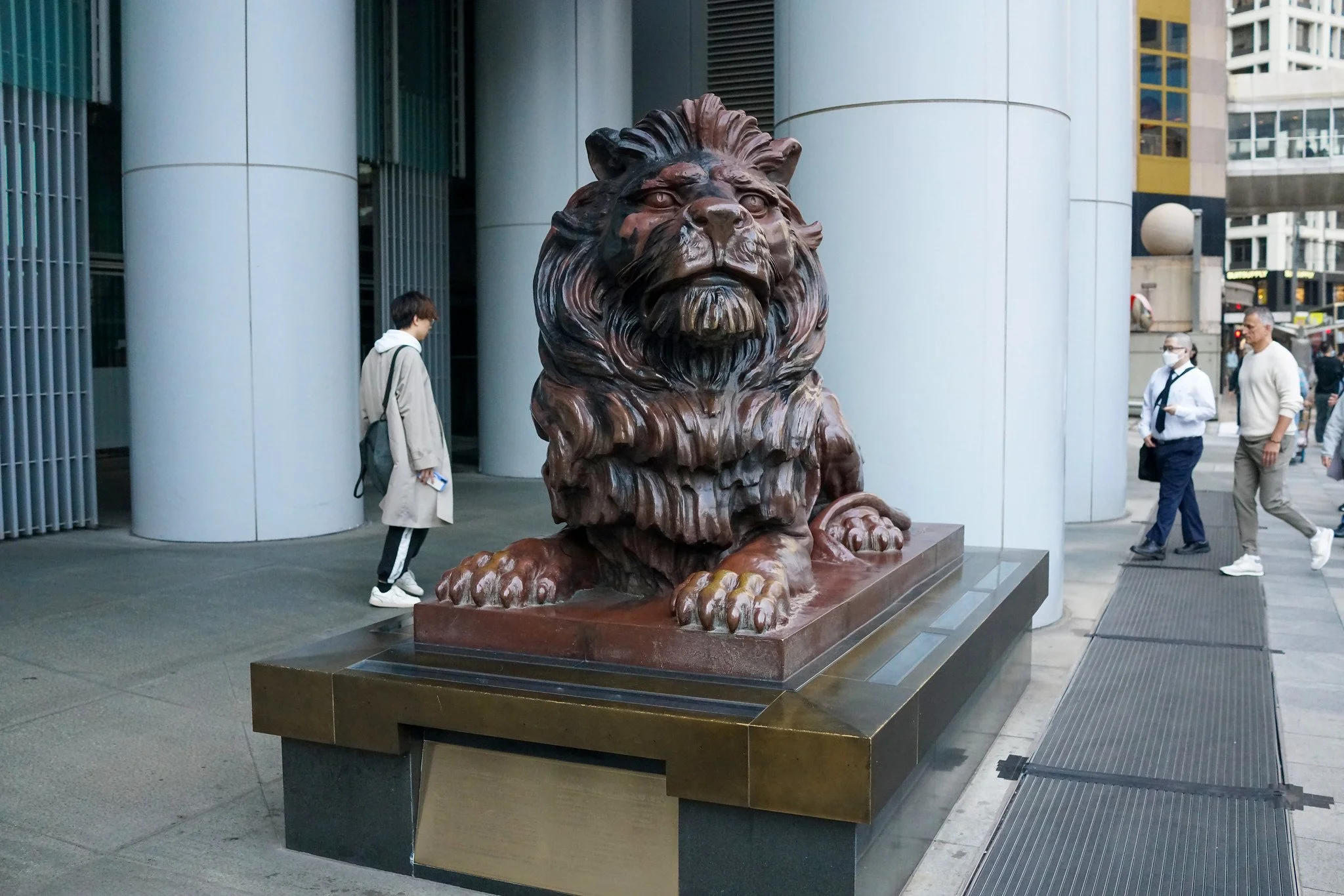
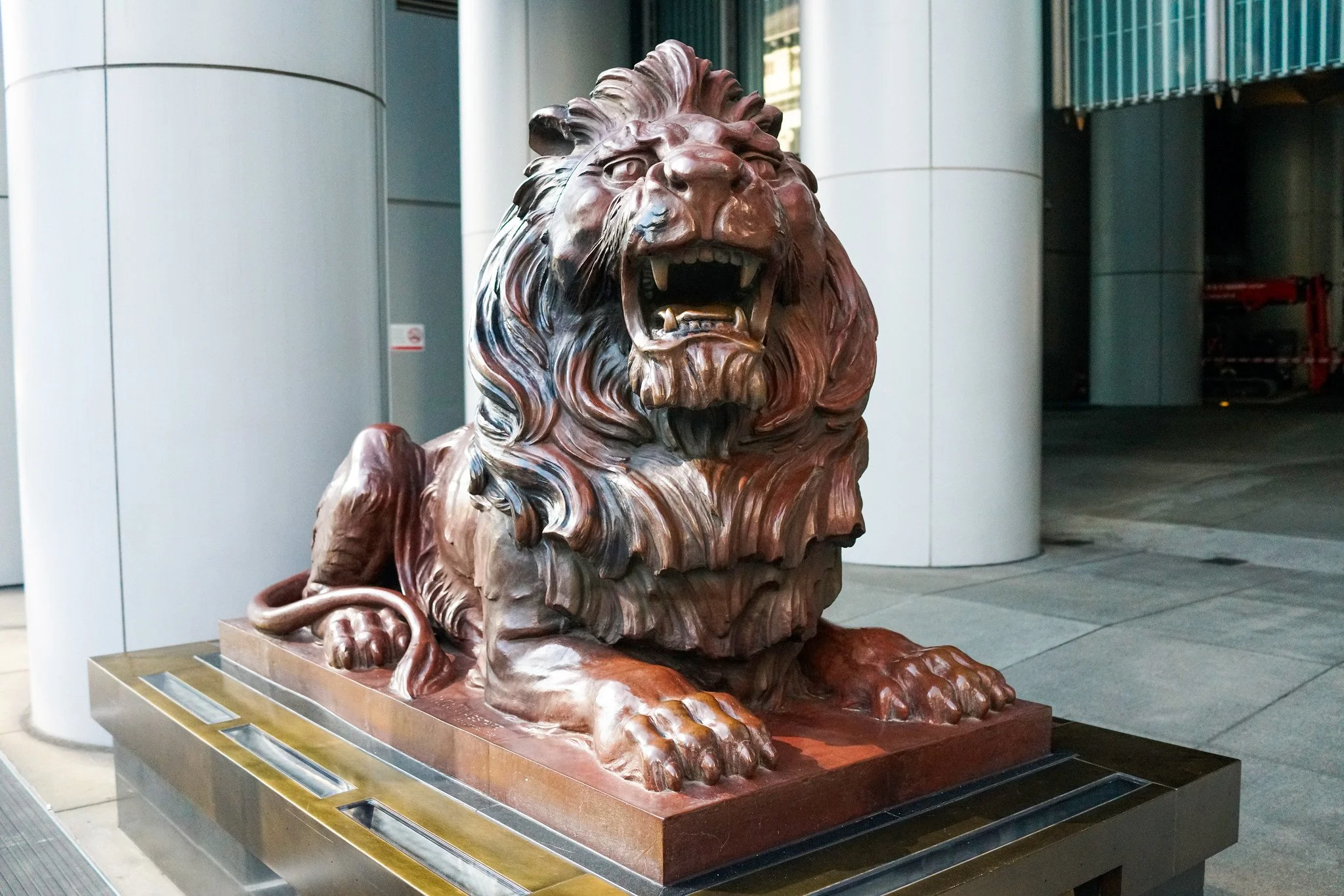
Angry Lion “Stephen” | HSBC Headquarters | Hong Kong
I have totally lost count of the number of times I have touched the angry lion at HSBC Headquarters in Hong Kong, it is many, many thousands of times since 1972 and I was also lucky enough to be a visitor before the old building was demolished and replaced by the Sir Norman Foster “oil rig” in 1985, I actually went there and watched part of the tedious putting back the lions in the exact spot that they should be according to Feng Shui principles, I was fascinated.
Whether I am with guests or my own, I always make a detour to the lions to rub them.
Feng Shui Overview of HSBC Headquarters in Hong Kong - and the very real Feng Shui war with the Bank of China Headquarters about 8 minutes walk away
Section 1: The Building, Dragon Energy and those Bronze Lions
The HSBC Main Building at 1 Queen’s Road Central, completed in 1985 and designed by Norman Foster, is widely regarded as having some of the best feng shui in Central. Geomancers were consulted throughout its planning and construction, blending modern architecture with traditional Chinese principles to ensure the smooth flow of qi (life energy) for prosperity and protection.
In Hong Kong feng shui tradition, Victoria Peak is believed to be the home of powerful mythical dragons that bring wealth and good fortune. These dragons reside in a “dragon’s lair” at the Peak, with their energy pathways - often called dragon veins — flowing downhill toward the sea. Central District, including the HSBC site, lies along one of the most important of these veins, which runs down from the Peak via several main roads, including Queen’s Road Central.
The dragon’s “breath” (positive qi) is said to roll down this path, carrying prosperity from the mountains to the harbour. HSBC’s design deliberately keeps the view open to the water through the plaza in front, allowing this energy to flow freely over the building and across Victoria Harbour to Kowloon. Water represents wealth in feng shui, so this unobstructed path is seen as a magnet for financial success. Blocking the dragon’s route is believed to bring misfortune, but HSBC’s open plaza and positioning ensure the dragon’s energy can pass through without obstruction, benefiting the bank and even extending prosperity across the harbour.
When I am by myself I quite often sit at the Stephen lion and let all that positive feng shui wash over me!
click on any image to enlarge
© Copyright Acknowledged | All rights reserved | 3 images taken by Jamie
© Copyright Acknowledged | All rights reserved | HSBC for the old imago
HSBC Lions | Old and New HSBC Headquarters | Hong Kong
At the main entrance stand two famous bronze lions, nicknamed “Stephen” (the one with an open mouth, appearing to roar) and he is my favourite and “Stitt” (the calmer, closed-mouth one). These are replicas of the original lions from HSBC’s Shanghai branch in the 1920s. In feng shui, lions are powerful guardians that ward off evil and attract wealth. Rubbing their paws or mouths is a popular ritual believed to bring good luck. Their placement - one male and one female - creates a yin-yang balance, ensuring protective energy flows in while keeping negativity out. Over the decades, constant touching has polished their surfaces, reinforcing their status as almost sacred objects for prosperity.
Some local stories even claim the lions “come alive” during typhoons or crises, growling to protect the bank….
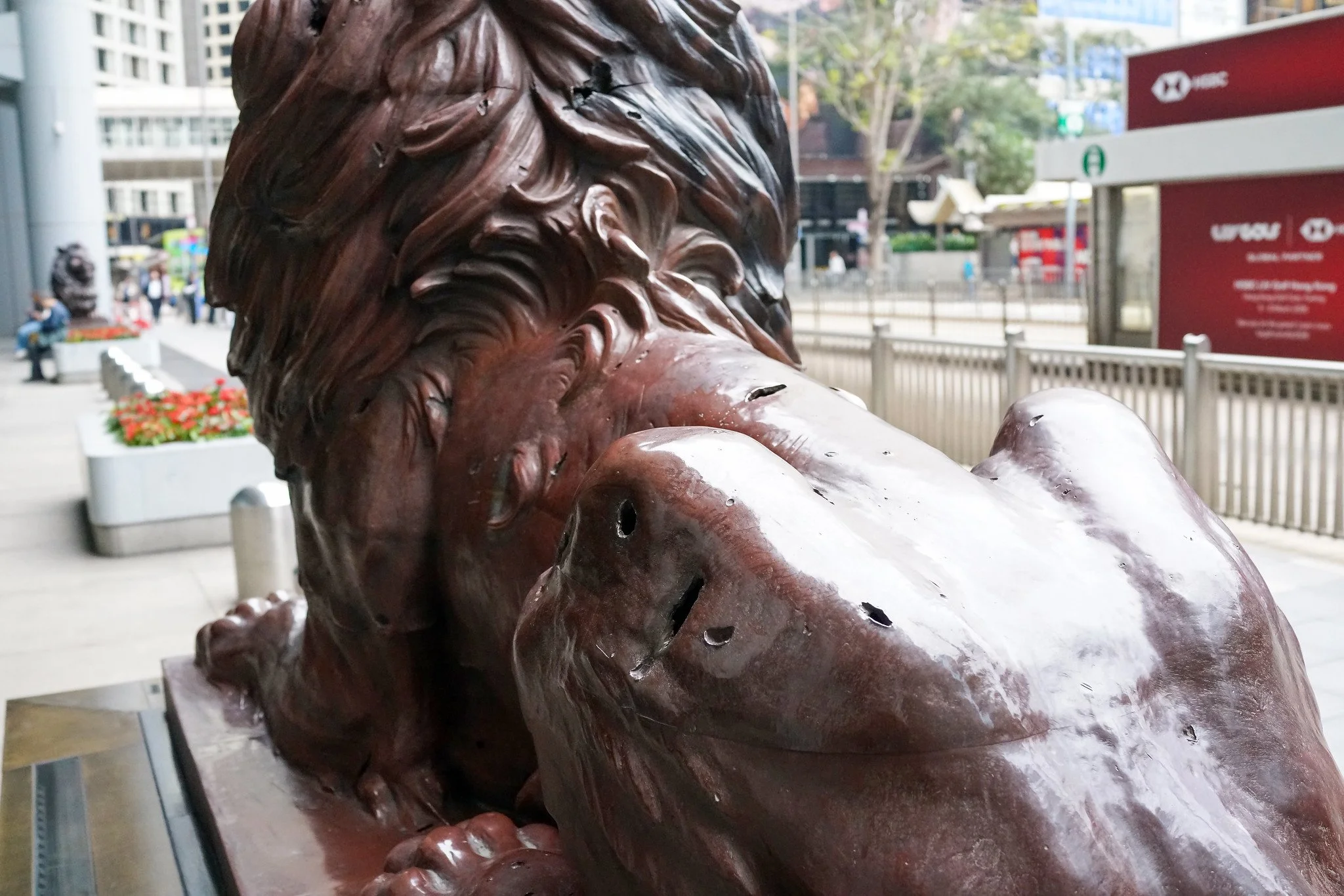
One intriguing detail on the growling lion Stephen is the noticeable shrapnel and bullet-like marks that many assume came from direct fire during the 1941 battle of Hong Konbg. A long-time Hong Kong observer (this would be me and my theory) offers a compelling theory about why those marks appear on what seems to be the “wrong” side - the side facing the building rather than the open street or harbour. During the war the lions stood close to the old granite headquarters. (see historic image above) Any incoming shells or bullets that struck the hard stone wall could have ricocheted and hit the lions from behind or from the inner side. The jagged holes and embedded fragments on Stephen’s left hindquarters and back align logically with this rebound effect… refer to the 3rd image above
Section 2: The Meticulous 1985 Reinstallation, Hidden Design Details and the HSBC Feng Shui Paradox
When the old 1935 headquarters was demolished and the new Sir Norman Foster-designed building rose in its place, the lions could not simply be dropped back into position. Extensive feng shui consultations were required. In 1981, as demolition approached, the lions were first moved under the strict supervision of feng shui master Lung King-cheung (David Lung). They were temporarily placed in Statue Square across the road so they could “watch over” the construction site. Master Lung used the traditional luopan compass to mark exact positions and ensure the lions remained in harmony with the contours of the hill behind, preserving the same auspicious orientation as before. The entire removal process, including special ceremonies, took considerable time and care to respect their talismanic protective powers.
The reinstallation in the new building was equally deliberate. On 1 June 1985, under the careful supervision of the feng shui master, Stephen and Stitt were lifted simultaneously by two cranes - to avoid favouring one lion over the other - and lowered precisely into their final positions. A week later, HSBC Chairman Sir Michael Sandberg led an official welcome ceremony for the lions’ return. This level of attention reflected how seriously the bank treated the need to maintain the lions’ powerful feng shui role in the new structure.
The building’s hollow ground-floor atrium allows qi to flow through like wind in a valley, preventing stagnation. A large sunscoop (a system of 480 mirrors) reflects natural sunlight deep into the atrium, bringing in positive, bright energy. The facade’s triangular elements were reportedly reversed or adjusted on the advice of geomancers to avoid sending out negative energy. The building is classically supported in Form School Feng Shui: flanked by protective “Azure Dragon” hills to the east and “White Tiger” hills to the west, with mountains behind for stability and an open “bright hall” (the plaza and harbor) in front to collect wealth energy. During construction, traditional rituals were performed to avoid disturbing spirits or the site’s natural energy.
click on the image to enlarge
© Copyright Acknowledged | All rights reserved | image taken by Jamie
The open atrium + forecourt | HSBC Headquarters | Hong Kong
The escalators leading from the ground floor (see image above) into the atrium are deliberately angled (about 30 degrees off the main entrance axis). In feng shui belief, negative energy or evil spirits (sha qi) travel in straight lines. By offsetting the escalators, the design prevents these harmful energies from entering the building directly. This adjustment was a specific recommendation from the geomancers involved in the project. The open plaza itself also helps by allowing positive wind and qi to circulate freely, acting as a welcoming space for good energy.
Yet here lies the HSBC feng shui paradox: despite the building’s many excellent feng shui features and the immense care taken with the lions and overall design, the headquarters is still widely believed by many locals to be under constant attack from the aggressive sha qi of the Bank of China Tower nearby. This creates an ongoing energetic tension that no amount of internal adjustments has fully resolved in the eyes of traditional practitioners.
People everywhere cherry-pick beliefs that suit them, and Hong Kong’s high-stakes environment (dense, competitive, typhoon-prone) amplifies this. Feng Shui explains the unexplainable - why one business booms while another flops - so inconsistencies get rationalized: "The lions aren't traditional foo dogs? Well, they're 'Western foo dogs' blessed by history!" Or for the logo: "Those sharp edges are dynamic, like a dragon's claws, channeling energy aggressively for banking wins." It's a cognitive dissonance thing: Beliefs evolve to fit what people want to keep (like iconic symbols). Plus, communal rituals (rubbing the lions) build social cohesion - everyone does it, so it must be okay. In a city where even skyscrapers have "dragon holes," tolerating HSBC's quirks reinforces Feng Shui's adaptability, not its flaws.
click on the image to enlarge
© Copyright Acknowledged | All rights reserved | image taken by Jamie
HSBC Headquarters | Central District | Hong Kong
Section 3: The Feng Shui War with the Bank of China Tower
If you llok at the image above, HSBC is the grey “oil rig” style building and the New Bank of China is at thef far left with the “rugby posts” at the top - the art deco building next to HSBC is the original Bank of China building from the 1950’s and the huge skyscraper is Cheung Kong Center (with its own Feng Shui beliefs!) and to the right of HSBC is the Standard Chartered Bank which is connected to HSBC via a walkway. The "Feng Shui War" between the HSBC Headquarters and the Bank of China Tower in Hong Kong is one of the city's most famous urban legends, blending architecture, superstition, corporate rivalry, and traditional beliefs. It centers on the completion of the Bank of China Tower in 1990 (designed by I.M. Pei), which many locals viewed as a major breach of Feng Shui principles - unlike most major Hong Kong buildings that consult geomancers extensively.
The tower's design features sharp triangular edges, pointed corners, and prominent X-shaped structural bracing on its facade. In Feng Shui terms:
Sharp angles and points are believed to generate sha qi ("killing energy" or aggressive, harmful qi), often compared to knives, blades, or arrows slicing through the surrounding environment.
The X-shapes were interpreted by some as ominous symbols (like crossing out a name, evoking death or misfortune).
The overall form earned nicknames like "yaat baa dou" (Cantonese for "one knife" or "a cleaver"), with critics saying its edges "cut" the good fortune of nearby buildings.
This was especially sensitive because the tower reportedly skipped traditional Feng Shui consultations (unlike HSBC, which hired geomancers). Feng Shui masters claimed the sharp forms directed negative energy toward the former Government House, the HSBC building next door, and other neighbors, contributing to perceived bad luck like business failures, stock drops, or even personal misfortunes. Some stories blame the tower for a string of incidents during/after construction, including financial troubles for nearby companies and empty upper floors in the Bank of China Tower itself (said to be left vacant to "mitigate" its own bad energy).
click on the image to enlarge
© Copyright Acknowledged | All rights reserved | image taken by Jamie
The Feng Shui Cannon | HSBC Headquarters | Hong Kong
HSBC's "Counterattack": The Cannons
You can actually see the 2 cannons in the images, the 1st image is the cannot at the front and the 2nd image above is the cannon from the back of the building, I know their purpose but if you let your imagination run riot they do actually look like massive military hardware | guns! and the colour is right as well!
I often wonder if senior management of both banks get together over lunch and trade stories about the Feng Shui wars!
To defend against this incoming sha qi, HSBC allegedly installed two large, cannon-like structures (actually maintenance cranes or service winches) on the southeast roof of their building, pointed directly at the Bank of China Tower. The idea is a classic Feng Shui remedy: redirect or "fire back" the harmful energy to its source, neutralizing the threat.
This move turned the situation into a full-blown "war" in popular telling - HSBC as the defender blasting away at the aggressor. Many accounts claim HSBC's fortunes rebounded afterward (e.g., share prices recovering from a low around the time), while the Bank of China Tower remained "cursed" in local lore.
The Reality Check (and Enduring Legend)
The cranes | cannons were actually part of the original 1985 HSBC design (pre-dating the Bank of China Tower by years), so they weren't added as a direct response. Despite this, the story persists as a powerful cultural myth - symbolizing tension between colonial British influence (HSBC) and rising mainland Chinese power (Bank of China), played out through ancient geomancy.
,,, and who is to say that senior management of HSBC heard rumours of a new Bank oF China skyscraper and its design well in advance of its construction!
It's a perfect example of how seriously Hong Kong takes Feng Shui in business and architecture, even for modern skyscrapers. Locals often point to real events (stock fluctuations, empty floors) as "proof," while skeptics see it as coincidence or clever PR.
The HSBC lions stand right at the front line of this architectural and spiritual standoff. Stephen and Stitt face outward, mouths open and closed, ready to ward off negative energy while channelling prosperity inward. They have become living symbols of how Hong Kong blends cutting-edge finance with centuries-old beliefs.
The Standard Chartered Bank headquarters at 4-4A Des Voeux Road Central has a much quieter feng shui reputation compared to HSBC or the Bank of China. Its rectangular shape with rounded corners avoids sharp angles that could generate sha qi, creating a calm and stable energy. It benefits from the harbor in front (wealth energy) and Government Hill behind (solid support), making it a harmonious and balanced site.
In the popular “Feng Shui war” narrative, Standard Chartered is often described as the wise bystander: while HSBC and Bank of China engage in an energetic duel with cannons and sharp edges, Standard Chartered’s neutral, non-aggressive design allows it to quietly absorb the spillover prosperity without conflict. It’s seen as a “safe” and strategically peaceful building in the middle of Central’s energetic battlefield.
click on the image to enlarge
© Copyright Acknowledged | All rights reserved | image taken by Jamie
That Hexagon Logo | HSBC | Hong Kong
Why HSBC Gets a Free Pass on Its Triangular Logo
The HSBC logo is a stylized hexagon. Introduced in 1983 and adopted globally in 1998, the red-and-white hexagon was designed by Henry Steiner. It was derived from the bank's original 19th-century house flag - which featured a red hourglass shape on a white field—by adding two triangles to the sides.
Design Meaning: The hexagon represents the bank's "original house flag" and was inspired by the Scottish flag (St Andrew's Cross) to honor the bank's Scottish roots.
Symbolism: It represents trade, communication from all directions, and a fusion of Eastern and Western cultures.
Purpose: The geometric shape was chosen to be easily recognizable and to be easily placed against various backgrounds.
The hexagon has become a key part of the bank's visual identity, often referred to as the red-and-white hexagon or the "iconic red hexagon
However to a normal person such as myself, it is basical a bunch of triangles and triangles are NOT good from a Feng Shui point of view.
One of the most interesting parts of the HSBC feng shui story is the question of its own logo. The HSBC logo does indeed feature a combination of triangles arranged into a red-and-white hexagon with outward-pointing elements. Yet it largely escapes the kind of criticism leveled at the sharp triangular forms of the Bank of China Tower. (how convenient!)
The difference comes down to context and scale. Feng shui is highly contextual - sharp angles and triangles aren't universally "bad"; their effect depends on size, orientation, intention, and overall harmony with the surroundings. The Bank of China Tower’s triangles are massive architectural features on a 70-storey skyscraper, creating long, blade-like edges and X-bracing that many interpret as "poison arrows" or sha qi slicing outward toward neighbors. The HSBC logo, by contrast, is a small, flat graphic on signage, documents, and branding. It is not a physical structure emitting energy across the skyline, so it does not carry the same "cutting" force.
Moreover, the HSBC logo was deliberately designed in the early 1980s by Henry Steiner with cultural sensitivity in mind. It draws from the bank’s historical flag while incorporating concepts of the four and eight directions (baat fong), symbolising business coming from all directions. The triangles were arranged to channel prosperity inclusively rather than aggressively. The hexagon form is seen as balanced and harmonious - it “holds” energy rather than shooting it out. Because HSBC’s headquarters already enjoys strong feng shui credit (mountain behind, water in front, open atrium, protective lions, angled escalators), this goodwill extends to the brand. Once a place or brand has that positive reputation, minor elements like logo triangles get a pass or are rationalised positively (“dynamic like a dragon’s claws” or “pointing outward to gather business from all directions”).
In the end, HSBC does not really get a complete free pass - its triangular elements were scrutinised and adjusted during design to align with positive interpretations. But the difference boils down to perception shaped by context, consultation, overall harmony, and storytelling. The building itself is viewed as a feng shui success story with active protections. That goodwill extends to the brand, allowing the logo’s triangles to be seen as dynamic and inclusive rather than aggressive.
If you happen to be in Central, stop for a moment in front of the HSBC building. Look at Stephen and Stitt. Watch the steady stream of people touching their paws for luck. Look up at the rooftop “cannons” and a block awayd at the sharp angles of the Bank of China Tower. You are not just looking at two banks and a pair of statues. You are looking at one of the clearest examples of how feng shui remains very much alive in modern Hong Kong - shaping not only where buildings stand, but how the people who work inside them think about power, protection and prosperity.
These stories - dragons, spirit-deflecting escalators, lion guardians, rooftop cannons, neighbouring foo dogs, the famous paradox, the tolerant logo, the deeper handover-era theories, and other notable feng shui battles across the city — may sound bizarre, but they reflect how deeply Feng Shui influences decisions in Hong Kong’s business world. I frame them as cultural beliefs that many locals take seriously, often linking them to real events like stock recoveries or empty floors in rival buildings to make the drama more relatable. Guests usually love the storytelling aspect, even if they remain skeptical!
That is the real magic of the HSBC headquarters. It is far more than a bank building. It is a living lesson in how an ancient Chinese practice continues to influence one of the world’s most important financial districts — right down to the smallest detail of where two bronze lions decide to open or close their mouths.
click on any image to enlarge
© Copyright Acknowledged | All rights reserved | images taken by Jamie
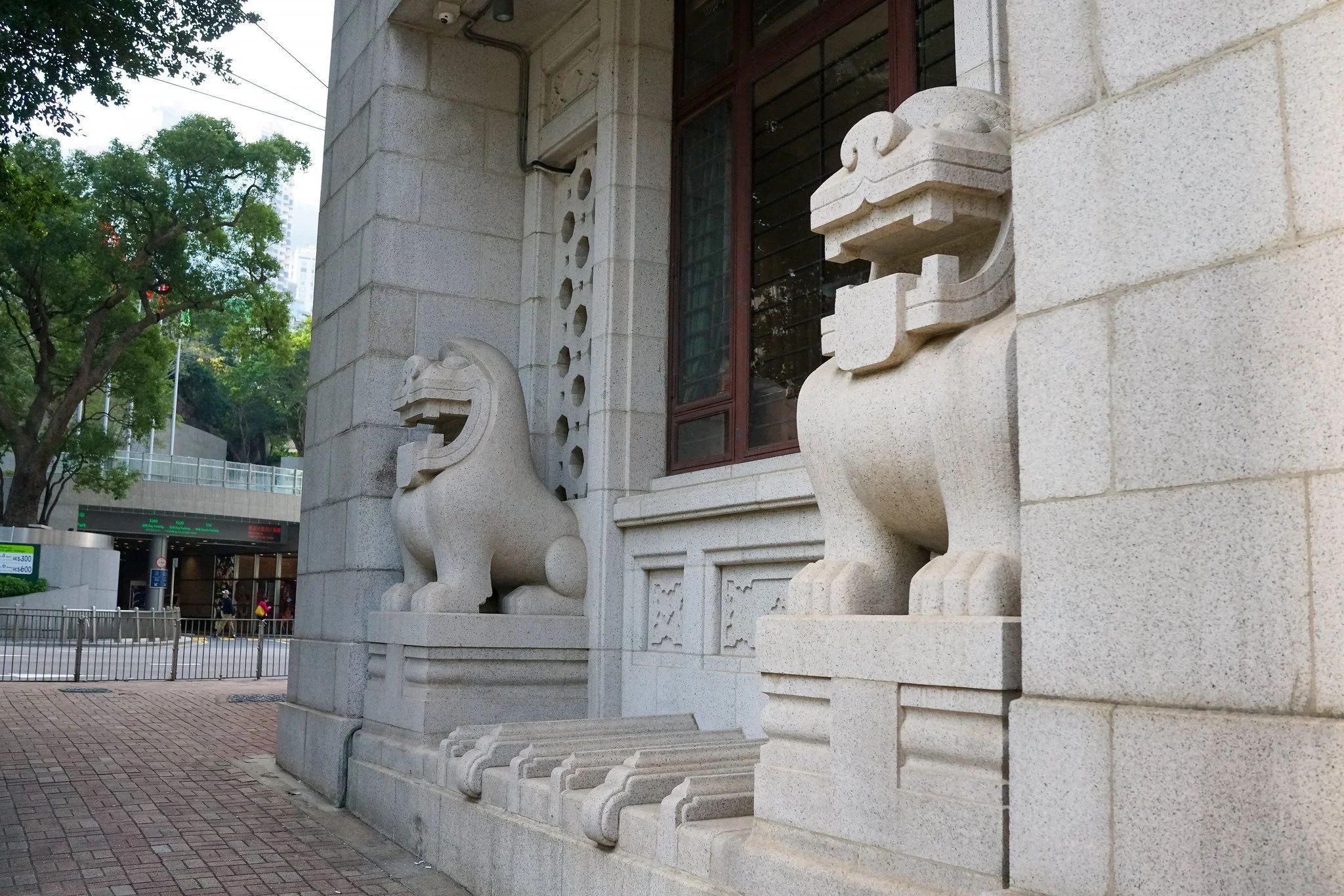
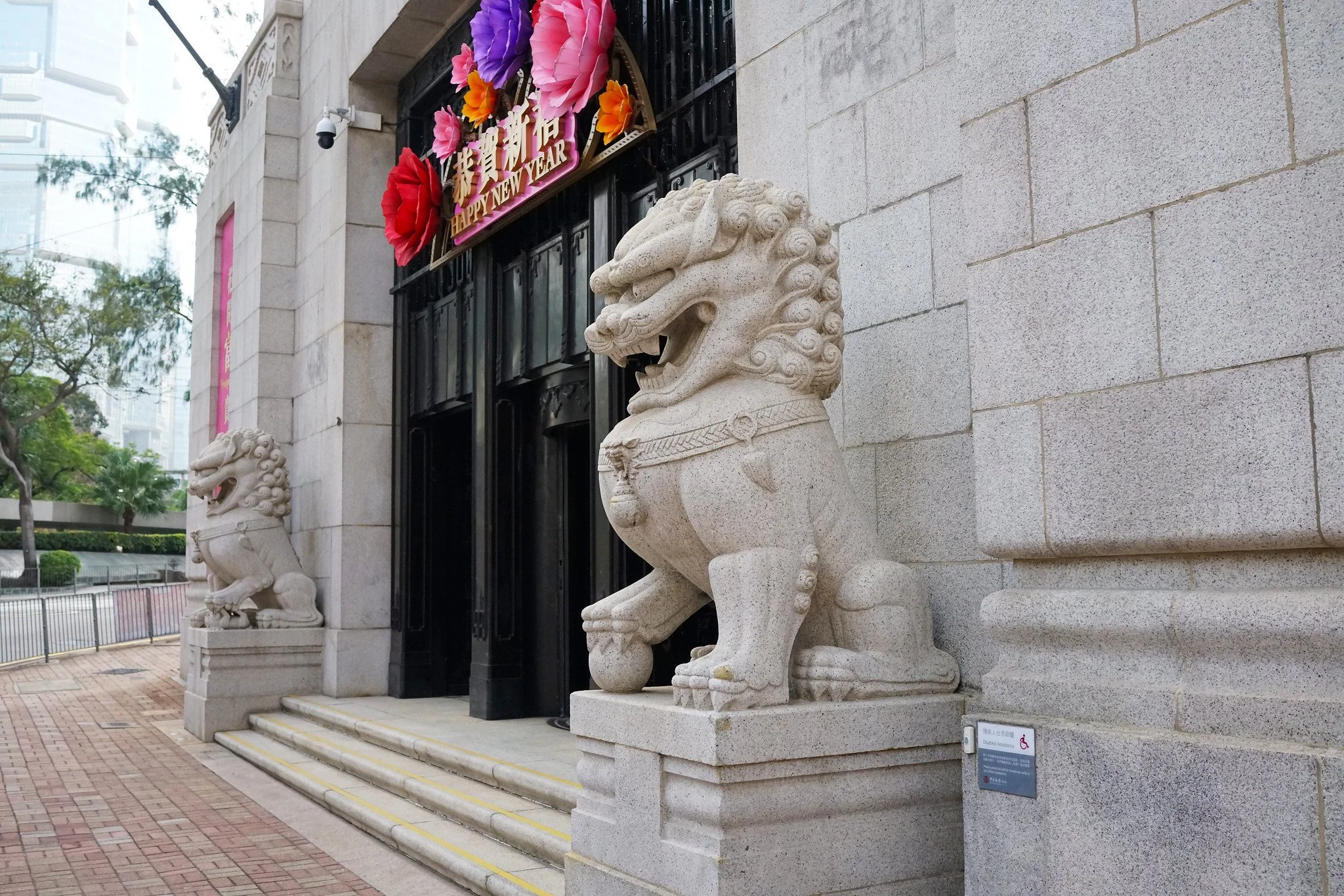
Bank of China (1951) | Foo Dogs | Hong Kong
There are 2 sets of Foo Dogs guarding the Bank of China Headquarters next door - a counter balance to the HSBC Lions perhaps ????
The Physical Setup of this pair of creatures….
HSBC lions (Stephen and Stitt): Two large bronze guardian lions at the main entrance of the current HSBC headquarters (1 Queen's Road Central). They are Western-style in design (inspired by Venetian Arsenal lions), named after British bank managers, and have become iconic. They face outward, with Stephen roaring on the left and the calmer Stitt on the right. They are heavily associated with feng shui protection - warding off "water glare" sha qi from the harbour and bringing prosperity. Locals (and tourists) constantly rub their paws and noses for luck.
Old Bank of China headquarters (next door at 2A Des Voeux Road Central): This 1951 granite Art Deco building (the former main HQ before the 1990 tower) has traditional Chinese granite foo dogs (stone guardian lions) at its main entrance on Des Voeux Road. There is a classic male-female pair: the male (left, usually) plays with an embroidered ball, the female protects a cub. These are proper shishi / foo dogs in the traditional Chinese style - muscular, ornate, and unmistakably Eastern.
(Note: The old BOC building also has another, more Western-style pair of stone lions at the other end facing toward Admiralty, but the main granite foo dogs on Des Voeux are the ones most people notice when comparing to HSBC.)
Please refer to the 2 images above that show both pairs of foo dogs
They are literally neighbours - only a short distance apart in the same block of Central.
Is There a Real Connection?
Historically and physically: No direct designed connection. The HSBC lions date back to the 1935 building (with roots in the 1923 Shanghai pair). The old BOC building and its granite foo dogs were added later, in the early 1950s. They were chosen independently as standard guardian figures for important bank buildings in that era. Both pairs serve the same basic purpose - to guard the entrance and symbolise strength/prosperity - but one pair is bronze/Western-inspired and the other is traditional Chinese granite.
In feng shui terms: Both are guardian figures meant to protect their respective buildings from negative energy and invite positive qi. Traditional foo dogs (the BOC granite pair) are classic symbols of protection, with the male/female yin-yang balance. HSBC's bronze lions are treated similarly in local practice, even though they are not "authentic" foo dogs - locals often call them "HSBC foo dogs" or "Western foo dogs" and give them the same ritual respect (rubbing for luck).
Are They Compatible, Balanced, or Countering Each Other?
In popular imagination and storytelling, they are generally seen as compatible neighbours rather than rivals.
They sit in roughly the same energetic zone in Central, both benefiting from the dragon vein coming down from the Peak and the harbour in front.
Some locals view the whole stretch of banks (HSBC + old BOC + nearby Standard Chartered) as having a collective "guardian presence" that strengthens the area's overall prosperity energy. The lions/foo dogs are part of the street-level feng shui landscape rather than being in direct opposition.
There is no widespread story of them actively countering or fighting each other. The big "feng shui war" narrative in Hong Kong is almost entirely focused on the 1990 Bank of China Tower (the sharp, angular I.M. Pei skyscraper) versus HSBC — with its sha qi arrows and the rooftop "cannons." The old granite BOC building and its foo dogs are rarely dragged into that drama. They are seen as more traditional and "harmonious" compared to the controversial new tower.
Some tour guides and locals playfully note the contrast:
HSBC has the famous, touchable bronze pair that became global symbols.
Old BOC has the more "authentic" Chinese granite foo dogs.
This can be framed positively - as two different cultural expressions of the same protective idea standing side by side in modern Hong Kong. It shows how the city blends Eastern tradition with Western banking influence.
Any Interesting Stories or Legends?
Not many dramatic legends specifically linking the two pairs. The real stories tend to stay separate:
HSBC lions get the lion's share of attention (pun intended) because of their dramatic WWII survival, the careful 1985 feng shui reinstallation with cranes and ceremonies, and the daily rubbing ritual.
The old BOC granite foo dogs are quieter symbols of the building's Art Deco era and its role as the pre-1990 Chinese banking presence in colonial Hong Kong.
I always try and turn this into an engaging point: "Look across - HSBC has its famous bronze lions, Stephen and Stitt. Right next door at the old Bank of China building you see traditional granite foo dogs. One pair feels very British-Hong Kong, the other very Chinese. Yet both do the same job: guarding their bank and inviting good fortune. In Hong Kong style, they coexist peacefully on the same street, just like the banks themselves have learned to do business side by side despite the bigger feng shui dramas happening higher up with the new tower."
click on the image to enlarge
© Copyright Acknowledged | All rights reserved | image taken by Jamie
The Bank of China Building | on the left | Hong Kong
Was the new Bank of China Tower deliberately built much larger/taller than the 1985 HSBC HQ as payback because the 1985 HSBC had been made taller than the 1951 BOC HQ?
Fact first: Yes, the size jump is dramatic and noticeable.
The old 1951 Bank of China headquarters (the granite Art Deco building next door) was only 17 storeys - a modest mid-rise.
The 1985 HSBC headquarters (Sir Norman Foster’s building) jumped to 44 storeys and 179 m tall - suddenly the dominant structure on the block.
The 1990 Bank of China Tower (I.M. Pei) shot up to 70–72 storeys and 367 m tall (including spire) - more than double HSBC’s height and the tallest building in Hong Kong/Asia at the time.
Speculation that makes sense: Many locals and tour guides quietly treat this as a classic case of architectural one-upmanship with feng shui undertones. In the years leading up to the 1997 handover, the Bank of China (a mainland state-owned institution) was seen by some as asserting symbolic dominance in the British colony. Building the tallest, most striking tower right next to HSBC - after HSBC had “overshadowed” the old BOC building - felt like a deliberate statement: “We are now the biggest kid on the block.” The timing (BOC Tower finished just seven years before the handover) adds to the theory that it was partly about projecting mainland power and confidence. Whether the height itself was chosen specifically to “overpower” HSBC’s feng shui is impossible to prove, but the visual and energetic dominance it created is exactly what fuels the war stories.
Why on earth did I.M. Pei incorporate elements that broke the “laws of feng shui”? Or was it simply that BOC wanted a magnificent, iconic skyscraper?
Fact first: Pei and his team did not consult any geomancers. The sharp triangular prisms, X-bracing (later softened to diamond shapes after public outcry), and knife-like edges were chosen for structural, aesthetic, and symbolic reasons - the form was meant to evoke bamboo shoots rising strongly, representing growth, resilience, and Chinese renewal. Pei himself and his son (Sandi Pei) have repeatedly said the design was driven by engineering efficiency, site constraints, budget, and a desire to create something fresh and iconic, not by any intent to create bad feng shui.
My reasoned speculation: It was almost certainly not deliberate sabotage. Pei was a modernist architect working for a client (Bank of China) that wanted a bold, forward-looking statement in the lead-up to 1997. The 1980s–90s were a time when many Chinese institutions were embracing Western modernism while still nodding to Chinese symbolism (bamboo = strength and flexibility). The feng shui issues were an afterthought that blew up locally because the building was so visually aggressive in a city obsessed with harmony. Pei, being Chinese-American and trained in the West, simply operated outside the local feng shui framework - he later called some of the criticism “superstition.” The client likely prioritised “magnificent and instantly iconic” over traditional geomancy, which is exactly why the tower became the lightning rod for the war stories.
Are there any other weird theories about the feng shui wars that I haven’t covered yet?
A few extra layers that float around in local lore and tour-guide circles:
Political symbolism / “pre-handover power play”: Some older Hongkongers claim the BOC Tower’s sharp angles were subtly designed (or at least welcomed) to “cut” British colonial luck and clear the way for 1997. The targeting of Government House in particular is seen by conspiracy-minded locals as no accident.
Empty floors as self-protection: The persistent rumour that several upper floors of the BOC Tower were left deliberately vacant for years “to let the bad energy escape” or to avoid concentrating sha qi inside the building itself. (In reality, some floors were slow to lease, but the story stuck.)
The “collective guardian” theory: A softer, more positive spin - that the HSBC lions and the old BOC granite foo dogs together create a protective “double gate” for the whole Central banking district, balancing Western and Chinese protective energy so the area as a whole prospers despite the tower drama higher up.
The “cannons were always there” myth-busting: We already covered this but some conspiracy versions claim HSBC secretly angled or modified the cranes after the BOC Tower opened, even though photos prove the cranes existed from 1985.
Any Official comments?
Very few, and they are all carefully neutral or dismissive:
I.M. Pei / Pei team: Repeatedly stated they were not influenced by feng shui and that the geometry was purely aesthetic and structural. They modified the X-bracing only because of the public backlash, not because they accepted the criticism as valid.
Bank of China: Has never officially confirmed or denied the feng shui stories. They simply present the tower as a symbol of strength and modernity.
HSBC: Has stayed completely silent on the “cannons” legend for decades. They treat the rooftop structures as ordinary maintenance cranes and have never confirmed any feng shui intent.
In short, the institutions involved treat the whole war as colourful local folklore rather than something they want to engage with officially. That silence has only helped the legend grow stronger.
click on the image to enlarge
© Copyright Acknowledged | All rights reserved | image taken by Jamie
The Bank of China Building | White Roof Antenna | Hong Kong
Not quite finished….
The white structures on top of the Bank of China Tower (the two tall, upright masts/posts visible from many angles) are not daggers or any deliberate feng shui weapon. That idea is a common local misunderstanding or playful exaggeration that grew out of the broader "feng shui war" legend and for want of a better phrase I call them rugby posts!
What They Actually Are
They are antenna masts / communication towers combined with lightning protection rods.
The Bank of China Tower reaches 315 metres to the roof, but the total height including these masts is 367.4 metres.
One or both masts serve as radio/communication antennas (for broadcasting, mobile signals, or building systems).
They also function as lightning rods - essential in Hong Kong’s typhoon-prone climate to safely conduct lightning strikes away from the structure.
In architectural terms, they are functional extensions of the building’s height and technical systems, not symbolic elements. The architect I.M. Pei and his team designed the tower with a tapering, crystalline form inspired by bamboo shoots (symbolising growth and strength in Chinese culture), and these masts complete the vertical expression at the very top.
The “Daggers” or “Rugby Posts” Perception
From certain angles (especially from street level or across the harbour), the two white uprights do look strikingly like rugby goal posts or tall poles - hence the nickname
In the heat of the 1990s feng shui controversy, some locals and tour guides jokingly or seriously interpreted all the tower’s sharp triangular edges and protruding elements as “daggers,” “knives,” or “arrows” shooting sha qi (negative/killing energy) outward. The white masts on top sometimes got lumped into that narrative as additional “pointy” features.
However, there is no credible feng shui master or official source claiming the white masts specifically represent daggers. The main feng shui complaints have always focused on the tower’s large triangular prisms, X-bracing (later softened), and overall knife-like silhouette - not these functional masts.
The “daggers” story is part of the same urban legend ecosystem as HSBC’s rooftop “cannons.” It’s colourful folklore that grew because the tower was the first major Hong Kong skyscraper built without consulting geomancers, and its bold, angular modernism clashed with traditional preferences for rounded or harmonious forms.
Bottom Line
Actual purpose: Practical - antennas for communication + lightning protection. (no data as to whether they have actually been struck by lightning!)
“Daggers” claim: Not accurate. It’s a folk interpretation born from the tower’s overall sharp aesthetic and the intense feng shui debates of the era. The real feng shui controversy was about the building’s massing and angles, not these specific white structures. (try telling that to local folk!)
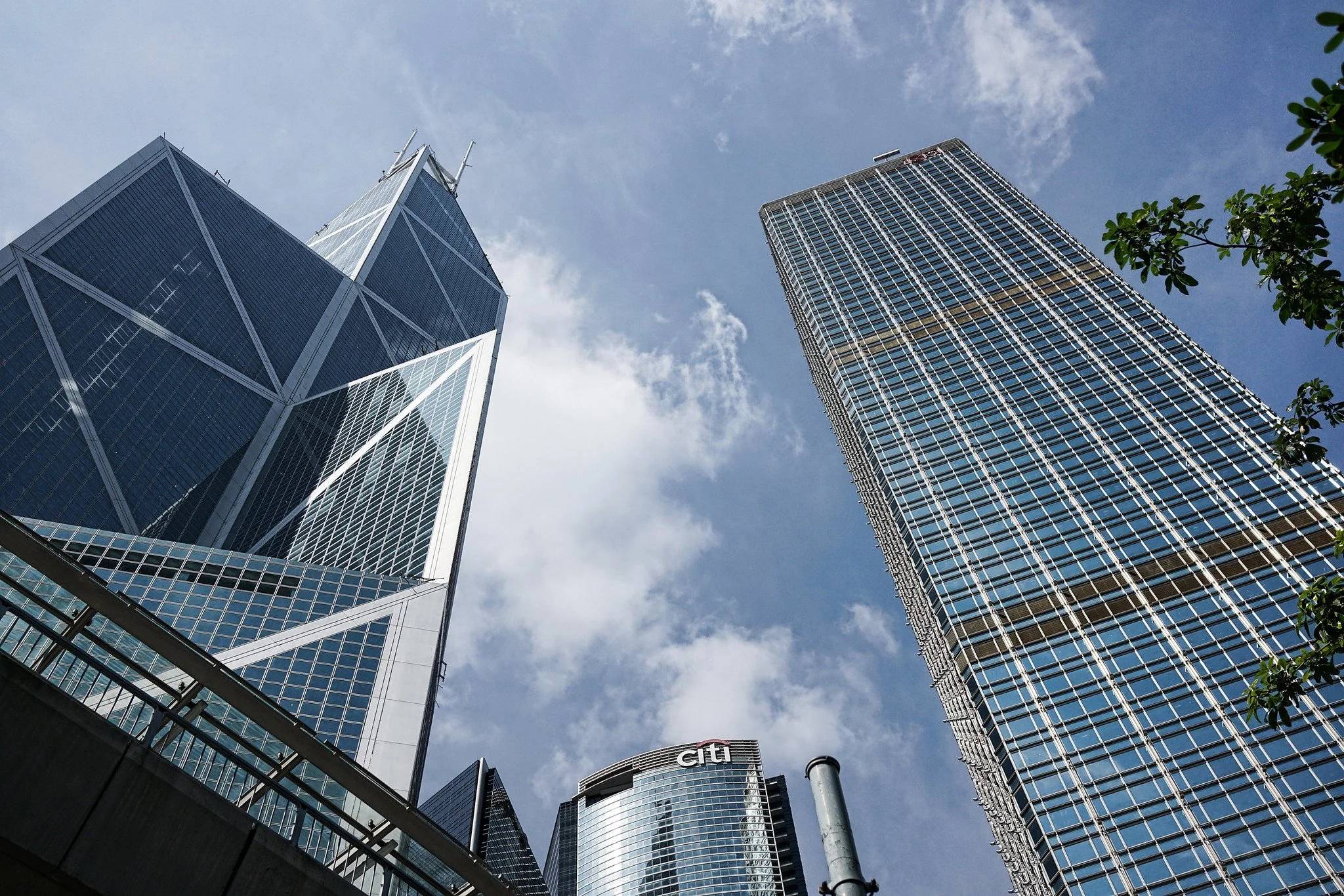
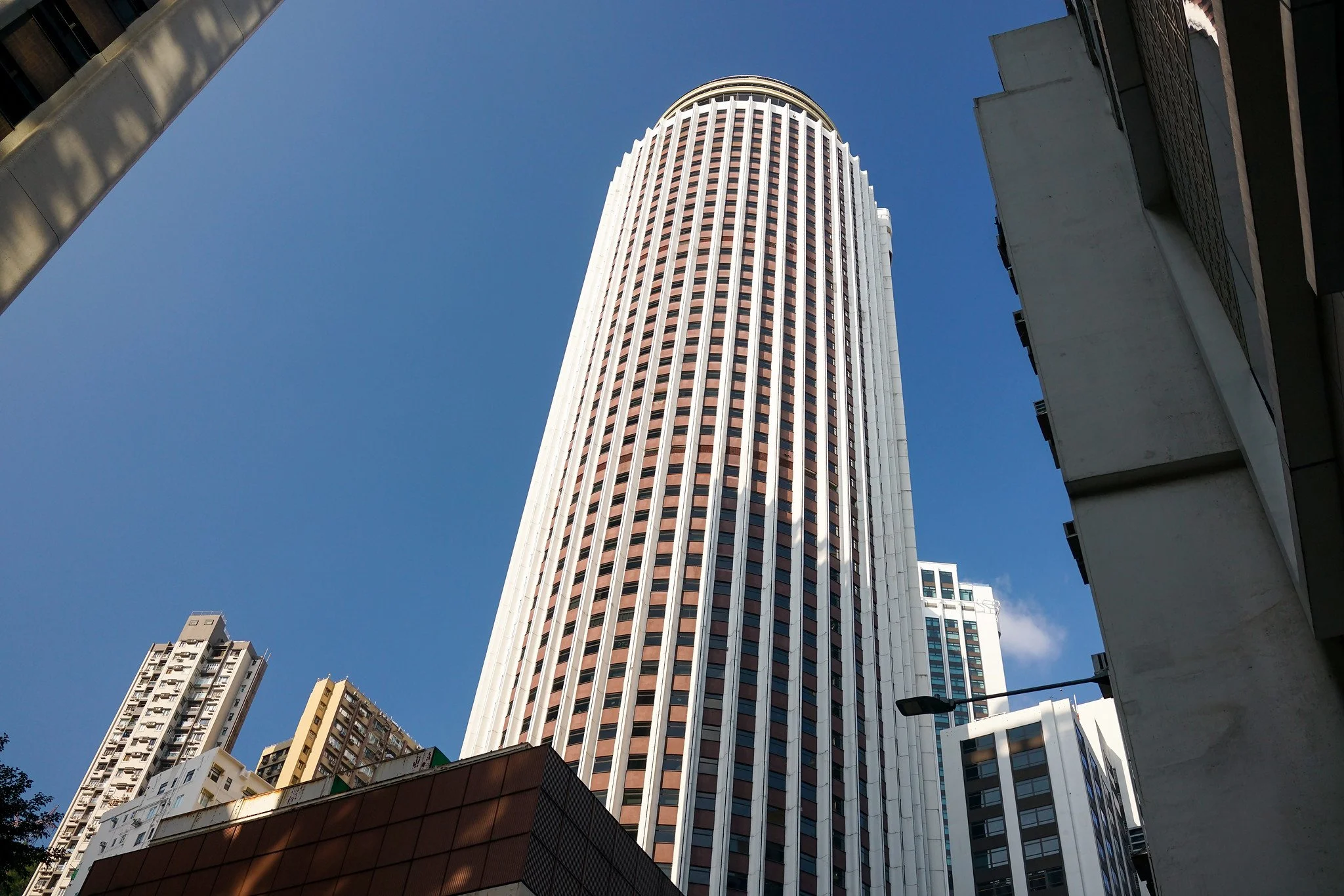
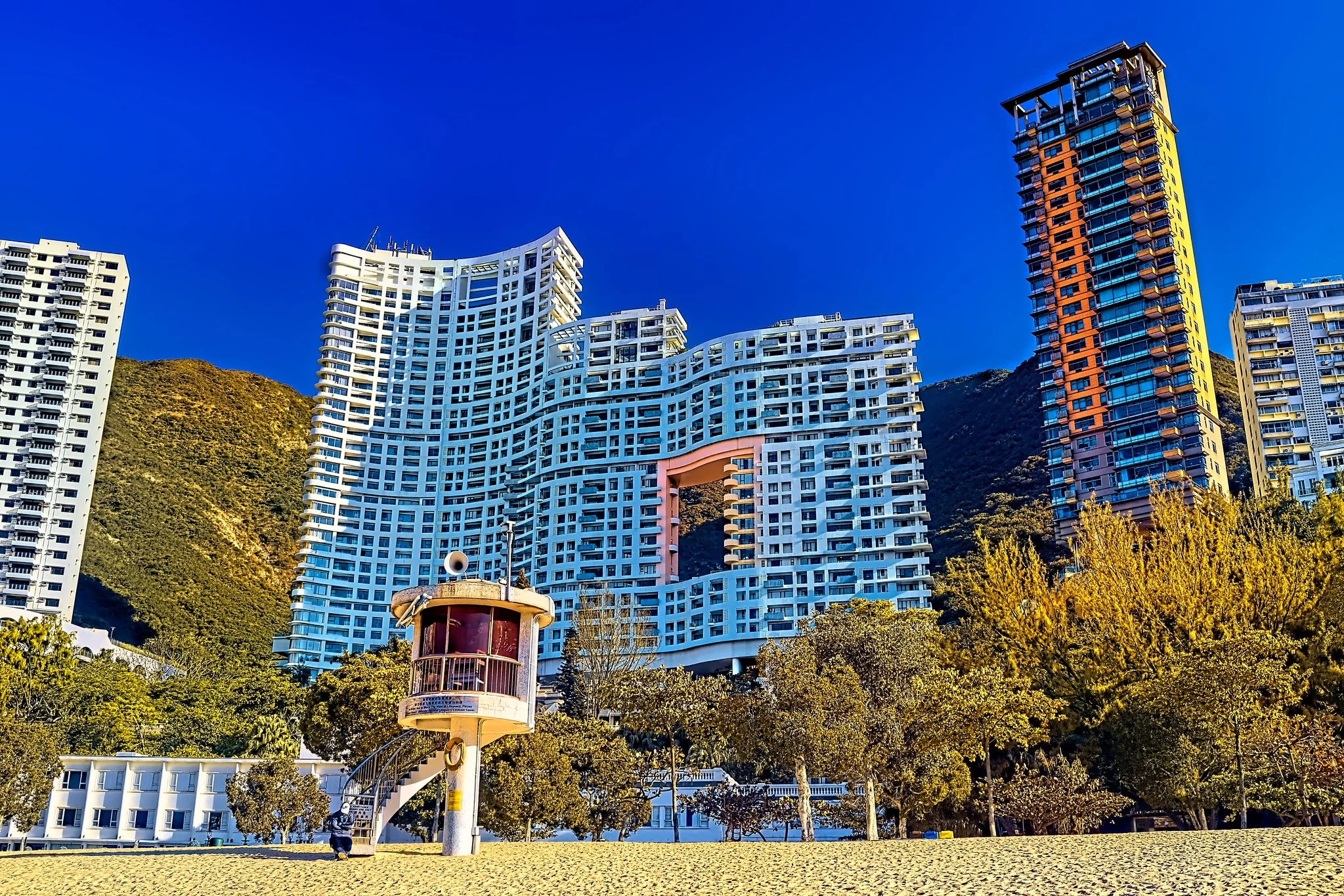
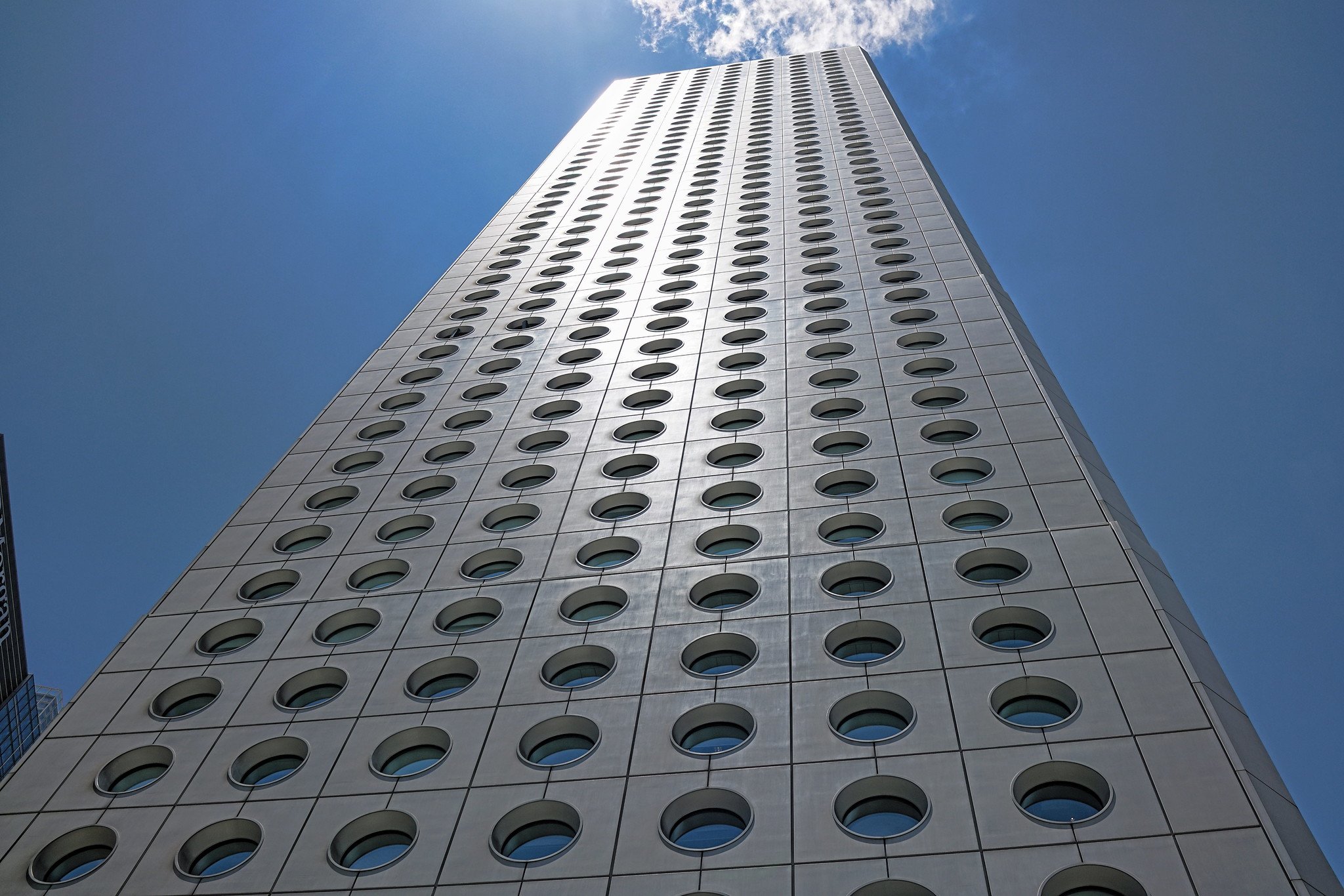
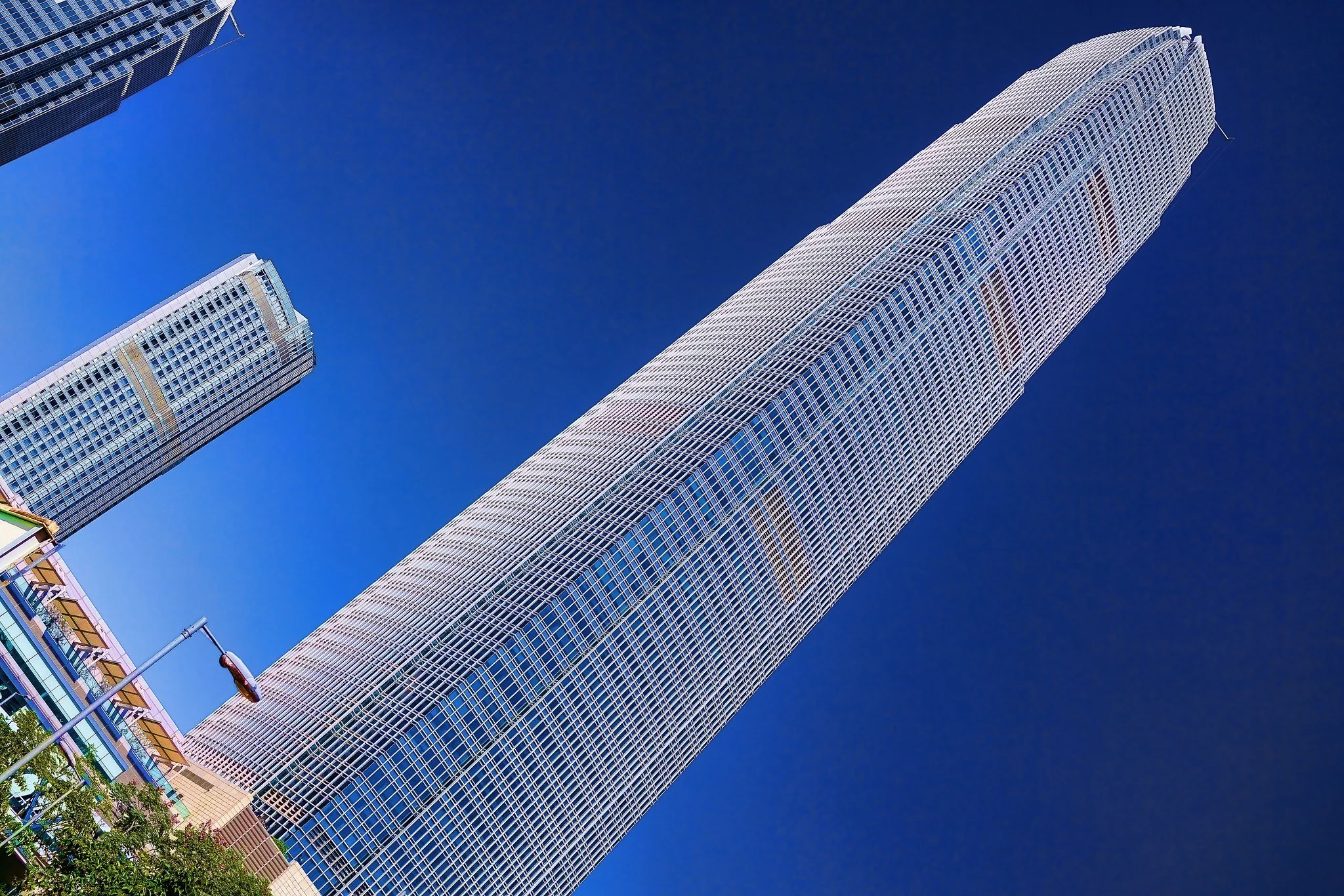
Click on any image to enlarge
© Copyright Acknowledged | All rights reserved | images taken by Jamie
Iconic Hong Kong Buildings | Feng Shui | Hong Kong
Other Notable Feng Shui Battles in Hong Kong
The HSBC–Bank of China “war” is the most famous, but it is part of a much broader pattern in the city. Other notable examples include:
Please refer to the images above
The Cheung Kong Center - The Wise Bystander: Built in 1999 by Li Ka-shing’s company and physically sandwiched between HSBC and the Bank of China Tower. Its sober, square design with soft angles and reflective glass is said to let sha qi from the BOC Tower “bounce off” or swirl around without penetrating, while staying safely out of range of HSBC’s rooftop “cannons.” Many see it as a textbook example of playing it safe in a high-stakes feng shui battlefield. in the image it is the building to the right of the Bank of China
Hopewell Centre - The “Burning Candle” Remedy: The cylindrical Hopewell Centre (1980) was criticised for resembling a giant candle or cigarette — shapes associated with fire and rapid “burning out” of luck. To counteract this, a large swimming pool was added to the roof. Water is believed to balance the fiery energy and prevent the building (and its owner, Gordon Wu) from “going up in smoke.” The pool remains one of the more visible feng shui remedies in Hong Kong.
Dragon Holes and “Holes in the Skyline”: Many buildings feature large circular or rectangular openings (dragon gates) cut through the middle, such as the Repulse Bay apartment block. These allow powerful dragons living on the mountain ridges to fly freely down to the harbour for water (wealth). Blocking their path is said to bring misfortune.
Jardine House (“The House of a Thousand Holes”): Its hundreds of circular porthole-style windows were initially criticised as resembling coins falling out or “bullet holes,” but were later reinterpreted positively as coins pouring in or watchful eyes over the harbour.
IFC and Reclamation Issues: The International Finance Centre towers sit on reclaimed land that some masters claim disrupts the natural flow of harbour water (wealth energy), leading to various corporate troubles blamed on this interference.
These stories illustrate that the HSBC - Bank of China “war” is the most famous, but almost every major skyscraper in Hong Kong is judged not just on height, cost, or design, but on how it interacts with invisible energies - and how its neighbours respond.
I like to frame it as: Now, if Feng Shui seems like nonsense to you, consider this HSBC paradox - it shows you can explain away anything, even when beliefs fly in the face of logic. Traditional foo dogs need a male-female pair for balance, but here we have two blokes, Stephen and Stitt, straight out of British lore. And that logo? All those triangles should be sha qi city, slicing away good fortune. Yet geomancers tweaked it, locals rub the lions anyway, and HSBC keeps printing money. Why? Because in Hong Kong, Feng Shui isn't about perfect rules - it's about what works. If the dragon's breath flows and the bank prospers, who needs logic? It's the ultimate cultural hack: Adapt, believe, and let the qi do its thing.
This keeps guests engaged and amused ! chuckling at the "illogic" while appreciating the depth - perfect for incredulous types.
click on the image to enlarge
© Copyright Acknowledged | All rights reserved | image taken by Jamie
The Standard Chartered Bank Building | + HSBC | Hong Kong
The Standard Chartered Bank building (at 4-4A Des Voeux Road Central, right next to HSBC) has a much quieter and more harmonious feng shui reputation compared to the dramatic HSBC vs Bank of China Tower "war." It doesn't have its own major legends or scandals, but it does feature in the broader Central banking district stories — often in a positive or neutral light.
Standard Chartered's Feng Shui Reputation
The building is a 42-storey tower (completed in the 1990s) with a relatively straightforward rectangular form and rounded corners. In traditional feng shui terms, this design is seen as calm and stable because it avoids the sharp "poison arrows" or aggressive angles that caused so much controversy with the Bank of China Tower. It benefits from the classic "mountain behind, water in front" setup - with Government Hill providing solid support at the back and Victoria Harbour (wealth energy) in front.
Locals and some tour guides describe it as the "wise bystander" or "peaceful neighbour" in the energetic standoff between HSBC and Bank of China. While those two engage in a dramatic duel (sharp edges firing sha qi one way, rooftop "cannons" firing back the other), Standard Chartered sits modestly in between and is said to quietly absorb the spillover prosperity without getting caught in the crossfire. Its neutral, non-aggressive design lets it benefit from the strong dragon vein flowing down from Victoria Peak and the overall positive qi of the Central banking cluster.
The Bridge | Walkway Connection
There is a pedestrian bridge/walkway that connects the Standard Chartered Bank Building directly to the HSBC headquarters area. In local storytelling, this link is sometimes playfully interpreted as allowing Standard Chartered to "borrow" or directly benefit from HSBC's excellent feng shui. HSBC has strong protective features (open plaza for qi flow, angled escalators to block straight-line sha qi, the powerful bronze lions as guardians, and the harbour view for wealth). The physical connection is seen by some as a conduit that lets positive energy and prosperity "flow" across to Standard Chartered, giving it an extra layer of protection and good fortune without needing dramatic remedies of its own.
There is one light-hearted anecdote: at one point a typhoon reportedly blew one of HSBC's rooftop "cannons" (maintenance cranes) slightly out of alignment so it pointed toward Standard Chartered instead of the Bank of China Tower. Standard Chartered's management was apparently alarmed enough to send a lawyer's letter asking HSBC to fix it quickly. This story is told with a wink - it shows how seriously some people take even the smallest shifts in these symbolic alignments.
Overall, Standard Chartered is portrayed as the sensible, low-drama bank in the trio. It doesn't need cannons or major countermeasures because its form is harmonious and it sits in a "safe" position within the group. The walkway connection reinforces the idea that good feng shui can be shared among neighbours in Hong Kong's dense financial district.
… and also look at the paper Hong Kong currency, all 3 of the big banks - HSBC, Bank of China and The Standard Chartered Bank issue the bank notes, they are connected in so many ways!
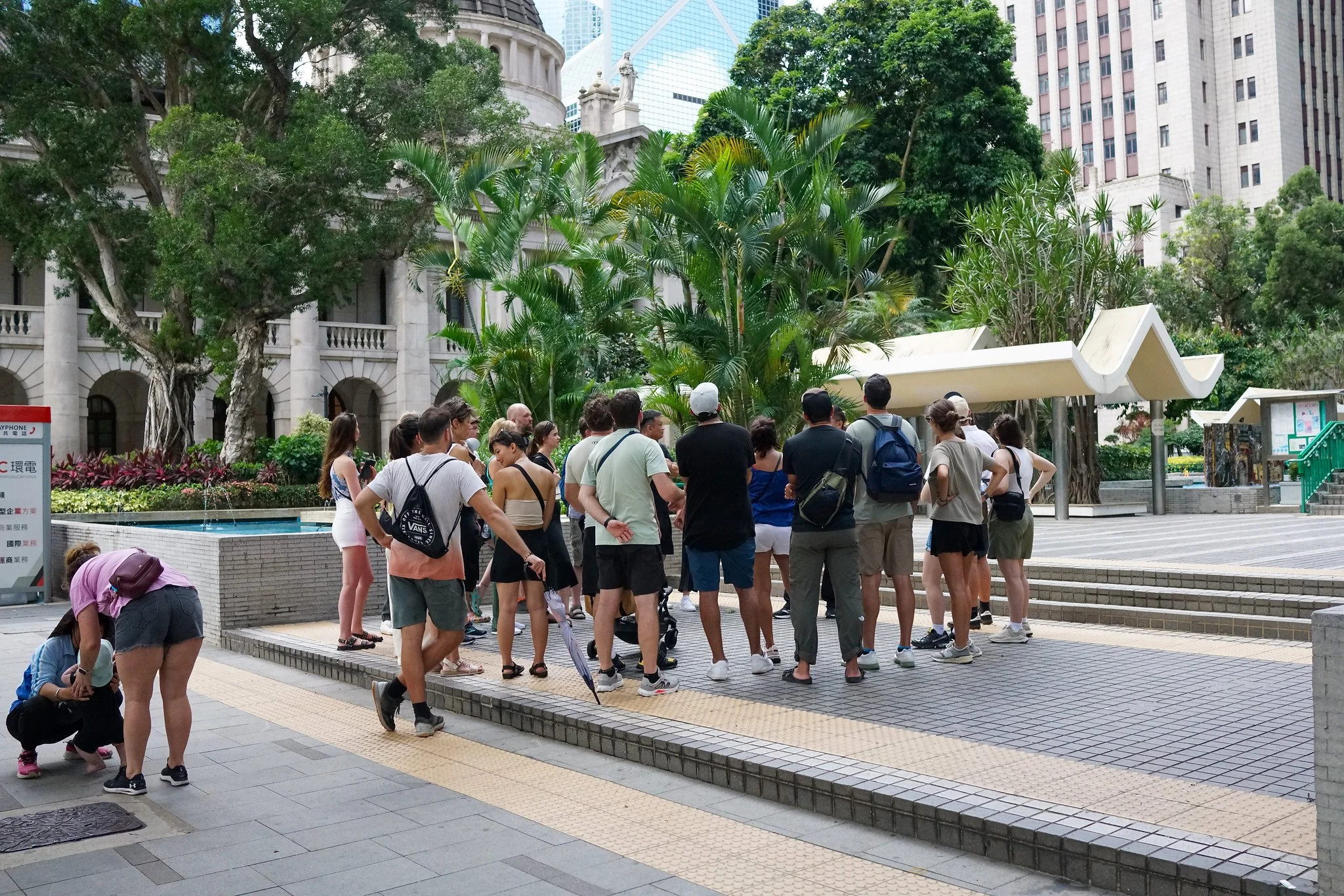
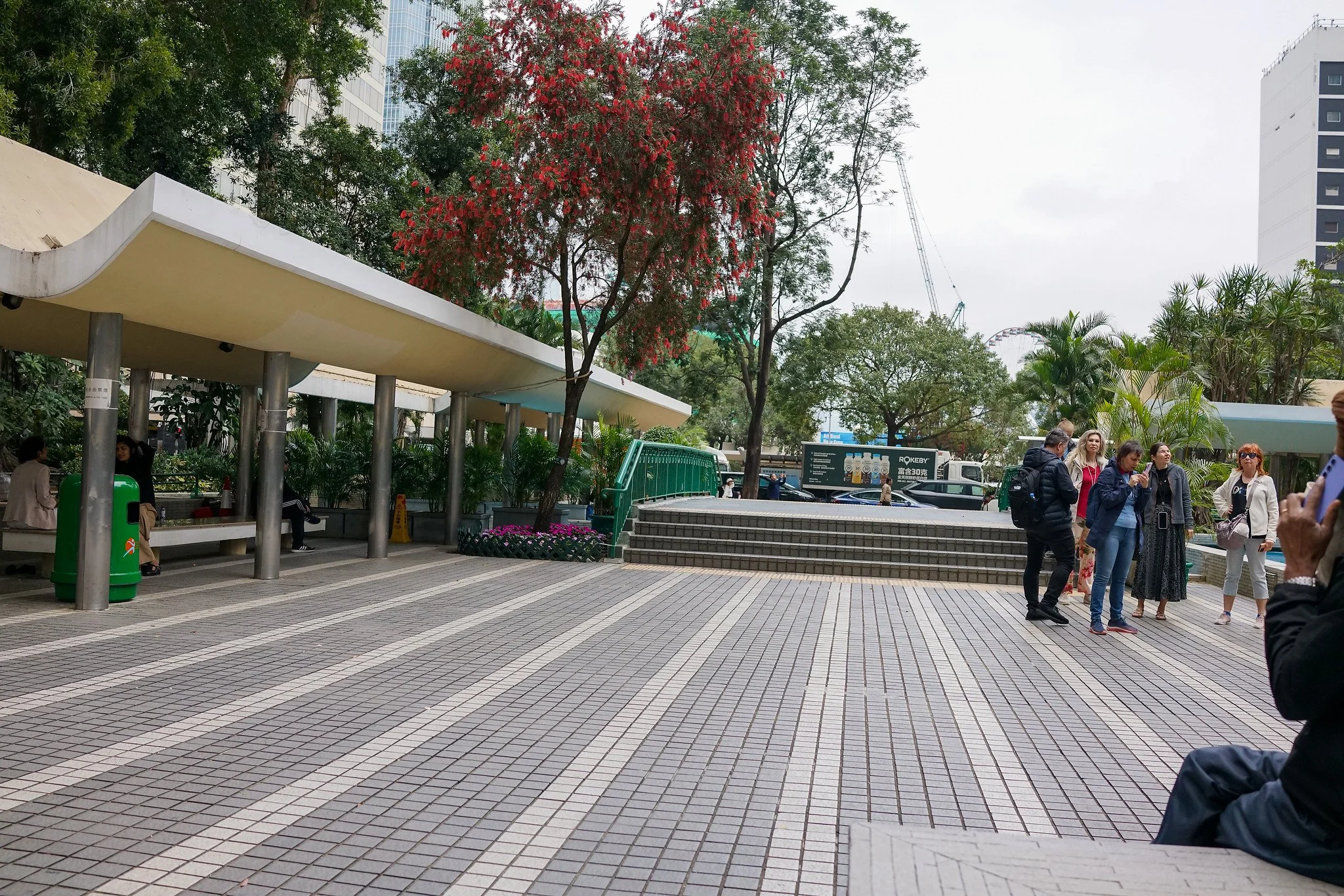
click on any image to enlarge
© Copyright Acknowledged | All rights reserved | images taken by Jamie
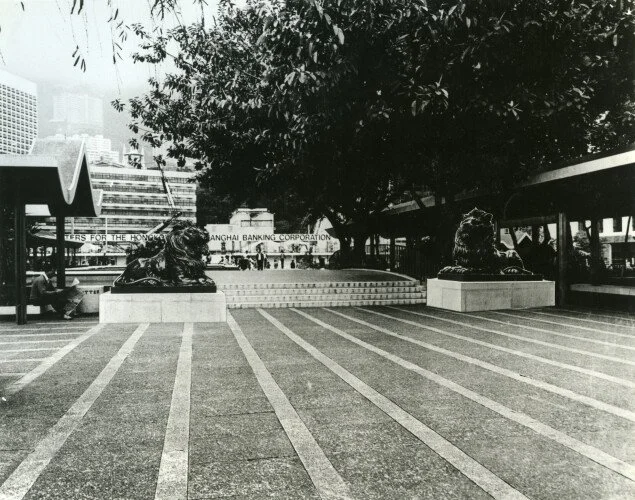
1982 Site of HSBC Lions Statue Square | 2026 | Hong Kong
I do not have (amazingly) an image of the spot from the 1982 image below but the 2 images above actually show the position
The image on the left with the tour group, of they walked up the steps and went straight they would come to a bridge, the bridge is where the lions where placed
The image on the right is from the opposite side of the bridge, so from this angle you have been able to see the 2 lions over the bridge and behind me and across the road is HSBC Headquarters
click on the image to enlarge
© Copyright Acknowledged | All rights reserved | HSBC for the old imago
HSBC Lions relocated to Statue Square | 1982 | Hong Kong
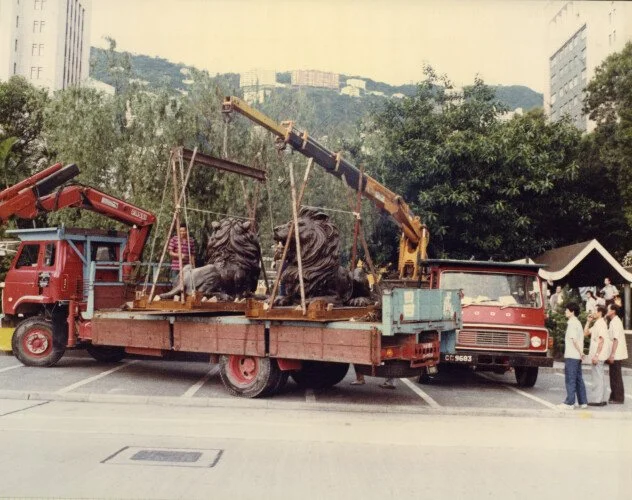
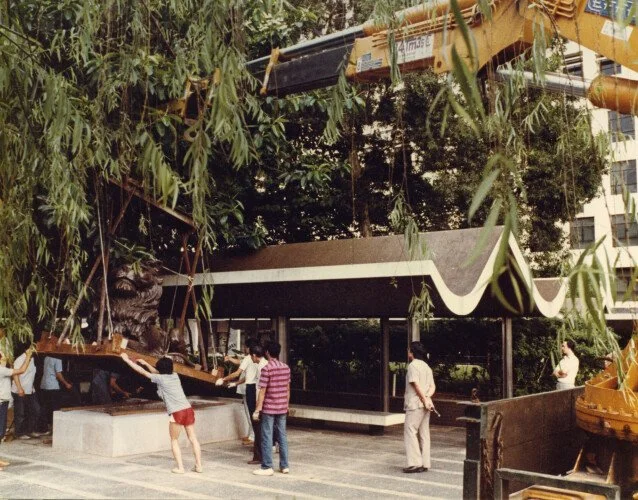
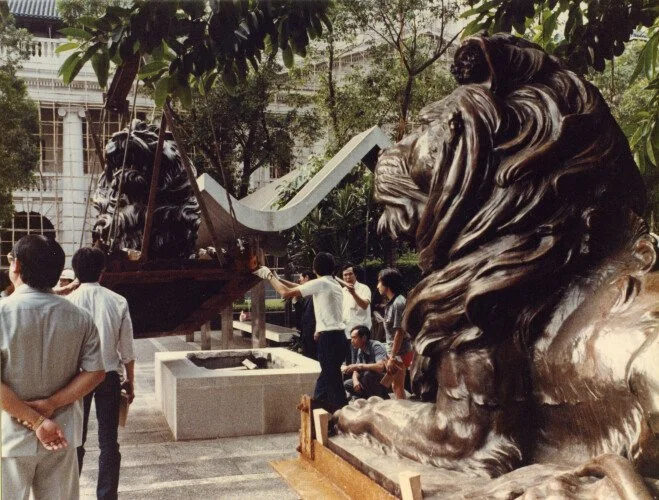
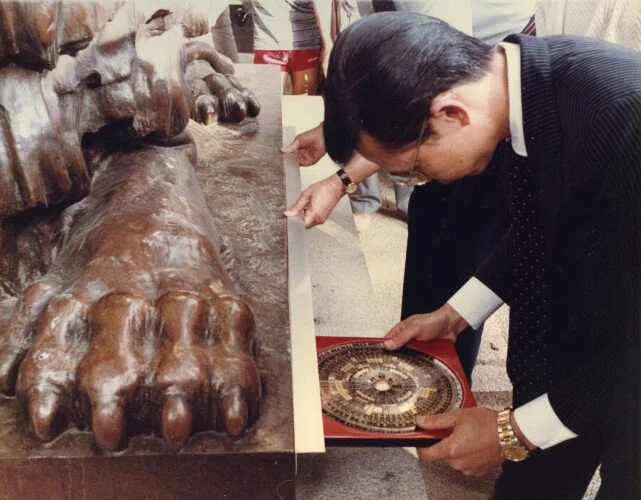
click on the image to enlarge
© Copyright Acknowledged | All rights reserved | HSBC for the old imago
HSBC Lions Moved to Statue Square | 1982 | Hong Kong
What the Records Show
Boy, these images brought back some memories… I was a young lad of 21..
My favourite image is the of the Feng Shui master using his compass, I had a wry smile on my face, what struck me was the solid gold Rolex watch! this guy was for sure at the top of his game
The lions were moved to Statue Square (just across the road from the old HSBC headquarters) in June 1982 as the 1935 building was demolished to make way for the new Norman Foster-designed headquarters. They remained there for about three years (watching over the construction site) until their ceremonial return on 1 June 1985.
HSBC’s own corporate history archive contains a dedicated photograph album documenting this temporary relocation. It includes:
Photos of the lions being transported and lifted onto plinths in Statue Square.
Images showing one or both lions in their temporary location, with the HSBC construction site visible in the background.
Shots of feng shui master David Lung (Lung King-cheung) on site using a traditional luopan compass to mark and verify the exact auspicious positions.
These images are publicly viewable on the official HSBC History website (history.hsbc.com) in the “Roaring to Life” exhibition and the “Lions on the Move” collection. Specific examples include:
A photograph of one lion (often identified as Stephen) being placed onto a plinth in Statue Square, dated around 4 June 1982.
Views of the lions in their temporary home in Statue Square, with the construction activity behind them.
Photos of the feng shui master working at the site.
So there you go, a nostalgic way to finish this post
I do not do Food Tours in Hong Kong but I know people that do!
I do not do food tours as mentioned above, I have very specific reasons and part of it is that I do not speak Cantonese or write Chinese, I am from Yorkshire in England and I lack the language gene and it is not through lack of trying and yes a lot of restaurants do not have English menu’s or staff who speak conversational English.
.. and yet I have eaten at close to 1,400 restaurants in Hong Kong since January 2nd 1972, my wife was born in Hong Kong and we have been together over 40 years and her first language is Cantonese and a lot of her family are Chinese or half Chinese so I have never had much of an issue!
This does not translate to doing food tours though, yes, I could do them, no problem there but they would never ever be as good as the food tours done by my friends (see the 3 links above) most of their awesome guides are locally born Hong Kong Chinese and obviously food culture is part of their DNA, it is impossible for me to compete with that!
So please feel free to contact them for food tours
click on any image to enlarge
© Copyright Acknowledged | All rights reserved | all images taken b Jamie
Jamie’s Hong Kong | Some of my favourite images | Hong Kong 101
© Jamie Lloyd | J3 Consultants Hong Kong | J3 Private Tours Hong Kong |
| 2010 - 2026 All rights reserved. |
Click on any image to enlarge to full screen
Current images from my Instagram feed