Bamboo Scaffolding in Hong Kong - A comprehensive guide
A detailed history, origins, and current status in Hong Kong as of early 2026

The J3 Group - Premium Quality Private Tours | Experiences and Insider Chats since 2010
Me Jamie, your host, I am English and I have lived in Hong Kong since January 2nd 1972 - I know the place.
A meaningful blog post with a difference - tips on Travel, Tourism, Tours, Daily Life and my personal thoughts on Hong Kong.
Please do visit Amazing Hong Kong
Hong Kong | Pearl of the Orient
Customised Private Tours + Experiences in Amazing Hong Kong
Jamie has lived in Hong Kong - Pearl of the Orient for 50+ years
Carefully Crafted Personalised and Customised Itineraries by Jamie | Hong Kong’s Most Experienced Private Tour Guide for : Solo Travellers Friends Families Seniors Couples Business People MICE Delegates.
Private Tours Cultural Tours Walking Tours Sightseeing Tours City Tours Night Tours Layover Tours Transit Tours Private Shore Excursions Bespoke Tours Personalised Tours Jewish Heritage Tours Luxury Private Tours Day Tours Luxury Boat Tours Themed Tours Private Family Tours Private Day Tours Corporate Tours
Just you, your family or friends and Jamie your personal English private tour guide - over 2,400+ tours completed since 2011 - Jamie offers quality Private Tours of Hong Kong
Tour Group Size 1 - 6 people only
J3 Group Hong Kong | J3 Consultants Hong Kong | J3 Private Tours Hong Kong
Creating Memories That Will Last A Lifetime
Go here for the Hong Kong Michelin Restaurant Guide which includes the Bib Gourmand Category

Timeless Hong Kong Stories, Tailored Just for You by Jamie
A Resident since 1972 - Sharing Hong Kong as Only a Local Can
click on the image to enlarge
© Copyright Acknowledged | All rights reserved | image taken by Jamie
Bamboo Scaffolding 2026 | Sham Shui Po District | Hong Kong
Bamboo Scaffolding in Hong Kong: Ancient Craft, Modern Reality, and Why It’s Still Everywhere You Look - A very detailed Guide
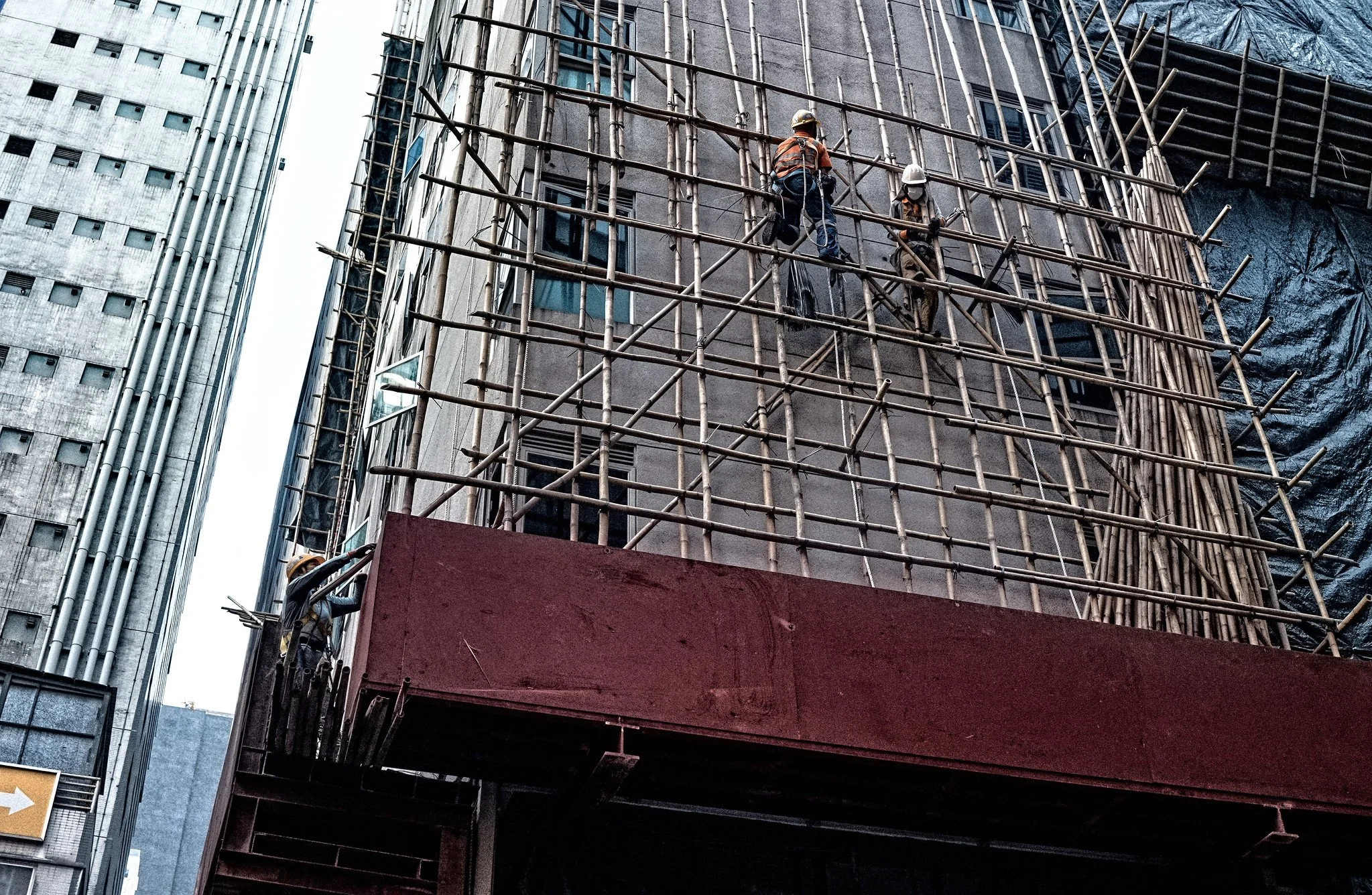
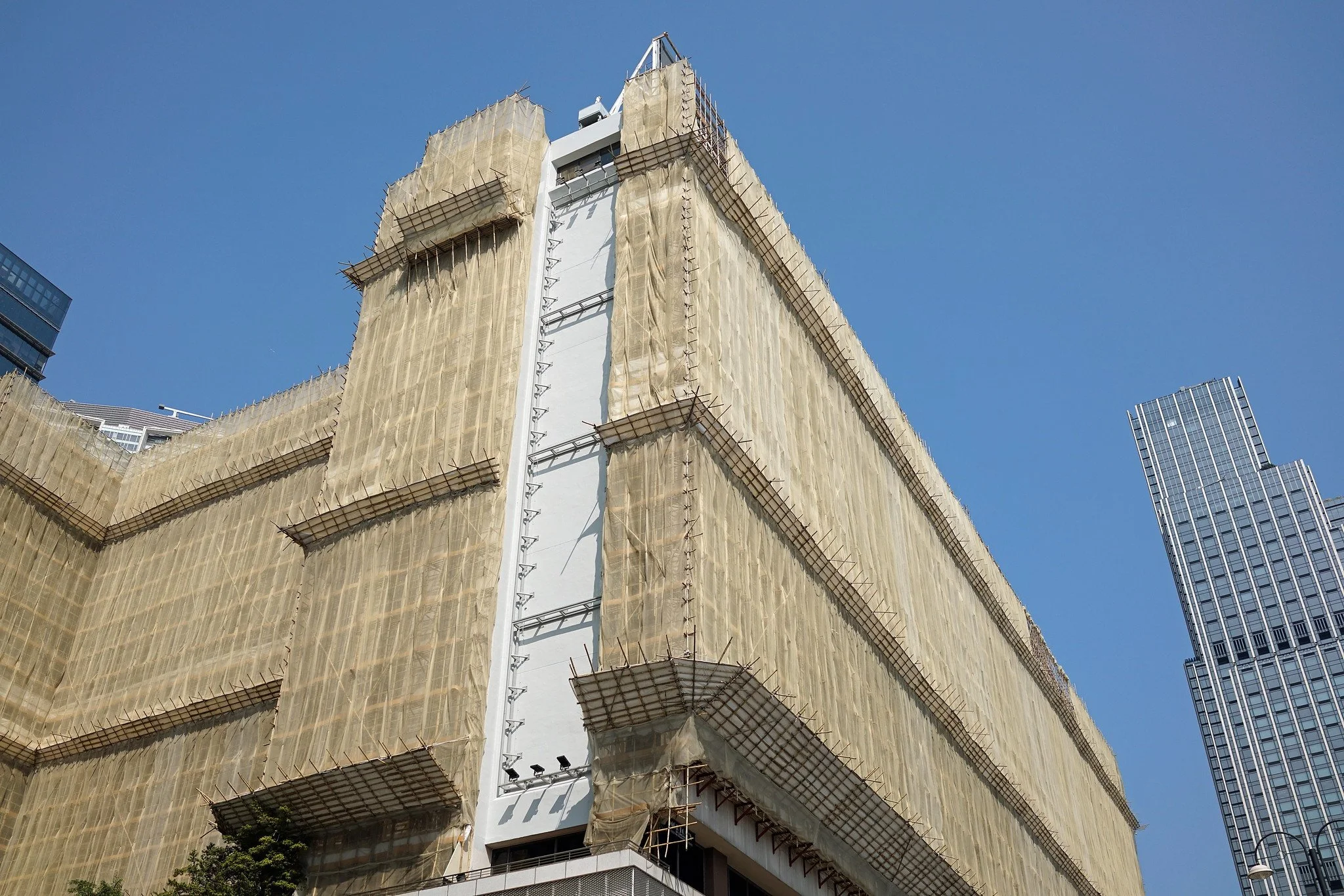
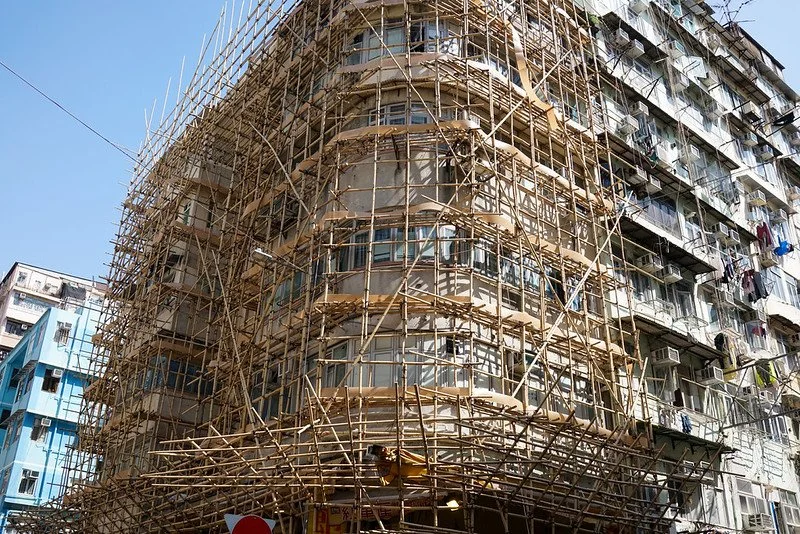
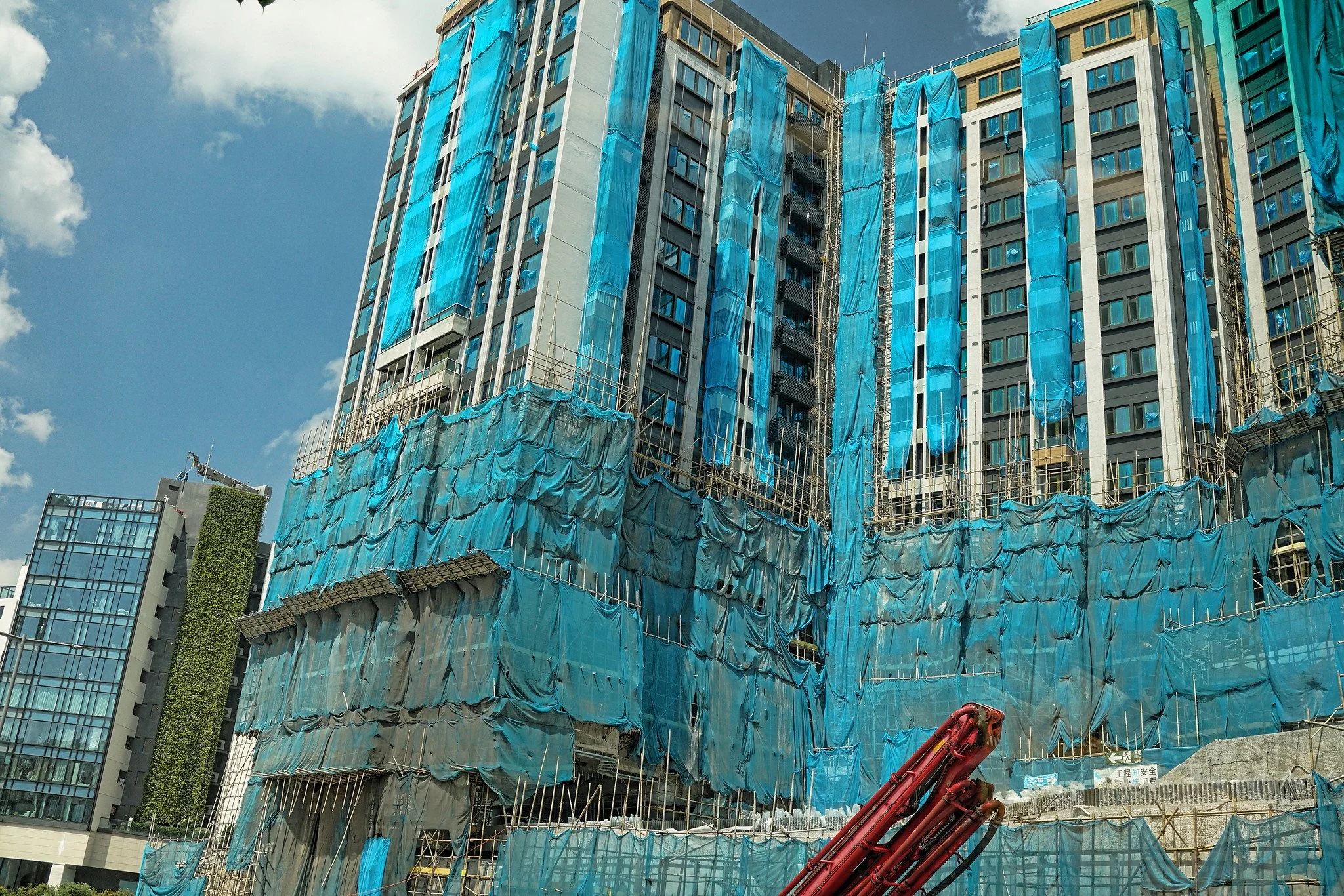
As a Hong Kong resident for 54 years and the owner of J3 Private Tours Hong Kong and J3 Consultants Hong Kong, with over 2,360 private tours completed, one of the most frequently discussed topics on my tours is the intricate bamboo scaffolding that defines so much of the city’s skyline and streetscapes. From towering full-building wraps in bustling districts like Central, Wan Chai, or Mong Kok to the everyday small truss-out platforms balanced 30+ floors up outside individual apartments for quick repairs, bamboo scaffolding remains a highly visible, living part of Hong Kong’s vertical life. Tourists are fascinated by the skill and ingenuity involved, while international media often misreports the situation with talk of an imminent “blanket ban.” Here is the most complete picture - from its ancient origins to today’s practical, economic, and regulatory realities.
There are a lot of misconceptions, so it is time to put the record straight and it is a pretty complex subject not something that can be covered by a 2 line quote!
Origins and Deep History
Bamboo scaffolding has deep roots in Chinese construction traditions, where bamboo’s natural properties—lightweight, strong, flexible, fast-growing, and abundant—made it an ideal material long before modern alternatives existed. The practice is not a recent invention but one that evolved over centuries as part of everyday building techniques in southern China, particularly in humid, rainy regions like Guangdong and the Pearl River Delta.
The earliest documented uses of bamboo in structural or scaffolding-like applications trace back to ancient China. Records indicate it was employed for stilt houses during the Sui and Tang dynasties (roughly 581- 907 AD), where bamboo frameworks helped elevate structures above flood-prone or damp ground to protect against moisture, pests, and vermin. Some accounts place the origins even earlier, around the Han dynasty (206 BC - 220 AD), approximately 2,000 years ago, when bamboo was already a staple in large-scale engineering and temporary structures. Chinese folklore attributes the invention to the legendary sage Yao Chao-shi (sometimes spelled Yau Chao-shi), who in primordial times supposedly taught people to build protective nest-like frameworks from bamboo to shield against wild animals during periods of chaos; these simple structures are said to have evolved into more formal scaffolding systems. While this is legendary rather than strictly historical, it reflects the material’s ancient cultural significance.
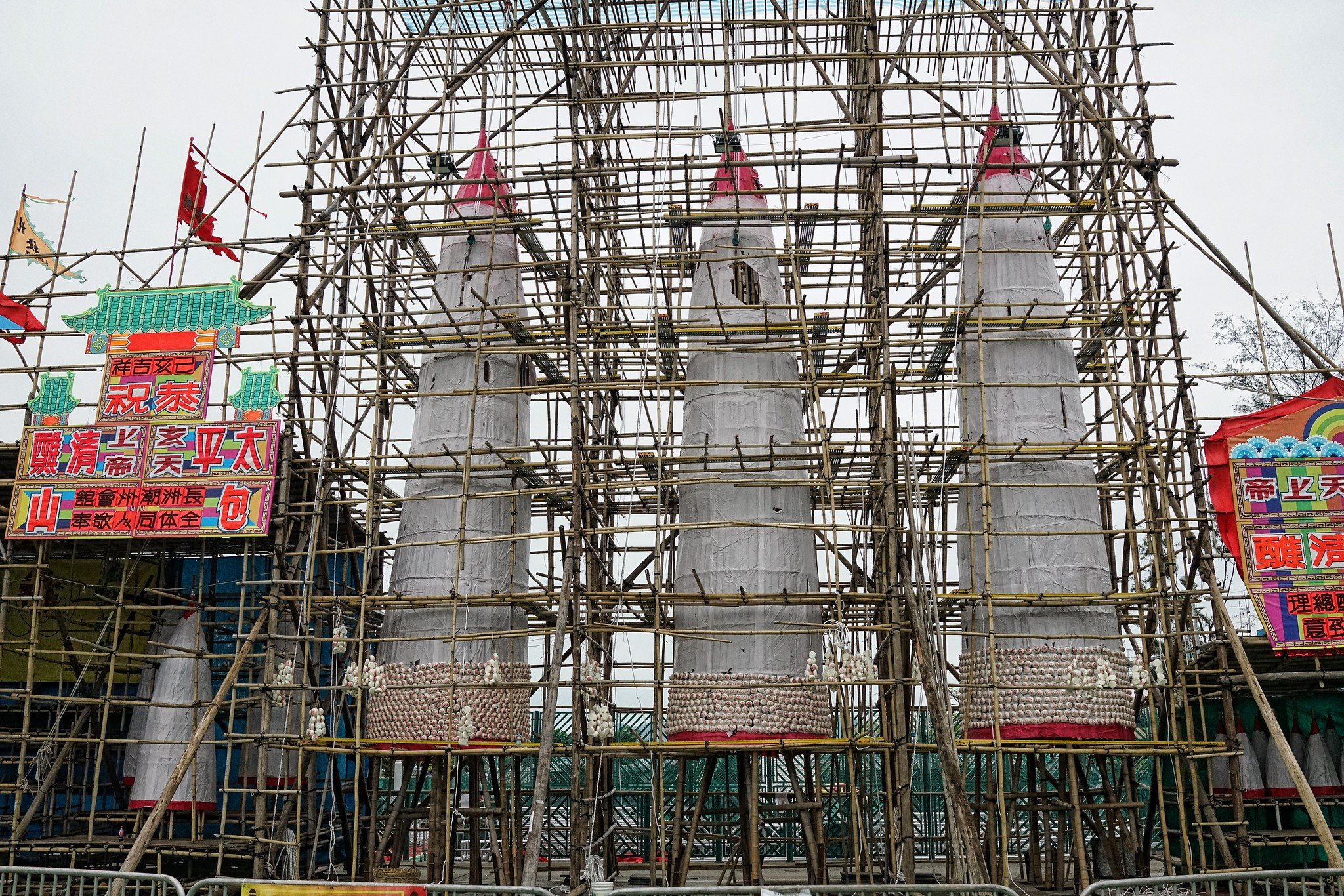
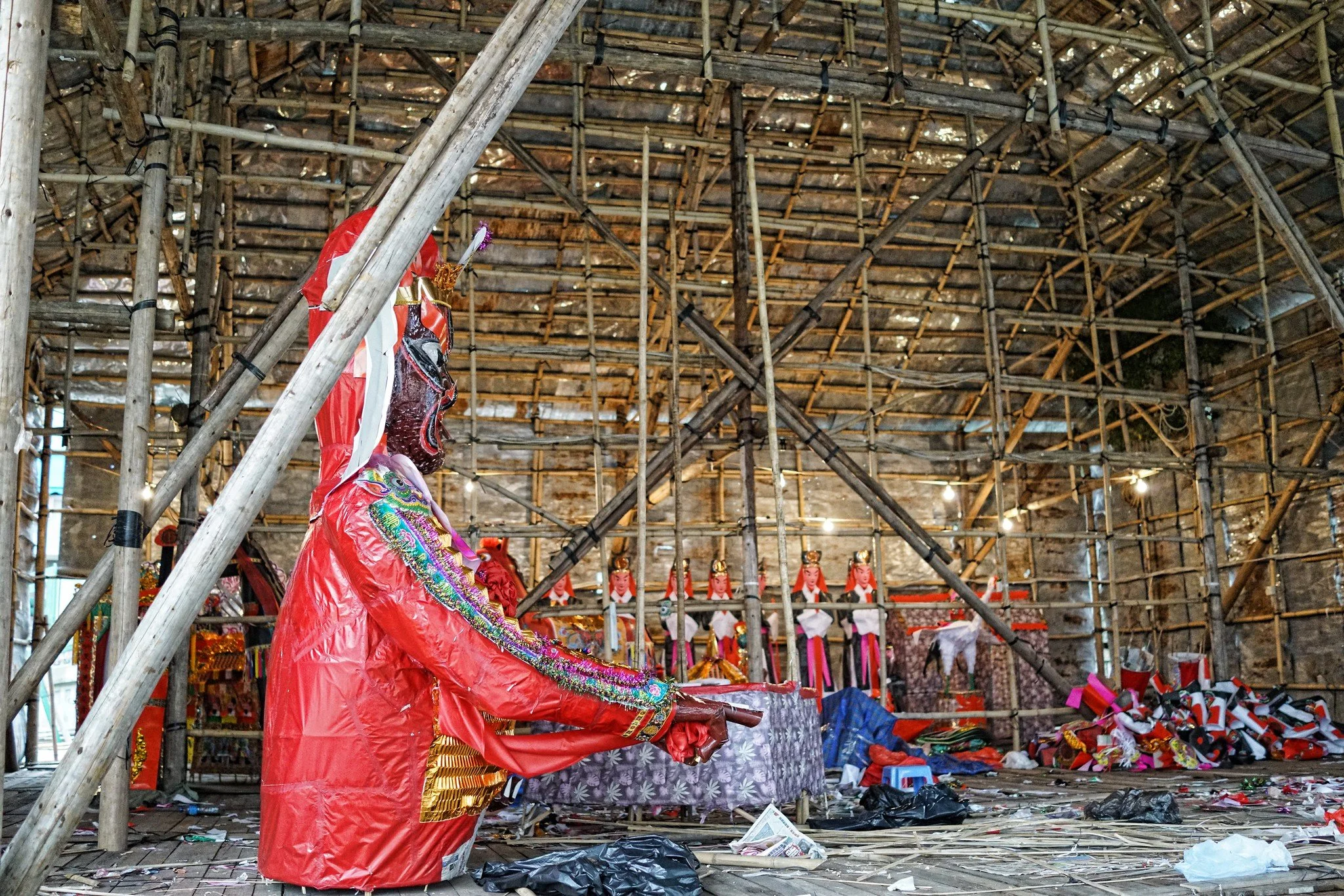
click on any image to enlarge
© Copyright Acknowledged | All rights reserved | images taken by Jamie
Bamboo Scaffolding | Cheung Chau Bun Festival | Hong Kong
The clearest visual evidence of bamboo scaffolding in use for urban construction appears in the famous Song dynasty handscroll Along the River During the Qingming Festival, painted by Zhang Zeduan around 1085 - 1145 AD (Northern Song period). This artwork depicts everyday street scenes in the capital Bianjing, including bamboo frameworks supporting building work - showing the technique was already commonplace in Chinese cities over 900 years ago. By the Song dynasty, bamboo scaffolding was integrated into both practical construction and cultural events, such as temporary bamboo theatres (open-air stages for opera and festivals) - see the 2 images above, a tradition that persists in parts of Hong Kong and Macau today.
The craft became especially embedded in southern Chinese building practices, including Cantonese techniques for tying poles with bamboo strips or ropes and using specific species like Kao Jue (pole bamboo) for standards, ledgers, and bracing. It spread to Hong Kong in the mid-18th century (around the 1750s), brought by migrants and builders from Guangdong. Its use surged dramatically in the mid-20th century during Hong Kong’s post-WWII construction boom in the 1950s - 1960s, when rapid urbanization and high-rise development demanded fast, affordable, and adaptable scaffolding. Skilled workers from the mainland helped refine the techniques for taller buildings, and by the late 20th century, bamboo scaffolding was instrumental in constructing iconic structures like the International Finance Centre. Even today, about 80% of scaffolding in Hong Kong remains bamboo-based (with the rest metal or hybrid), a testament to its efficiency in the city’s dense, vertical environment.
In short, the best educated guess on first use is at least 1,000 - 2,000 years ago in ancient China, with practical scaffolding techniques evident by the Sui-Tang period (for stilt houses and similar) and widespread urban application confirmed by the 12th century Song dynasty. It has been passed down through generations of tradespeople, evolving into the highly skilled craft seen in Hong Kong today.
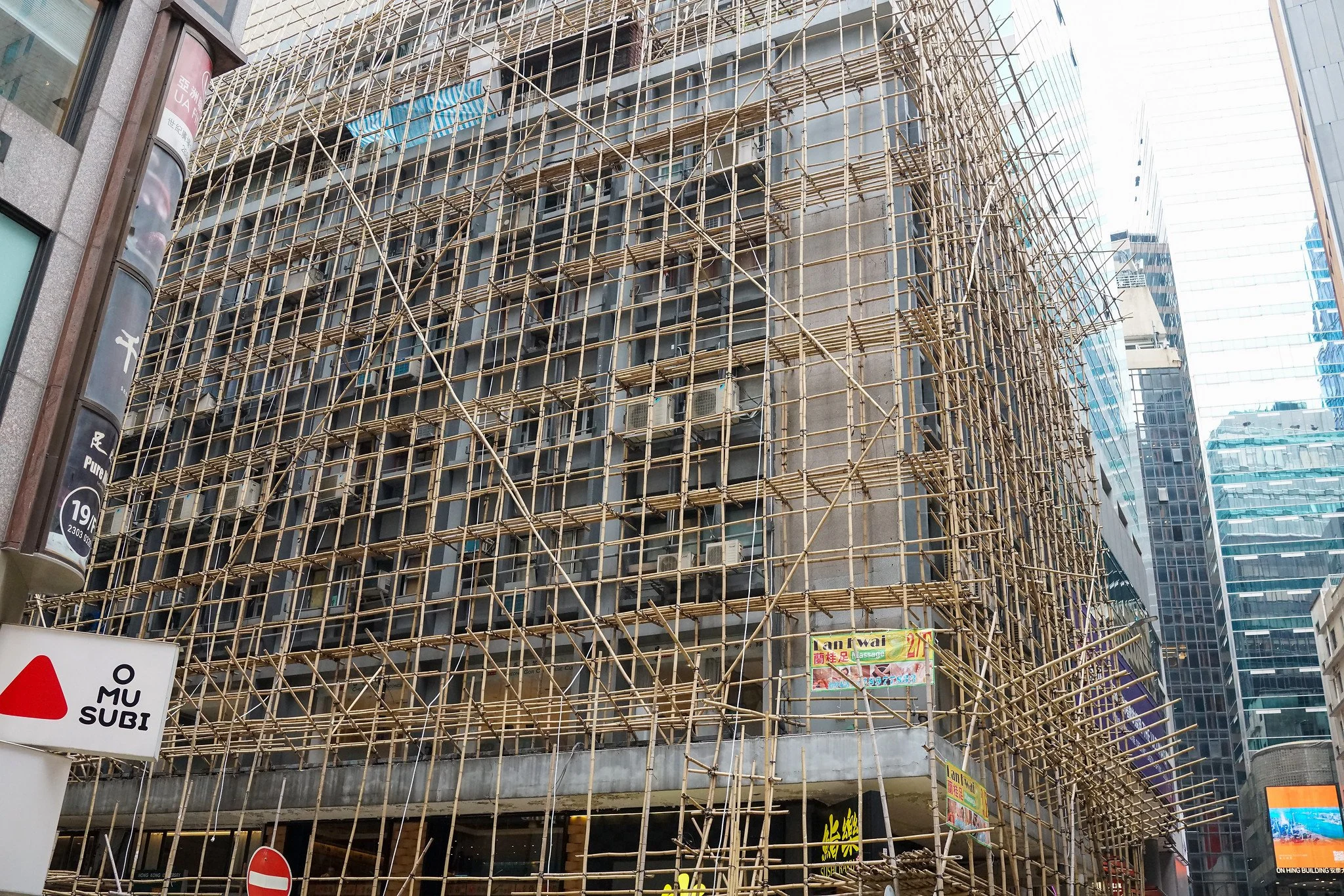
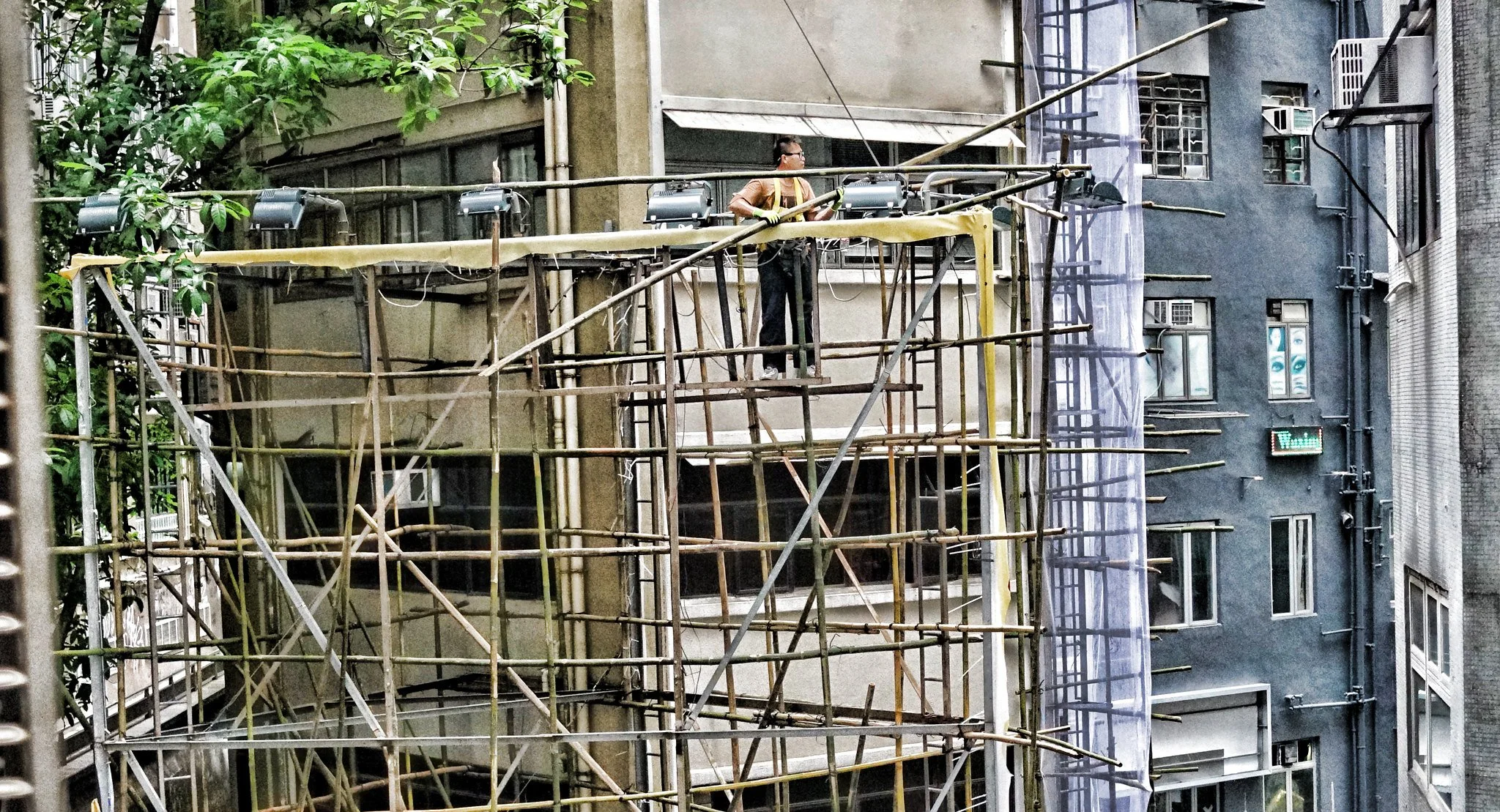
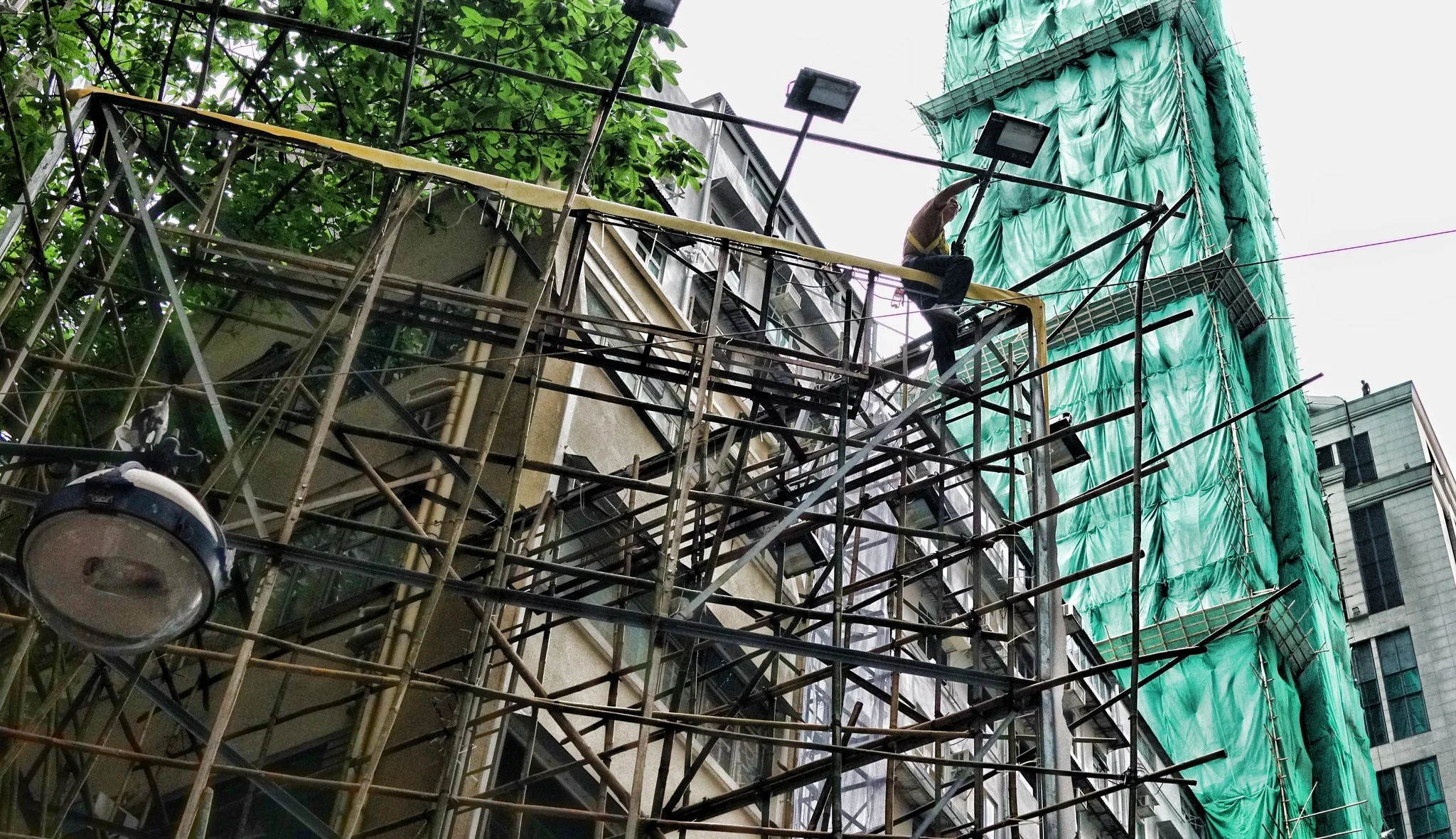
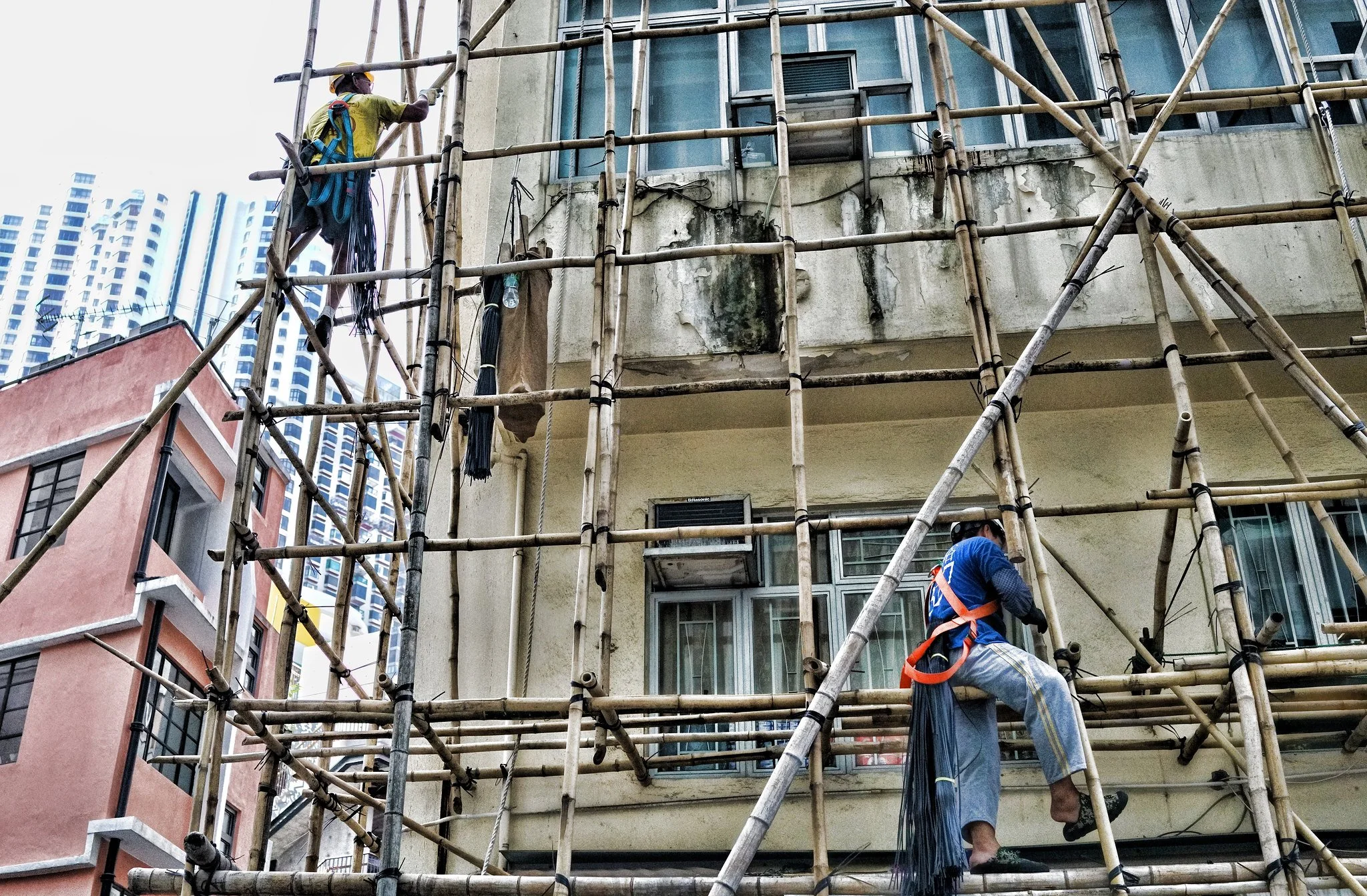
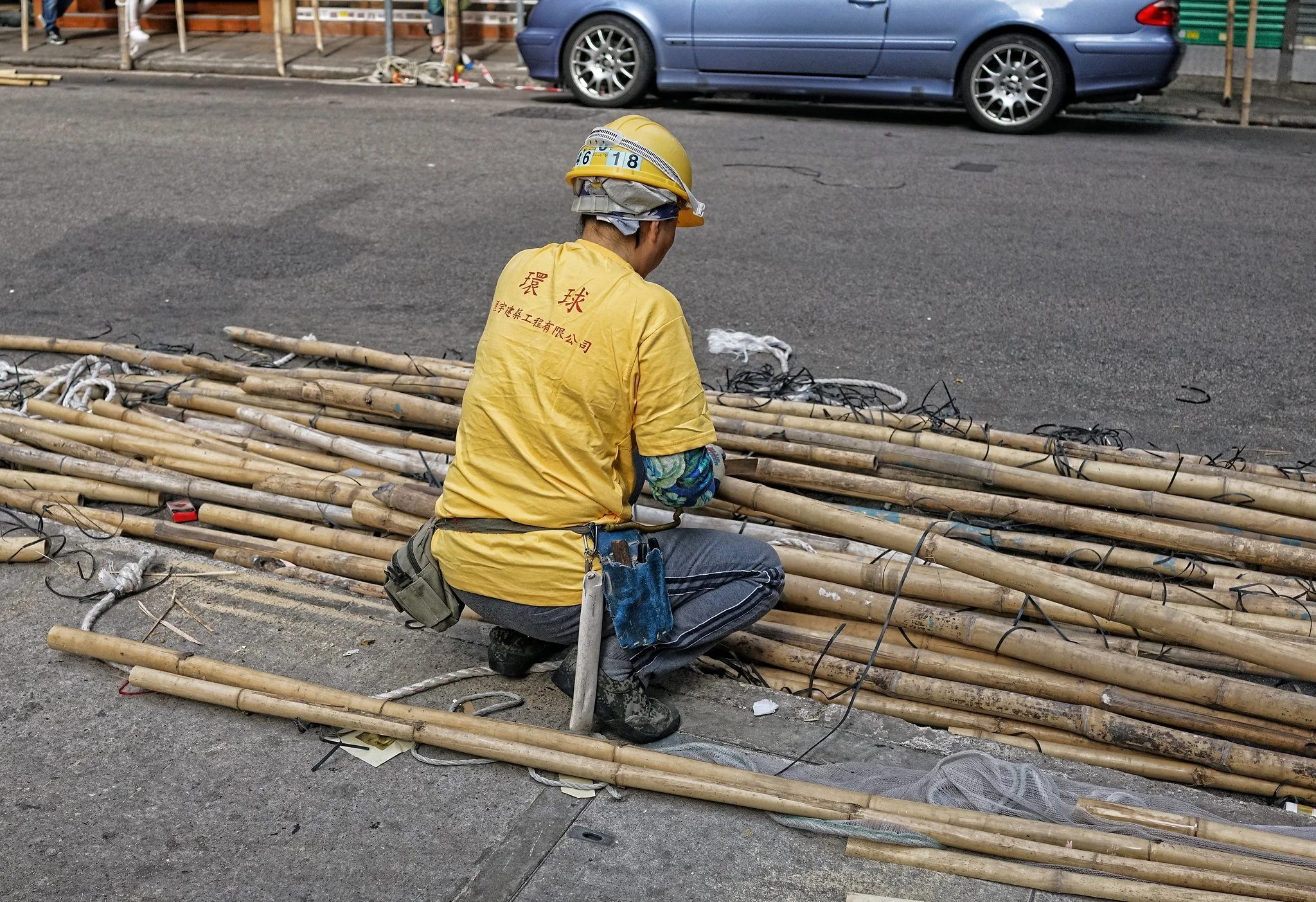
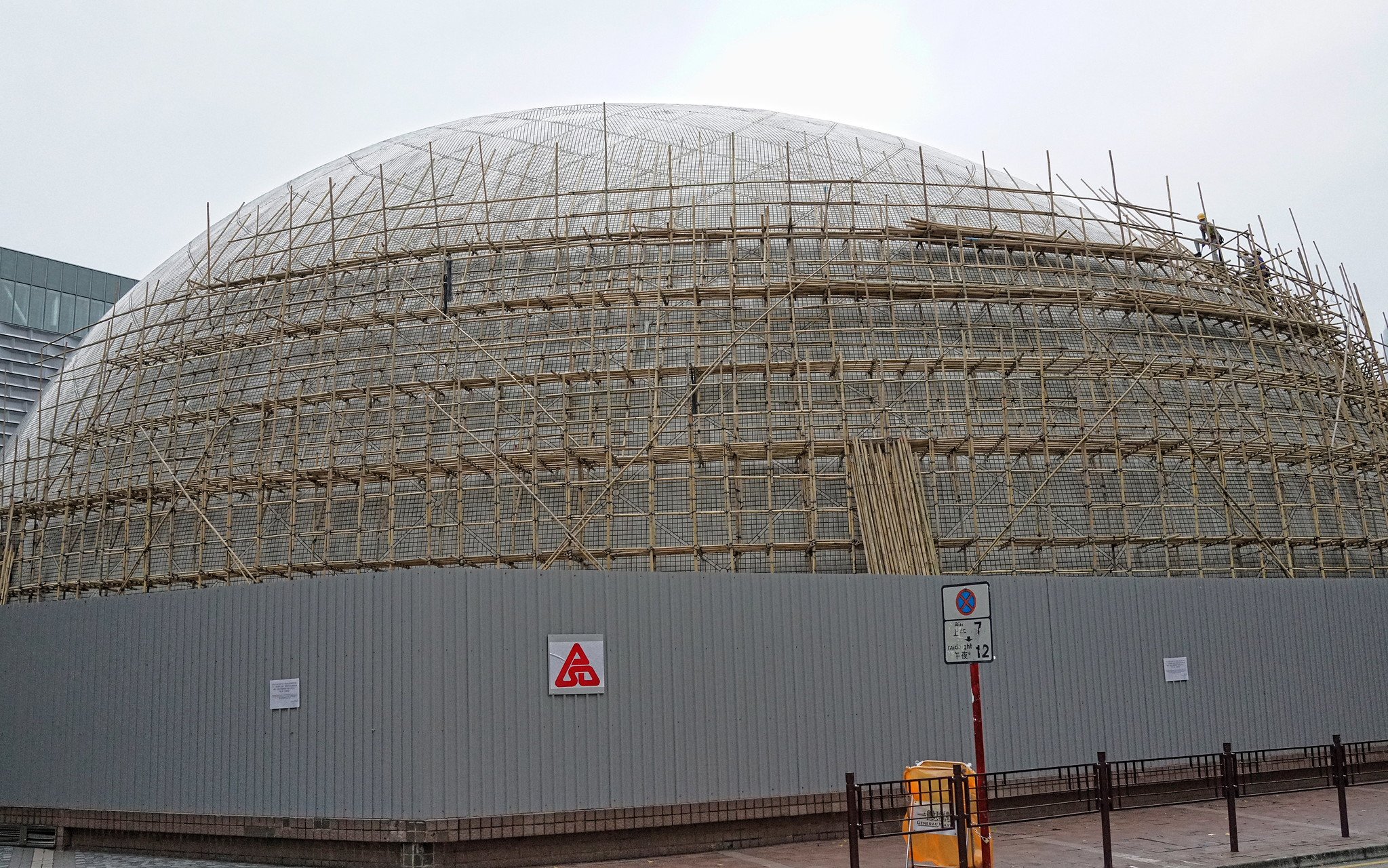
click on any image to enlarge
© Copyright Acknowledged | All rights reserved | images taken by Jamie
Bamboo Scaffolding | All Districts - Everywhere! | Hong Kong
The Workforce: Official Numbers vs the Widely Quoted 4,000+ Figure | Official registered numbers (Labour Department / Where the “4,000+” figure comes from
Updated clarification on bamboo scaffolder numbers in Hong Kong - March 2026
So one of the big issues is the actual number of bamboo scaffolders in Hong Kong
The “4,000+” figure has been circulating for years in press reports and union statements - including in SCMP articles I may have referenced - and it is not something my memory invented. I have cross-checked the most recent official government data against those reports. The two numbers are real but measure slightly different things, which explains why the official registered count is lower while the union figure I (and many others) have seen remains around 4,000. There has not been a sudden 50% drop in the actual workforce; the discrepancy is longstanding and stems from how the data is counted and presented.
Official registered numbers (Labour Department / Construction Workers Registration Ordinance)
As of June 2025, the exact official tally under the Construction Workers Registration Ordinance (Cap. 583) for the specific trade of Bamboo Scaffolder is:
491 semi-skilled workers
2,043 skilled workers
Total: 2,534 registered bamboo scaffolders
Given how seriously the Government takes statistics I presume the figures are correct
These are the only workers legally allowed to erect, alter, or dismantle bamboo scaffolds on construction sites without constant direct supervision (subject to the Code of Practice for Bamboo Scaffolding Safety). The government publishes these figures in response to Legislative Council questions (July 2025) and they have been stable for years - for comparison, the 2022 figure was 2,479. Metal scaffolders, by contrast, total around 7,830 registered, bringing the combined scaffolding workforce to just over 10,000.
Where the “4,000+” figure comes from
It is pretty odd here how the press is more likely to quote a trade rep rather than official figures which may not be totally up to date
The 4,000+ number I remember (and that I have used in blog posts) consistently originates from statements by the Hong Kong and Kowloon Bamboo Scaffolding Workers Union, particularly its chairman Ho Ping-tak. In multiple 2025 interviews and statements (e.g., March 2025 coverage of the metal-scaffolding policy shift), he referred to “over 4,000 bamboo scaffolding workers with intermediate and advanced licenses” or “4,000 specialist workers” who could be affected. Media outlets (SCMP, HKFP, The Standard, and others) have quoted this union estimate directly for years when discussing job impacts or heritage concerns.
In practice, the union’s broader 4,000+ count appears to include:
Registered skilled and semi-skilled bamboo scaffolders (the official 2,534)
Workers holding additional “intermediate” or “advanced” truss-out certificates
Provisional or semi-skilled trainees still gaining experience
A small pool of experienced helpers or older workers who may not be formally re-registered every year but are still active on sites
Possibly some crossover scaffolders who are metal-registered but regularly work on bamboo projects (especially in hybrid or private-sector jobs)
This is why the union has used “4,000+” as a consistent headline figure for at least the past decade - it reflects the total specialist labour pool the trade relies on, rather than the narrow registered-trade headcount alone.
Why the Numbers Look Lower Officially While Demand Remains High, a more comprehensive report
Demand for bamboo scaffolding in the private sector is as strong as ever, particularly for façade maintenance and those common small truss-out platforms you see 30+ floors up. So why does the official registered figure appear more modest than the longstanding union estimate?
Several practical factors explain the difference without signalling any collapse in the trade:
Stricter registration and training requirements have focused the official tally. The revised Code of Practice (with truss-out updates from October 2024) means only formally registered and certified workers can legally perform certain tasks. This has reduced the informal inclusion of casual helpers or older workers who were counted more loosely in earlier union estimates.
An aging workforce and slower recruitment. Many veteran scaffolders are in their 50s and 60s. The trade requires a physically demanding three-year apprenticeship or a one-year intensive course plus years of on-site experience. Attracting sufficient younger Hong Kongers remains challenging, even though the craft is still viable.
Higher productivity and specialisation. Highly skilled “master” scaffolders can supervise multiple sites efficiently. Small, experienced crews handle the daily jobs - especially individual apartment truss-out platforms - quickly and effectively. One qualified worker today covers far more ground than in previous boom decades.
The policy shift affects only part of the market. The March 2025 Development Bureau directive making metal the default in new public works tenders impacts mainly larger government projects. Private-sector renovation, maintenance, and small repair work — the bulk of daily bamboo use - continues largely unchanged.
In short, the official 2,534 reflects the strictly registered trade category, while the 4,000+ captures the broader practical specialist pool keeping Hong Kong’s scaffolding needs met every day.
Bamboo vs Metal Scaffolding: Detailed Cost Comparison in Hong Kong (as of early 2026)
Bamboo’s continued dominance in private work comes down to clear economic advantages over metal (steel or aluminium) systems.
Material costs: A basic “hair bamboo” pole costs around HK$15, while a sturdy grade-A pole suitable for structural use ranges from HK$100 - 300. Comparable metal tubes or components often cost HK$280 or more. Bamboo poles are roughly 5 - 6% the price of equivalent metal parts.
Overall project costs: Bamboo scaffolding generally costs 30 - 40% (often described as about one-third) of an equivalent metal system when materials, labour, erection, and dismantling are included. For small renovation or façade jobs, switching to metal can triple the scaffolding portion of the budget. In public works contexts, government data shows bamboo at approximately 1% of total contract sum versus 2% for metal.
Labour and installation: Bamboo is dramatically faster - 5 to 6 times quicker to erect and up to 12 times faster to dismantle. It requires no heavy machinery in many cases; workers carry poles by hand and custom-cut them on site for irregular buildings. Metal assembly is more standardised but involves heavier components that demand more equipment and time, especially in Hong Kong’s confined streets.
Lifecycle considerations: Bamboo poles have limited reuse due to weather and tying wear, but they are renewable, lightweight, locally sourced (mainly Guangdong/Guangxi), and easy to dispose of. Metal systems cost more upfront but are reusable over many projects (10+ years) with proper maintenance. For one-off or short-duration private maintenance jobs - the most common daily use - bamboo’s low entry cost and adaptability win decisively.
Site-specific realities: Bamboo excels for irregular older buildings, narrow alleys, and especially those small truss-out platforms 30+ floors up outside single apartments. Metal is bulkier, heavier, and often too rigid or expensive for quick, targeted repairs.
So, as is typical in Hong Kong, cost is a major factor particularly for older buildings
In practice, bamboo keeps private-sector bids competitive and minimises disruption to residents. While metal offers standardisation and durability for large new builds, bamboo’s cost-effectiveness and flexibility make it the practical choice for the majority of everyday Hong Kong work.
I also take images of trucks in Hong Kong (over 20,000+) and the bamboo scaffolding trade has its own particular style of truck, see the 3 images below, a common sight in Hong Kong
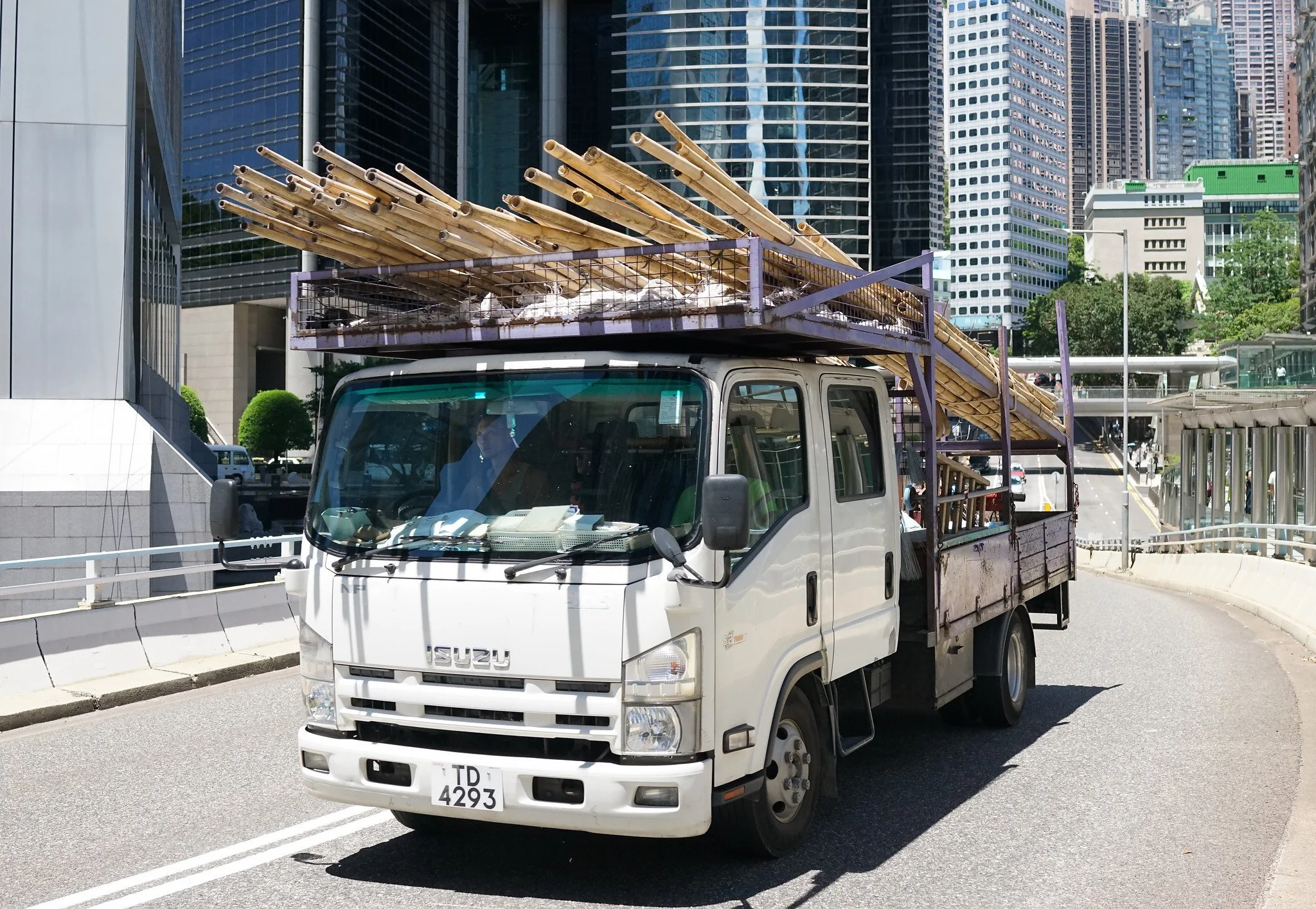
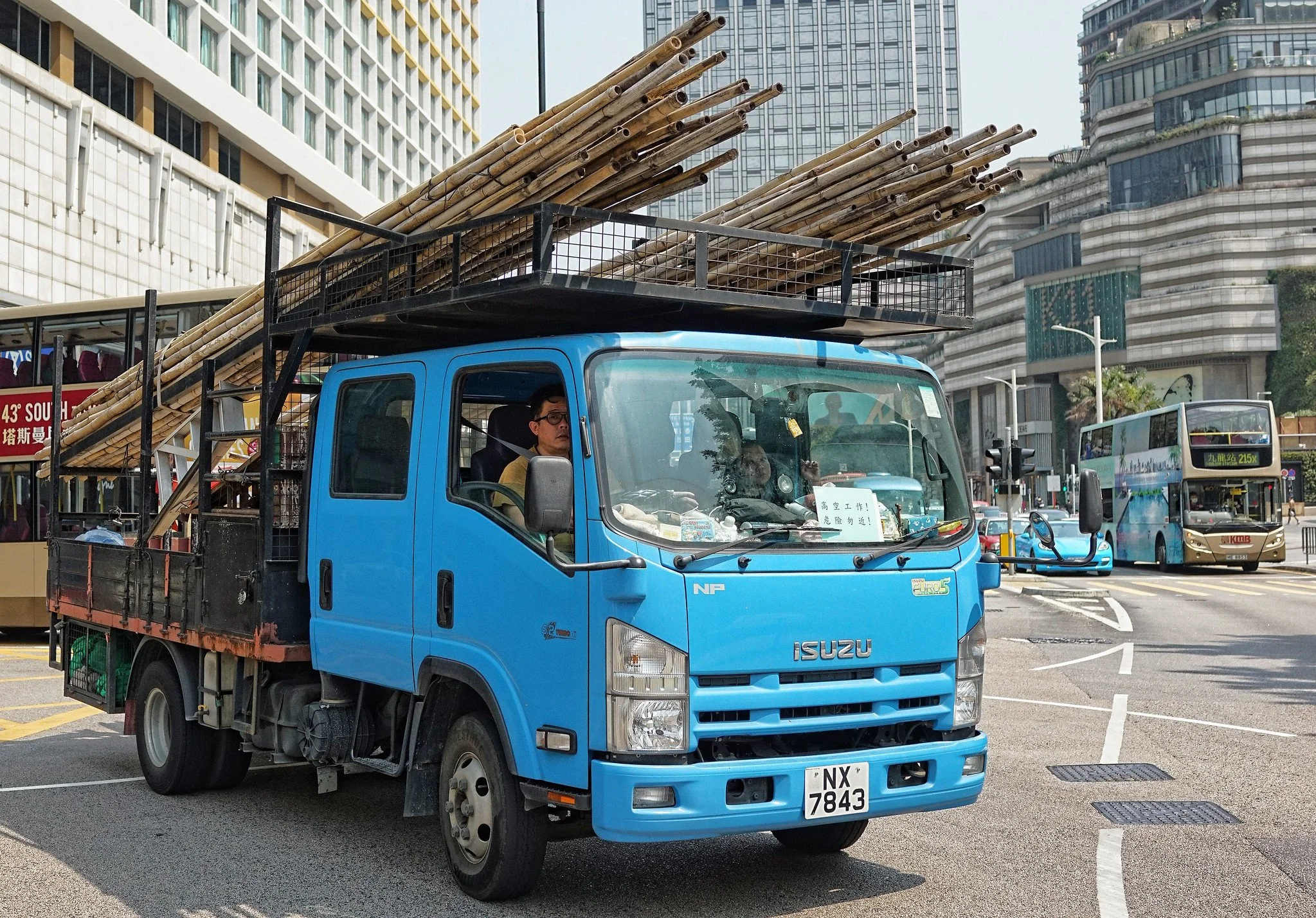
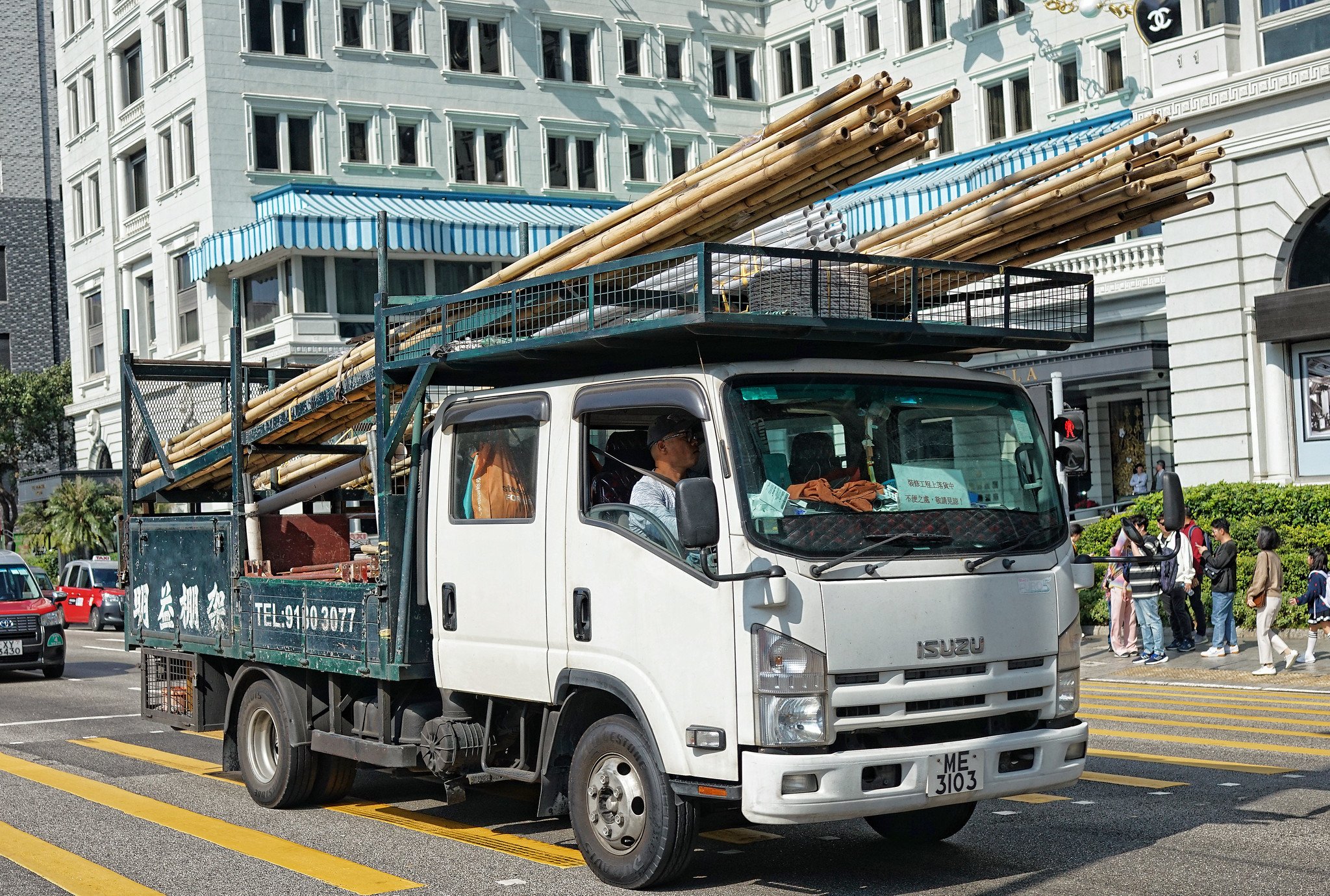
click on any image to enlarge
© Copyright Acknowledged | All rights reserved | images taken by Jamie
Bamboo Scaffolding | Specialised Trucks | Hong Kong
Current Status: No Blanket Ban, Regulations, Qualified Workers, and Practical Realities (Legislation vs Reality)
Post-2025 fire response: After the Tai Po incident and other accidents, the government launched citywide inspections of bamboo scaffolding, required removal of certain protective meshes in some cases, and discussed a longer-term “roadmap” for wider metal adoption in suitable sites. However, official statements (including from July 2025 Legislative Council questions) reaffirm no ban is planned. The focus remains on enhancing safety standards for bamboo where it continues to be used. The Construction Industry Council temporarily suspended new bamboo scaffolder training assessments in late 2025 to review protocols, but the trade itself is not being eliminated.
Government officials have repeatedly confirmed there is no blanket ban on bamboo scaffolding and “no intention to ban” its use.
The Code of Practice for Bamboo Scaffolding Safety (major updates in 2024, with truss-out provisions from October 2024 and further guidelines in 2025) carries statutory weight. Key requirements include:
Erection and dismantling only by trained workers under competent-person supervision.
Fortnightly inspections and proper documentation.
Adequate bracing, tying-back to the building, and wind-load considerations.
Specific rules for truss-out scaffolds (maximum 6m height, steel brackets anchored to the structure, prior notification to the Labour Department via the Construction Industry Council, and additional safety training).
The March 2025 Development Bureau circular made metal scaffolding the default for new public works tenders (with justification still required for bamboo exceptions), citing bamboo’s variable strength, weather deterioration, and higher combustibility.
The daily reality I see on tours is that bamboo scaffolding continues to dominate private-sector construction, renovation, and façade maintenance. It still makes up the bulk (around 80%) of scaffolding in these areas because of its speed, low cost, and superior adaptability to Hong Kong’s older high-rises and tight urban fabric. Those small truss-out platforms for individual apartment repairs would be far more cumbersome and expensive with metal. The government’s approach focuses on improving safety through better supervision, training, and selective metal adoption rather than elimination. Regulations set important standards, but practical economic and logistical needs keep bamboo essential for affordable, efficient repairs in our vertical city.
Hong Kong vs Singapore Scaffolding: Two Competing Cities, Different Approaches
Hong Kong and Singapore are often compared as sleek, high-density Asian financial hubs with intense vertical development. Their scaffolding practices reveal contrasting priorities and to be honest it had never occurred to me that Singapore has a totally different policy with regards to Bamboo Scaffolding
In Singapore, bamboo scaffolding is not permitted on construction sites. Strict Workplace Safety and Health (WSH) regulations enforced by the Ministry of Manpower prioritise non-combustible materials to reduce fire risks. The city-state relies on standardised metal (steel or aluminium) systems that provide predictability, engineering compliance, and strong fire-safety performance. This aligns with Singapore’s emphasis on uniformity and advanced safety standards, though it can mean higher upfront costs and less flexibility for irregular or small-scale repair work.
Hong Kong, by contrast, remains one of the last major global cities where traditional bamboo scaffolding thrives, especially in the private sector. Its flexibility, significantly lower cost, and cultural continuity allow it to adapt rapidly to older buildings, narrow streets, and everyday maintenance needs that metal often handles less efficiently. While Hong Kong is gradually increasing metal use in public works for safety reasons, bamboo’s practicality ensures it remains dominant for private jobs — preserving a skilled trade and a tangible link to southern Chinese building heritage that Singapore has largely phased out.
This difference shows how two competing cities balance tradition versus standardisation: Singapore leans heavily on uniform, fire-resistant metal solutions, while Hong Kong maintains a practical blend of heritage, economics, and real-world adaptability.
Why Bamboo Scaffolding Persists and Why It Matters
Bamboo scaffolding is far more than a visual curiosity or cultural relic (including its role in temporary bamboo theatres, part of Hong Kong’s intangible cultural heritage). It is a pragmatic, cost-effective solution that helps keep our high-density living affordable and repairs efficient. On my Private Tours, I regularly point out these scaffolds because they showcase genuine Hong Kong ingenuity - generations of highly skilled tradespeople applying ancient techniques to the demands of a modern megacity.
International coverage sometimes exaggerates the policy shifts as a full phase-out or blanket ban; the reality for private-sector and maintenance work is far more nuanced. The craft continues to evolve with stricter safety oversight, but its economic and practical advantages mean you will keep seeing bamboo scaffolding on nearly every tour - a resilient symbol of what makes Hong Kong uniquely itself.
Does the Hong Kong Government Treat Bamboo Scaffolding as an Intangible Heritage Asset? (And Which Department?)
No - the Hong Kong Government does not officially list construction bamboo scaffolding (the type used for building works, façade maintenance, or truss-out platforms on high-rises) as an item in its Intangible Cultural Heritage (ICH) Inventory.
The Bamboo Theatre Building Technique (used for temporary open-air stages for Cantonese opera and festivals) is formally included in the Intangible Cultural Heritage Inventory of Hong Kong. I have 2 images above taken on Cheung Chau Island which match this classification
Official government clarification (July 2025 Legislative Council reply) explicitly states: “Bamboo scaffolds erected for building-related works are distinct from bamboo theatres, and are not included in the ICH Inventory.”
The responsible body is the Intangible Cultural Heritage Office, which sits under the Leisure and Cultural Services Department (LCSD) in the Home Affairs Bureau. This office manages the ICH Inventory and the advisory committees that review items.
The government has noted that if members of the public or stakeholders submit a formal proposal to add “the building technique of bamboo scaffolding in the construction industry” to the inventory, the ICH Office will conduct a survey and research, then submit findings to the Sub-committee on Intangible Cultural Heritage Items and the Intangible Cultural Heritage Advisory Committee for deliberation. So far, no such listing for everyday construction scaffolding has been made.
In practice, while many locals, media outlets, and cultural commentators describe bamboo scaffolding broadly as part of Hong Kong’s living heritage (and it is promoted in tourism and education contexts), the official ICH designation applies only to the theatre-building technique, not the construction trade itself.
Average Fatalities Related to Bamboo Scaffolding Issues Over the Past 20 Years
The Labour Department publishes detailed statistics on industrial accidents involving bamboo scaffolds, but comprehensive bamboo-specific fatality figures are only readily available and consistently reported from 2018 onward. Pre-2018 data often groups all “falls from height” or “scaffolding-related” accidents without always isolating bamboo versus metal or other causes.
I often wonder how the scaffolders deal with rain, winds and loss of concentration, they must have nerves of steel but accidents do happen
Recent official figures (2018–August 2025):
There were 24 deaths related to bamboo scaffolding on construction sites (Labour Department data, confirmed in multiple 2025 Legislative Council replies and public statements).
This covers roughly 7.5 years → an average of approximately 3.2 fatalities per year in the most recent period.
Longer-term context (full 20 years, 2006–2025):
No single official published table breaks down only bamboo-scaffolding fatalities across the entire 20-year span in the same consistent format.
However, broader construction-industry fatality data (from Labour Department and Housing Authority reports) shows:
Annual construction fatalities have typically ranged between 10 and 25 per year, with falls from height (very frequently involving bamboo scaffolds or working platforms) historically accounting for the majority.
In earlier years (e.g., 2000s - 2010s), media and safety reports frequently noted that more than half of fatal falls in construction involved bamboo scaffolding or related platforms.
One 2009 analysis indicated that in the 11 years up to 2007, there were 149 fatal falls in construction, with over half linked to bamboo scaffolding/working platforms.
Best estimate for average over the past 20 years:
Taking the reliably documented recent period (≈3.2 per year) and the historically higher incidence of scaffolding falls in earlier decades, a reasonable long-term average is in the range of 3 - 5 fatalities per year specifically tied to bamboo scaffolding issues.
The rate appears to have been somewhat higher in the 2000s- early 2010s (when bamboo was even more dominant and safety codes were less stringent) and has trended lower in recent years due to improved codes of practice, training requirements, and supervision rules.
Important notes on the data:
Most bamboo-related fatalities involve falls from height during erection, dismantling, or work on truss-out scaffolds, or occasional collapses.
The Labour Department has been tightening rules (e.g., the 2024 Code of Practice updates and truss-out notifications) precisely because of these incidents.
For comparison, overall construction fatalities (all causes) have averaged around 15 - 20 per year over the past decade, so bamboo-specific cases represent a notable but not overwhelming share.
These numbers are tragic for the families and the skilled tradespeople involved, which is why the government, unions, and industry continue to focus on safety enhancements while preserving the craft where it remains practical (especially in private-sector and small-scale work).
Bamboo scaffolding vs Typhoons - yes, it is an issue and has been historically
There have been several notable incidents over the years where large sections (sometimes described as “whole walls” or full-building wraps) of bamboo scaffolding collapsed or were blown off during typhoons or intense tropical storms in Hong Kong. These events highlight the challenges of wind loads, heavy rain, and the need for robust tying-back and bracing - issues that have driven updates to the Code of Practice for Bamboo Scaffolding Safety.
Here are the most prominent and well-documented examples from the past 20+ years:
1. October 8, 2021 - Happy Valley (Broadwood Road / Beverly Hill estate) - Most Dramatic Recent “Whole-Wall” Collapse
During the approach of Tropical Storm Lionrock (with heavy rain and strong winds triggering a Black Rainstorm Warning and No. 3 Strong Wind Signal), a massive bamboo scaffolding and protective netting that completely surrounded a 30-storey residential building collapsed.
The entire section peeled away and crashed onto Broadwood Road below, blocking the road, crushing vehicles, and trapping people inside cars.
Casualties: One 55-year-old female construction worker was killed (crushed in the wreckage; she died in hospital). Three other workers were rescued. Two drivers trapped in cars were also freed; one suffered minor injuries from bamboo debris smashing through a windshield.
This incident received widespread international coverage (AP, SCMP, Sky News, etc.) because of the dramatic visuals of the full-height scaffolding failing in one go.
2. July 2025 - North Point - Typhoon Wipha
Powerful winds from Typhoon Wipha ripped scaffolding (a mix of bamboo and metal elements) from a high-rise building.
Large sections crashed onto parked cars below.
Casualties: No fatalities or serious injuries reported, but the collapse caused significant property damage and shocked residents. Video footage circulated widely showing the dramatic failure.
Other Historical Context
Typhoons and strong tropical storms have repeatedly caused scaffolding failures in Hong Kong. Older incidents (e.g., during Typhoon Dot in 2005 or earlier storms) often involved collapsed bamboo scaffolding, fallen debris, and injuries, though full “whole-wall” collapses like the 2021 event are less commonly detailed in public records from decades ago.
In many cases, collapses are linked not just to the bamboo itself but to factors such as inadequate tying-back to the building, insufficient bracing, weather-related deterioration of ties, or unauthorised modifications. The Labour Department and Construction Industry Council have used these events to strengthen requirements for wind-load calculations and typhoon-season inspections.
Important Broader Perspective
These typhoon-related collapses are relatively rare compared to other scaffolding accidents (such as falls during erection/dismantling or small platform failures), but they tend to be highly visible and disruptive because they can affect entire streets and buildings. The 2021 Happy Valley incident is the clearest modern example of a near “whole-wall” failure during stormy weather.
The government’s response has been to emphasise better supervision, proper anchoring, use of stronger ties, and — in public works — encouraging more metal scaffolding where suitable. However, as we’ve discussed before, there is still no blanket ban, and bamboo remains widely used in the private sector precisely because of its adaptability when correctly installed
So there you. I have always wanted to do a comprehensive blog on bamboo scaffolding and this is it
I do not do Food Tours in Hong Kong but I know people that do!
I do not do food tours as mentioned above, I have very specific reasons and part of it is that I do not speak Cantonese or write Chinese, I am from Yorkshire in England and I lack the language gene and it is not through lack of trying and yes a lot of restaurants do not have English menu’s or staff who speak conversational English.
.. and yet I have eaten at close to 1,400 restaurants in Hong Kong since January 2nd 1972, my wife was born in Hong Kong and we have been together over 40 years and her first language is Cantonese and a lot of her family are Chinese or half Chinese so I have never had much of an issue!
This does not translate to doing food tours though, yes, I could do them, no problem there but they would never ever be as good as the food tours done by my friends (see the 3 links above) most of their awesome guides are locally born Hong Kong Chinese and obviously food culture is part of their DNA, it is impossible for me to compete with that!
So please feel free to contact them for food tours

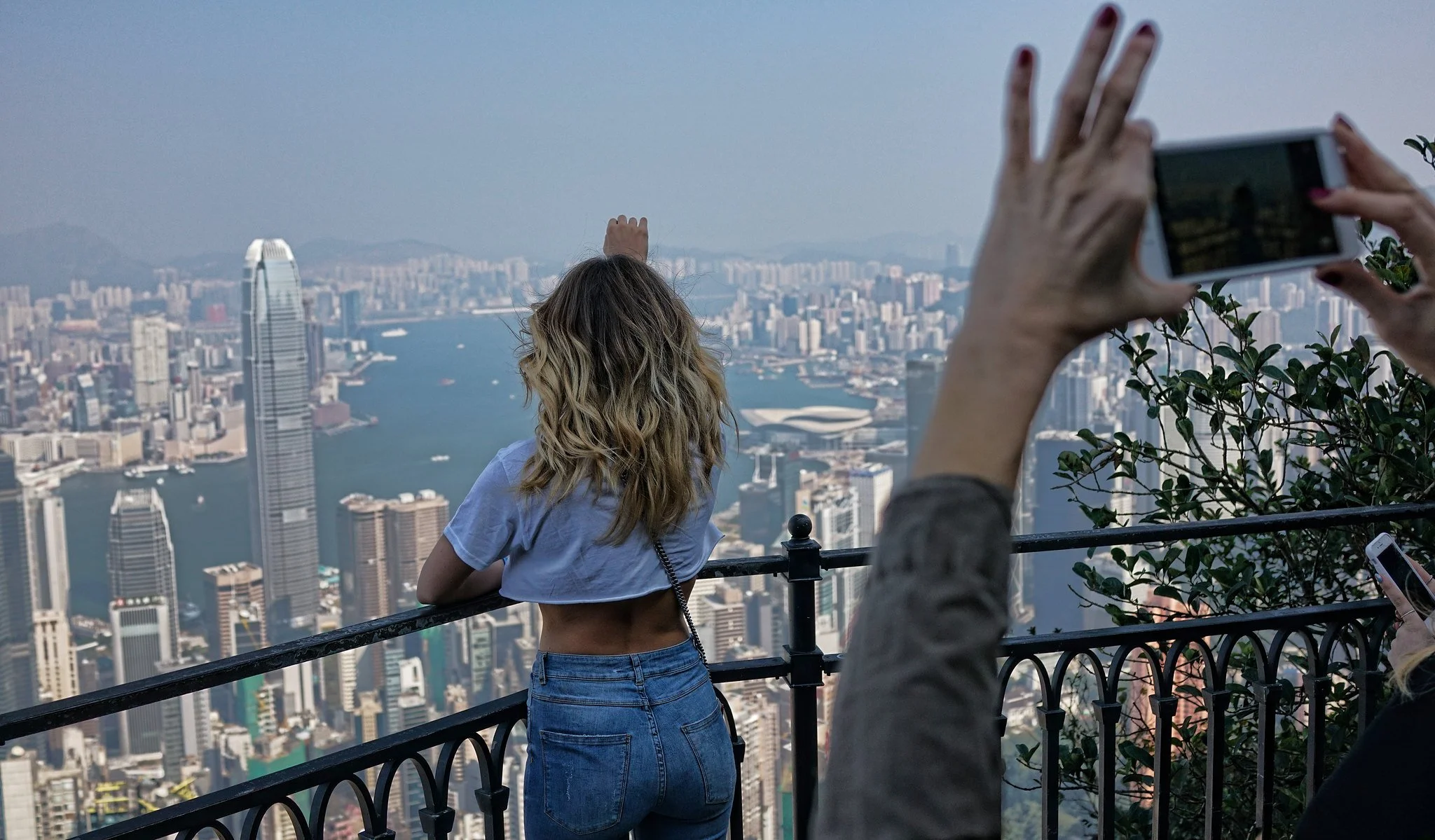

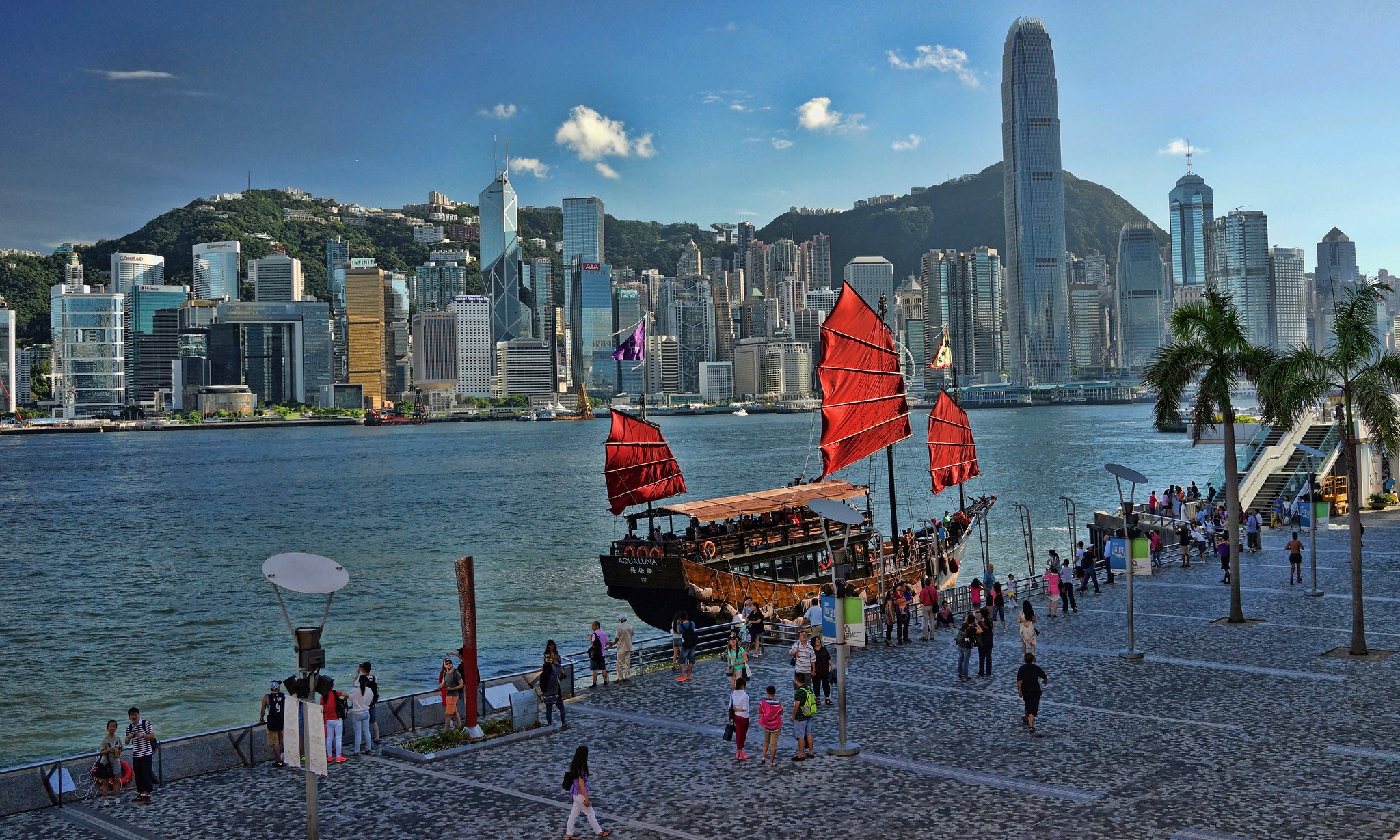
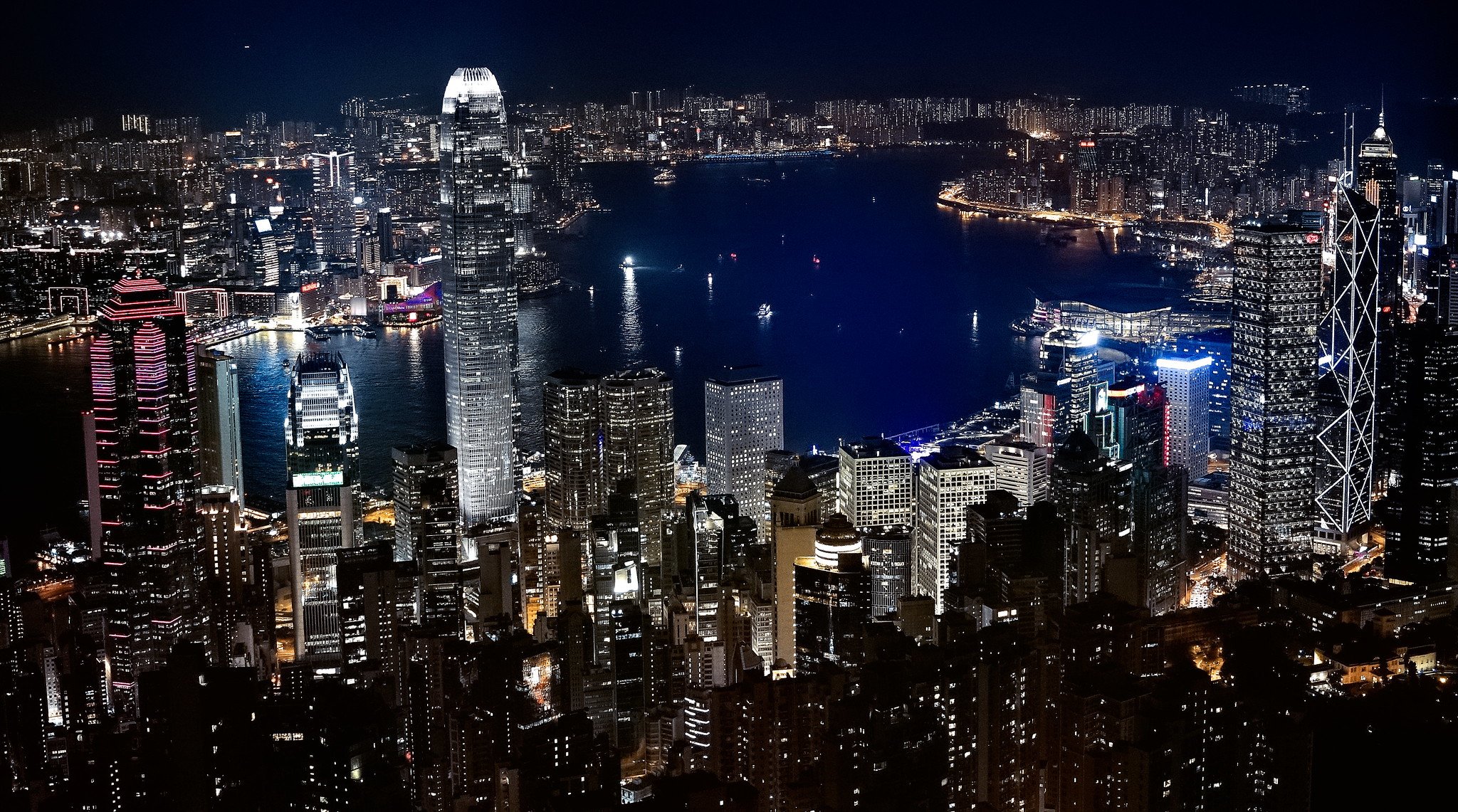

click on any image to enlarge
© Copyright Acknowledged | All rights reserved | all images taken b Jamie
Jamie’s Hong Kong | Some of my favourite images | Hong Kong 101
© Jamie Lloyd | J3 Consultants Hong Kong | J3 Private Tours Hong Kong |
| 2010 - 2026 All rights reserved. |
Click on any image to enlarge to full screen




Current images from my Instagram feed