Untold Story of Hong Kong’s red & green roof Minibuses
The Stats and Secrets of Hong Kong’s Public Light Buses

The J3 Group - Premium Quality Private Tours | Experiences and Insider Chats since 2010
Me Jamie, your host, I am English and I have lived in Hong Kong since January 2nd 1972 - I know the place.
A meaningful blog post with a difference - tips on Travel, Tourism, Tours, Daily Life and my personal thoughts on Hong Kong.
Please do visit Amazing Hong Kong
Hong Kong | Pearl of the Orient
Customised Private Tours + Experiences in Amazing Hong Kong
Jamie has lived in Hong Kong - Pearl of the Orient for 50+ years
Carefully Crafted Personalised and Customised Itineraries by Jamie | Hong Kong’s Most Experienced Private Tour Guide for : Solo Travellers Friends Families Seniors Couples Business People MICE Delegates.
Private Tours Cultural Tours Walking Tours Sightseeing Tours City Tours Night Tours Layover Tours Transit Tours Private Shore Excursions Bespoke Tours Personalised Tours Jewish Heritage Tours Luxury Private Tours Day Tours Luxury Boat Tours Themed Tours Private Family Tours Private Day Tours Corporate Tours
Just you, your family or friends and Jamie your personal English private tour guide - over 2,400+ tours completed since 2011 - Jamie offers quality Private Tours of Hong Kong
Tour Group Size 1 - 6 people only
J3 Group Hong Kong | J3 Consultants Hong Kong | J3 Private Tours Hong Kong
Creating Memories That Will Last A Lifetime
Go here for the Hong Kong Michelin Restaurant Guide which includes the Bib Gourmand Category

Guided by Stories, Private Tours of Hong Kong with Jamie
A Resident since 1972 - Quality Private Tours of Hong Kong
click on the image to enlarge
© Copyright Acknowledged | All rights reserved | image taken by Jamie
Red Top Minibus | Public Light Bus | Hong Kong
Foreword
I have been riding these forever, I have lost count of the number of times I have been on them and these days I am pretty much on one every day of the week to drop me off at my local MTR Station (Subway) the Minibus literally stops outside our apartment block.
I rather suspected the history of these iconic vehicles was a lot more complex than I thought so I have been doing some research, I have also accumulated over the years over 5,000 + images of these buses including some very rare variants. it actually took a while to choose the images
I love the above image and the minibus is still running today, it is ancient but has a rather snappy licence plate!
In the text below PLB = Public Light Bus
So here you go
Public Light Buses: Hong Kong’s Iconic, Nimble Lifeline on the Road
Public Light Buses, affectionately known as minibuses or “xiao ba” in Cantonese, are one of the most distinctive and indispensable elements of Hong Kong’s public transport landscape. With their compact size, cream bodies, and signature coloured roofs, they zip through narrow streets, residential estates, and hilly districts where larger franchised buses simply cannot go. As mentioned above - for decades, I have relied on them for quick commutes across the city, completing 10 to 12 trips a week on average, and they never cease to fascinate me with their blend of efficiency, flexibility, and raw character and by that I basically mean the non English speaking drivers who drive like maniacs!
In 2026, as Hong Kong continues to evolve into a smarter, greener metropolis, these little workhorses remain a vital bridge between the MTR, franchised buses, and the final kilometre of many journeys. Their story is one of adaptation, regulation, and resilience in a city that never stops moving and boy are minibuses iconic.
What makes Public Light Buses truly unique is their dual personality - split between the regulated green-roofed scheduled services and the more freewheeling red-roofed ones. They carry over 1.47 million passengers daily, (by comparison the Subway or MTR system carries 5 million + people a day) filling gaps that bigger transport modes overlook. Yet behind the familiar rattle and the occasional sharp braking lies a complex ecosystem shaped by government policy, economic realities, driver culture, and even historical necessity.
In this detailed exploration, I delve into every facet - from fleet numbers and licensing to the reasons behind their sometimes hair-raising driving styles and why so many vehicles look as though they have been on the road since the last century.
Whether you are a daily rider, a visitor curious about local life, or simply someone who appreciates Hong Kong’s transport quirks, this post aims to give the fullest picture possible of these beloved (and occasionally infamous) minibuses. (Note: While many locals casually refer to them as “yellow minibuses,” the accurate description is cream-bodied, which holds true even for the oldest examples still in service.)
Fleet Size and Operational Scale in 2026
Government statistics always seem to be a year or two behind, please bear that in mind
As of the latest official figures from end-2024 (with no major changes reported into 2026), the total number of licensed Public Light Buses remains capped at a maximum of 4,350 vehicles. This ceiling has been in place since 1976 to prevent oversupply and excessive competition on the roads. In practice, the active fleet stands at approximately 4,340 licensed vehicles:
Green minibuses (scheduled services): 3,419 vehicles.
Red minibuses (non-scheduled services): 921 vehicles.
These figures reflect a tightly controlled system where new licences are rarely issued, leading to very slow fleet turnover.
Licensed Drivers: Numbers, Qualifications, and Demographics - Including Mainland China Recruitment
There are currently around 165,000 holders of valid full driving licences endorsed for Public Light Buses. However, only about 8,000 are actively driving them on a regular basis. This huge gap highlights a chronic driver shortage that has persisted for years. The pre-service training course required for new PLB drivers is a 16-hour modular programme capped at HK$1,500 (with individual modules at HK$750), and applicants must also pass practical driving tests and obtain the appropriate commercial vehicle endorsement on their licence. The full driving licence application itself costs around HK$900, though commercial test fees add several hundred dollars more. There is no per-driver “fleet limit”—the overall vehicle cap of 4,350 applies to the entire PLB trade, not individual operators or drivers.
To address the long-term shortage (exacerbated by an ageing workforce), the government launched the Labour Importation Scheme for the Transport Sector (PLB/Coach Trade) in June 2023. This allows operators to import drivers from Mainland China under quotas, with mandatory local training and licensing before they can work. By April 2025, over 830 mainland drivers had arrived, with more than 800 completing training and receiving Hong Kong driving licences. The scheme has been extended in phases, and operators have welcomed it as a practical way to keep services running. Imported drivers are often paid at lower rates, which helps control costs but has sparked debate about wages and integration.
Personally, I would not feel entirely comfortable trusting drivers from the Mainland, mainly because they are used to driving on the right side of the road in China, and the transition to Hong Kong’s left-hand system adds an extra layer of risk in my view I am pretty sure the drivers on my route are Hong Kong Chinese., this is a personal opinion, I am not sure how easy it is to make the transition if you have been driving on the wrong side of the road for 30 - 40 years!
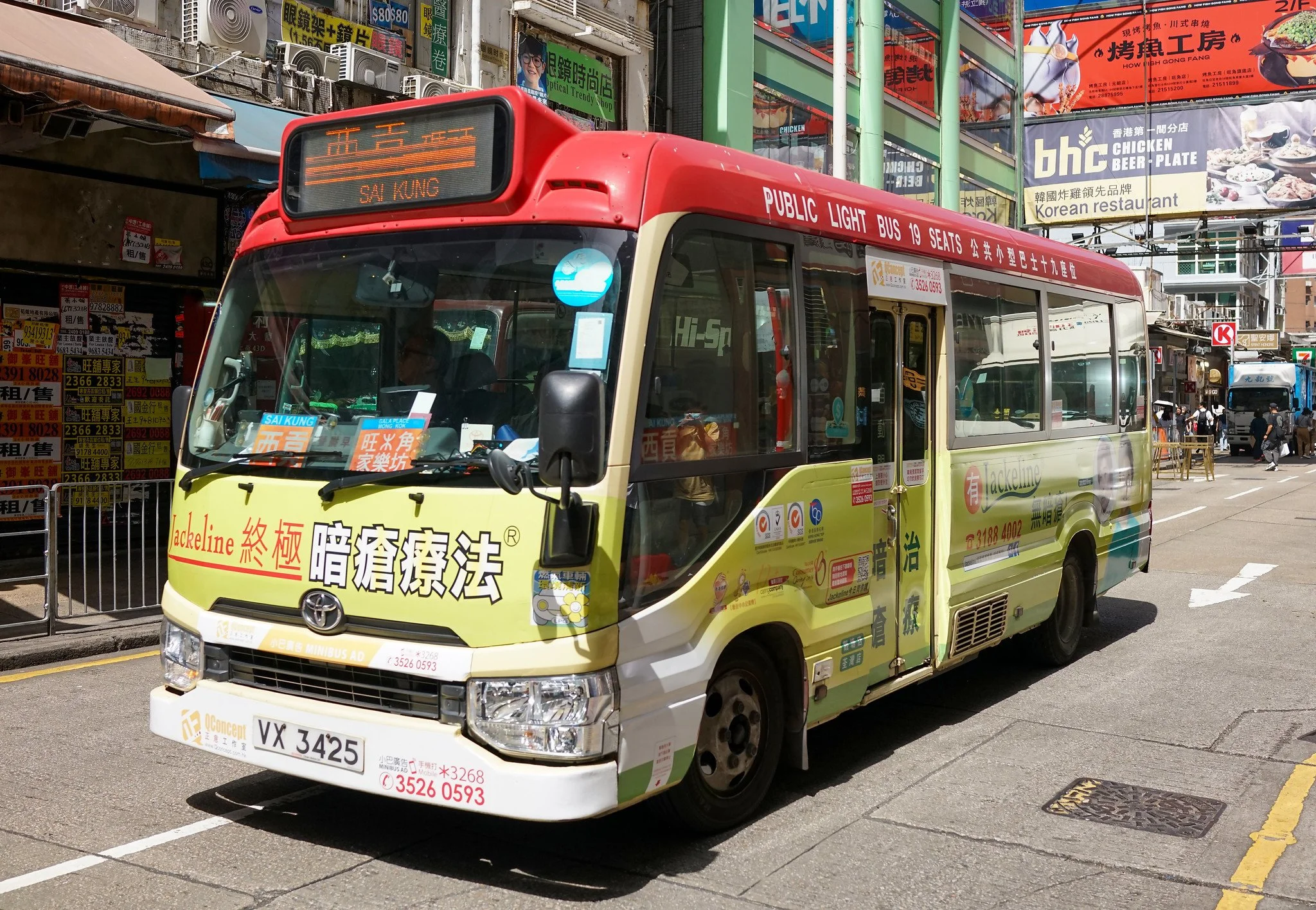
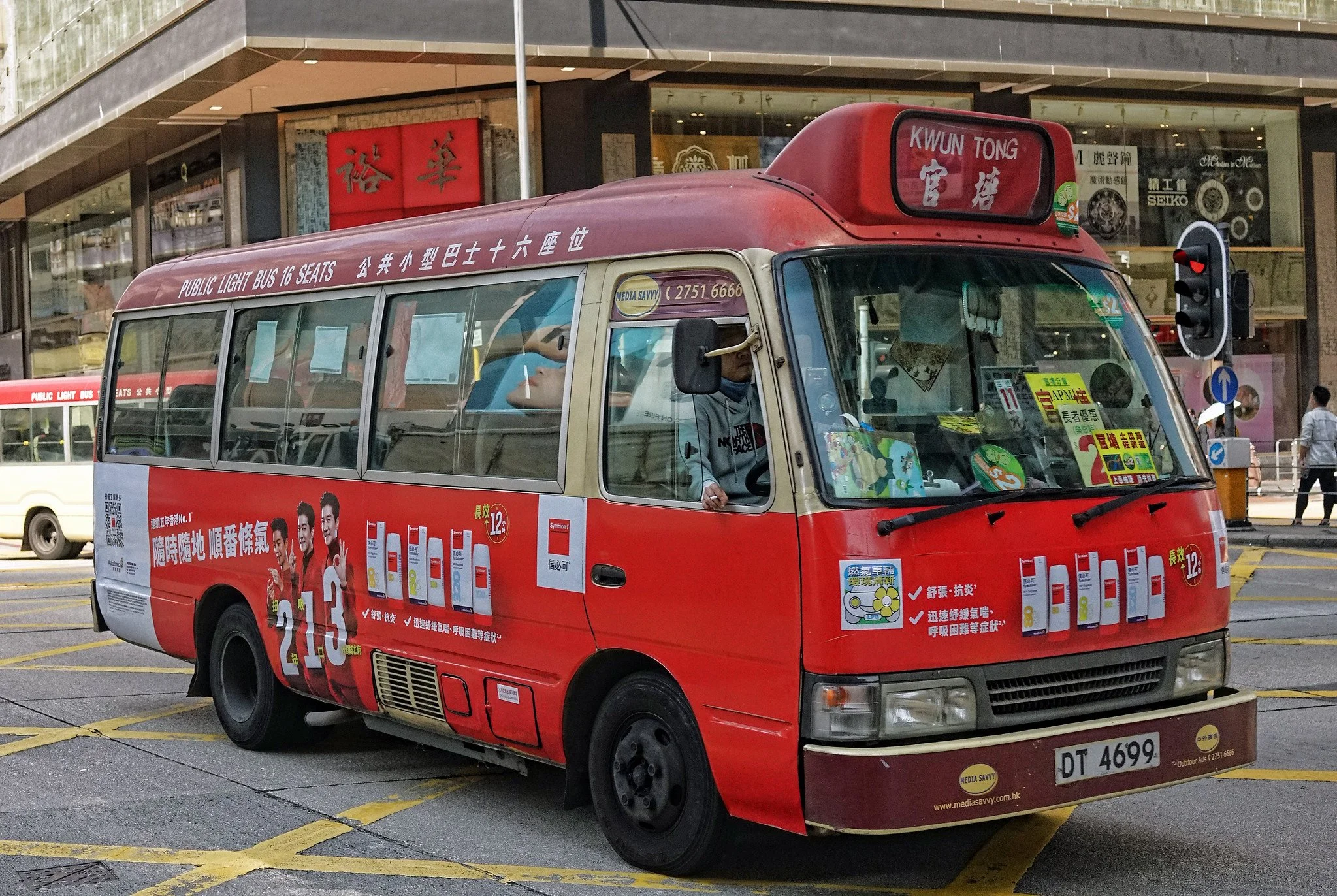
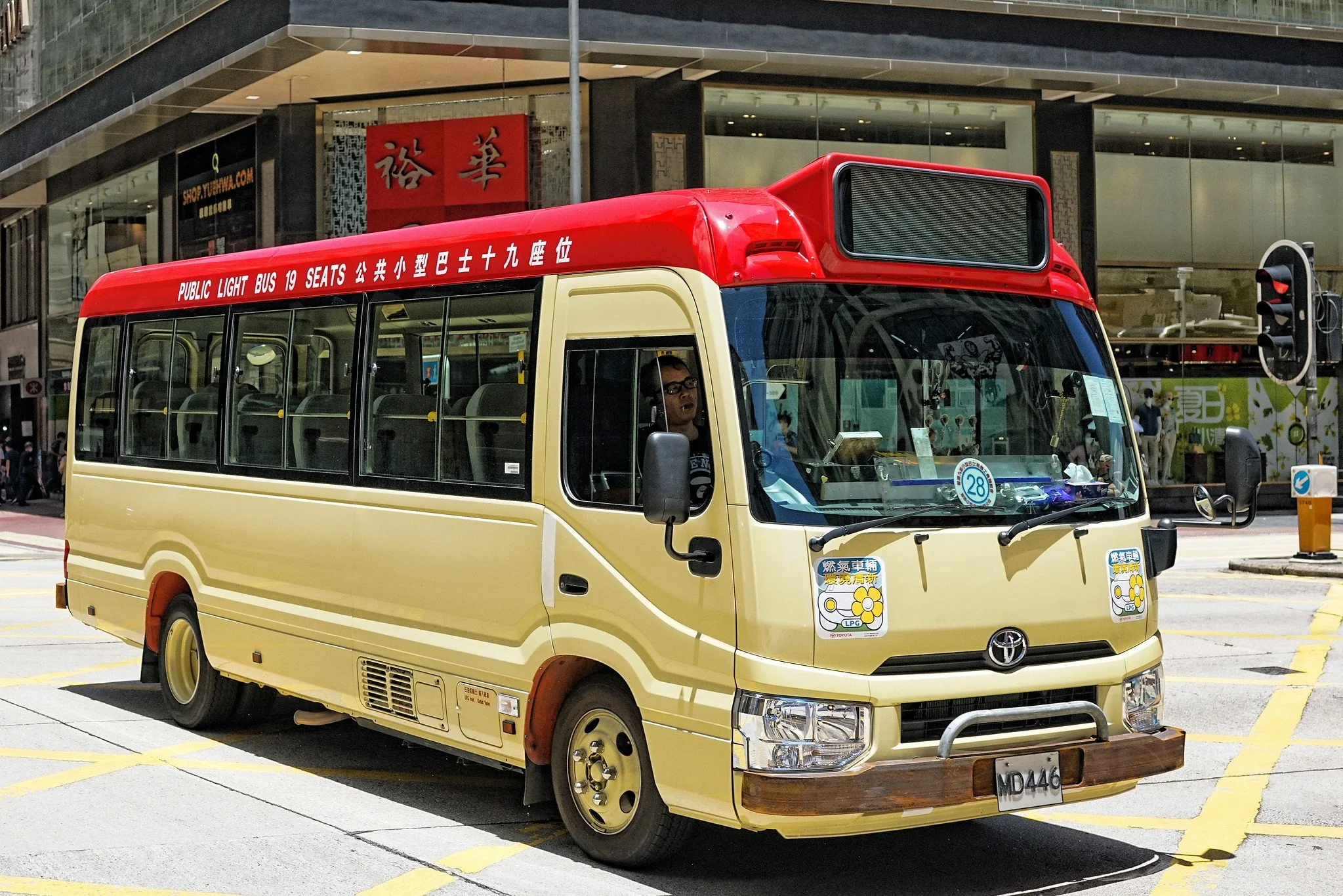
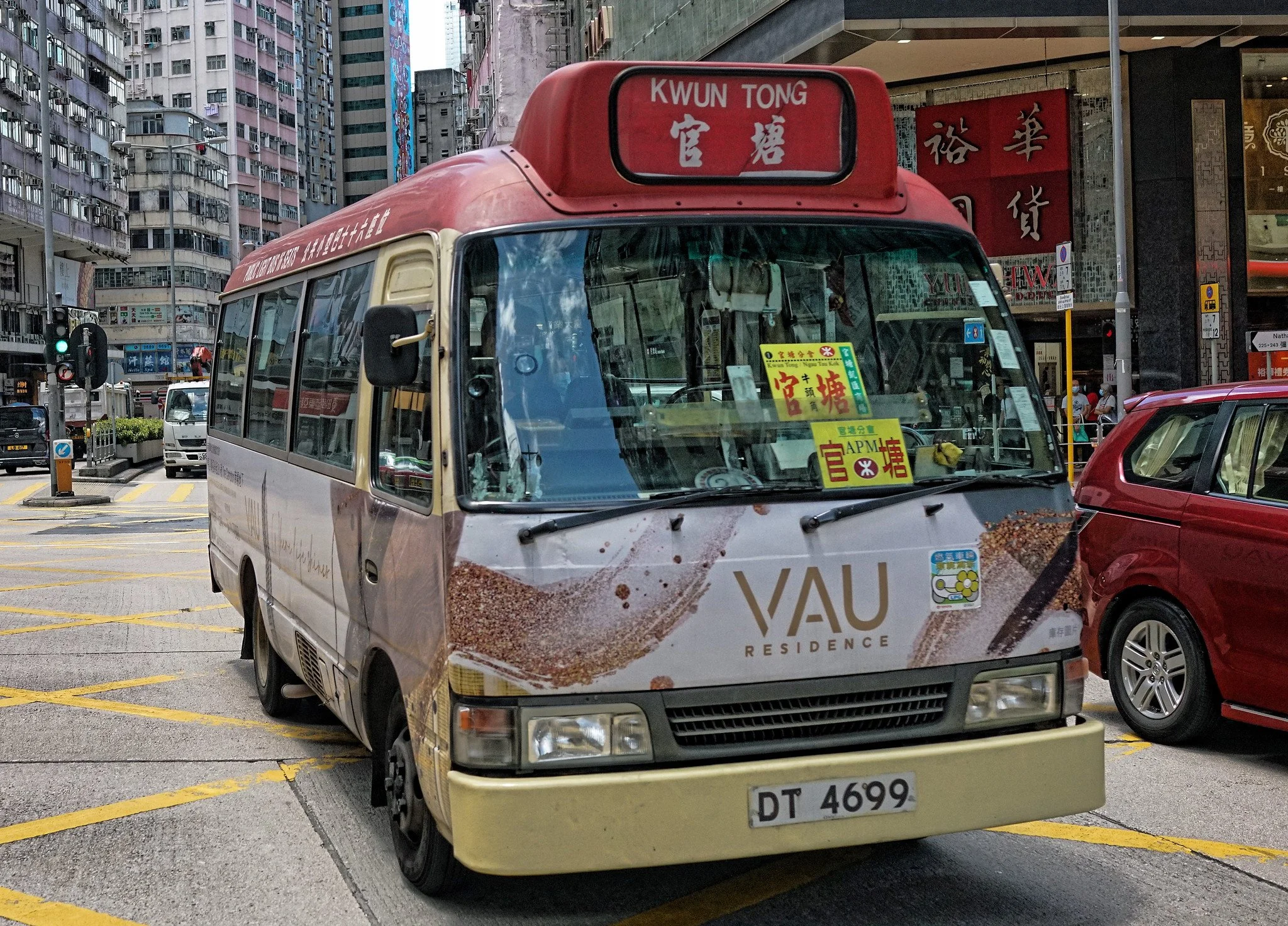
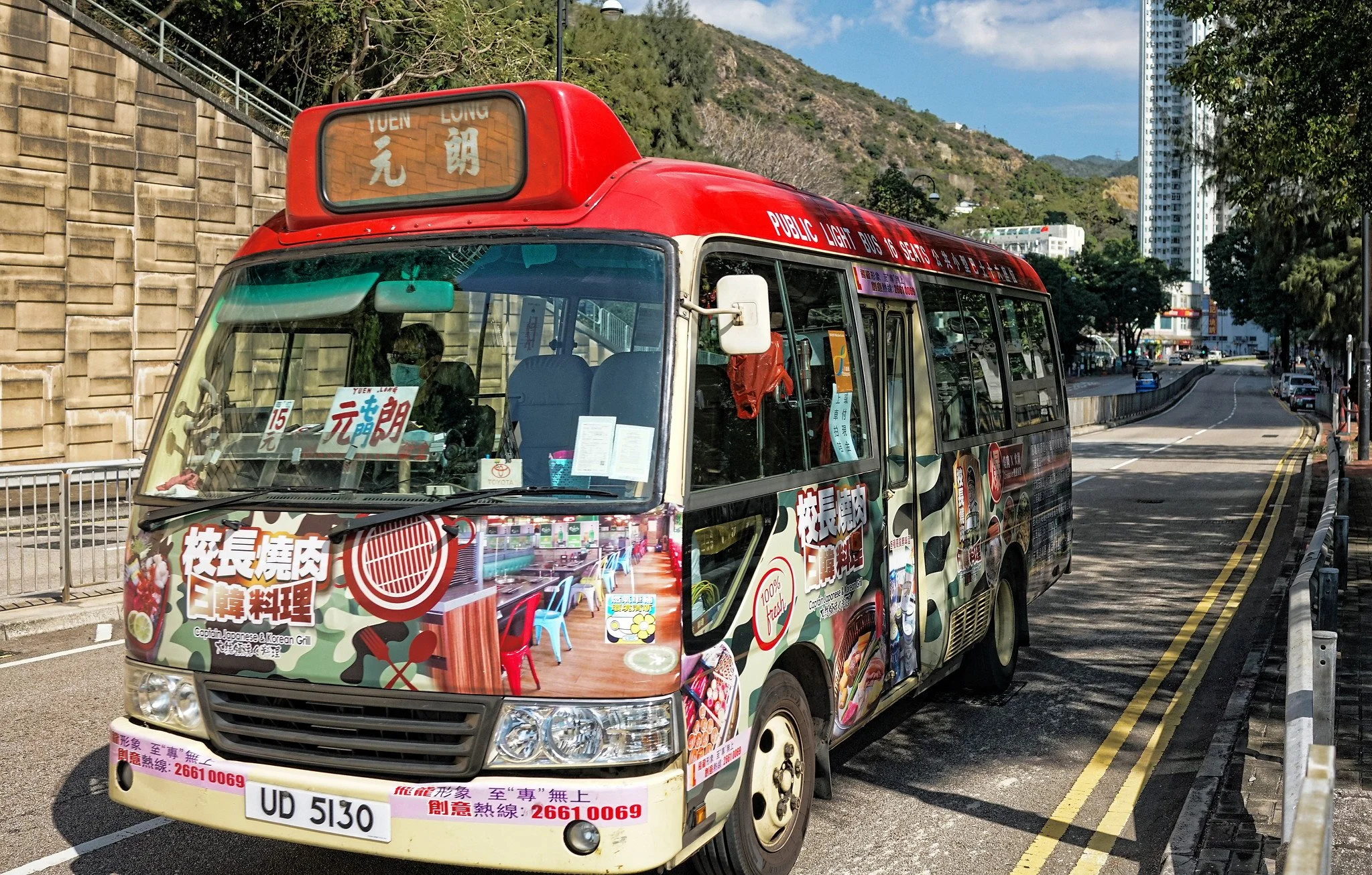
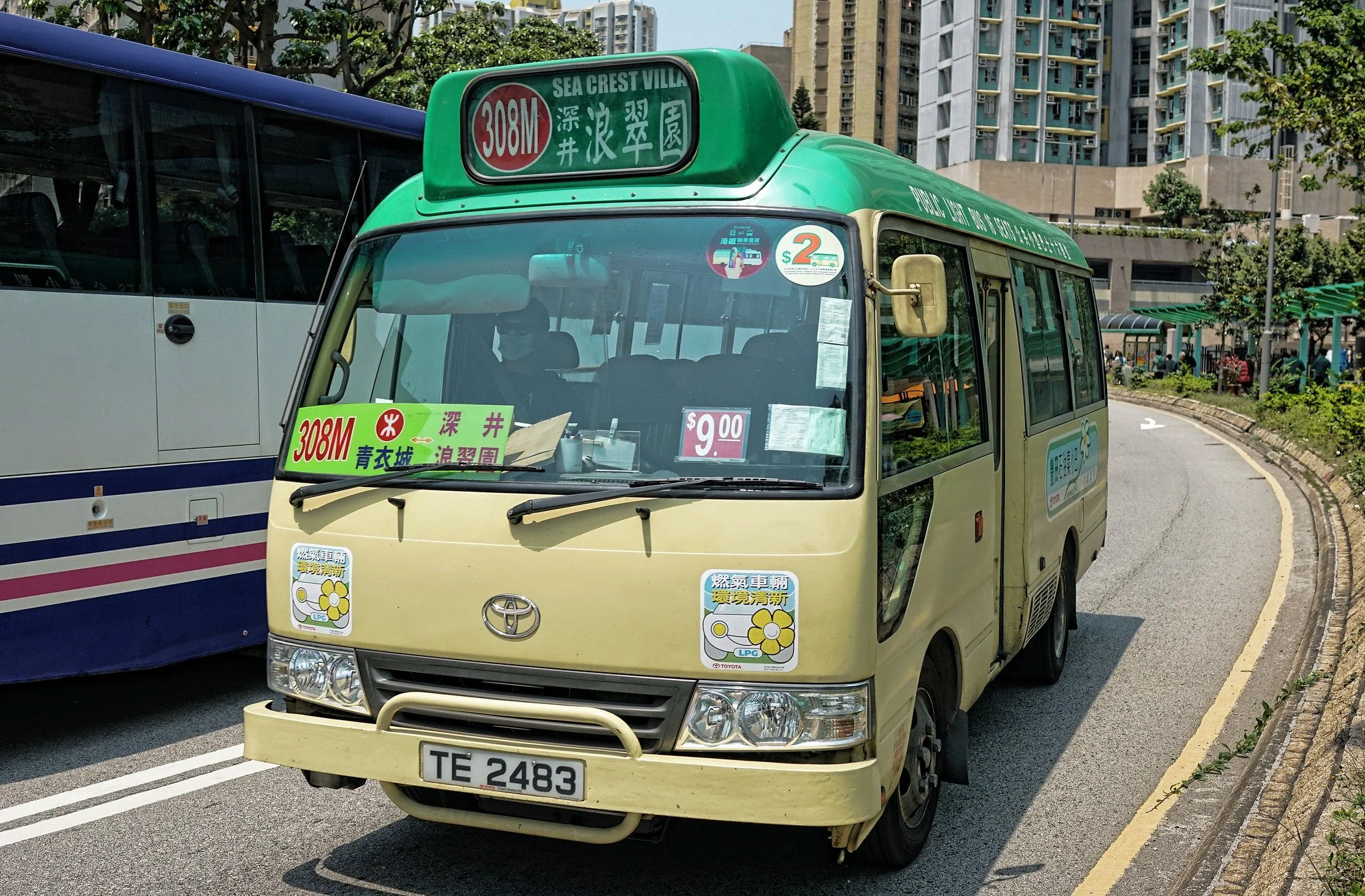
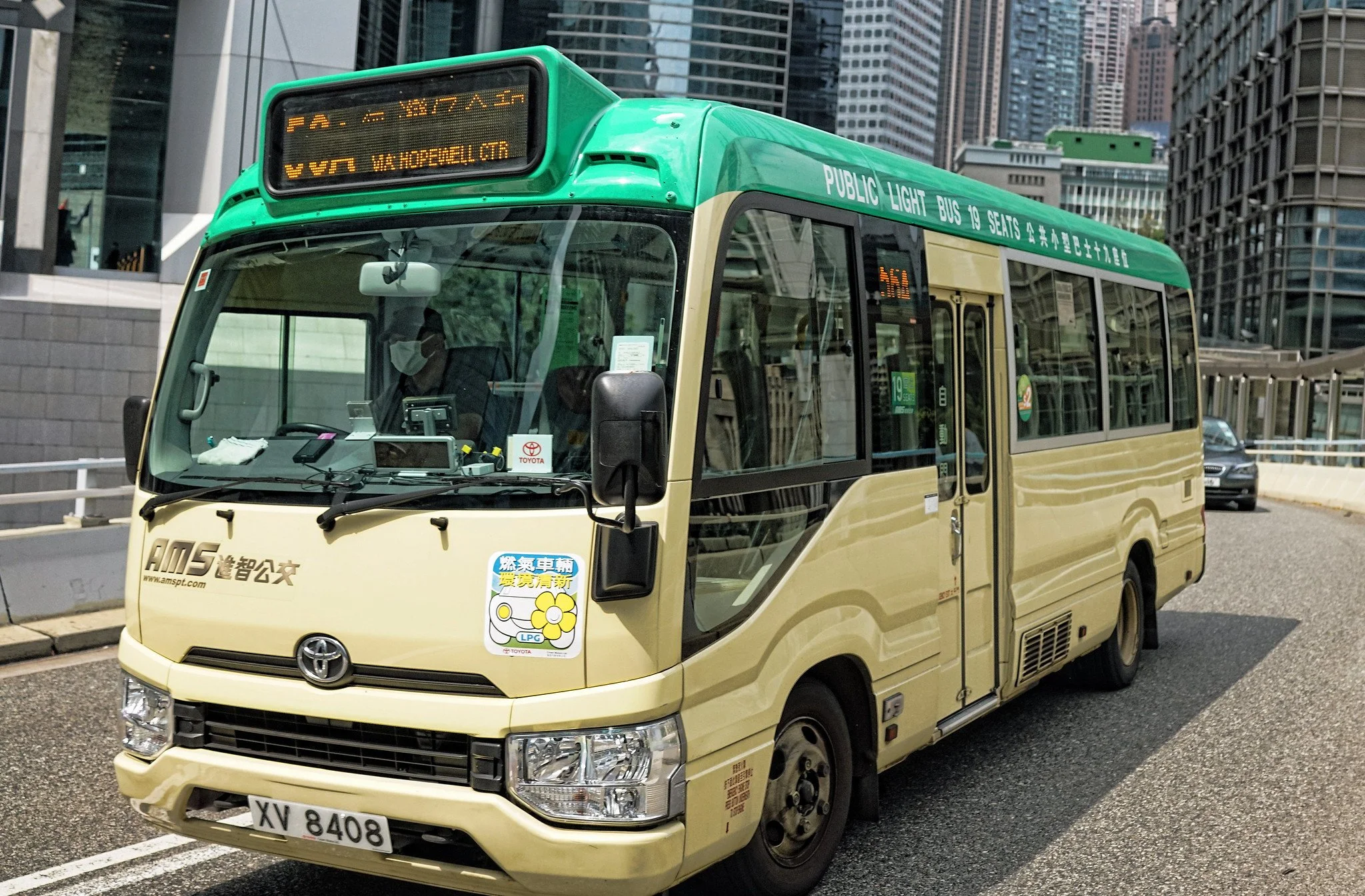
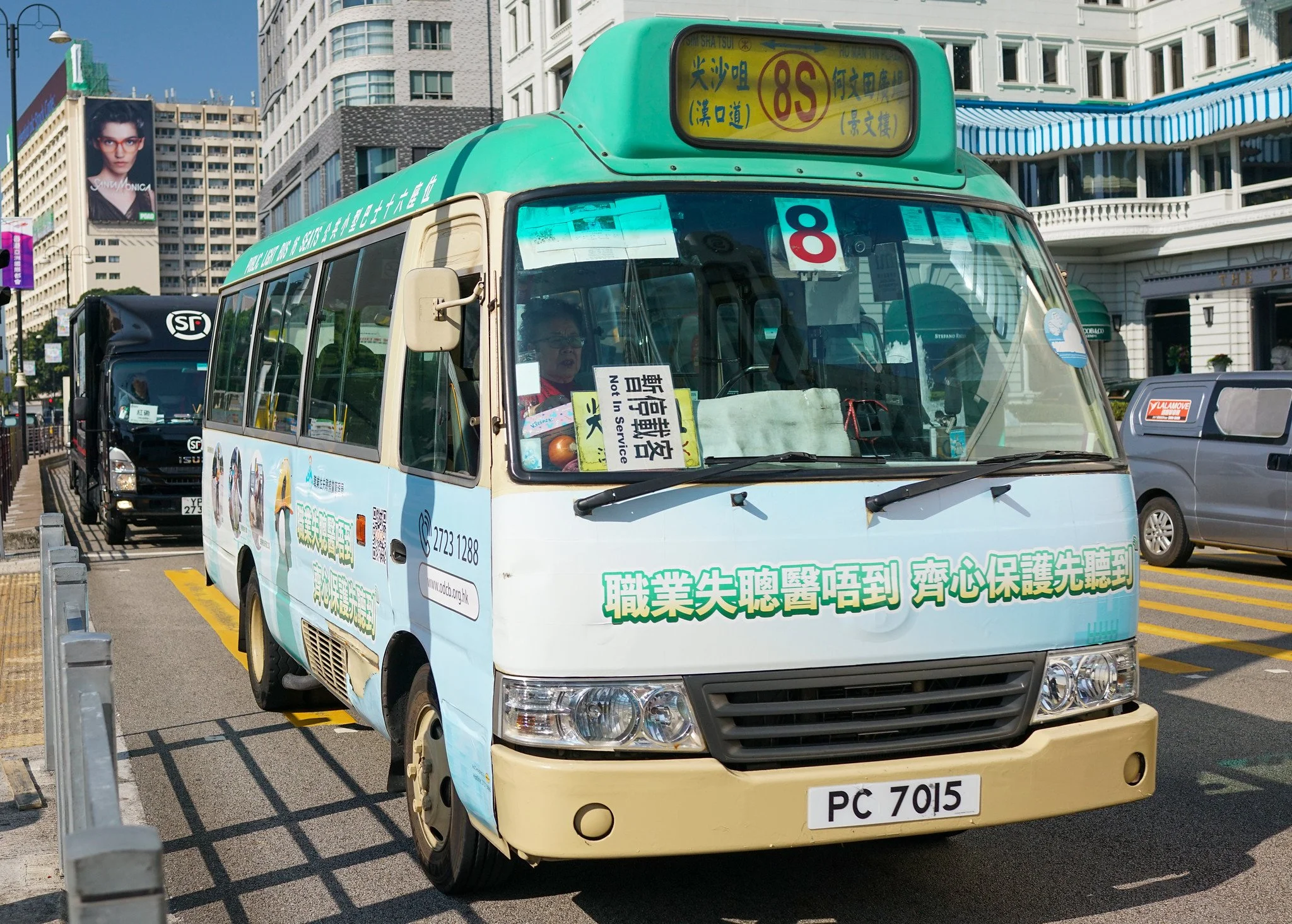
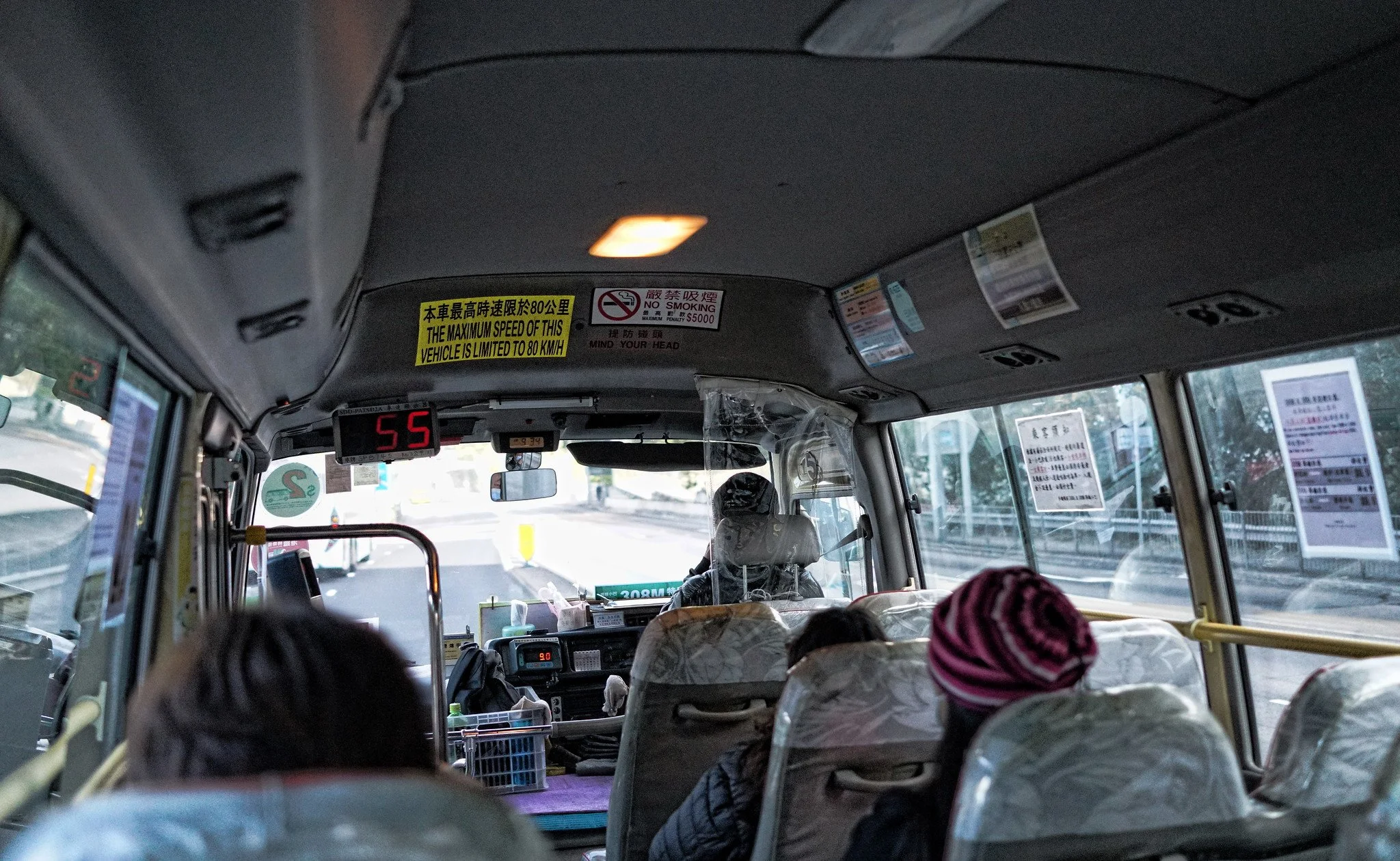
click on any image to enlarge
© Copyright Acknowledged | All rights reserved | images taken by Jamie
Red + Green Top Minibuses | Public Light Bus | Hong Kong
Green Roof vs Red Roof Minibuses: Key Differences and Numbers on the Road
The colour of the roof is far more than decorative - it defines the entire operating model:
Green Minibuses (GMBs) operate on 358 fixed routes (67 on Hong Kong Island, 82 in Kowloon, and 209 in the New Territories as of late 2024). They run to published schedules with fixed fares regulated by the Transport Department. Service frequency and headways are monitored and approved. In practice, however, they do not automatically stop at every designated stop like Citybus or KMB double-deckers. Passengers must ring the bell (which often does not work reliably) or shout to the driver to request a stop. I have observed this on virtually all the routes I travel regularly. I am generally comfortable taking guests on green-top minibuses, as their driving style stays within acceptable limits for me.
Red Minibuses (RMBs) have no fixed routes, no mandatory timetables, and no government-controlled fares. Drivers can choose paths dynamically based on demand, hail passengers almost anywhere (except prohibited zones), and adjust fares - often charging more during peak times, rain, or late nights. They are essentially share-taxis on wheels. Personally, I would never take a guest on a red-top minibus because of the more unpredictable and aggressive driving style not to mention the route could change on a dime. we have many red roof PLB’s in our town but I never use them, I prefer the double decker buses which are very reliable, safe and actually stop at the bus stops they are supposed to stop at!
In 2026, green minibuses still dominate the roads numerically (about 3,419 vehicles carrying roughly 1.325 million passengers daily), while the smaller red fleet (921 vehicles) serves around 146,000 passengers per day but offers greater flexibility in underserved or dynamic areas.
A Brief History: When and Why Public Light Buses Were Introduced
Public Light Buses were formally introduced on 1 September 1969. The official rationale was to regulate and legalise the chaotic but essential services that had sprung up during the 1967 riots. When franchised bus and tram staff went on strike, illegal nine-seater “New Territories taxis” and private vans flooded urban areas to fill the transport vacuum. Rather than crack down entirely, the government chose to issue public light bus licences, bring the operators into the regulated fold, and turn an ad-hoc solution into a permanent, supplementary public transport mode. By the early 1970s, the green minibus scheduled service was added in 1972 to provide more structure alongside the free-roaming red minibuses. The goal was clear: offer quick, point-to-point connectivity to residential areas and narrow roads while preventing uncontrolled competition with larger buses.
As a family we arrived in January 1972 and I used to take the green top PLB’s on a regular basis
Average Fare for One Person in 2026
Green minibus fares are fixed by route and typically range from HK$7 to HK$15 for most journeys within Hong Kong Island, Kowloon, or the New Territories, with cross-harbour services slightly higher. Recent adjustments (such as New Territories route 105 rising from HK$11.5 to HK$12.4) show fares creeping up modestly with operating costs. - my minibus fare to the local subway station is HK$10.50 which is very affordable
Red minibus fares remain market-driven and can start at HK$10 but easily reach HK$20–25 or more during peak demand or bad weather. Overall, an average one-person fare across both types in 2026 sits comfortably between HK$12 and HK$18, still making PLBs one of the most affordable and convenient options for short-to-medium trips.
Why the 80 km/h Speed Limit? - And How the Speed Limiter Actually Works
Since 13 April 2012, every Public Light Bus has been legally limited to a maximum of 80 km/h, regardless of the road’s posted limit (which may be higher). The measure was introduced after years of concern over the disproportionately high involvement of PLBs in serious accidents. A speed limiter device must be fitted and regularly inspected. The cap was a direct safety response to the aggressive driving culture that had developed, aiming to reduce collision severity while still allowing the nimble minibuses to outperform larger vehicles in urban traffic.
So here is the thing, I was unaware that there was a device that automatically limits the speed, well that is the theory, reality as usual is a little different
The speed limiter is an approved electronic device that actively restricts engine power/fuel delivery once the vehicle reaches or tries to exceed 80 km/h. It is designed to automatically prevent sustained speeds above the limit. A loud warning beep (and dashboard telltale) sounds when approaching the limit or if the device detects a fault. In theory, the bus should not be able to maintain speeds over 80 km/h for long periods. In reality - as I experience on almost every ride - drivers often push right up to or briefly over 80 km/h (sometimes reaching 85 km/h), the beep sounds loudly, and the driver then brakes manually. This cycle is very common.
Possible reasons include a small tolerance in the system, drivers anticipating and managing the limiter to maintain momentum, or occasional calibration/maintenance issues (though tampering is illegal and checked during inspections). The Transport Department emphasises that the limiter, combined with the legal limit, is a key safety tool, but real-world compliance still depends heavily on driver behaviour and frankly most of the time the driver ignores the beeping and the passengers do not care
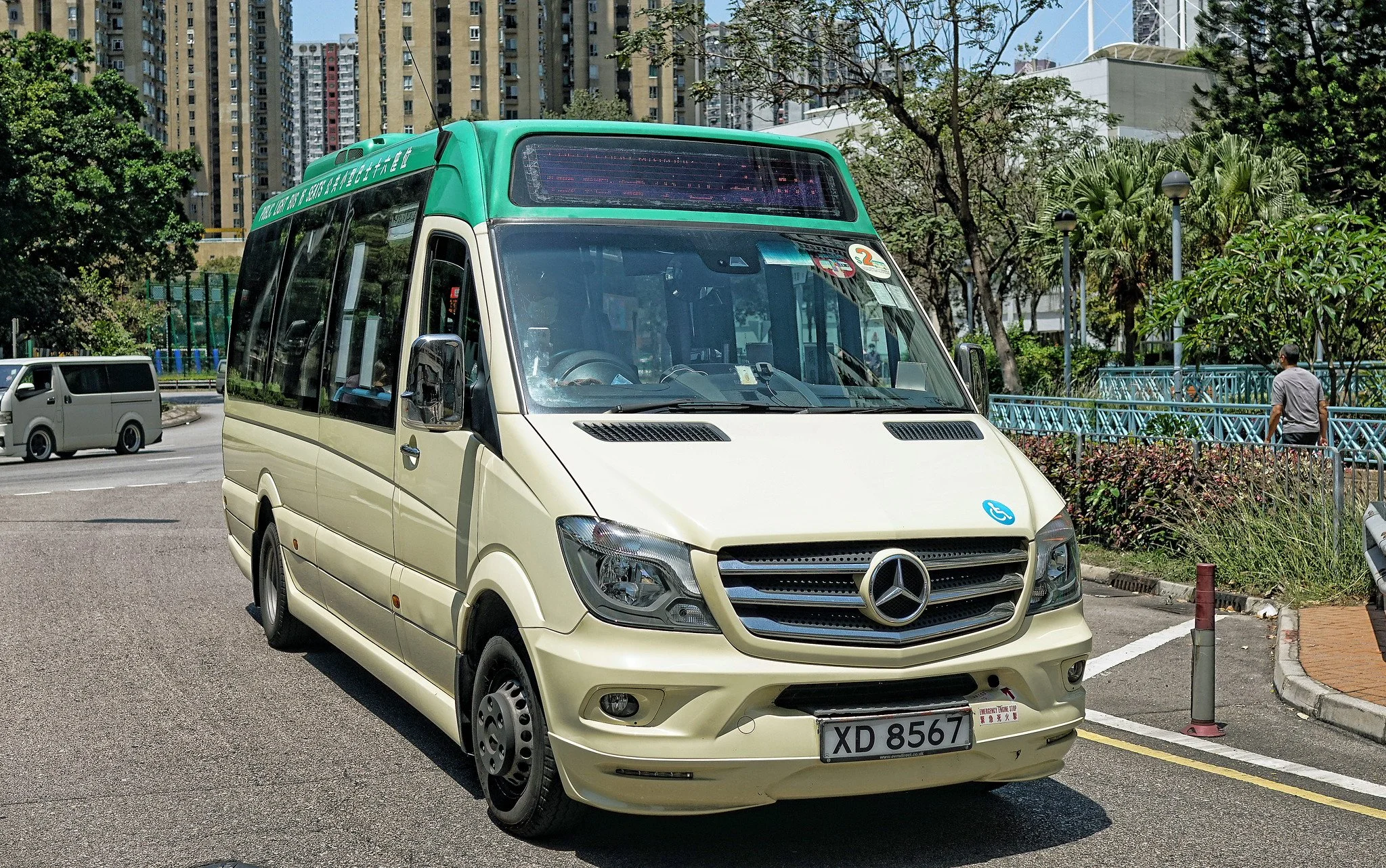
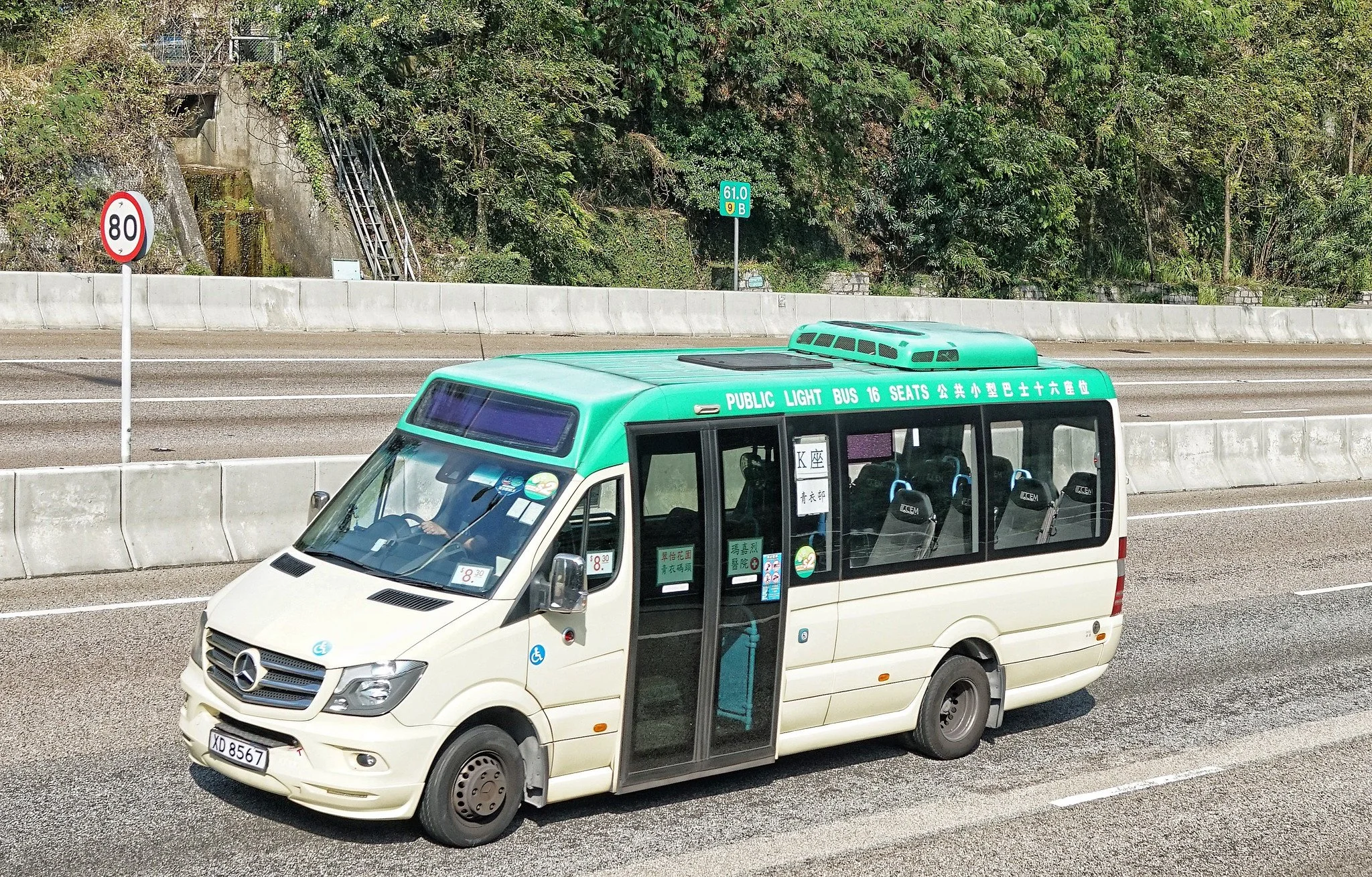
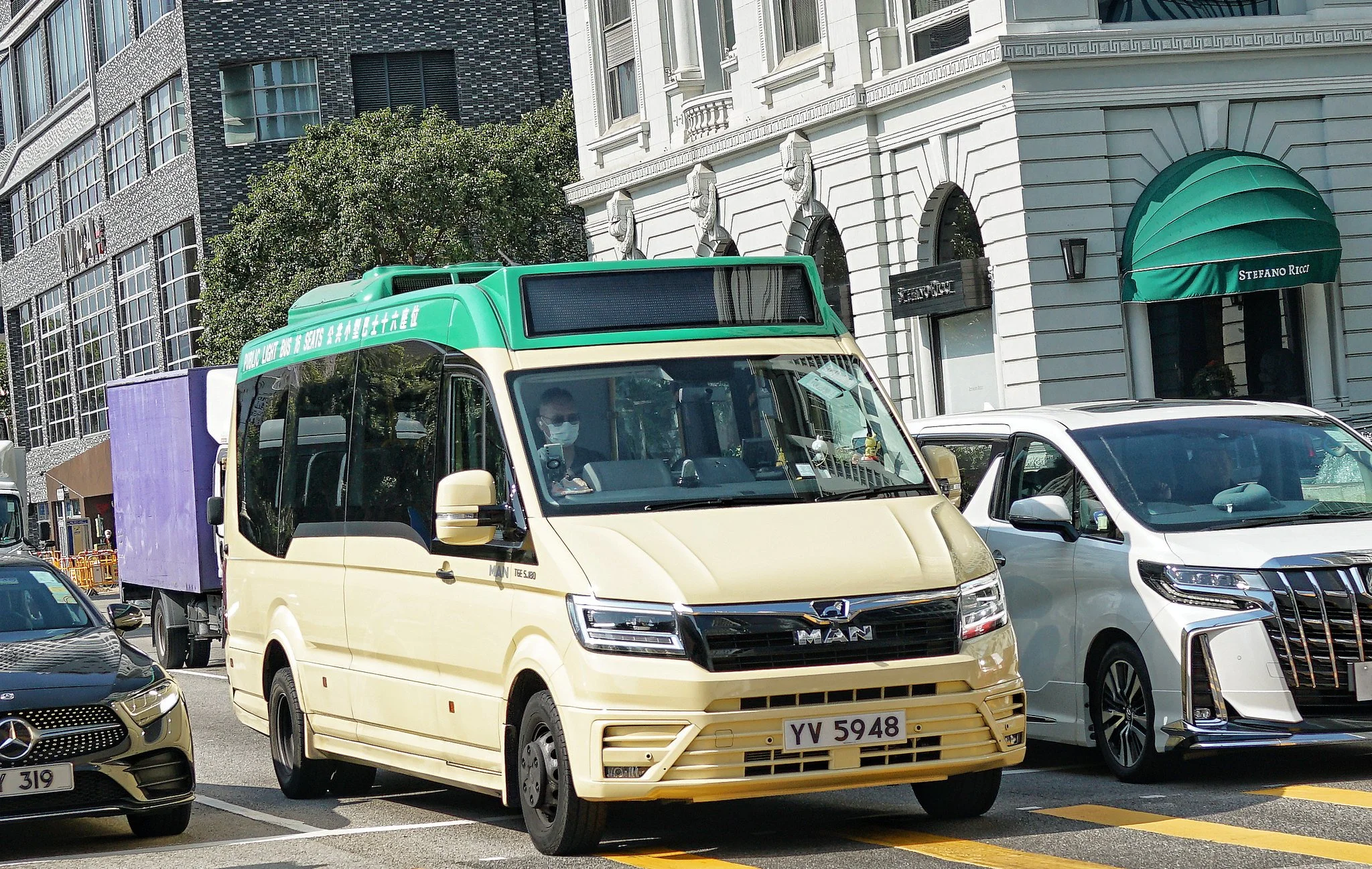
click on any image to enlarge
© Copyright Acknowledged | All rights reserved | images taken by Jamie
Rare Minibus Variants | Public Light Bus | Hong Kong
Toyota Dominance and Rare Variants: Mercedes-Benz, MAN and Others
Toyota was not dominant at the start, early Public Light Buses in the late 1960s and 1970s used a variety of makes, including British and Japanese models such as Bedford and smaller vans. However, the Toyota Coaster became the overwhelming standard from the 1980s onward and remains virtually the only model seen on Hong Kong roads today. Its reliability, compact dimensions, and suitability for 16- or 19-seat configurations made it the operator’s choice. Newer Coasters offer both manual and 6-speed automatic transmissions, but the majority of the fleet - especially older vehicles - still use 5-speed manual gearboxes and I have never come across an automatic bus on my routes
While the vast majority are Toyota Coasters, rarer cream-bodied variants do appear. The Mercedes-Benz green-top with the wheelchair sticker (XD 8567 in the photo above) is a low-floor Sprinter 516CDi introduced under the wheelchair-accessible trial scheme. It runs on hospital routes such as New Territories Route 413 (Tsing Yi Ferry Terminus - Princess Margaret Hospital). The MAN green-top I photographed (YV 5948) above looks noticeably larger than the standard Toyota 19-seater and is consistent with the MAN TGE 5.180 or similar models used in small numbers for modern or accessible configurations.
These European variants add welcome diversity and highlight ongoing efforts to test more spacious or accessible designs within the strict fleet limits.
Seating Capacity: 16 or 19 Seats - Has This Always Been the Case?
No. Early PLBs were often 9- to 14-seaters. Capacity gradually increased over decades, and in August 2017 the Transport Department relaxed rules to allow 19-seat configurations (with some retrofitted 16-seaters). Today, most new or recently upgraded vehicles are 19-seaters, offering higher revenue potential while still fitting the “light bus” definition and as a passenger I much prefer the 19 seater mainly because it means the bus is newer with more comfy seats
Wheelchair-Friendly Green Minibuses: Design, Routes, and Hospital Service
Long overdue and now we have them
Hong Kong introduced low-floor wheelchair-accessible Public Light Buses through a dedicated trial scheme launched by the Transport Department in January 2018. These special green-top vehicles - including the Mercedes-Benz Sprinter and earlier Optare Solo SR models - are built with a low-floor entry, a deployable ramp, designated wheelchair space (usually for one passenger), seat belts, and additional handrails for safety and comfort. They meet all PLB regulations while providing genuine accessibility that standard high-floor Coasters cannot match. Operators must provide advance reservation via hotline (typically 1–14 days ahead) so the driver can prepare the ramp and space.
These accessible minibuses were initially trialled on hospital routes and have since become a requirement for new green minibus services serving hospitals. Key examples include:
Route 54M (Kennedy Town Station – Queen Mary Hospital)
Route 808 (Kam Ying Court – Prince of Wales Hospital)
Route 413 (Tsing Yi Ferry Terminus – Princess Margaret Hospital)
Route 90A (Yau Tong – Hong Kong Children’s Hospital)
Route 503 (Queens Hill Estate – North District Hospital)
Additional routes (such as Kowloon CX1 and New Territories 505) have also received them over time. The focus on hospital corridors makes perfect sense - they greatly improve independence for patients, elderly passengers, and carers making medical trips. From my own observations riding green minibuses daily, these vehicles represent a quiet but meaningful step toward inclusive transport in a city where mobility challenges are common (and do not get me started on steps, I will save my comments on that for another post)
Accident Statistics Over the Past 20 Years
Public Light Buses have historically accounted for a noticeable share of road incidents - roughly 6% of total crashes in some earlier analyses, despite comprising a tiny fraction of the vehicle fleet. On average over the past two decades, PLB-involved accidents have hovered around 1,800 to 2,000 per year, with peaks during periods of economic pressure or lax enforcement. Many involve rear-end collisions, red-light running, or sudden lane changes in dense traffic - issues that prompted the 2012 speed-limiter rules and ongoing safety campaigns.
Mandatory Seat Belts on Public Light Buses
From 25 January 2026, seat belt rules were introduced for seated passengers on public transport vehicles, including Public Light Buses, where seat belts are fitted. Drivers and passengers are required to wear them, with penalties for non-compliance. However, the initial broad application to buses faced technical and practical challenges, leading to a quick repeal and revision of parts of the regulation shortly after implementation. For PLBs, the requirement applies where belts are installed (most modern vehicles have them), reinforcing safety alongside the speed limiter. In practice, enforcement and passenger compliance vary, but the rule underscores the government’s ongoing efforts to improve safety on these fast-moving minibuses.
The reality is that on a bus wearing a seatbelt seems to be optional, the drivers do not check nor do they care, the only deterrence is that is there is a very minimal risk of the minibus being pulled over by the Traffic Police for a spot check, that has never, ever happened to me and not only that, the seatbelt is about as basic as it gets, it fits across your waist only.
The Triad Connection: Real Issue or Urban Legend?
It was very much a real issue for red minibuses, particularly from the 1990s into the 2010s. Police operations repeatedly targeted triad groups extorting “protection” fees or route-control payments from red minibus drivers - sometimes HK$30,000 joining fees plus monthly subscriptions. Arrests were made on routes in Wan Chai, Mong Kok, Tsuen Wan, and elsewhere. While tighter regulation, CCTV, and police focus have reduced visible triad activity in recent years, the historical link between certain red minibus operations and organised crime remains part of the trade’s colourful (and occasionally dark) backstory.
Why the Rude Attitudes and Maniac Driving? My Observations and the Real Reasons
In my experience photographing over 5,000 + of these minibuses and riding them constantly, both red and green drivers can come across as brusque, impatient, and willing to push the limits despite the 80 km/h cap. The reasons are economic and structural rather than personal malice. Red top drivers are often self-employed or working on a daily rental basis (around HK$800 per day in past years); every extra passenger and every faster trip directly affects their income. Green top drivers work under operators but face tight schedules and performance expectations. Add long shifts (often 12+ hours), Hong Kong’s relentless traffic, passenger pressure for speed, and the fact that many drivers are older men who have been doing this for decades, and the “maniac” style becomes understandable - even if it remains unsafe and frustrating. It is less about deliberate recklessness and more about survival economics in one of the most expensive cities in the world.
Why Manual Transmission in a Stop-Start World?
Most PLB Toyota Coasters, especially the older and mid-life fleet that dominates the roads, are equipped with 5-speed manual transmissions. While newer models offer automatics, operators have stuck with manuals for lower purchase and maintenance costs, slightly better fuel efficiency in skilled hands, and greater driver control in Hong Kong’s hilly, congested streets. Manual gearboxes also allow experienced drivers to manage engine braking and acceleration more precisely during frequent stops. The trade-off is more fatigue, but cost and tradition have kept manuals prevalent.
When you ride on a minbus the gear changes are irritating to say the least and frankly the buses lack power, they are tinny and just seem off, hardly a scientific assessment but i do think it would make for a smoother ride if they had an automatic transmission
Decades of experience should make drivers safer and more cautious, but with minibuses the opposite often happens. Long-term drivers accumulate thousands of hours in a high-pressure environment - tight schedules, passenger demands for speed, competitive earnings (especially on red routes), and the physical/mental toll of stop-start traffic in a dense city. Over time, this can normalise aggressive habits: tailgating, sudden lane changes, pushing the 80 km/h limit, and ignoring the speed limiter beep. It becomes “muscle memory” of bad practice rather than refined caution. The older demographic (mostly men over 60) compounds this - many entered the trade when rules were looser, and habits are hard to break.
It might not seem logical to owners of the minibuses but I suspect that many younger drivers are put off becoming a minibus driver because it is a lot easy to drive an automatic bus!
This point about younger drivers being deterred is logical and widely discussed in the trade. Driving a manual Toyota Coaster PLB all day in Hong Kong’s hilly, congested conditions is physically demanding and mentally exhausting compared to the smoother, automatic transmission on modern franchised double-deckers (Citybus/KMB). Younger locals often prefer jobs with better pay, regular hours, air-conditioned cabs, and less public confrontation. The manual gearbox, combined with lower relative earnings and the “maniac driver” reputation, makes PLB work unattractive to new blood. This is why the government turned to importing mainland drivers - it’s a short-term patch for the shortage, but it doesn’t solve the underlying cultural and ergonomic issues.
My take: There is no easy fix, but several practical steps could help:
Accelerate the shift to electric/automatic e-PLBs (as in the pilot scheme) - smoother driving, less fatigue, modern appeal.
Improve pay and conditions for local drivers (shorter shifts, better rest, performance bonuses for safe driving).
Stronger enforcement and training refreshers focused on safety culture rather than just revenue.
Public campaigns to change the “fast and furious” image of minibuses.
As they say, good luck with that, nice thoughts but it will never happen and that is reality in Hong Kong
Driver Demographics: Why Mostly Men Well Over 60?
The typical PLB driver is male and aged 60 or above because the job’s irregular hours, physical demands, and relatively modest pay (see below) deter younger locals. Many drivers entered the trade decades ago and stayed; others are retirees supplementing pensions. A persistent shortage has led operators to rely on this experienced but ageing workforce. Recent government proposals to tighten medical checks for drivers aged 65+ (lowering the threshold from 70 and requiring more frequent certificates) reflect safety concerns tied directly to this demographic reality.
Monthly Earnings for a Minibus Driver
Average gross monthly earnings for PLB drivers hover around HK$17,300 or US$2,200 (based on 2026 salary data), though red drivers can earn more on good routes or during peak seasons and less on slow days. Green drivers often work on more stable hourly or shift contracts. The figure is respectable but not high by Hong Kong standards, especially when factoring in long hours, no guaranteed breaks, and the physical toll. Imported drivers are generally paid at lower rates, which helps operators manage costs amid the shortage.
Age Restrictions for the Licence
Applicants must be at least 21 years old to obtain a commercial driving licence for Public Light Buses. There is no strict upper age limit, but drivers aged 65 and above (with proposals to formalise this) face increasingly stringent medical examinations, including vision, hearing, and reaction tests. Licences for those over 70 are typically issued for one year only and require fresh medical certification each renewal.
Why So Many Minibuses Are 10 - 20 Years Old (or Older) - and Government Moves Toward Electric Models
With the fleet capped at 4,350 and new Toyota Coaster prices exceeding HK$700,000, operators have every incentive to run vehicles as long as they pass annual inspections. Toyota’s legendary durability allows many PLBs to remain roadworthy well into their second or third decade. Slow fleet renewal, high replacement costs, and the reliability of older Coasters explain why the roads are still full of 10- to 20-year-old (and sometimes older) minibuses.
That said, the government is actively pushing greener alternatives through the Pilot Scheme for Electric Public Light Buses (e-PLBs) run by the Environmental Protection Department. This initiative subsidises up to 80% of the vehicle price for successful green minibus operators participating in trials, with dedicated charging infrastructure already operating at public transport interchanges such as Kowloon Tong (Suffolk Road) and Kwun Tong Yue Man Square (including pantograph and plug-in chargers). By the end of 2024 only a handful of electric PLBs were licensed, but trials involving more vehicles continued progressively into 2025 and 2026. Modern e-PLB models in the scheme typically feature automatic transmissions (standard in contemporary electric drivetrains), which could ease driver fatigue on frequent stop-start routes while supporting Hong Kong’s broader goal of zero vehicular emissions by 2050. This represents a promising shift that could gradually refresh the ageing fleet if the pilot proves successful and expands.
Hong Kong Electric Minibuses: The Green Transition Taking Shape in 2026
Hong Kong’s Public Light Buses have long been the nimble backbone of the city’s transport network, but like many aspects of daily life here, they are slowly entering a greener chapter. Electric minibuses (e-PLBs) represent a key part of the government’s push toward zero vehicular emissions by 2050, and while the numbers are still modest, the pilot programmes and supporting infrastructure signal real momentum. As someone who rides green minibuses almost daily, I watch these developments with interest - cleaner air, quieter operation, and potentially smoother rides with automatic transmissions could transform the familiar experience without losing the convenience that makes PLBs so essential.
The shift to electric is not happening overnight, given the fleet cap, high vehicle costs, and the practical challenges of charging in a dense urban environment. Yet the combination of subsidies, dedicated trials, and technological improvements is laying the groundwork for wider adoption. Below is a detailed look at where things stand in 2026, including the current pilot scheme, models in use, infrastructure, challenges, and what it means for riders and operators.
I am not a fan of electic vehicles but I would welcome an Electric PLB
Current Scale and more information Government Pilot Scheme
The Pilot Scheme for Electric Public Light Buses, led by the Environmental Protection Department (EPD), is the main initiative. It subsidises up to 80% of the vehicle purchase price for participating green minibus operators.
Trials focus on real-world performance, route suitability, and charging logistics. Key trial points include public transport interchanges at Kowloon Tong (Suffolk Road) and Kwun Tong Yue Man Square, with pantograph (overhead fast-charging) and plug-in facilities already operational.
By the end of 2024, only 4 electric PLBs were fully licensed in the territory, alongside thousands of LPG models. The second round of applications closed in August 2024, and trials with additional vehicles (including batches of around 13–16 in some phases) progressed through 2025 into 2026.
Broader targets align with the updated Hong Kong Roadmap on Popularisation of Electric Vehicles, which emphasises commercial fleets like PLBs as priorities for scaling up after initial pilots.
In a nutshell it is very slow progress, new technology takes time to get established, it talen 13 years for electric cars to get established in Hong Kong
Models, Technology, and Features
Most e-PLBs in the pilot are based on modified Toyota Coaster platforms or purpose-built electric chassis from approved suppliers. Key points include:
Automatic transmissions are standard on these modern electric models (unlike the manual-heavy traditional fleet), offering smoother acceleration and reduced driver fatigue on stop-start routes.
Battery ranges and charging speeds are being tested specifically for Hong Kong’s hilly terrain, frequent stops, and high daily mileage.
Benefits observed so far include near-silent operation, zero tailpipe emissions, lower long-term maintenance (no diesel engine), and improved air quality in dense areas.
Pre-qualified models have obtained type approval from the Transport Department, ensuring they meet local safety and operational standards.
Infrastructure and Support Measures
Dedicated charging bays at selected PTIs support multiple e-PLBs simultaneously.
The government continues to update guidelines for charging-enabling infrastructure in new public transport facilities.
Additional funding comes through the New Energy Transport Fund, with ongoing evaluation of how e-PLBs perform compared to LPG and diesel counterparts.
Operators receive technical support for charging arrangements and route optimisation during the pilot phase.
Challenges and Realistic Outlook
Electric minibuses still face hurdles:
High upfront costs (even with 80% subsidy, the remaining 20% plus charging setup is significant for small operators).
Limited range and charging time compared to diesel/LPG, which can affect tight schedules on longer routes.
The overall fleet remains overwhelmingly traditional (cream-bodied Toyota Coasters), so e-PLBs currently make up a tiny fraction of the 4,350 cap.
Driver training for the new technology and handling of heavier battery weight is an added requirement.
apathy from the owners and elderly drivers
Despite these, the pilot’s progress and extension of related labour/import schemes show commitment. If successful, broader rollout could accelerate fleet renewal and pair nicely with automatic transmissions for better comfort and safety.
My Personal Take as a Regular Rider
Electric minibuses have the potential to keep everything I love about green PLBs (convenience, route coverage, hail-and-ride flexibility with bell/shout stops) while fixing pain points like noise, emissions, and some of the jerkier manual driving. I look forward to more routes converting - especially if the smoother automatic operation reduces the aggressive feel that sometimes appears on older diesel models. For visitors or guests, an electric green minibus would be an even more pleasant introduction to this iconic transport mode.
Suggestions for Operators and Policymakers
Expand successful trial routes and share performance data publicly to build rider confidence.
Offer incentives for red minibus operators to transition where feasible.
Invest in more en-route or depot charging to minimise downtime.
Combine electrification with driver training programmes (including for imported workers) to ensure smooth adoption.
it is not rocket science, the transition is inevitable and us long suffering commuters will appreciate any effort to speed things up
Electric minibuses are still in the early stages in Hong Kong, but they mark an exciting evolution for a transport staple that has served the city for over 50 years. As more e-PLBs hit the roads, I’ll continue sharing real-world observations from my daily rides
My Thoughts and Suggestions for the Future
Public Light Buses remain a quintessentially Hong Kong transport experience - fast, personal, and deeply woven into daily life. Their strengths (flexibility, coverage of hard-to-reach spots) far outweigh the frustrations for most riders, yet the safety issues, driver shortages, and ageing fleet deserve serious attention. The importation of mainland drivers provides short-term relief but raises valid questions about training, road familiarity (especially the switch from right- to left-hand driving), and overall safety standards.
Encouraging younger local drivers through better pay and conditions, accelerating the shift to electric models with automatic transmissions, and perhaps converting more red routes to green for consistency could preserve the best of this system while modernising it. As someone who has spent decades on these buses, I believe they deserve both celebration and thoughtful evolution
So there you go
Jamie’s Hong Kong Insider Chat
AI Itinerary Rescue Service - Bring your AI-generated plan (or any self-designed itinerary) and I will spend the full two hours reviewing it with you. I’ll fix the impossible timings, suggest smarter routing, add interesting places that AI never finds, adjust for your group’s energy levels, and create a realistic, enjoyable day-by-day flow that actually works in real Hong Kong. Most guests leave saying “This is exactly what we needed”
I do not do Food Tours in Hong Kong but I know people that do!
I do not do food tours as mentioned above, I have very specific reasons and part of it is that I do not speak Cantonese or write Chinese, I am from Yorkshire in England and I lack the language gene and it is not through lack of trying and yes a lot of restaurants do not have English menu’s or staff who speak conversational English.
.. and yet I have eaten at close to 1,400 restaurants in Hong Kong since January 2nd 1972, my wife was born in Hong Kong and we have been together over 40 years and her first language is Cantonese and a lot of her family are Chinese or half Chinese so I have never had much of an issue!
This does not translate to doing food tours though, yes, I could do them, no problem there but they would never ever be as good as the food tours done by my friends (see the 3 links above) most of their awesome guides are locally born Hong Kong Chinese and obviously food culture is part of their DNA, it is impossible for me to compete with that!
So please feel free to contact them for food tours
I do not do Hiking Tours in Hong Kong but I know someone that does!
I do not do Hiking Tours, never have and never will even though I used to go Hiking a lot when I was a lot younger, The Hong Kong Government is promoting hiking tours so I urge you to contact my friend Sabrina at Hong Kong Trails and Tours, she is a long time Hong Kong resident and and a very experienced hiker with close to 700 Hikes in 15+ years under her belt, please click on the link below




click on any image to enlarge
© Copyright Acknowledged | All rights reserved | all images taken b Jamie
Jamie’s Hong Kong | Some of my favourite images | Hong Kong 101
© Jamie Lloyd | J3 Consultants Hong Kong | J3 Private Tours Hong Kong |
| 2010 - 2026 All rights reserved. |
Click on any image to enlarge to full screen
Current images from my Instagram feed