Not a Myth : Tigers, Leopards & Wild Boars in Hong Kong
What Really Roamed Our Hills and Why It Matters Now in Hong Kong

The J3 Group - Premium Quality Private Tours | Experiences and Insider Chats since 2010
Me Jamie, your host, I am English and I have lived in Hong Kong since January 2nd 1972 - I know the place.
A meaningful blog post with a difference - tips on Travel, Tourism, Tours, Daily Life and my personal thoughts on Hong Kong.
Please do visit Amazing Hong Kong
Hong Kong | Pearl of the Orient
Customised Private Tours + Experiences in Amazing Hong Kong
Jamie has lived in Hong Kong - Pearl of the Orient for 50+ years
Carefully Crafted Personalised and Customised Itineraries by Jamie | Hong Kong’s Most Experienced Private Tour Guide for : Solo Travellers Friends Families Seniors Couples Business People MICE Delegates.
Private Tours Cultural Tours Walking Tours Sightseeing Tours City Tours Night Tours Layover Tours Transit Tours Private Shore Excursions Bespoke Tours Personalised Tours Jewish Heritage Tours Luxury Private Tours Day Tours Luxury Boat Tours Themed Tours Private Family Tours Private Day Tours Corporate Tours
Just you, your family or friends and Jamie your personal English private tour guide - over 2,400+ tours completed since 2011 - Jamie offers quality Private Tours of Hong Kong
Tour Group Size 1 - 6 people only
J3 Group Hong Kong | J3 Consultants Hong Kong | J3 Private Tours Hong Kong
Creating Memories That Will Last A Lifetime
Go here for the Hong Kong Michelin Restaurant Guide which includes the Bib Gourmand Category

Guided by Stories, Private Tours of Hong Kong with Jamie
A Resident since 1972 - Quality Private Tours of Hong Kong
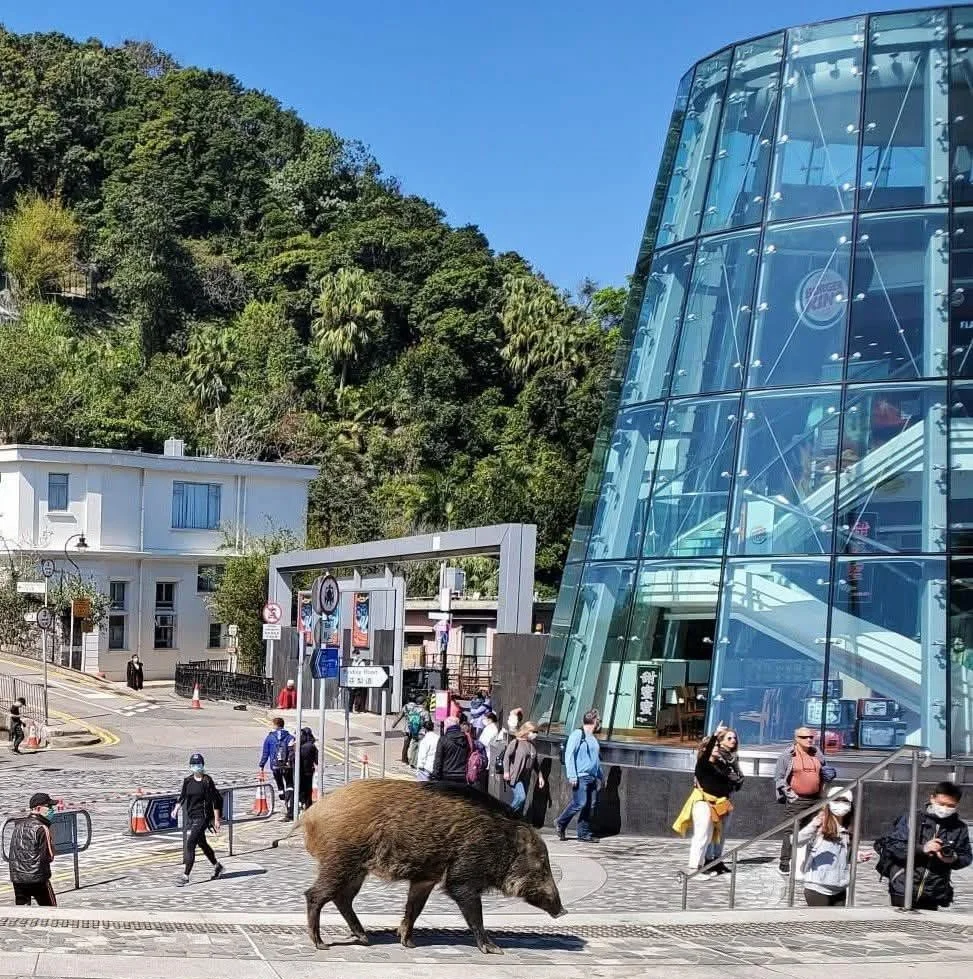
click on the image to enlarge
© Copyright Acknowledged | All rights reserved | image sent to me by a friend
Wild Boar | Victoria Peak | Hong Kong
Foreword
I have done a few posts historically on boars and tigers in Hong Kong so I thought it time for an update considering I have seen wild boars at Victoria Peak in Hong Kong a couple of times recently and my guests where amazed as they thought I was pulling their leg!
Lets face it, a wild boar is not like a cat or dog, they are not cute and cuddly, they are very large and have a mean disposition and in an encounter you will see close up and personal their hair trigger temper and getting close is going to end very badly for you.
As a long-time Hong Kong resident (over 50+ years) with a deep love for our city’s natural heritage, I have always been fascinated by the wild boars that roam our countryside and country parks. These sturdy creatures have been part of Hong Kong’s landscape for as long as anyone can remember, quietly sharing the hillsides with us until recent years when their presence in more populated areas has sparked both wonder and concern. Lately, while leading walks around Victoria Peak, I have noticed a noticeable uptick in boar sightings along the trails - families rooting through the undergrowth or suddenly appearing on the path ahead. It prompted me to dig deeper into their story, not just as a guide who knows Hong Kong, but as someone who believes understanding our wildlife is key to living alongside it responsibly. I have now expanded this piece with important historical context that many people still find surprising - the role our long-vanished apex predators played in keeping the balance.
What follows is my detailed rewrite of earlier thoughts on this subject, expanded with fresh observations from Victoria Peak and the latest available data. I have structured it to give context, history, biology, policy, and practical advice so readers can appreciate these animals fully while staying safe.
Hong Kong’s wild boars are native, resilient, and undeniably part of our identity, yet their increasing boldness demands thoughtful management. I hope this piece helps hikers, residents, and nature lovers approach the topic with the same balance of respect and realism that I try to bring to every private tour I do.
The Native Roots: A Brief History of Wild Boars in Hong Kong
Wild boars, known scientifically as Sus scrofa, are Hong Kong’s largest native terrestrial mammal and have inhabited our territory for centuries. For most of the city’s recorded history, they coexisted peacefully with human communities, keeping largely to the dense forests and shrublands of the New Territories, Lantau, and Hong Kong Island’s country parks. With no large natural predators left after the local extinction of leopards and the end of tiger visits from the mainland in the last century, their numbers were naturally regulated by food availability and habitat. Urban expansion and the habit of feeding them changed that dynamic dramatically in the past decade or so. Sightings in built-up areas, once rare, became commonplace as boars ventured closer to residential zones in search of easy meals from rubbish bins or handouts.
Their presence ties into the broader ecology of southern China, where wild boar populations have fluctuated with glacial cycles over hundreds of thousands of years. In Hong Kong specifically, they have always been viewed as part of the rural fabric - occasionally raiding farms but rarely causing widespread alarm until human feeding and habitat pressure pushed them into conflict.
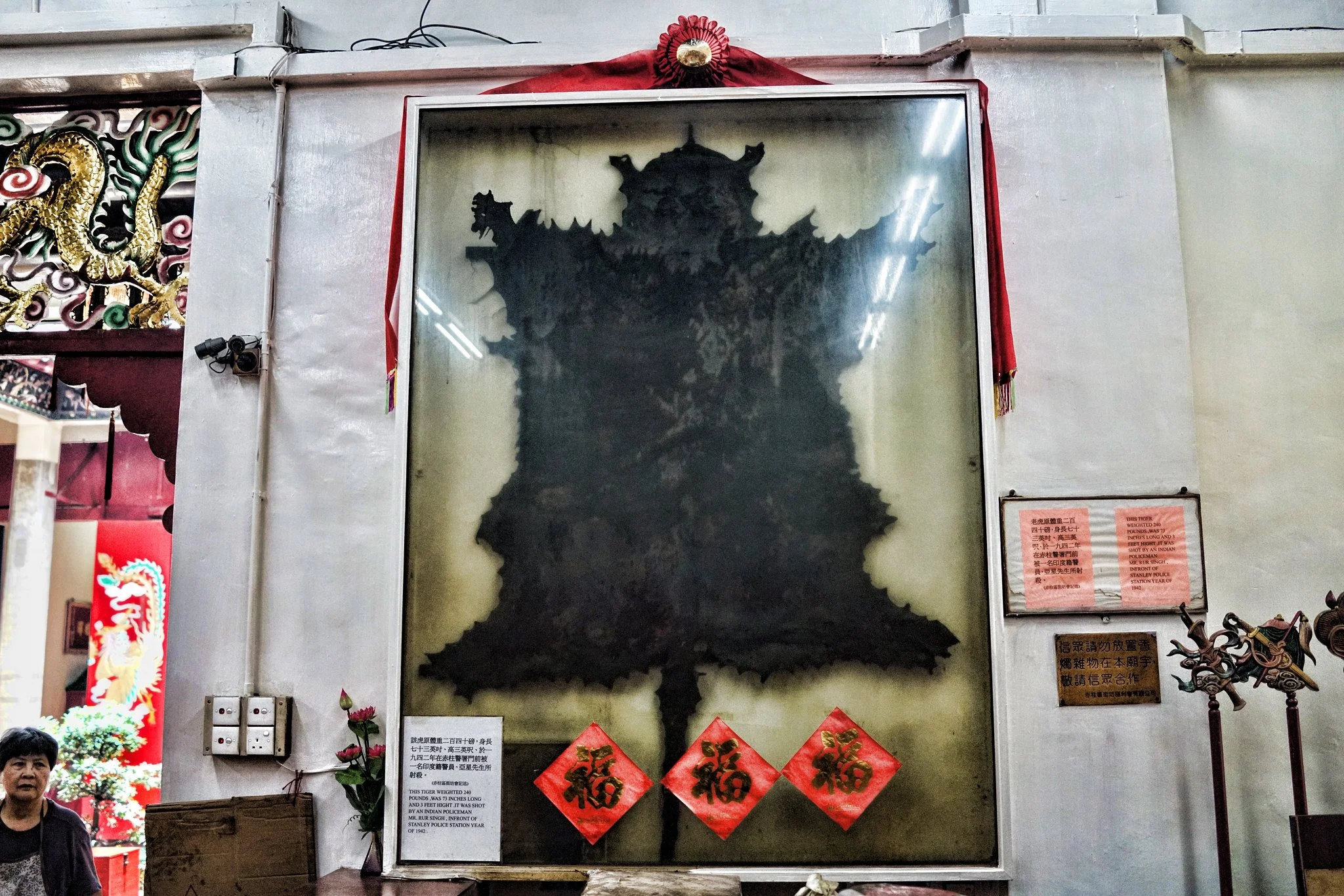
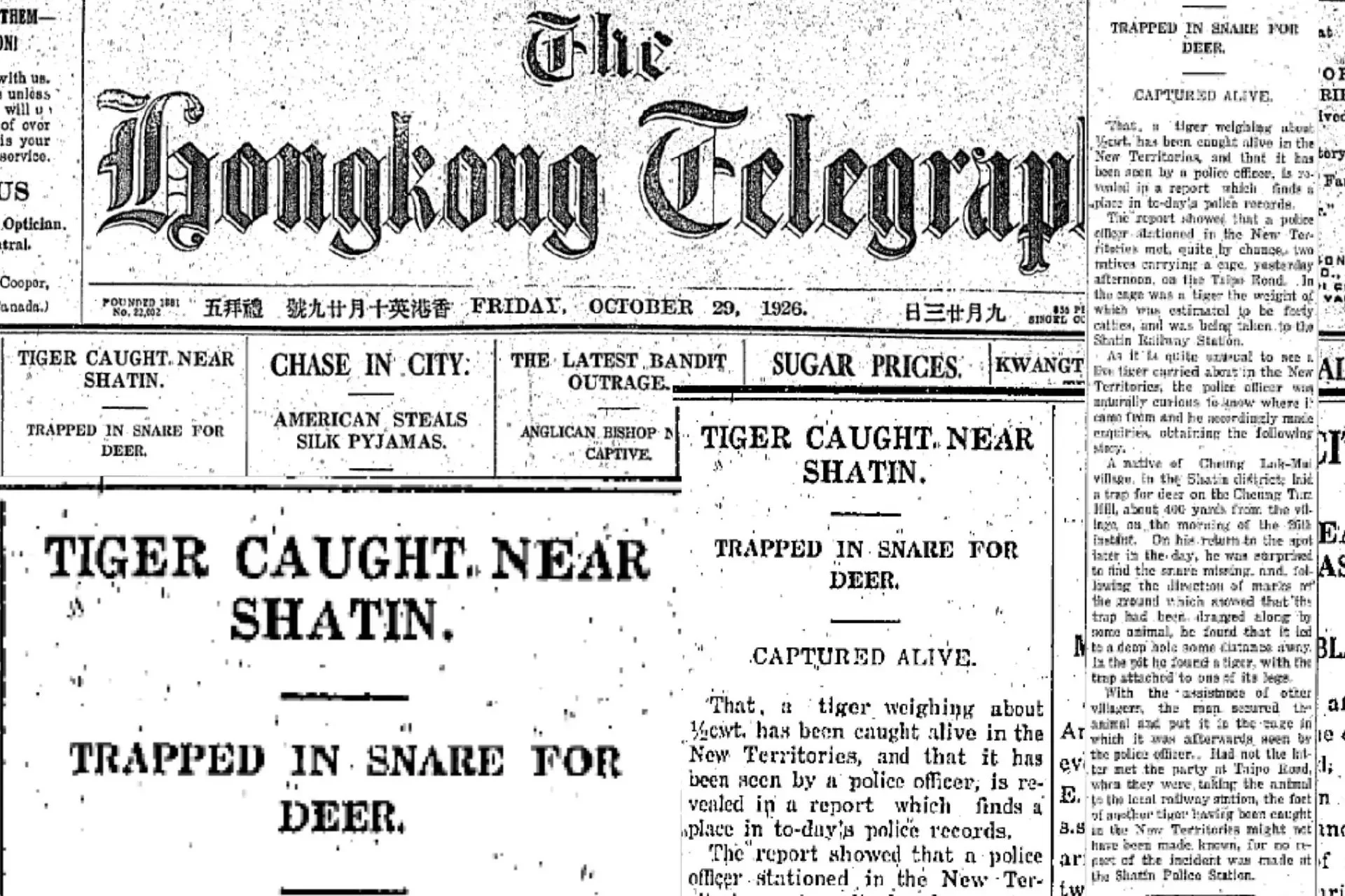
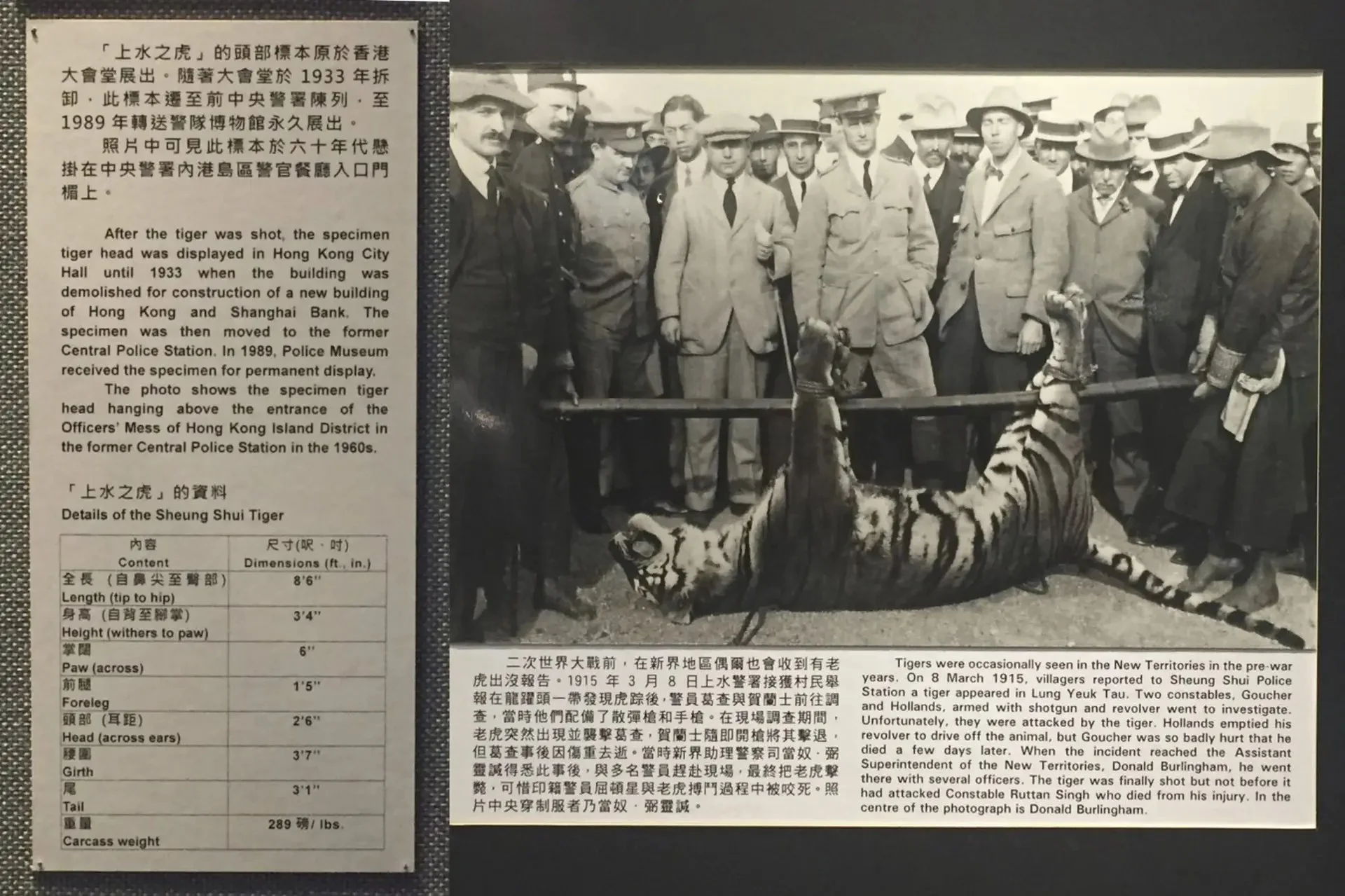
click on any image to enlarge
© Copyright Acknowledged | All rights reserved | Tiger skin image by Jamie
Tigers | Roamed and attacked historically | Hong Kong
The Vanishing Apex Predators: Tigers Once Roamed Hong Kong (and ate the boars!)
Many visitors and even long-time residents are surprised - and sometimes don’t quite believe me - when I tell them that wild tigers once roamed parts of Hong Kong. These were not escaped circus animals as some assume, but genuine wild South China tigers, a subspecies native to southern China. They would occasionally wander or swim across the border from Guangdong province into the New Territories, drawn by abundant prey such as wild boar and farmers’ livestock. Being strong swimmers, they sometimes even reached Hong Kong Island and outlying areas like Stanley and Lamma.
Notable incidents stretch back to the early 20th century. One of the most famous occurred in 1915 in Sheung Shui, where a tiger killed two policemen. Another tiger was shot in Stanley in 1942 during the Japanese occupation. Reports of sightings and encounters continued through the 1950s, with the last reasonably credible accounts dating to around 1965. (although I have read some articles of sightings in the 1970;s)
After that, habitat loss, hunting pressures on the mainland, and Hong Kong’s rapid urban development brought these visits to an end. Today the South China tiger is considered functionally extinct in the wild, with no confirmed sightings anywhere in China for decades. Their disappearance removed one of the few natural checks on wild boar populations, helping explain the later increase in boar numbers we have witnessed.
Leopards: Another Forgotten Predator of Our Hills in Hong Kong
I was dumbfounded when my research brought up Lepoards, I had NO idea! and honestly if you visit Hong Kong you simply cannot imagine these beasts roaming Hong Kong!
What surprises people even more is that leopards (Panthera pardus) also once lived in or regularly visited Hong Kong, again coming naturally from southern China rather than any circus escapes. These adaptable big cats were recorded in the New Territories and on Hong Kong Island well into the 20th century. One documented case involved a leopard shot dead on 26 November 1943 during the wartime period. Historical accounts suggest they preyed on similar animals to tigers - wild boars, monkeys, and livestock - and helped keep boar numbers in check alongside other predators. Like the tigers, leopards became locally extinct due to habitat destruction, hunting, and the pressures of urban growth. Their disappearance, together with that of the tigers, removed the main natural controls on wild boar populations, setting the stage for the increases we later saw once human feeding took over. Today only the much smaller leopard cat (Prionailurus bengalensis) remains as a native wild feline in our country parks - shy, nocturnal, and far less imposing than its larger cousins of the past.
Important clarification: When I speak of historical leopards in Hong Kong, I mean the true Panthera pardus - the big leopard - and not the small leopard cats that many hikers still spot at night in places like Tai Po Kau or Sai Kung. The two are often confused by casual observers, but they are entirely different animals. The big leopards disappeared decades ago; the little leopard cats remain one of our success stories.
Everything in the earlier paragraphs (the 1943 Taimoshan record, etc.) refers only to the real leopards. I never mixed the two up.
Other Extinct or Locally Extinct Wildlife : The Lost Giants of Our Hills in Hong Kong
What fascinates me even more when I reflect on Hong Kong’s natural past is how much larger and richer our wildlife community once was before human pressures took their toll. Long before tigers and leopards made their final visits, our territory formed part of a vast tropical broad-leaved forest system that supported truly impressive animals. Elephants, rhinoceroses, bears, wolves, and various species of large deer roamed freely across what are now our New Territories and Hong Kong Island. These megafauna gradually disappeared as forests were cleared for agriculture and settlement, particularly from around the 10th - 11th centuries onward, with accelerating losses through the centuries that followed. By the time systematic records began in the colonial era, they had already vanished without trace from our landscape.
Among the carnivores that held on longer were red foxes and possibly dholes (wild red dogs), both of which became locally extinct in the 20th century alongside the big cats. The dhole, a pack-hunting canid, would have been a formidable predator of wild boars and smaller mammals in earlier times. Even some of our more familiar species have complicated histories: the original native rhesus macaques that once lived wild on Hong Kong Island and in the New Territories largely died out by the mid-20th century due to habitat loss and hunting, with today’s troops in places like Kam Shan Country Park descending mainly from introduced or released animals. Other mammals such as the Chinese pangolin remain critically scarce and at high risk, while the Eurasian otter was long thought locally extinct in many areas before encouraging recent signs of return on Lantau Island in Hong Kong.
These losses paint a sobering picture of how quickly a vibrant ecosystem can change. With the departure of these predators and large herbivores, the natural checks on species like wild boars weakened dramatically. It is a reminder that the boar populations we manage today exist in a landscape already stripped of much of its original balance – one more reason why thoughtful human intervention and respect for remaining wildlife are so essential if we want to preserve what is left of Hong Kong’s natural heritage.
I cannot help but dwell on elephants and rhinos wandering around Hong Kong…. gosh it means I do not have to go to Thailand for my elephant fix!
Back to wild boars now….
Physical Characteristics of Wild Boars, Family Life, and That Mean Streak
Adult wild boars in Hong Kong can be impressive: they reach body lengths of up to two metres and weights of 200 kilograms, though most fall in the 100 - 150 kg range depending on age, sex, and nutrition. Males (boars) tend to be larger and more solitary, sporting prominent tusks used for digging and defence, while females (sows) are smaller but fiercely protective when piglets are involved. Their coarse, bristly coats range from dark brown to black, and they possess a powerful snout perfectly adapted for rooting up tubers, insects, and fallen fruit.
Typical family groups, called sounders, consist of 6 to 20 closely related females and their young. Litters average 4–6 piglets (sometimes up to 10–12 in good conditions), born after a gestation of about 115–140 days. Piglets start with striped coats for camouflage and stay with the mother for several months. In the wild, boars can live 9–10 years, though many do not reach that age due to disease, injury, or human intervention; average lifespan is often shorter, around 4–6 years in high-pressure environments.
That “mean disposition” is usually defensive rather than aggressive by nature. Sows with piglets become highly protective if they feel cornered or if someone approaches too closely – a single charge can cause serious injury. Males may also react if startled. Years of being fed by humans have reduced their natural wariness, turning normally shy animals into bold opportunists that associate people with food. This habituation explains many of the charges and bites reported in recent years.
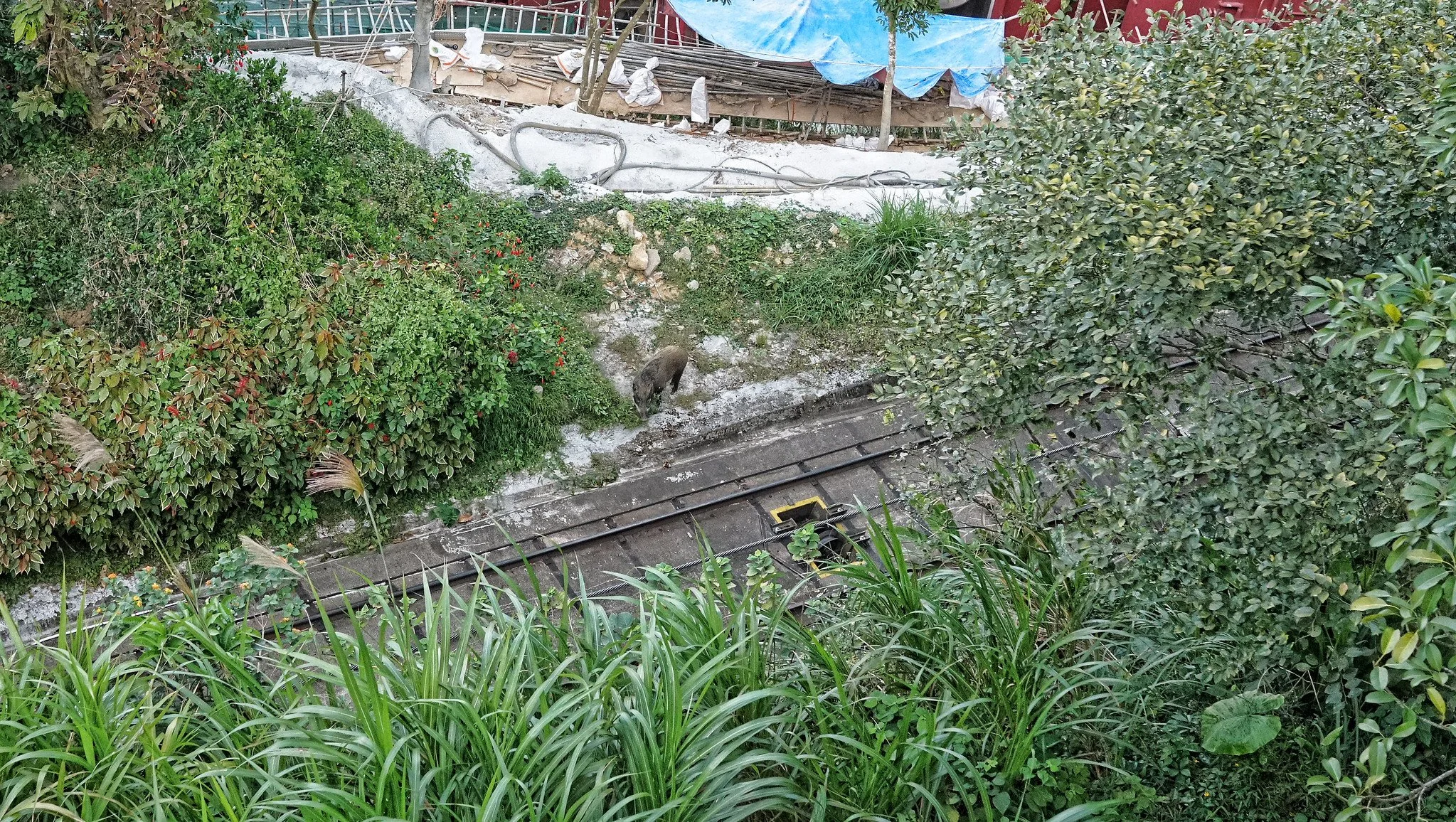
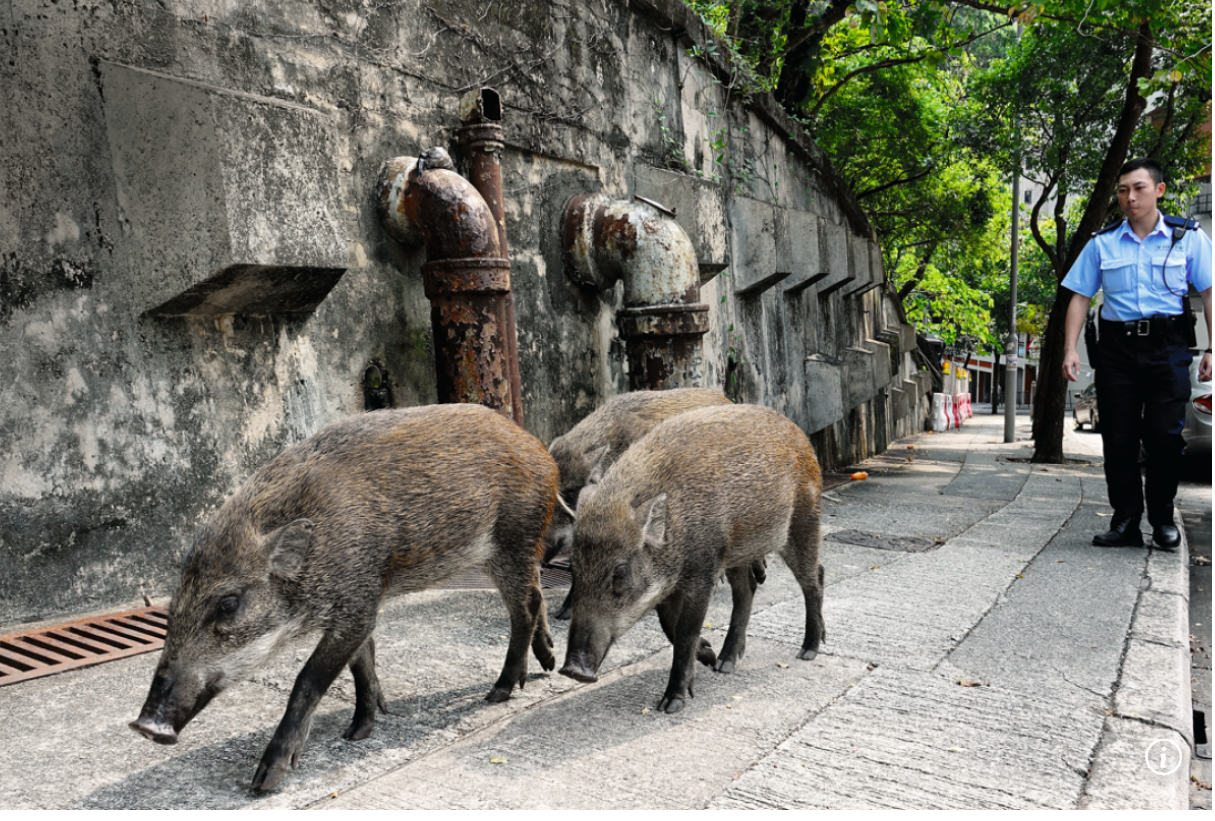
click on any image to enlarge
© Copyright Acknowledged | All rights reserved | image on the left taken by Jamie
Wild Boars | They do NOT have a sweet disposition | Hong Kong
Wild Boar Population Estimates : From Peak to Decline
Reliable counts are challenging because boars are nocturnal and spread across rugged terrain, but official surveys provide a clear picture of recent trends:
2019: approximately 2,500 wild pigs across Hong Kong
2022: around 1,830
2023: about 1,360
2024: roughly 900
The population appears to have peaked around 2019 - 2021 before intensive management took effect. Earlier informal estimates from the 2000s and 2010s suggested numbers in the low thousands in countryside areas, but no precise historical maximum exists prior to systematic monitoring. The rapid rise coincided with increased feeding and urban fringe development; the sharp drop since 2021 reflects sustained control efforts.
Government Population Control : A Detailed Timeline of Measures regarding wild boars
Hong Kong authorities have tried several approaches over the decades:
1970s - 2017: Licensed civilian hunting teams culled nuisance animals when requested by the Agriculture, Fisheries and Conservation Department (AFCD). Hundreds were removed annually in peak periods.
2017: Launch of the pilot Capture and Contraception/Relocation Programme (CCRP). Boars were trapped, sterilised or given contraceptive vaccines, microchipped, and moved to remote countryside areas.
2019: Full suspension of hunting due to animal welfare concerns; CCRP became the main strategy.
November 2021 - present: Shift to targeted capture-and-dispatch for boars causing nuisances or posing risks near residential zones. Veterinary officers use dart guns with anaesthetic followed by humane injection. From November 2021 to April 2026, over 2,373 wild pigs were humanely dispatched. In 2024 alone (January–November), 633 were removed in 317 operations.
2022 - 2025: Feeding ban expanded territory-wide under the Wild Animals Protection Ordinance. Fixed penalties of HK$5,000 introduced in 2025, with maximum fines up to HK$100,000 plus imprisonment.
2026 onward: Comprehensive review of strategies underway, with an enhanced action plan expected mid-2026 drawing on local, Mainland, and overseas experience. Additional cameras, traps, and rural-area operations have been rolled out.
These measures have reduced nuisance black spots from 42 in 2022 to 15 in 2024 and cut human injury cases by about 80% from 2022 levels.
Tio be honest, when seeing these statistics I cannot help but think that this “culling” could be done differently, Hong Kong is 430sq miles, we have 263 islands (mostly uninhabited), how hard would it be to relocate the boars to remote locations?
Why the Serious Efforts to Control Numbers of wild boars
Public safety is paramount. Boars raiding bins, damaging farmland, and occasionally charging hikers or residents create real risks - seven injuries were recorded in early 2025, down significantly but still unacceptable. Hygiene concerns arise when large groups congregate near homes, and economic losses to farmers add pressure. Without predators and with abundant human food, unchecked growth would only worsen conflicts in our crowded city.
Local Culture and the Feeding Paradox - not good for the wild boars
Despite the risks, many Hong Kong locals still feed wild boars. Some see it as an act of compassion or kindness toward “cute” animals; others link sightings to good fortune, especially during the Year of the Pig. Cultural affection for pigs as symbols of prosperity runs deep in Chinese tradition. Unfortunately, this well-meaning habit has backfired spectacularly. Handouts condition boars to lose fear of humans, drawing them into urban areas and creating exactly the problems the government is now forced to manage. The territory-wide feeding ban and public education campaigns (“All For No Feeding”) are crucial steps, yet enforcement remains a challenge when emotions run high.
I had to laugh (tragically) when I see news reports of wild boars running wild in shopping malls and reports of squads of police officers doing their best keystone cops imitation when trying to corner a huge boar - let me be clear, Hello Kitty is cute, Labubu is cute, cats and dogs are cute (to a point) but when you are face to face with an angry boar with large tusks, lets just say that cute is the wrong word!
Wild boars are very common at Victoria Peak in Hong Kong : What I Am Seeing Lately
Victoria Peak trails have become a hotspot. The mix of woodland, open slopes, and proximity to residential edges makes it ideal boar habitat. I have encountered more family groups there recently - sows with half a dozen striped piglets trotting across paths or rooting near the summit lookout. Increased sightings reflect both population dynamics and the fact that hikers now know where to look. The Peak’s elevation and cover give boars daytime security they lack in busier lowland parks.
in the past year, wild boars seem to have made camp along the Peak Tram tracks near the Barker Road station which has disrupted service a few times, recently I have had 2 confirmed sightings at this spot and much to the delight of my guests, they where very close to the track so you could appreciate how big they are and get a decent picture!
Advice If You Come Face to Face with a Mean Mother Boar and Her Offspring
Stay calm and give them space - that is the golden rule. Do not approach, especially piglets, no matter how adorable they look. Back away slowly without turning your back or running; sudden movements can trigger a charge. If the sow seems agitated, step behind a large tree or boulder and wait quietly until the group moves on. Never feed or try to shoo them with sticks or bags. Report persistent nuisances or injuries immediately to the police (999) or AFCD. Most encounters end peacefully if you respect their space; the vast majority of boars want nothing more than to continue their search for natural food.
Clearly these guidelines where written by someone who does not understand human nature, the natural reaction from most people would be to turn, scream and run! the dumber ones would look for a rock to throw at the boar and the really really dumb ones would see a Labubu stuffed animal and try and pet it!
I have had one instance when I was in this situation, angry mum and some piglets trotting along Lugard Road and I simply stepped back and let them pass, I had forgotten just how big the adults are and with those tusks they look pretty mean.
… and now back to my burning question about more mythical exotic beasts!
The Odds of Tigers or Leopards Still Hiding in Hong Kong Today
Hong Kong covers roughly 430 square miles (about 1,114 km²), with around 40% protected as country parks and special areas. That leaves a surprising amount of rugged, forested, and hilly terrain - especially in the New Territories, Lantau, and parts of Hong Kong Island - where large animals could theoretically stay out of sight. When I first learned about our historical tigers and leopards, the same question jumped into my mind: could a few still be out there, hiding in plain sight in some remote valley or dense woodland?
After looking closely at the evidence, I have to say it is extremely unlikely bordering on impossible for viable populations of either species to persist here today. Here is why, in plain terms and not trying to sound like Sir David Attenborough
A single tiger needs a huge territory - typically 20 to 100 square miles or more depending on prey availability - to survive and breed. A breeding pair or small family group would require far more connected habitat than our fragmented landscape offers. Hong Kong’s country parks, while green and extensive, are criss-crossed by roads, hiking trails, reservoirs, and urban edges. Camera traps, trail monitoring, and intensive ecological surveys over the past two decades have recorded thousands of wildlife images and never once captured a tiger or leopard. The only “big cat” sightings turn out to be leopard cats (Prionailurus bengalensis), which are native, common in our parks, and frequently mistaken for larger felines when glimpsed at a distance or in poor light. (I find that odd as they are the size of a normal house cat!)
For South China tigers specifically, the story is even clearer. As mentioned earlier the subspecies is considered functionally extinct in the wild across its entire former range in southern China. No confirmed wild individuals have been documented anywhere since the late 1980s or early 1990s, despite intensive camera-trapping efforts on the mainland. The few dozen that may still exist are in captivity, often with genetic issues from small founder populations. With the border heavily developed and patrolled, and no tigers recorded crossing into Hong Kong for over half a century, the chance of even a lone wanderer making it here is negligible.
Leopards face the same reality. The last confirmed records in Hong Kong date back to the 1940s (such as the one shot at Tai Mo Shan in 1943). Like tigers, any surviving animals would need prey, space, and mates - none of which our current ecosystem can sustainably provide without leaving obvious traces: large kills, tracks, scat, or livestock losses that would be widely reported. Modern Hong Kong has millions of trail users, hikers with phones, and conservation cameras. A hidden leopard or tiger would almost certainly have been photographed, filmed, or DNA-sampled by now.
Why the “Hiding in Plain Sight” Idea Persists for Leopards and Tigers
It is romantic to imagine a secret population clinging on in some forgotten corner - our hills do look wild enough in places like Tai Mo Shan or the Sai Kung peninsula. But ecology does not work that way for apex predators. Without a viable population on the mainland sending occasional dispersers across the border (which no longer happens), and with decades of zero credible evidence, the odds drop to near zero. Misidentifications happen - a large feral dog, a big leopard cat, or even a wild boar in shadow can trigger the imagination - but thorough searches after every reported sighting have turned up nothing and the witness who was probably drunk has sobered up!
My Take on The Big Cats as Someone Who Has Been Walking Around Hong Kong For 50+ years
I would love nothing more than to be proven wrong one day by a clear photo or track cast that experts confirm. It would be the wildlife story of the century for Hong Kong. But based on everything we know - population biology, decades of monitoring, and the total absence of any hard evidence since the 1960s - I believe our tigers and leopards are truly gone from these hills. What remains are the smaller, fascinating natives like leopard cats, civets, macaques, and of course our wild boars.
That loss makes protecting what we still have even more important. The country parks that once supported big cats now sustain a different but still rich ecosystem. Let’s keep them that way by respecting the wildlife rules, not feeding animals, and supporting conservation that gives species like the returning otters and our shy leopard cats the best chance to thrive.
The Last Word
Wild boars embody the tension between Hong Kong’s rich biodiversity and the realities of modern urban life. Culling, while effective and necessary for safety, should remain a last resort within a broader strategy that includes habitat improvement, stricter feeding enforcement, and public education. I would love to see more investment in non-lethal tools - better rubbish infrastructure, electric farm fencing, and perhaps refined fertility control in low-conflict zones - so future generations can still enjoy seeing these magnificent animals in their proper wild setting. Ultimately, the responsibility lies with us: stop feeding, respect boundaries, and appreciate wild boars from a safe distance. Only then can we restore the peaceful coexistence that defined our relationship for so long..
…and again, the Government should look at relocation to remote areas where population levels are very, very low, how hard can it be?
Jamie’s Hong Kong Insider Chat
AI Itinerary Rescue Service - Bring your AI-generated plan (or any self-designed itinerary) and I will spend the full two hours reviewing it with you. I’ll fix the impossible timings, suggest smarter routing, add interesting places that AI never finds, adjust for your group’s energy levels, and create a realistic, enjoyable day-by-day flow that actually works in real Hong Kong. Most guests leave saying “This is exactly what we needed”
I do not do Food Tours in Hong Kong but I know people that do!
I do not do food tours as mentioned above, I have very specific reasons and part of it is that I do not speak Cantonese or write Chinese, I am from Yorkshire in England and I lack the language gene and it is not through lack of trying and yes a lot of restaurants do not have English menu’s or staff who speak conversational English.
.. and yet I have eaten at close to 1,400 restaurants in Hong Kong since January 2nd 1972, my wife was born in Hong Kong and we have been together over 40 years and her first language is Cantonese and a lot of her family are Chinese or half Chinese so I have never had much of an issue!
This does not translate to doing food tours though, yes, I could do them, no problem there but they would never ever be as good as the food tours done by my friends (see the 3 links above) most of their awesome guides are locally born Hong Kong Chinese and obviously food culture is part of their DNA, it is impossible for me to compete with that!
So please feel free to contact them for food tours
I do not do Hiking Tours in Hong Kong but I know someone that does!
I do not do Hiking Tours, never have and never will even though I used to go Hiking a lot when I was a lot younger, The Hong Kong Government is promoting hiking tours so I urge you to contact my friend Sabrina at Hong Kong Trails and Tours, she is a long time Hong Kong resident and and a very experienced hiker with close to 700 Hikes in 15+ years under her belt, please click on the link below




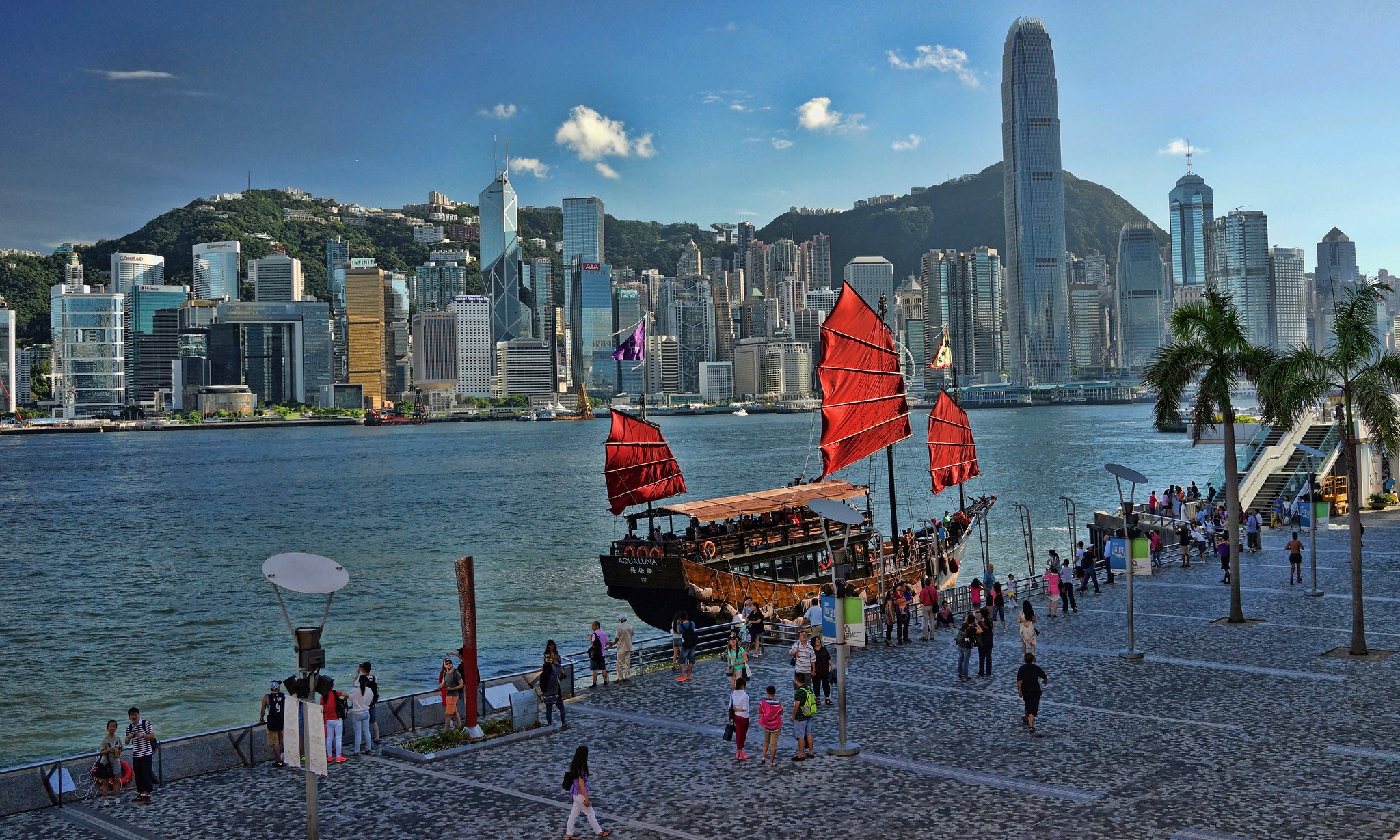
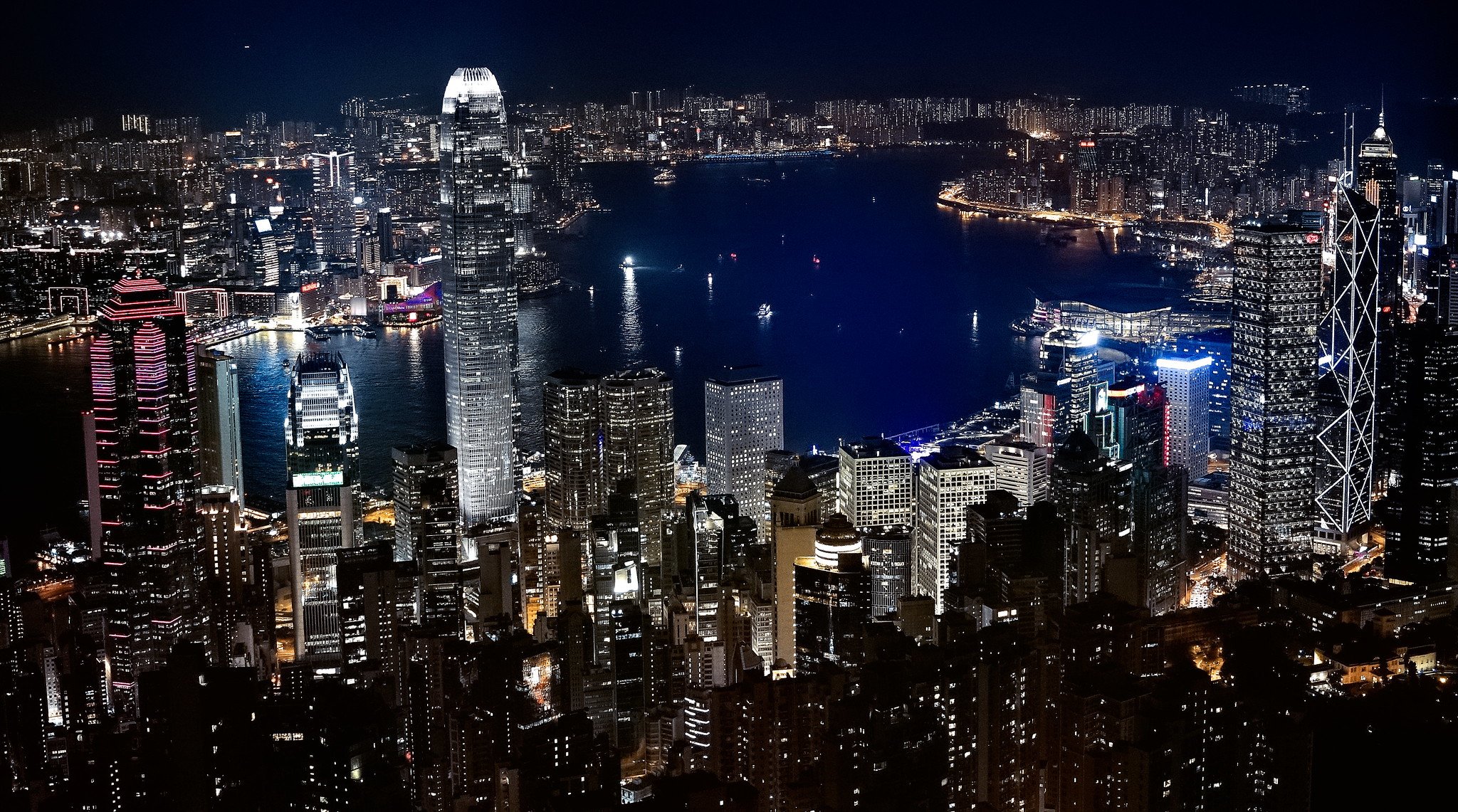



click on any image to enlarge
© Copyright Acknowledged | All rights reserved | all images taken b Jamie
Jamie’s Hong Kong | Some of my favourite images | Hong Kong 101
© Jamie Lloyd | J3 Consultants Hong Kong | J3 Private Tours Hong Kong |
| 2010 - 2026 All rights reserved. |
Click on any image to enlarge to full screen







Current images from my Instagram feed