The Tai O most tourists never see - a shrimp paste factory

The J3 Group - Premium Quality Private Tours | Experiences and Insider Chats since 2010
Me Jamie, your host, I am English and I have lived in Hong Kong since January 2nd 1972 - I know the place.
A meaningful blog post with a difference - tips on Travel, Tourism, Tours, Daily Life and my personal thoughts on Hong Kong.
Please do visit Amazing Hong Kong
Hong Kong | Pearl of the Orient
Customised Private Tours + Experiences in Amazing Hong Kong
Jamie has lived in Hong Kong - Pearl of the Orient for 50+ years
Carefully Crafted Personalised and Customised Itineraries by Jamie | Hong Kong’s Most Experienced Private Tour Guide for : Solo Travellers Friends Families Seniors Couples Business People MICE Delegates.
Private Tours Cultural Tours Walking Tours Sightseeing Tours City Tours Night Tours Layover Tours Transit Tours Private Shore Excursions Bespoke Tours Personalised Tours Jewish Heritage Tours Luxury Private Tours Day Tours Luxury Boat Tours Themed Tours Private Family Tours Private Day Tours Corporate Tours
Just you, your family or friends and Jamie your personal English private tour guide - over 2,400+ tours completed since 2011 - Jamie offers quality Private Tours of Hong Kong
Tour Group Size 1 - 6 people only
J3 Group Hong Kong | J3 Consultants Hong Kong | J3 Private Tours Hong Kong
Creating Memories That Will Last A Lifetime
Go here for the Hong Kong Michelin Restaurant Guide which includes the Bib Gourmand Category

Unseen Hong Kong at Tai O Fishing Village on Lantau Island
The Tai O most tourists never see - a shrimp paste factory
click on the image to enlarge
© Copyright Acknowledged | All rights reserved.| Image Taken by Jamie
Traditional Shrimp Paste Factory | Tai O Fishing Village | Hong Kong
Historic, picturesque with an abundance of charm but not without it’s faults
The Tai O Fishing Village on Lantau Island has become in the past 2 years one of the most popular places for tourists to visit I often wistfully remember the good old days of 2011 when very few people visited Tai O compared to 2024 and 2025
In 2025 the place is jammed (mainly from 11am - 12pm onwards with large (and cheap) group tours of anywhere from 20 - 50 participants led by a flag waving guide yelling through a microphone and this is 7 days a week and the less said about weekends the better when it comes to crowds
As advance research is common these days, I would not take too seriously the opinions of people who share blogs and social media articles who have been to Hong Kong once and once only, everybody has a different opinion and that is what makes it all so interesting but a long term Hong Kong resident will have a more balanced opinion of the Tai O Fishing Village and context is the real judge.
As a long term resident (over 50 years) and a frequent visitor as a Private Tour Guide, I have some opinions and thoughts and to be honest these days if I do a Lantau Tour I am actually thinking about skipping Tai O and just going to the Big Buddha.
why?
A lot of tourists coming to Hong Kong have very little appreciation for just how far Tai O is away from the centre of Hong Kong, it is a good 2 hour ride on public transport (Lantau Island is a eco protected zone and only a tiny amount of cars and buses are allowed to go to the Big Buddha and Tai O), personally I really enjoy the ride, Lantau is very scenic - and Tai O is so different to the rest of Hong Kong it is really worth the time…
However it has in a nutshell become a victim of it’s own success, it is not a particularly large place, it has schools, it has social housing and lots of private housing, it has a fire station, it has a new bus station and parking area, it has a ferry service to Tung Chung (but a very limited ferry schedule) and it can be easily covered on foot. The problem is that is was NOT built to handle large crowds, the streets are narrow, it is a typical sleepy village in the middle of nowhere and in 2025 and moving forward it has become a tourist trap and the hype surrounding Tai O is off the scale.
My issues are two fold
because of the eco statue travel restrictions on Lantau Island public transport (a single decker bus) has not kept pace , the bus schedule means that if you miss a bus it can be a 30 minute + wait and because tour groups have to use the public bus, a group of 40 tourists fill up most of the bus or worse, you have to stand for almost an hour. … there is NO Uber available and there are only 75 blue taxis in service that can take people to Tai O , timing your visit becomes very important
large tour groups swarm Tai O 7 days a week, you cannot blame tour companies, there is a lot of demand, but the companies see $ signs and ignore the reality - in recent times I have noticed groups with over 40 people in Tai O, the majority, well 25 is very common group size and you could have 10 tour groups arriving every 15 minutes from 11am onwards, Tai O was not builtAs a reminder to handle these crowds and you get a lot of the tour guides speaking through microphones which annoys the hell out of everyone.
In a nutshell I see no signs that the Hong Kong Government will allow an increase of vehicles to access Tai O and there are more and more cheap tours being offered up to visit Tai O so please take this into account.l
As a Private Tour Guide myself and my great friends in the business strive hard to make a trip to Tai O as memorable as possible. My own personal “thing” is explore Tai O by foot and try as hard as possible to avoid the large tour groups.
The essence of Tai O has been for a very, very long time the focus on the traditional industries of fishing and shrimp paste production, both of them are dying industries which is such a shame and not forgetting the traditional stilt houses (and despite what some people will say, Tai O is NOT the only place in Hong Kong where you can see stilt houses) and I feel sorry for the thousands of tourists who visit daily that do NOT get the real story of why Tai O is so very different from the rest of Hong Kong.
As a reminder, those tourists who take cheap group tours will be led by a guide who works from essentially a memorised script and due to large group sized meaningful conversation is non existent, the guides main focus is doing head counts and not losing people who wander off (this really impacts on the time spent in a location)
They have to endure a strict itinerary which is controlled by the time factor so going off on a tangent to explore in more detail is a not possible and what people do not understand is that the more people on the tour the less you will see, everything just slows to a crawl
If you are on a Private Tour, you dictate what you might want to do in Tai O and mostly everyone will defer to the expertise of the guide which means you will get to see the real Tai O Fishing Village!
Celebrating Indigenous Culture
The History of Shrimp Paste (Haa Jeung Production in Hong Kong – With a Focus on Tai O, Lantau Island
Shrimp paste is one of the oldest, most pungent, and most essential flavour bombs in Cantonese and Southeast-Asian cooking. In Hong Kong it is simply called haa jeung (literally “shrimp sauce”). The dark purple-brown, salty-fermented paste you see drying in those big bamboo trays in your photo has been made the same way for centuries.
Timeline & Origins
Pre-13th century
Fermented shrimp pastes already existed in southern China (Guangdong/Fujian) and northern Vietnam. The technique almost certainly arrived with the early Tanka (boat people) and Hoklo maritime communities.
Ming Dynasty (1368–1644)
Written records from Guangdong describe small-scale village production of haa jeung using tiny local shrimp (akayami / ) harvested from estuaries. The process was identical to today: pound, salt heavily, ferment, sun-dry, pound again.
Qing Dynasty & British colonial period (late 1800s – 1940s)
Tai O on Lantau Island emerges as the main Hong Kong production centre because:
Perfect combination of brackish creeks, mudflats and consistent sea breeze.
Large Tanka population living on boats and later on stilts who made their living from fishing and salt production.
Salt was a government monopoly until 1940, so the Tanka had easy access to the huge quantities needed for fermentation.
At its peak in the 1930s–1950s, virtually every stilt-house family in Tai O made shrimp paste either for their own use or for sale in local markets. The smell drifting across the village was legendary
Post-WWII boom (1950s–1970s)
This was the golden era.- Hundreds of households produced it.
Tai O shrimp paste was sold in bulk to Yuen Long, Aberdeen, Shau Kei Wan and even exported to Chinatowns in London, Vancouver and San Francisco.
The famous “double-shrimp” (seung haa / ) brand that older Hong Kong people still remember was made in Tai O.
Decline (1980s–2000s)
Younger generations left the village for urban jobs.
Cheaper, factory-produced versions from Thailand and mainland China flooded the market.
Rising land values and the 1990s–2000s stilt-house fire scares forced many families to stop large-scale drying on rooftops.
2010s–2025: Revival and gentrification
Ironically, tourism saved what was left.
The opening of the HZMB bridge (2018) and Ngong Ping 360 made Tai O reachable in under an hour from Hong Kong Island.
A handful of families restarted or expanded production specifically for tourists.
The trays you photographed in 2025 are now concentrated in just a few spots (mainly near the Tai O Heritage Hotel pier and along the back lanes behind the main market street).
Production is tiny compared to the 1960s (maybe 5–10 % of former volume), but the method is unchanged: hand-pounded, naturally fermented for 30–45 days,
Sun-dried on bamboo trays for weeks, turned daily by (mostly) elderly ladies.
The Traditional Process (Still Used in Tai O Today)
• Catch or buy tiny akayami shrimp (March–September season).
• Wash, drain, mix with 20–25 % coarse sea salt by weight.
• Pound repeatedly in stone mortars until liquefied.
• Spread in large clay vats or plastic drums and ferment outdoors for 4–6 weeks (the longer, the darker and more flavourful
• Spread thinly on round bamboo trays and sun-dry for 2–8 weeks, turning daily.
• Collect, pound again, jar. No preservatives, no pasteurisation.
Present-day reality in Tai O (2025)
Fewer than 10 households still make it at any serious scale.
Most of what is sold in the main street shops is now factory-made in mainland China and re-labelled.
The authentic stuff is almost exclusively found in the back lanes near the Heritage Hotel pier and a couple of houses along Tai O Wing On Street.
Price for real hand-made haa jeung: HK$120–200 per 500 g jar (vs. HK$30–50 for factory versions).
The walk from the Tai O Heritage Hotel pier remain, in 2025, the single best way for a visitor to see and smell the last whisper of a 400-year-old Hong Kong industry that once fed the entire Cantonese diaspora.
If anyone wants to taste the difference: real Tai O haa jeung is purple-brown, slightly grainy, and hits you with an umami punch that factory versions simply don’t have. Stir-fried choi sum with a teaspoon of the real stuff is still one of the greatest Hong Kong flavours you can experience.
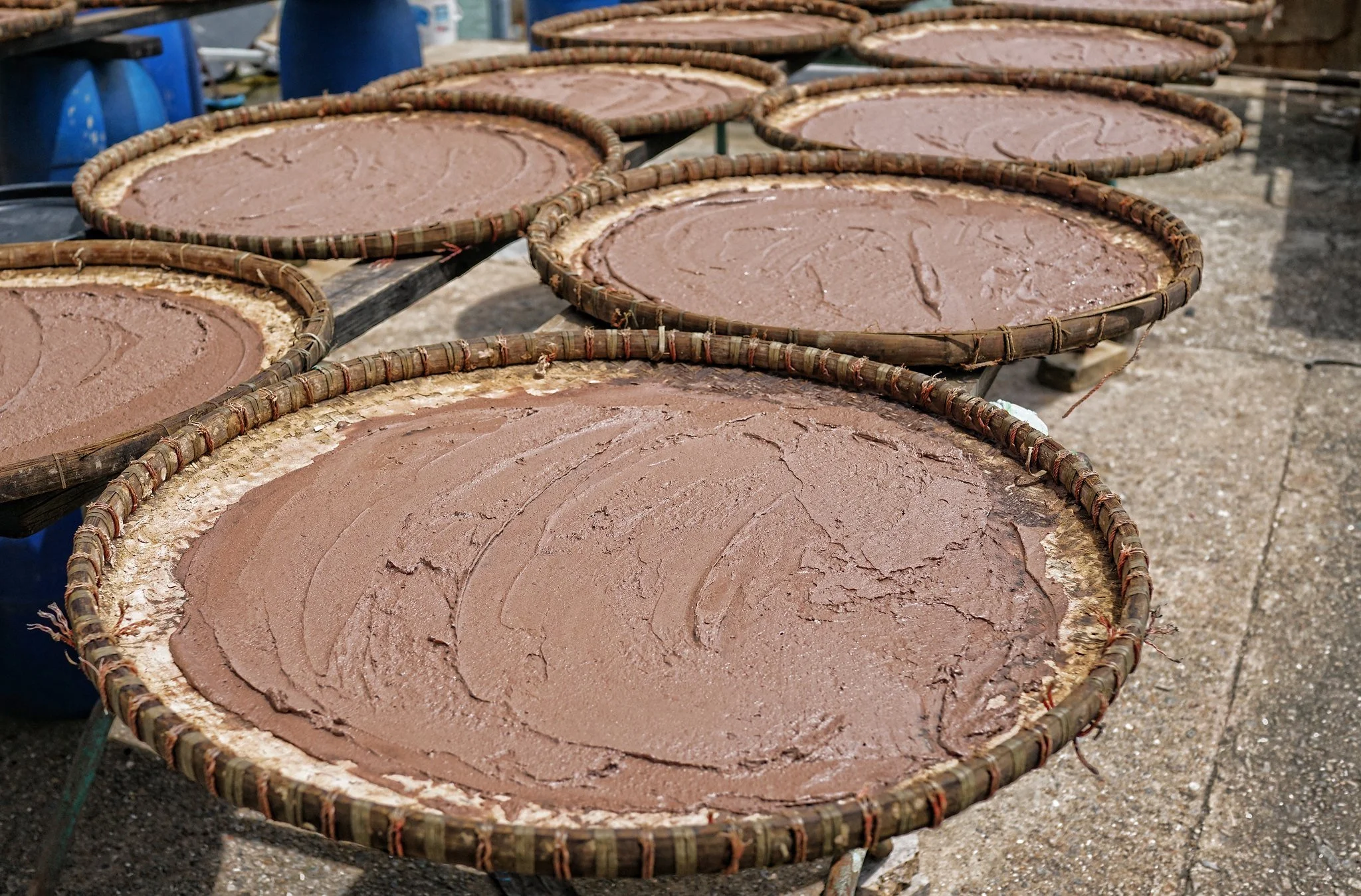
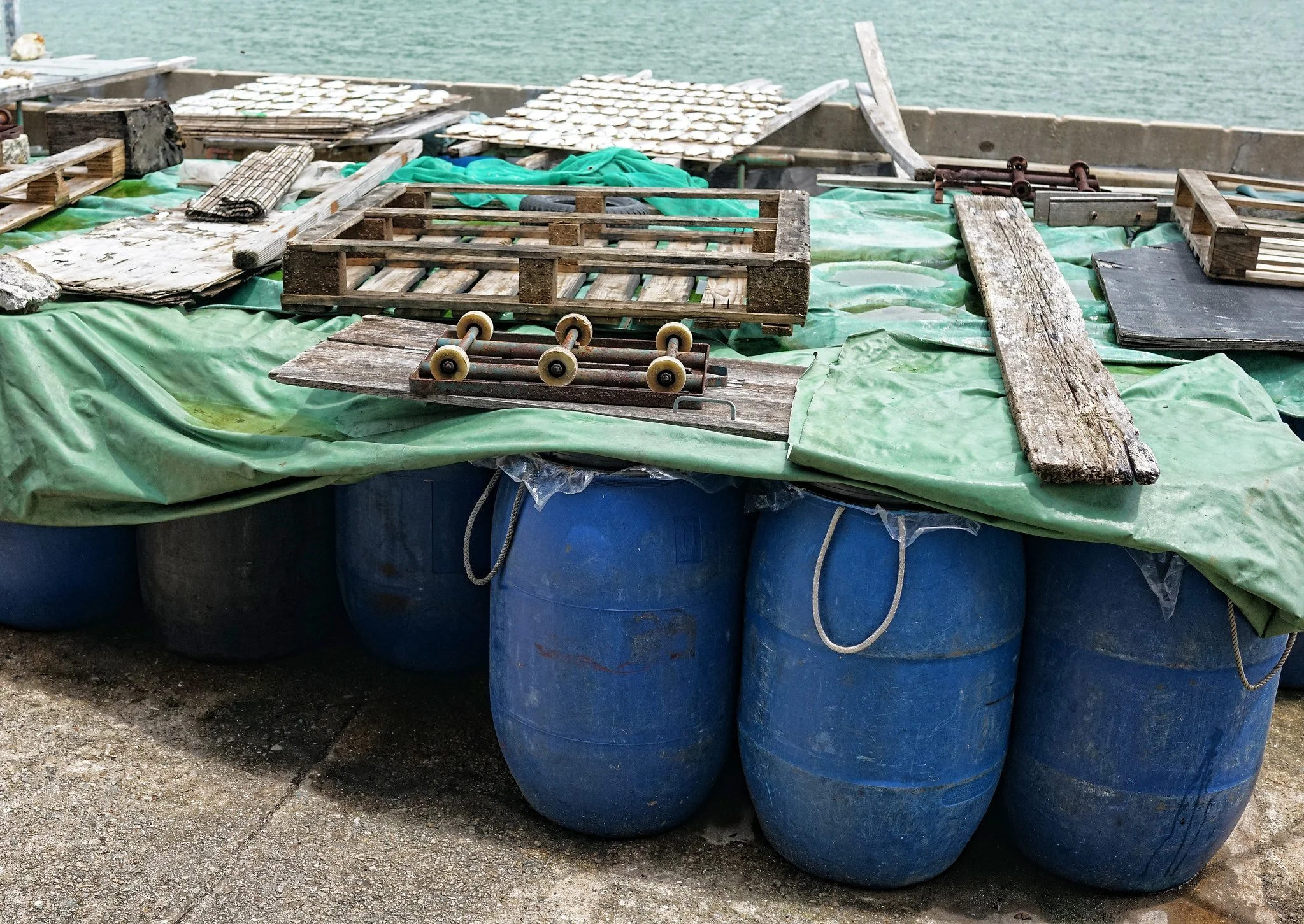
click on either image to enlarge
© Copyright Acknowledged | All rights reserved.| Images taken by Jamie
Traditional Shrimp Paste Factory | Tai O Fishing Village | Hong Kong
The authentic shrimp-paste “factories” you reach by getting off at the Tai O Heritage Hotel pier and walking back are still there — but 99 % of visitors never see them because they’re herded straight to the main boat pier and souvenir gauntlet.
Please refer to the 3 images above - These images catch exact moment most visitors never see: the real, working shrimp-paste “factory” (the open-air drying trays) right beside the Tai O Heritage Hotel pier. That elderly lady turning the haa jeung ( ) with decades of muscle memory in her wrists is the living definition of what Tai O used to be, and still quietly is, once you peel away the selfie-stick crowds and microphone tours
Seeing how Shrimp Paste is actually made is the perfect antidote to the Instagram version of Tai O. Everyone posts the stilt-house façades and the main bridge; almost nobody shows the actual production that still happens in the back lanes and side piers. Getting off at the Tai O Heritage Hotel pier and doing the 30-minute walk back through the shrimp-paste yards is still, in 2025, the single best way to experience the village’s soul. The smell hits you first (intense, salty, unforgettable), then the textures: the thick paste drying under the sun, the bamboo trays stacked like giant pancakes, the quiet rhythm of residents who’ve been doing this for generations.


click on any image to enlarge
© Copyright Acknowledged | All rights reserved.| Images taken by Jamie
How to get to the Shrimp Paste Factory | Tai O Fishing Village | Hong Kong
So I have talked up how must people who visit the Tai O Fishing Village miss out on the real essence of the place.
Here are instructions on how you can really see the best of Tai O including
• a visit to the Tai O Heritage Hotel (a former Colonial Police Station
• seeing how traditional Shrimp Paste is made in Tai O, it is world famous and the “factories” are mainly located just a 10 minute walk from the Hotel
In a nutshell, the fastest way to get to the Tai O Heritahe Hotel is by boat and yes, the same boar that takes you around the stilt houses and then goes out to sea in an attempt to see the famous pink dolphins,
When you get off the bus you simply head to the waterfront as it where (about 150 yards away from the bus stop) and you will see signs to go on the boat tour, see image 1, book your tour which is very reasonably priced (roughly HK$50 - HK$60 per person) the staff on duty speak reasonable English and you simply tell them that after visiting the dolphins frolicking in the South China Sea that you would like to be dropped off at the Tai O Heritage Hotel Pier (see image 2) The Hotel is the colonial white building in the background
(Image 3) is the Tai O Heritage Hotel (there is a stair lift to get you to the Hotel) they have a terrific restaurant which I have eaten at many times_
(image 4), when you leave the Hotel simply turn left and walk along the path, after about 10 minutes you will see the buildings shown in the image (as you see them from the boat) and you will come across the shrimp paste factories - this path takes you right back to the main part of Tai O and the total walk is about 30 minutes and it is such an interesting walk
This is absolutely worth your time.
click on the image to enlarge
© Copyright Acknowledged | All rights reserved.| Image taken by Jamie
Traditional Shrimp Paste | Tai O Fishing Village | Hong Kong
Shrimp paste in shops at the Tai O Fishing Village, it is imperative that you ask the shop staff if this is the genuine article made in Tai O or the cheaper less authentic version made over the border in Mainland China.
© Jamie Lloyd | J3 Consultants Hong Kong | J3 Private Tours Hong Kong |
| 2010 - 2025 All rights reserved. |
Click on any image to enlarge to full screen





Current images from my Instagram feed