The Former French Mission Building, Central, Hong Kong
The history of the building and it’s uses on this site since 1842

The J3 Group - Premium Quality Private Tours | Experiences and Insider Chats since 2010
Me Jamie, your host, I am English and I have lived in Hong Kong since January 2nd 1972 - I know the place.
A meaningful blog post with a difference - tips on Travel, Tourism, Tours, Daily Life and my personal thoughts on Hong Kong.
Please do visit Amazing Hong Kong
Hong Kong | Pearl of the Orient
Customised Private Tours + Experiences in Amazing Hong Kong
Jamie has lived in Hong Kong - Pearl of the Orient for 50+ years
Carefully Crafted Personalised and Customised Itineraries by Jamie | Hong Kong’s Most Experienced Private Tour Guide for : Solo Travellers Friends Families Seniors Couples Business People MICE Delegates.
Private Tours Cultural Tours Walking Tours Sightseeing Tours City Tours Night Tours Layover Tours Transit Tours Private Shore Excursions Bespoke Tours Personalised Tours Jewish Heritage Tours Luxury Private Tours Day Tours Luxury Boat Tours Themed Tours Private Family Tours Private Day Tours Corporate Tours
Just you, your family or friends and Jamie your personal English private tour guide - over 2,400+ tours completed since 2011 - Jamie offers quality Private Tours of Hong Kong
Tour Group Size 1 - 6 people only
J3 Group Hong Kong | J3 Consultants Hong Kong | J3 Private Tours Hong Kong
Creating Memories That Will Last A Lifetime
Go here for the Hong Kong Michelin Restaurant Guide which includes the Bib Gourmand Category

The Former French Mission Building, Battery Path, Hong Kong
The history of buildings and it’s uses on this site since 1842
click on the image to enlarge
This building was probably one of the first permanent structures built in Hong Kong in 1842 just months after the British claimed Hong Kong in 1841 and it has such an interesting history if you put in the time to research and cross reference the data.
I have lived in Hong Kong since 1972 so 53 years which means I have walked past this building many thousands of times, it is located literally 50 yards yards away from St. Johns Cathederal and it has not really changed much at all, despite the fact that many Hong Kong Government Departments have had offices in this building and one of the little things that I have noticed is that it is home to a small population of squirrels!
I have never been in the building as quite simply it has never been really open to the public unlike St. Johns Cathedral (1849) which welcomes visitors and is 50 yards away, so it is a bit of a mystery for most Hong Kong residents, I am always amused somewhat the the French Mission Building was a Catholic site and St. Johns Cathedral is Protestant!
I do know a little about the early history of the building which was used as the home for the first Governor of Hong Kong but according to this, the building on this site today bears very little resemblance to the original building.
The Former French Mission Building, located at 1 Battery Path, Central, Hong Kong, was not one of the first permanent structures built in Hong Kong after the British occupation in 1841. While the site itself has historical significance and was developed early in the colonial period, the current building does not date back to the immediate post-1841 era.
The original structure on the site, known as Johnston House, was constructed in 1842 and served as a residence for Sir Henry Pottinger, Hong Kong’s first governor, from 1843 to 1846. This makes it one of the early structures built after the British took control of Hong Kong following the Treaty of Nanking in 1842. However, the building that stands today, known as the Former French Mission Building, is the result of a major renovation and extensive rebuilding in 1917 by the French Society of Foreign Missions. This renovation transformed the earlier structure into a three-story, Neo-Classical building made of granite and red bricks, with features like a chapel and cupola added during the process.
To clarify, while the site was occupied by an early structure in 1842, the current Former French Mission Building, as it exists today, was largely constructed in 1917. Thus, it is not considered one of the first permanent structures from the 1841 period, as the original building was significantly altered. Other structures, such as parts of St. John’s Cathedral (completed in 1849) or early colonial buildings like Flagstaff House (1846), are more representative of the earliest permanent constructions in Hong Kong from that time and naturally this means I get to mention that in fact the oldest British or Western style colonial building still standing is in fact a Church | Chapel in Hong Kong Cemetery in Happy Valley which was completed in 1845 one year before Flagstaff House, I wrote a blog post about this with all my research notes
The complete history and story of the Former French Mission Building on Battery Path in Central, Hong Kong including it’s early name as Johnston House (see below)
The Former French Mission Building, located at 1 Battery Path on Government Hill in Central, Hong Kong, is a declared monument with a rich history spanning over 180 years. Constructed in the Neo-Classical style during the Edwardian period, this three-story building with a basement, made of granite and red bricks, has served multiple roles, reflecting Hong Kong’s colonial and post-colonial evolution. Below is a comprehensive account of its history and significance, drawn from various sources and critically examined for accuracy.
click on the image to enlarge
This is the Former French Mission building when it was the home for Augustine Heard and Co. an American Trading Company in the late 19th Century prior to the major renovation in 1917 - the building is the one on the right with the flagpole (St. Johns Cathedral is on the left), it does actually look quite a bit like the newer building! and note Victoria Peak in the background which is pretty much devoid of anything.
Early History (1842–1915): From Johnston House to a Colonial Hub
The site of the Former French Mission Building was first developed in 1842, shortly after the British occupied Hong Kong in 1841 during the First Opium War and the territory was ceded to them under the Treaty of Nanking. Initially known as Johnston House, the building was a mansion constructed for Sir Henry Pottinger, Hong Kong’s first British governor, who resided there from 1843 to 1844. His successor, John Francis Davis, also briefly lived there before moving to Caine Road. During this period (1843–1846), the building likely served as one of the early homes of the Legislative Council of Hong Kong, underscoring its early administrative importance.
Johnston House was a prestigious residence, but it faced challenges typical of early colonial Hong Kong. Historical records note that it was burgled on the night of April 26, 1843, highlighting the rudimentary security of the fledgling colony. After Pottinger’s departure in 1844, the building changed hands multiple times, reflecting the dynamic commercial and political landscape of Hong Kong.
In the late 19th century, the building was owned by Indian-born Jewish trader Emanuel Raphael Belilios, who briefly held it before selling it to Augustine Heard and Company, an American trading firm involved in the opium trade, which was a cornerstone of Hong Kong’s early economy. The firm renovated the building in the 1870s and 1880s, transforming it into a three-story structure and adding a corner tower. However, Augustine Heard and Company went bankrupt in 1876, and the building passed to other occupants, including the Russian Consulate in the 1870s and briefly HSBC, indicating its versatility as a commercial and diplomatic space.By 1879, the Hong Kong government leased the building, and by 1911, it housed the Sanitary Board and Registrar-General’s offices, marking its transition to a government administrative role.
Transformation by the French Mission (1915–1917)
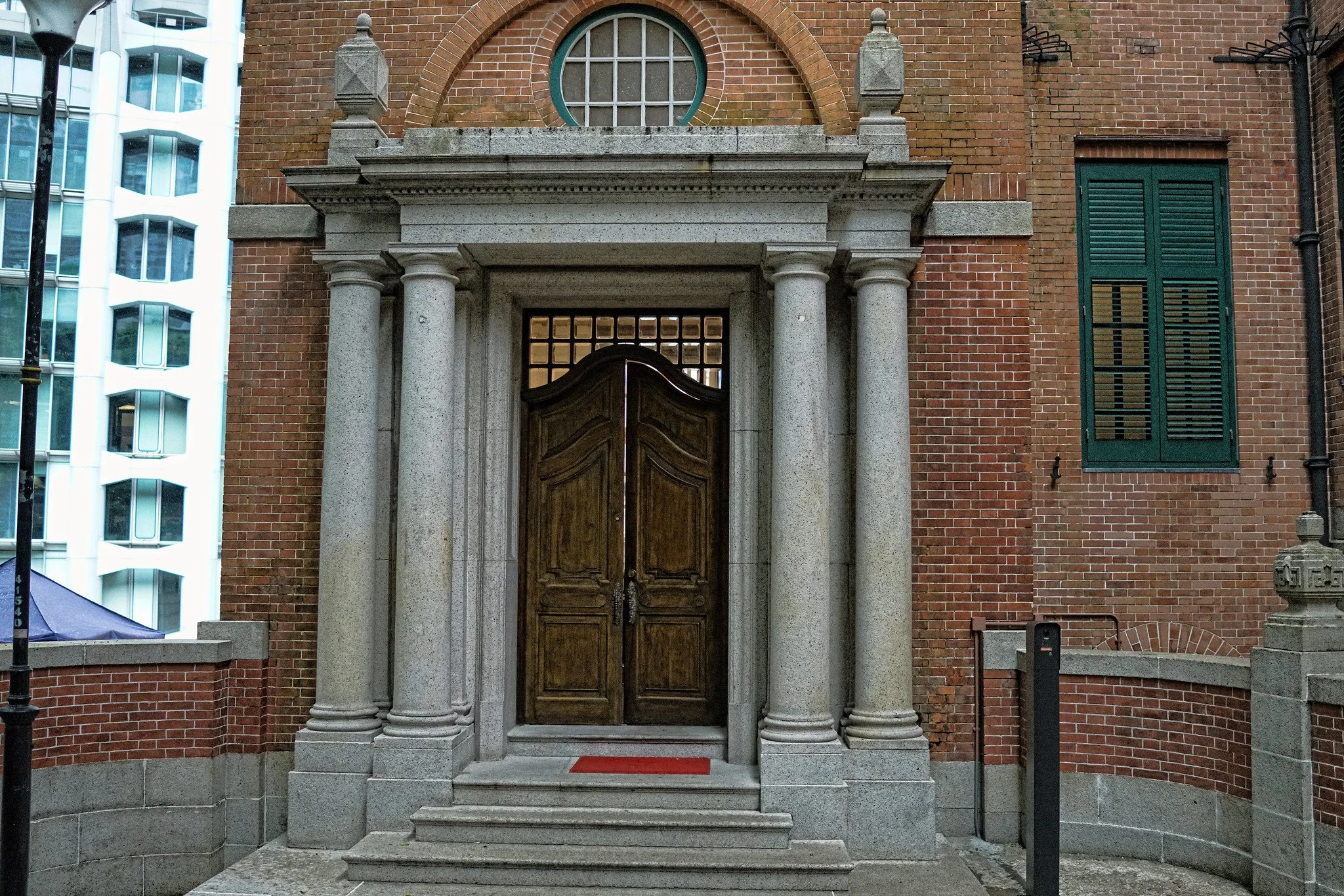
In 1915, the Paris Foreign Missions Society (Société des Missions Étrangères de Paris), a Catholic missionary organization, acquired the building. The society, known for its approach of adapting to local customs and promoting native clergy, commissioned a major renovation, described as an “extensive rebuilding.” The architects, Leigh & Orange, two of Hong Kong’s most influential early architects, transformed the structure into its current form. They added a chapel with a cupola in the northwest corner, refaced the building with red brick (departing from the all-white façade of the nearby “Beaconsfield” structure), and incorporated Neo-Classical features such as balustraded verandahs, ornate columns, and a vaulted ceiling in the ground-floor hall. The renovated building, completed in 1917, became known as the French Mission Building, serving as the society’s Procure of Hong Kong.
The building’s design integrated advanced technology for the time, such as reinforced concrete floor slabs and I-beams, while retaining classical elements suited to Hong Kong’s subtropical climate, like the open verandah for heat insulation. The green louvres on the façade, part of the original design, remain a distinctive feature. The basement also housed practical spaces, including a wine cellar and living quarters for servants and coolies during the French Mission’s tenure.
Wartime and Post-War Roles (1941–1953)
The building’s history took a dramatic turn during World War II. Before Hong Kong fell to Japanese forces in 1941, it was briefly used by the colonial government. After the war, from August 23, 1945, to April 1946, it served as the temporary headquarters of the Provisional Hong Kong Government, playing a critical role in re-establishing British administration following the Japanese occupation.
In 1949, when the Society of Jesus was expelled from Canton, it relocated its St. Ignatius Language School to the top floor of the French Mission Building, along with accommodation for Joseph Mallin of the Society. This marked a brief return to its missionary roots before the building’s next phase.


click on the image to enlarge
The Former French Mission Building, Battery Path, Hong Kong | Declared Monument
Government and Judicial Functions (1953–2015)
In 1952, the French Mission sold the building back to the Hong Kong government, with the transaction finalized in 1953. Over the subsequent decades, the building housed various government departments and judicial functions, reflecting its adaptability:
Education Department: Post-1953, it served as an administrative office.
Victoria District Court: From 1965 to 1980, it functioned as a courthouse.
Supreme Court: From 1980 to 1983, it briefly housed the Supreme Court.
Government Information Services: Starting in 1987, it served as an office for public communications.
From July 1, 1997, to September 6, 2015, the building served as the Hong Kong Court of Final Appeal, established after the transfer of sovereignty from the United Kingdom to China. During this period, the former chapel was converted into a courtroom, with the verandah enclosed with glass and air-conditioned to serve as a passageway for judges. A staircase, fitted with iron bars, connected the car park to the courtroom for transporting suspects, and two cells (one with a washbasin and squat toilet) were used for temporary detention. Cell No. 2 remains preserved as evidence of this judicial phase.
Preservation and Modern Use (2015–Present)
The Former French Mission Building was declared a monument on September 14, 1989, granting it legal protection against demolition—a rare status in Hong Kong, where rapid urban development often prioritizes new construction over heritage preservation. In 2010, when the government proposed redeveloping parts of Government Hill, including Battery Path, heritage activists successfully opposed the plan, arguing that alterations would compromise the area’s historical integrity. As a result, the government designated Government Hill as a hub for the legal sector.
After the Court of Final Appeal relocated to the Old Supreme Court Building on Jackson Road in September 2015, the French Mission Building underwent restoration to preserve its historical features while adapting it for modern use. The glass enclosure on the verandah was removed to restore its original open design, and salvaged materials were reused to minimize waste. The building now forms part of Hong Kong’s Legal Hub, alongside the former Central Government Offices and Two Exchange Square, hosting local, regional, and international law-related organizations (LROs) to enhance Hong Kong’s status as a legal and dispute resolution services center in the Asia-Pacific region.
Architectural and Cultural Significance
The Former French Mission Building is one of Hong Kong’s finest examples of historical architecture, blending Edwardian Neo-Classical elegance with functional design. Its key features include:
Materials and Style: Constructed with granite and red/orange bricks, it features Roman columns, a wooden staircase, a vaulted ceiling in the ground-floor hall, and a well-proportioned inner courtyard.
Chapel and Cupola: The northwest chapel, topped by a cupola, adds a distinctive silhouette.
Adaptive Design: The verandah and green louvres reflect adaptations to Hong Kong’s climate, while the use of reinforced concrete and I-beams showcases early 20th-century innovation.
Despite its historical and architectural value, the building is not open to the public, limiting access to its interior. However, its prominent location above Queen’s Road Central, opposite the HSBC Building, makes it a striking visual landmark for passersby. Visitors can appreciate its exterior by walking along Battery Path or the nearby Cheung Kong Park stairway.
Contextual Significance and Legacy
The building’s history mirrors Hong Kong’s transformation from a colonial outpost to a global financial hub. Its occupants—from governors and traders to missionaries, consulates, and courts—embody the city’s diverse colonial past, shaped by British administration, international trade (including the opium trade), and missionary activity. Its survival amidst Hong Kong’s rapid development is a testament to its cultural and historical importance, reinforced by its status as a declared monument.
The Former French Mission Building stands as a rare link to Hong Kong’s early colonial days, when Battery Path was part of the waterfront overlooking Victoria Harbour, before reclamation and skyscrapers reshaped the city’s skyline. Its continued use as part of the Legal Hub ensures its relevance, balancing heritage preservation with modern functionality.
Critical Reflection
While the sources provide a consistent narrative, some details, such as the exact dates of ownership transitions or the precise role of the building during the 1840s, rely on limited documentation and may require further primary source verification. The emphasis on its colonial and missionary history also risks overshadowing any potential pre-colonial or indigenous context of the site, though such records are scarce. The building’s inaccessibility to the public limits public engagement with its history, which could be addressed through guided tours or digital exhibitions, as suggested by its inclusion in heritage trails and virtual tours.
In conclusion, the Former French Mission Building is a layered testament to Hong Kong’s multifaceted history, embodying its colonial, commercial, religious, and judicial past while serving as a modern legal hub. Its preservation amidst the city’s relentless development underscores its enduring significance. For those interested in visiting, it remains a visually striking landmark best appreciated from Battery Path or nearby vantage points, though its interior treasures remain largely out of reach
On a side subject and after a discussion with my great friend Bill (another Private Tour Guide and historian in Hong Kong) I have some details on the red brick facade of the old Former French Mission Building
The Former French Mission Building, located at 1 Battery Path, Central, Hong Kong, is a declared monument constructed in the Neo-classical style during the Edwardian period. Its distinctive red brick façade and granite construction are key architectural features, with the red bricks playing a significant role in its aesthetic and historical identity. Below is an overview of the history of the fire bricks and other brickwork used in the building, based on available information.
History of the Former French Mission Building
Original Construction (1842): The building began as a mansion called Johnston House, built for Sir Henry Pottinger, Hong Kong’s first British governor. The original structure’s materials are not well-documented, but it likely used local stone and early brick forms typical of early colonial construction.
Alterations (1870s–1880s):
The building was modified into a three-storey structure, possibly incorporating more brickwork as construction techniques evolved. The exact nature of the bricks used in this period is unclear, but they were likely locally sourced or imported clay bricks.Major Renovation (1915–1917): In 1915, the Paris Foreign Missions Society acquired the building and commissioned a significant renovation by architects Leigh & Orange. This overhaul, completed in 1917, transformed the building into its current form, with a red brick façade replacing the earlier white façade (possibly based on the nearby “Beaconsfield” structure). A chapel with a cupola was added in the northwest corner, and the building was refaced with red bricks, which became its defining feature.
Fire Bricks and Brickwork
Red Brick Façade:
The red brickwork is a hallmark of the 1917 renovation. These bricks, likely fired clay bricks, were chosen for their durability and aesthetic appeal, aligning with the Neo-classical style. The red hue is due to the high iron content in the clay, which, when fired at high temperatures (around 1,000–1,300°C), produces shades from pink to dark red. The bricks were probably imported or locally produced at brickworks, as Hong Kong had limited local brick manufacturing at the time, though specific sourcing details for this building are not documented.
Fire Brick Characteristics:
While the term “fire bricks” typically refers to refractory bricks designed to withstand high temperatures (e.g., in kilns or fireplaces), the Former French Mission Building’s red bricks are primarily structural and decorative. There is no direct evidence that specialized fire bricks were used in the façade or general construction. However, the building’s chapel, which includes a cupola, may have incorporated fire-resistant materials for internal features like fireplaces or structural supports, as was common in Edwardian architecture.
The bricks’ durability suggests they were fired at high temperatures to achieve the strength described as “artificial stone.”Other Brickwork Features: The brickwork is complemented by white brims and Roman columns, creating a striking contrast typical of Neo-classical design. The building’s green louvres, part of the original 1917 design, and balustraded verandahs enhance the brick façade’s elegance.
The use of reinforced concrete floor slabs and I-beams indicates advanced construction techniques for the time, integrating modern engineering with traditional brickwork.Restoration Efforts: During later renovations, particularly after the Court of Final Appeal relocated in 2015, the building was restored to preserve its original brickwork. The glass enclosure on the verandah (added when it served as a court) was removed to restore the open design, maintaining the integrity of the red brick exterior. The staircase, once used by domestic helpers and later for court purposes, also reflects the functional integration of brickwork in the building’s layout.
Historical Context of Brick Use
Early Brick Use in Hong Kong: Bricks in early colonial Hong Kong were often imported or made from local clay, with mudbricks or fired clay bricks used in early structures. By the early 20th century, fired clay bricks were standard for durable constructions due to their strength and resistance to weathering, unlike earlier air-dried mudbricks.
Neo-classical Aesthetic: The choice of red bricks for the 1917 renovation reflects the Edwardian preference for combining classical aesthetics with modern materials. The red brick façade, paired with granite, gave the building a commanding presence, suitable for its varied uses over time, from a governor’s residence to a legal hub.Cultural Significance: The red brickwork, along with features like the cupola and columns, distinguishes the building as one of Hong Kong’s few preserved colonial structures. Its survival amidst rapid urban development highlights its heritage value, recognized when it was declared a monument in 1989.
Limitations in Information
Specific details about the sourcing, manufacturing, or exact composition of the red bricks used in the 1917 renovation are not provided in available sources. It is unclear whether the bricks were locally produced or imported, though Hong Kong’s reliance on imported materials during this period suggests the latter is possible.
The term “fire bricks” may be a misnomer here, as the sources do not explicitly confirm the use of refractory bricks. Instead, the red bricks are likely standard fired clay bricks chosen for structural and aesthetic purposes.
Conclusion
The Former French Mission Building’s red brick façade, established during the 1917 renovation by Leigh & Orange, is a defining feature of its Neo-classical design. These bricks, likely high-iron-content clay bricks fired for durability, replaced an earlier white façade and were paired with granite and white decorative elements. While there is no direct evidence of specialized fire bricks, the building’s robust brickwork has contributed to its longevity and heritage status. The integration of modern construction techniques, like reinforced concrete
The bricks used in old buildings in Hong Kong, particularly from the colonial era (1840s–1997), primarily came from local and regional sources, with some imported materials depending on the period and building type. Here’s a concise breakdown:
Local Production: Many bricks were made locally in Hong Kong, especially in areas like Kowloon and the New Territories. Kilns in places such as Yuen Long and Tai Po produced "red bricks" from local clay. These were commonly used in early colonial buildings, including tenements and smaller structures, due to their availability and low cost.
Mainland China: A significant portion of bricks, especially for larger projects, was sourced from southern China, particularly Guangdong Province. Cities like Guangzhou and Foshan supplied high-quality bricks via coastal trade routes. These were often used in government buildings, churches, and wealthier residences.
Imports from Britain and Other Countries: For prestigious colonial structures (e.g., government offices, cathedrals, or military buildings), bricks were sometimes imported from Britain or other parts of the British Empire, such as India. These "fire bricks" or specialized bricks were used for durability and aesthetic purposes, often seen in buildings like the old Central Police Station or St. John’s Cathedral. Shipping records from the 19th century indicate bricks were ballast in ships returning from Europe.
Reused Materials: In densely built areas, bricks from demolished structures were frequently reused. This was common during rapid urban expansion in the early 20th century, where old village houses or early colonial buildings were dismantled to make way for new developments.
Manufacturing Techniques: Early bricks were hand-molded and fired in traditional kilns, leading to variations in size and quality. By the late 19th and early 20th centuries, mechanized brick production in Hong Kong and China improved consistency, and some buildings used standardized bricks from larger factories.
My insider tip
Please note that in general if you book a tour on Viator or Tripadvisor you generally have NO control over what guide will lead your Private Tour of Hong Kong and this is the most important component of the tour. I urge you to check the actual company website and book via their website and do not forget to read Tripadvisor reviews as well.
© Jamie Lloyd | J3 Consultants Hong Kong | J3 Private Tours Hong Kong |
| 2010 - 2025 All rights reserved. |
Click on any image to enlarge to full screen










Current images from my Instagram feed