Jardine House in Hong Kong - An iconic building from 1973 in Hong Kong
A building that still stands out among modern skyscrapers

The J3 Group - Premium Quality Private Tours | Experiences and Insider Chats since 2010
Me Jamie, your host, I am English and I have lived in Hong Kong since January 2nd 1972 - I know the place.
A meaningful blog post with a difference - tips on Travel, Tourism, Tours, Daily Life and my personal thoughts on Hong Kong.
Please do visit Amazing Hong Kong
Hong Kong | Pearl of the Orient
Customised Private Tours + Experiences in Amazing Hong Kong
Jamie has lived in Hong Kong - Pearl of the Orient for 50+ years
Carefully Crafted Personalised and Customised Itineraries by Jamie | Hong Kong’s Most Experienced Private Tour Guide for : Solo Travellers Friends Families Seniors Couples Business People MICE Delegates.
Private Tours Cultural Tours Walking Tours Sightseeing Tours City Tours Night Tours Layover Tours Transit Tours Private Shore Excursions Bespoke Tours Personalised Tours Jewish Heritage Tours Luxury Private Tours Day Tours Luxury Boat Tours Themed Tours Private Family Tours Private Day Tours Corporate Tours
Just you, your family or friends and Jamie your personal English private tour guide - over 2,400+ tours completed since 2011 - Jamie offers quality Private Tours of Hong Kong
Tour Group Size 1 - 6 people only
J3 Group Hong Kong | J3 Consultants Hong Kong | J3 Private Tours Hong Kong
Creating Memories That Will Last A Lifetime
Go here for the Hong Kong Michelin Restaurant Guide which includes the Bib Gourmand Category

Jardine House in Hong Kong - An iconic building from 1973
A building that still stands out among modern skyscrapers
Jardine House, Central Business District, Hong Kong - opened in 1973
click on the image to enlarge
First up, I have a big family connection to Jardine House (originally known as Connaught Centre) suffice to say after all this time it is still by far my favourite building in Hong Kong, it is an icon in a sea of modern skyscrapers and yes, it was under construction when we arrived in Hong Kong in January 1972 and it is fixed in my memory, I have an almost spiritual connection to this iconic building.
So what is my family connection?
Vernon Roberts a Director and General Manager of the property developer Hong Kong Land was a pivotal figure in the rise and rise of Hong Kong Land and Jardine House was one of his pet projects, I know this because Vernon’s oldest son married my older sister!, they have 2 adult kids who are obviously direct descendants of Vernon Roberts, ie his grand children! oh and both of our families have a strong Welsh heritage
Vernon Roberts - a key figure in the history of modern Hong Kong
click on the image to enlarge

The World according to Grok
I am warming up to Grok AI - if you ask the right question is collates information in a very professional and seamless manner Case in point - the history of the iconic building Jardine House in the Central Business District in Hong Kong
The history of Jardine House in Hong Kong
Jardine House, originally named Connaught Centre, is a landmark skyscraper in Hong Kong’s Central district, reflecting the city’s evolution into a global financial hub. Its history spans its origins, construction, and lasting impact.
Vernon Roberts and the famous Jardine House property deal
click on the image to enlarge
Early History and Context
The site of Jardine House has deep historical roots tied to Jardine Matheson & Company, a trading firm founded in 1832 by William Jardine and James Matheson. The company, a major player in Hong Kong’s early economy, initially operated from Canton, trading goods like tea, silk, and opium. After the First Opium War, Jardines relocated to Hong Kong, becoming one of the dominant British “hongs” (trading houses). The first three generations of Jardine Houses were located at 20 Pedder Street, starting around 1841 with a Neoclassical-style building, followed by reconstructions in 1908 and 1956. The 1956 building, a 16-story structure, was sold during the land acquisition for the Landmark complex, now occupied by Wheelock House.
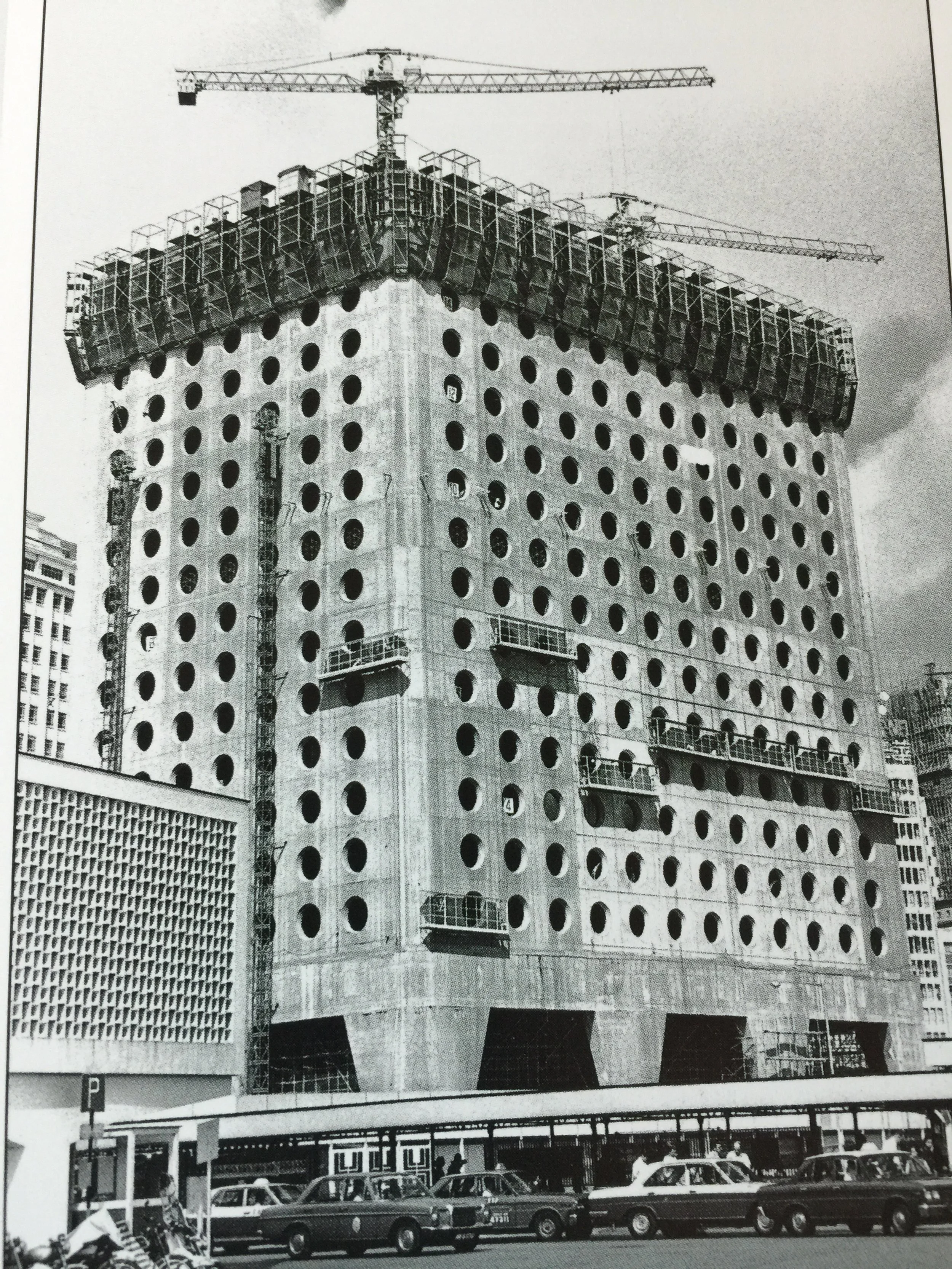

Jardine House (or Connaught Centre as it was originally named) under construction and it’s completion and opening in 1973
click on the image to enlarge
Construction and Design (1970–1973)
In 1970, Hongkong Land, a subsidiary of Jardine Matheson, acquired a prime plot of reclaimed land at 1 Connaught Place for a record-breaking HK$258 million, payable interest-free over 10 years. This deal included a government agreement ensuring no buildings to the north would obstruct its Victoria Harbour views, preserving its prominence. Construction began in 1970 and was completed in 1973, taking just 16 months—a remarkable feat for a 52-story skyscraper.
Designed by Canadian architect James Kinoshita of Palmer and Turner (now P&T Group), Jardine House stood 178.5 meters tall, making it the tallest building in Hong Kong and Asia upon completion. Its innovative design featured a reinforced concrete frame with a metal curtain wall and 1,748 circular “porthole” windows, inspired by Hong Kong’s nautical history and Chinese “moon gate” architectural traditions. These windows weren’t just aesthetic; they reduced structural load, allowing for fewer internal support beams and maximizing open floor space. The building’s exterior shear walls and hollow core design, likened to a “bamboo stalk,” were groundbreaking for the time, positioning it among the world’s tallest reinforced concrete towers.
The structure included advanced features: the fastest elevators in Asia (reaching 1,400 feet per minute), the largest air-conditioning chillers, and a ventilation system integrated into the penthouse “taipan rooms” to keep fire escapes smoke-free. The two-story lobby opened to a public plaza with reflecting pools and a Henry Moore bronze sculpture, Double Oval, enhancing its civic presence. The building connected to Central’s older business district via a footbridge, a forward-thinking urban integration.
Jardine House (or Connaught Centre as it was originally named) in 2025 and even though it has 52 floors and is 178m in height it is dwarfed by IFC (the building to the right in the image) which has 88 floors and is 412m in height!
click on the image to enlarge
Significance and Legacy
Upon its 1973 opening, Jardine House (still called Connaught Centre until 1989) became a symbol of Hong Kong’s rise as a financial powerhouse. It housed major tenants, including eight international banks and one of Hong Kong’s stock exchanges by 1974, cementing Central’s status as a commercial hub. Its construction marked the beginning of Central’s transformation, with Hong Kong’s GDP growing from US$8 billion (adjusted) in 1973 to US$360 billion by 2022.
The building’s distinctive windows earned it the cheeky nickname “House of a Thousand Arseholes,” a nod to both its design and the powerful “taipans” (business leaders) who worked there. Its cultural impact extended to media, appearing in films like The Mighty Peking Man (1977), The Amsterdam Kill, and the 1988 miniseries Noble House, where it represented the fictional Struan’s headquarters, inspired by Jardines.
Jardine House (or Connaught Centre as it was originally named) dominating the Hong Kong Skyline in the mid 1970’s as seen from Victoria Peak
click on the image to enlarge
Jardine House (or Connaught Centre as it was originally named) still visible but lost in a sea of skyscrapers in 2025 but as iconic as ever!
click on the image to enlarge
Modern Era and 50th Anniversary
Renamed Jardine House in 1989, the building remains a key asset in Hongkong Land’s portfolio, hosting top-tier firms like Invesco and Richemont. In 2020, BaseHall, a modern food hall, opened in its basement, reflecting ongoing innovation. The WWF Peter Scott Visitor Centre, a “nature classroom,” was added in 2023. Hongkong Land invests up to US$100 million annually to modernize its properties, ensuring Jardine House remains competitive with sustainable features like energy-efficient design and water reduction, earning green certifications.
In 2023, Jardine House celebrated its 50th anniversary with public talks, exhibitions, and the “Walk Up Jardine House” charity event, raising over HK$50 million for MINDSET, a mental health charity founded by Jardine Matheson. Despite losing its title as Hong Kong’s tallest building to Hopewell Centre in 1980, its unobstructed harbour views and iconic design keep it a standout in the skyline.
Enduring Impact
Jardine House’s blend of innovative engineering, historical significance, and cultural resonance makes it more than just a building. It catalyzed Central’s growth, introduced modern skyscraper design to Hong Kong, and remains a testament to the city’s ambition and resilience. Visitors can explore its architecture, enjoy BaseHall, or appreciate its plaza, which continues to draw locals and tourists alike.
Jardine House (or Connaught Centre as it was originally named) no longer dominating the Hong Kong Skyline in 2025 but it is still iconic!
click on the image to enlarge
The curious case of the falling tiles off the walls of Jardine House or Connaught Centre as it was previously known
Curious - the sign below refers to the fact that the original exterior of Jardine House was made up of small tiles and they started falling off hence the building had to be completely re - cladded before someone got killed..
This nugget is rarely mentioned in articles about Jardine House, but the original exterior was made up of sheets of small tiles and I guess it never occurred to anyone that they may lose adhesion over time! below is what was said when the building was under construction
“On August 12, 1972, the Post reported that one of Hong Kong’s “largest jigsaw puzzles, the facade of Connaught Centre, is rapidly taking shape […] Millions of pieces of tiles in specially precut, predetermined and individually numbered sections were prepared by the artistic department of the Italian glass mosaic tile manufacturer.”
I guess it seemed like a good idea at the time.
I should add that the cladding itself has its own issues, it has to be cleaned on a fairly regular basis as it gets dirty and is visible to the naked eye, no matter, it is still by far my favourite building in Hong Kong.
Jardine House (or Connaught Centre as it was originally named) and the not widely known sign signifying the rectification of a major issue in the buildings history
click on the image to enlarge
The even more curious case of “air rights” that Hong Kong Land secured in relation to Jardine House
Yes, it is true that Jardine House, Hong Kong's first skyscraper, has a unique agreement with the Hong Kong Government ensuring unobstructed harbour views for the tenants.
It is very common in Hong Kong for even the most iconic buildings to lose unobstructed views when a property developer puts of a monster skyscraper in front of your skyscraper, the classic case is the super iconic Bank of China skyscraper that has had most of its views obliterated in the past year!
HSBC Headquarters in Hong Kong has a similar deal.
Hong Kong Land secured a record land price in 1970 (see image above) and in exchange, the Hong Kong Government agreed that no building to the north of Jardine House would be built tall enough to obstruct its views.
This led to height restrictions on the General Post Office building that is directly in front of Jardine House, limiting it to 120 feet (37 meters) and to this day there is no sign of any building going up to test the air rights deal!
Vernon Roberts of Hong Kong Land and the legacy of Jardine House in Hong Kong
Vernon Roberts was a key figure in the history of Hongkong Land, serving as a director and general manager during a pivotal period. Under his leadership, Hongkong Land acquired a prime reclamation site in Central, Hong Kong, for a then-record price of HK$258 million in 1970.
This site became the location for the Connaught Centre, later renamed Jardine House, completed in 1973. At the time, Jardine House was Hong Kong’s tallest building and a significant milestone in the city’s development as a financial hub, featuring innovative design elements like its iconic circular windows.Roberts passed away on October 21, 1977, shortly before the unveiling of Connaught Place, a public square adjacent to Jardine House. The square, funded partly by Hongkong Land, features a Henry Moore sculpture, Double Oval, dedicated to Roberts upon its unveiling in December 1977.
Jardine House, located at 1 Connaught Place, remains a landmark in Central, Hong Kong, owned by Hongkong Land, a major property investment and development group founded in 1889 and partially owned by Jardine Matheson. The 52-story skyscraper, designed by P&T Architects, was Asia’s tallest building upon completion and is known for its distinctive “porthole” windows, earning it the local nickname “House of a Thousand Arseholes.” It continues to house prominent businesses and is connected to the Central Elevated Walkway.
Hongkong Land, under Roberts’ influence, played a significant role in shaping Central’s modern landscape, including developments like the Central Elevated Walkway and properties such as Exchange Square and Chater House. The company remains a leading landlord in Hong Kong, managing over 450,000 sq. m. of prime commercial space.


My insider tip
Please note that in general if you book a tour on Viator or Tripadvisor you generally have NO control over what guide will lead your Private Tour of Hong Kong and this is the most important component of the tour. I urge you to check the actual company website and book via their website and do not forget to read Tripadvisor reviews as well.
© Jamie Lloyd | J3 Consultants Hong Kong | J3 Private Tours Hong Kong |
| 2010 - 2025 All rights reserved. |
Click on any image to enlarge to full screen
Current images from my Instagram feed